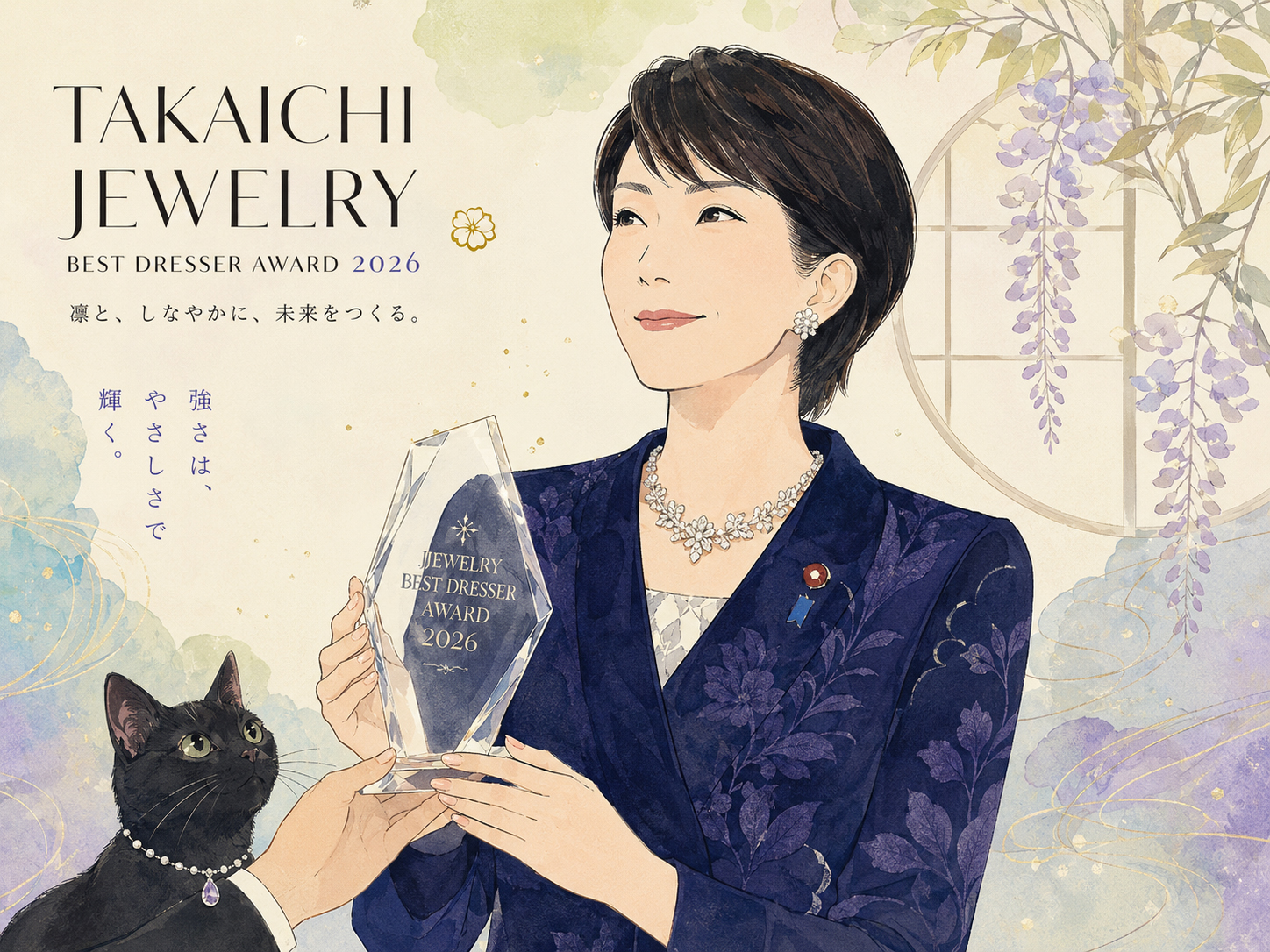
The headline sounds almost like comic relief: a prime minister, a jewelry award, pearls at Tokyo Big Sight. But Sanae Takaichi’s special award at the 37th Japan Jewelry Best Dresser Awards on July 4 was more than a society-page sparkle. It was a small public ceremony that revealed a large Japanese habit: the country reads power through objects, materials, manners, uniforms, bags, pens, pearls and the discipline of presentation.
According to reports, Takaichi appeared at the Tokyo ceremony wearing gold earrings and a necklace adorned with pearls. She used the moment to praise Japan’s pearl farming and processing technologies, saying they embody the country’s underlying strength. The scene was light, almost charming. Yet it arrived in the middle of a tougher political season: a first female prime minister, a conservative security hawk, a leader whose “work, work, work” mantra had become both a catchphrase and a national argument about overwork, gender and authority.
The Japan Jewelry Best Dresser Awards have been presented annually since 1990 to public figures nominated by jewelry industry professionals for shining the brightest or looking best in jewelry over the previous year. In most years, the event belongs to actors, singers and entertainers. In 2026, the special-award presence of the prime minister placed jewelry, politics and national branding on the same stage.
A ceremony built for sparkle, interrupted by politics
The 37th ceremony was held at Tokyo Big Sight as part of the summer jewelry-fair calendar. Other awardees included actress Minami Hamabe, actress and singer Atsuko Maeda, singer-songwriter Koichi Domoto, actress Marika Matsumoto and actress-singer Saki Takaoka. Takaichi received a special award, not a generational category prize. That distinction matters. It treated her not as a celebrity in the entertainment circuit but as a figure whose public image had become culturally visible enough for the jewelry industry to recognize.
For the jewelry business, the award is marketing. For the public, it is theater. For a prime minister, it is risk. A leader accepting a style award can look human, graceful and approachable. The same image can also look frivolous if the country is anxious about prices, security, taxes or scandal. Takaichi’s appearance had to walk that line. Pearls helped. They are beautiful, but not gaudy; Japanese, but global; feminine, but historically associated with discipline, patience and craft.
Why pearls are a Japanese industrial story
Takaichi’s reference to pearl farming and processing was not casual. Modern Japan helped transform pearls from rare aristocratic treasures into a global luxury product. Kokichi Mikimoto, working from the waters of Mie Prefecture, successfully produced cultured pearls in 1893. By the early twentieth century, Japan had turned a marine experiment into a world industry.
Before cultured pearls, natural pearls were scarce, unpredictable and extremely expensive. They depended on chance. Mikimoto’s achievement was not simply making pearls cheaper. It was the industrialization of beauty: science, aquaculture, craft, sorting, grading, retail and global branding. The story fits Japan’s larger modern history. A local technique becomes a precise industry; a natural material becomes a manufactured standard; a coastal town becomes part of a global market.
By the 1930s, Japan’s cultured-pearl industry had grown dramatically. After World War II, Mikimoto and other Japanese jewelers helped make pearls one of the country’s best-known luxury exports. Long before anime, gaming and high-tech consumer electronics became global symbols of Japan, pearls were already carrying a Japanese promise abroad: refinement through discipline.
Takaichi’s style problem — and opportunity
Every national leader has a visual grammar. For men, that grammar is usually boring by design: dark suit, tie, lapel pin, controlled repetition. For women leaders, the grammar is less forgiving. Too plain can be read as severe; too ornate as unserious; too feminine as weak; too masculine as artificial. Takaichi’s jewelry award sits inside that impossible double bind.
As Japan’s first female prime minister, Takaichi has been watched not only for policy but for appearance. Her workwear, tote bag and even writing pen became public talking points after she took office. Supporters saw a no-nonsense professional style. Critics and observers noted the contradiction: a woman breaking the ultimate political ceiling while opposing several liberal gender-equality reforms. Her image could inspire some women while frustrating others.
That tension makes the jewelry award unusually interesting. It gave Takaichi a way to appear feminine without apologizing for power, and patriotic without giving a security speech. Pearls softened the frame. The setting shifted attention from confrontation to craft. In a country where women in public life are often judged more intensely for dress than men, the award made the scrutiny visible — and then converted it into applause.
Japan’s public awards culture
Japan has a long tradition of best-dresser, best-glasses, best-smile, best-leather and best-jeans awards. These events can look unserious from outside, but inside Japan they serve a familiar purpose: they connect industries to celebrities, celebrities to television, television to consumer desire, and consumer desire to seasonal marketing.
Awards like these also create a public language of approval. They say: this person represents an image we want the product to carry. Eyeglasses become intelligence. Denim becomes youth. Leather becomes durability. Jewelry becomes radiance, elegance, status and memory. When the awardee is a prime minister, the product language becomes political language.
That is why Takaichi’s pearl moment is not merely a detail. It shows how Japanese public life still blends commerce, ceremony and symbolism. The state does not need to issue a policy document for a message to travel. A necklace can do some of the work.
The Thatcher comparison, the pearl correction
Takaichi has often been compared to Margaret Thatcher, a comparison she has at times welcomed. Thatcher used the handbag, the blue suit, the brooch, the voice and the coiffed silhouette as instruments of command. She made femininity compatible with hardness by turning each accessory into part of a disciplined political armor.
Japan’s version is different. Takaichi’s visual image is less imperial and more office-professional: practical bags, controlled tailoring, neat hair, small accessories, a serious face that can suddenly turn warm in ceremonial settings. The pearls at the jewelry award added a layer of Japanese industrial memory rather than British aristocratic polish.
In that sense, the award helped revise the “Iron Lady” frame. Pearls are not iron. They are made through irritation, protection and time. That metaphor may be more fitting for a leader governing in a fragmented parliament, facing inflation-weary voters, regional security tensions and the symbolic burden of being first.
Numbers and context
The politics beneath the sparkle
There is an obvious criticism: why should anyone care about a politician’s jewelry? The answer is that voters already do. Democracies are visual systems. People form impressions from policy, but also from gestures, clothing, rituals, settings and the company a leader keeps. A defense speech and an award ceremony live in different categories, yet both shape a leader’s public meaning.
For Takaichi, this matters because her political profile is unusually sharp. She is associated with hawkish security views, economic nationalism, fiscal expansion and a conservative social agenda. Her premiership is also symbolically historic. The jewelry award briefly pulled those contradictions into one frame: a hard-line conservative leader, praised in a soft cultural setting, wearing a product that symbolizes both Japanese craftsmanship and feminine elegance.
The result was almost surreal — exactly the kind of small Japanese story that opens into a larger one. It was funny, polished and politically useful. It also showed how modern Japanese leadership is becoming more performative, more consumer-facing, and more aware of image culture.
Japan.co.jp view
Japan’s political stories are often told through factions, budgets, scandals, security bills and election numbers. But countries also explain themselves through ceremonies. Takaichi’s jewelry award is a ceremony about industry, beauty, gender, authority and national craft. It is not the most important story of the week. That is why it is revealing. Important leaders do not only appear in important places.
The pearl is a useful object for this moment in Japan. It begins with vulnerability. It requires cultivation. It becomes valuable only after time, care and risk. It is natural and manufactured at once. Japan’s pearl industry turned that paradox into a global business. Takaichi’s award turned it into a political image.
The question is whether the image lasts. A pearl necklace cannot solve inflation, coalition arithmetic, China policy, labor shortages or the gender gap. But for one evening at Tokyo Big Sight, it gave Japan’s first female prime minister a softer language of power — and reminded the country that even the most decorative stories can carry hard meanings.
Reader takeaways
| Item | Meaning |
|---|---|
| What happened | Prime Minister Sanae Takaichi received a special award at the 37th Japan Jewelry Best Dresser Awards on July 4, 2026. |
| Why it matters | The event connected politics, gender, public image, Japan’s pearl industry and the ceremonial marketing culture of Japanese consumer industries. |
| Historical frame | Japan’s cultured-pearl industry dates to Kokichi Mikimoto’s 1893 breakthrough in Mie Prefecture. |
| Political frame | Takaichi’s image as Japan’s first female prime minister is shaped by both policy and style, creating a difficult double standard around femininity and authority. |
| Japan.co.jp read | The story is funny on the surface, but underneath it is about how Japan turns craft objects into national symbols. |
Sources and references
This article draws on Japan Today and Yomiuri/Star coverage of Takaichi’s special award at the 37th Japan Jewelry Best Dresser Awards, Reuters Connect photo metadata from the July 4 ceremony, AP reporting on Takaichi’s style-icon status and “work” mantra, GIA and JNTO background on Mikimoto and the birth of Japanese cultured pearls, and industry notes on the Japan Jewelry Best Dresser Awards.
- Japan Today: Takaichi wins jewelry best dresser award.
- The Star / Yomiuri: Takaichi receives special award and praises Japan’s pearl technology.
- Reuters Connect: July 4 ceremony image metadata.
- Associated Press: Takaichi’s fashion attention and work mantra.
- GIA: Japanese cultured pearls historical reading list.
- JNTO: Mikimoto Pearl Island and the birth of cultured pearls.