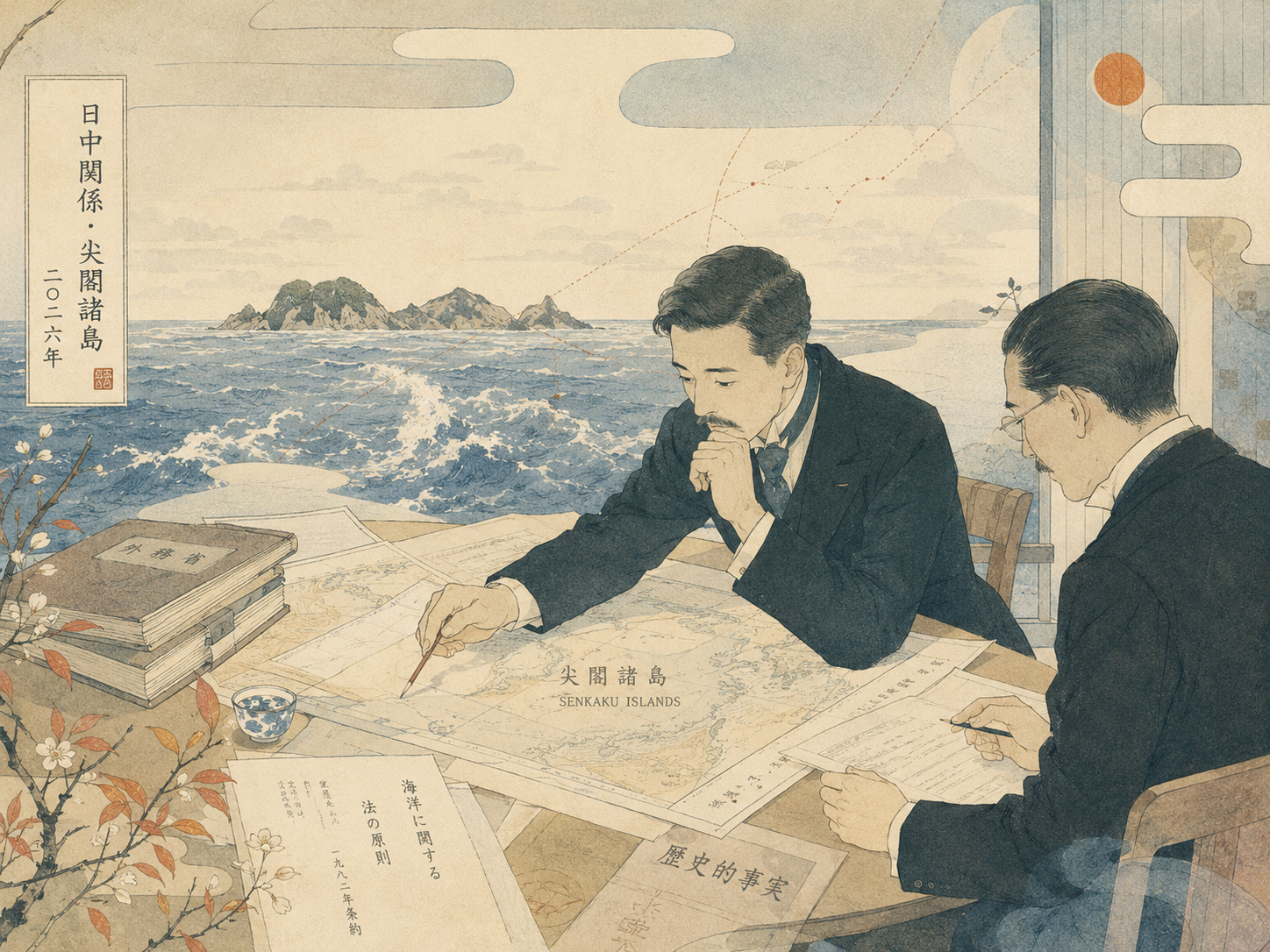
On a map, the Senkaku Islands look almost too small to carry the weight placed upon them. A handful of uninhabited outcrops in the East China Sea, administered from Ishigaki in Okinawa Prefecture, sit between Taiwan and Okinawa, west of the main Ryukyu chain and east of the Chinese coast. Yet on July 7, 2026, they again became the place where two governments narrated the same patch of sea as two different legal universes.
China’s Coast Guard said a Japanese fishing vessel had entered waters around the Diaoyu Islands, the Chinese name for the same island group, and that Chinese vessels expelled it. Japan’s Coast Guard gave the opposite account. It said two Chinese coast guard ships approached a Japanese fishing boat carrying two crew members inside Japanese territorial waters, and that Japanese patrol vessels ordered the Chinese ships to leave and succeeded in driving them out.
The important word is not only “confrontation.” It is “account.” In the Senkaku dispute, facts at sea are immediately converted into claims on land. A radio warning becomes a sovereignty statement. A fishing boat becomes a flag. A coast guard maneuver becomes a treaty question. Each side says it is enforcing law. Each side says the other side is the intruder. The islands themselves remain empty, but the water around them is crowded with law, memory, nationalism, fisheries, energy, alliance politics, and risk.
The July 7 standoff
The incident followed a familiar pattern. A Japanese fishing vessel operated near the islands. Chinese coast guard ships entered or operated in the same area. China framed its action as expelling a Japanese vessel from Chinese waters. Japan framed its action as protecting a Japanese fishing boat from Chinese coast guard ships inside Japanese territorial waters. Both governments reported success. Both reports cannot be legally true at the same time, because they rest on incompatible answers to the same question: whose waters are these?
That is why the confrontation matters even though no shots were fired. The Senkaku problem is not an occasional diplomatic quarrel. It is a repetitive performance of jurisdiction. Coast guard presence, warning broadcasts, shadowing, expulsion claims, and patrol statistics slowly build a record. Beijing wants to show that Japan’s control is contested in practice. Tokyo wants to show that administration continues, law enforcement continues, and the islands are not in dispute.
Where the islands are — and why they matter
The Senkaku Islands are uninhabited. Their Japanese names include Uotsuri, Kuba, Taisho, Kitakojima and Minamikojima. The largest, Uotsuri, is only a small island by normal geopolitical standards. But geography gives the group strategic weight. The islands lie near important sea lanes, close to rich fishing grounds, within a wider region of potential seabed resources, and near the line where Japan’s southwestern defense posture meets Taiwan contingency planning.
For Japan, the islands are administered territory. Tokyo’s view is that there is “no issue of territorial sovereignty” to be resolved, because the islands were incorporated into Okinawa Prefecture in January 1895 after surveys found them uninhabited and not under Qing control. After World War II, Japan says, the islands were placed under U.S. administration as part of Okinawa and returned to Japan with Okinawa in 1972.
For China, the islands are Diaoyu Dao, historically Chinese territory allegedly taken from China in the age of Japanese imperial expansion. Beijing argues that Japan’s sovereignty claims are invalid, and that Chinese law-enforcement operations are legitimate acts in Chinese waters. Taiwan also claims the islands as Diaoyutai, while maintaining practical fishing arrangements with Japan. The result is an unusually compressed dispute: small islands, multiple names, conflicting histories, and recurring encounters between civilian fishing and state patrol vessels.
The long shadow of 1895
Japan’s 1895 incorporation is central to Tokyo’s case. The Japanese government argues that it surveyed the islands from 1885 onward, confirmed they were terra nullius — land belonging to no state — and incorporated them before the end of the Sino-Japanese War. From the Japanese perspective, that timing matters because Tokyo insists the islands were not part of the territory ceded by Qing China after the war.
China reads the same era differently. Beijing ties the islands to the wider history of Japanese expansion and argues that Diaoyu Dao belonged to China before modern Japanese control. In Chinese historical memory, the legal details cannot be separated from the trauma of unequal treaties, imperial power and wartime occupation. This is why arguments about tiny islands quickly become arguments about the whole moral architecture of East Asian history.
Neither side is merely debating rocks. Japan is defending a postwar territorial and legal order in which it administers Okinawa and its surrounding islands. China is challenging what it sees as an unresolved legacy of Japanese expansion and postwar settlement. The islands therefore become a test of whose historical story has legal force.
Oil, maps and the 1970s awakening
The modern dispute sharpened after the late 1960s, when surveys suggested the East China Sea might contain valuable petroleum resources. Japan often points to this timing to argue that Chinese and Taiwanese claims emerged only after potential oil and gas value became known. Chinese and Taiwanese scholars and officials reject that framing, arguing that older historical connections had simply become newly urgent.
The energy story should not be exaggerated. The Senkaku dispute is not only an oil dispute, and hydrocarbons alone do not explain its intensity. But seabed resources gave the islands new economic relevance just as the postwar order was being rewritten. Okinawa reverted from U.S. to Japanese administration in 1972. China was entering a new phase of diplomacy. Taiwan faced a changed international environment. Old maps, new resources and Cold War alignments met in one disputed sea.
The East China Sea also remains an energy and fisheries space where legal boundaries matter. Exclusive economic zones, continental shelf claims, fishing rights, gas fields and patrol routes overlap. A coast guard vessel near the Senkakus is therefore not just near islands; it is near a broader contest over how the East China Sea should be divided, governed and policed.
2010: the collision that changed the mood
If July 7, 2026 felt familiar, that is because the Senkakus have already produced crises. The defining modern shock came in September 2010, when a Chinese fishing trawler collided with Japanese Coast Guard patrol vessels near the islands. Japan detained the captain. China protested intensely. The dispute grew into one of the most serious diplomatic confrontations between the two countries in years.
The 2010 incident mattered because it showed how fast an enforcement event could become a national crisis. Fishing, law enforcement, media, public anger, rare-earth anxiety and alliance signaling all merged. Since then, Tokyo has been acutely aware that a boat, a captain, a video clip or a patrol maneuver can outgrow the original facts of the encounter.
The lesson for Japan has been to strengthen coast guard readiness while avoiding unnecessary military escalation. The lesson for China has been that sustained law-enforcement presence can challenge Japan’s administrative control without crossing the threshold into open armed conflict. That is the gray-zone pattern: pressure short of war, repeated often enough to change political reality.
The gray-zone method
Gray-zone strategy is not mysterious. It is the use of non-war tools to shift facts on the ground — or in this case, facts at sea. Around the Senkakus, that means coast guard patrols, maritime law-enforcement claims, fishing-boat incidents, public statements, legal language, and diplomatic protests. Military ships may remain in the background while white-hulled coast guard vessels do the daily work.
For Beijing, frequent presence helps normalize Chinese jurisdictional claims. If Chinese vessels patrol regularly, order ships to leave and report that they have expelled intruders, China can tell its domestic and international audiences that it is not merely claiming the islands on paper. It is governing them in practice.
For Tokyo, allowing that normalization would be dangerous. Japan must show that its own coast guard can respond every time, that Japanese fishermen remain under Japanese protection, and that no Chinese operation changes the underlying legal position. This is a demanding task. A calm response must still be firm. A firm response must still avoid escalation. The Japan Coast Guard is therefore asked to perform a political mission with police tools.
The U.S. alliance dimension
The Senkakus are not only a Japan-China issue. They are also an alliance issue. The United States has repeatedly stated that Article V of the U.S.-Japan Security Treaty applies to territories under Japan’s administration, including the Senkaku Islands. Washington does not take a formal position on ultimate sovereignty, but it does recognize Japanese administration and has made clear that coercive changes to that administration would matter to the alliance.
This position is designed to deter escalation. But it also means that a local coast guard confrontation sits inside a much larger strategic frame. A collision, injury, boarding attempt, or miscalculation could trigger questions far beyond fisheries enforcement. What counts as an armed attack? What counts as coercion? How should Japan respond if China uses coast guard vessels rather than naval ships? How visible should U.S. support be?
Those questions are especially sensitive because Senkaku tensions now overlap with Taiwan tensions, Japan’s southwestern island defense buildup, and broader concern about Chinese maritime activity. A small island chain has become part of a larger arc of anxiety stretching from the South China Sea to Taiwan to Okinawa.
Why fishermen are at the center
It is tempting to see the fishing boats as props in a geopolitical drama. That would be unfair. Fishermen near Ishigaki and elsewhere have real livelihoods, real family histories and real incentives to fish in waters they regard as Japanese. But they also operate in a space where ordinary work can become a strategic incident.
Reuters reported earlier in 2026 that some Japanese officials had discreetly urged fishermen to avoid the flashpoint islands to reduce the risk of a clash. That reveals the dilemma. If fishermen go, Japan must protect them. If fishermen stay away, China may read absence as political space. If officials discourage fishing too openly, critics may say Japan is yielding. If officials encourage fishing too loudly, they may invite confrontation.
Thus the fisherman becomes the most exposed citizen in the dispute. His vessel is not a warship. But his presence tests a state’s claim. That is why the July 7 account repeatedly returns to the Japanese fishing boat. It was the object around which both coast guards built their narrative.
Two stories, one danger
The most striking feature of the July 7 confrontation is that both governments described themselves as the lawful enforcer. China said it expelled a Japanese vessel from Chinese territorial waters. Japan said it expelled Chinese coast guard vessels from Japanese territorial waters. Both accounts are written in the vocabulary of order, not aggression.
That symmetry is dangerous because each side can believe it is showing restraint while the other side sees provocation. A Chinese captain obeying Chinese instructions may appear to Japan as an intruder. A Japanese patrol ship carrying out Japanese law may appear to China as obstruction. The risk is not only that one side decides to escalate. The risk is that both sides think they are merely doing their job.
The Senkaku dispute is therefore a test of crisis management as much as sovereignty. Hotlines, clear rules of engagement, disciplined radio communication, political restraint and rapid diplomatic contact matter. The aim is not to solve the dispute in one incident. The aim is to prevent a patrol encounter from becoming the incident that history remembers.
Japan.co.jp view
Japan’s basic position is clear: the Senkakus are administered by Japan, part of Okinawa Prefecture, and subject to Japanese law. China’s challenge is equally clear: Beijing rejects that settled-administration frame and uses coast guard presence to make its claim visible. The July 7 confrontation did not change the map. It showed how contested the meaning of the map has become.
For readers, the key is to look past the ritual language of “expelled” and “intruded.” Those words are not neutral descriptions. They are instruments of sovereignty. When both sides say they expelled the other, they are not only reporting movement at sea. They are teaching their publics how to see the sea.
The islands remain uninhabited. The story around them is anything but empty. It carries the memory of 1895, the postwar settlement, the energy politics of the 1970s, the 2010 collision, the growth of gray-zone maritime power, and the modern fear that a local coast guard encounter could intersect with a regional security crisis. That is why July 7 matters. Not because war is inevitable, but because small confrontations, repeated often enough, can become the architecture of a larger confrontation.
Reader takeaways
| Item | Meaning |
|---|---|
| What happened | China and Japan gave conflicting accounts of a July 7, 2026 confrontation near the Senkaku/Diaoyu Islands involving coast guards and a Japanese fishing vessel. |
| Japan’s account | Japan said two Chinese coast guard ships approached a Japanese fishing boat and were ordered out of Japanese territorial waters. |
| China’s account | China said a Japanese fishing vessel entered Chinese waters around Diaoyu Dao and was expelled. |
| Why it matters | The incident is part of a repeated gray-zone contest over administration, law enforcement and sovereignty. |
| Historical frame | The dispute turns on competing interpretations of 1895 incorporation, postwar administration, 1972 Okinawa reversion, resource surveys and later crises such as the 2010 trawler collision. |
Sources and references
This article draws on current Reuters and DW/AFP/Reuters reporting on the July 7 confrontation, Japan’s Ministry of Foreign Affairs materials on the Senkaku Islands and China Coast Guard activity, U.S. government statements on Article V, energy background from the U.S. Energy Information Administration, and historical analysis of the 2010 trawler collision.
- Reuters: July 7, 2026 coast guard confrontation and conflicting accounts.
- DW / AFP / Reuters: report on the same July 7 standoff.
- Ministry of Foreign Affairs of Japan: Japan’s basic view on the Senkaku Islands.
- Ministry of Foreign Affairs of Japan: trends in China Coast Guard and other vessels around the Senkaku Islands.
- U.S. Energy Information Administration: East China Sea energy-resource background.
- U.S. Department of Defense: U.S. commitment to Japan’s defense including the Senkaku Islands.
- CSIS Asia Maritime Transparency Initiative: 2010 trawler collision history and coercion case study.