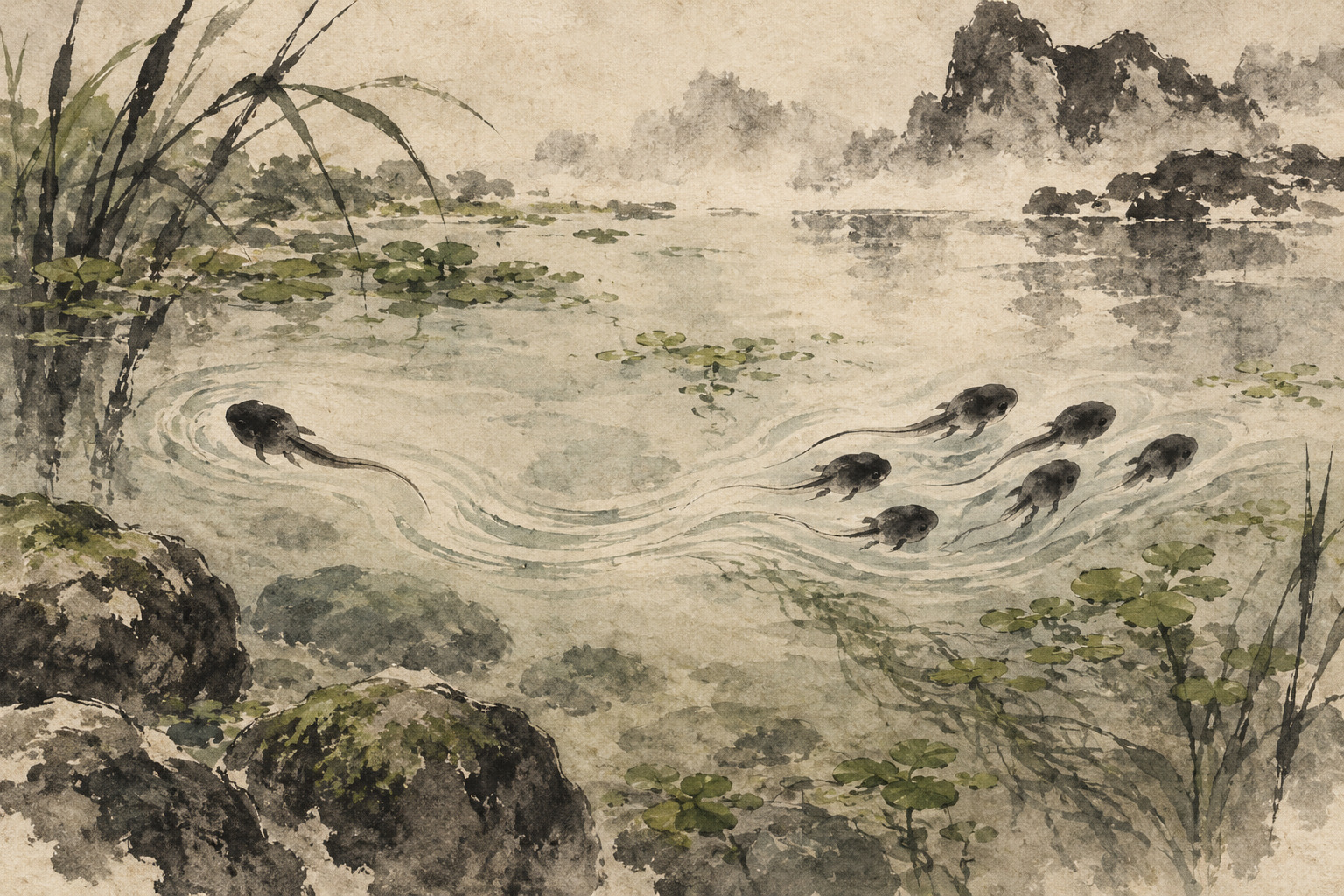
The black shoals that gather in shallow water each spring are more than accidental crowds. A controlled experiment in Japan suggests that a young toad’s tendency to approach other tadpoles depends partly on whether it encountered companions while developing.
Kazuko Hase, a researcher at Kyoto University’s Graduate School of Global Environmental Studies, raised Eastern-Japanese common toad tadpoles—Bufo formosus—either with siblings or alone. Solitary-reared animals later spent more time in the neutral center of a test arena than group-reared animals did. The effect was not a preference for relatives over strangers. It was a difference in whether subjects stayed near either group at all.
Kyoto University announced the result on September 7. Hase’s single-author paper, “Social isolation, rather than kinship, influences association behavior in toad tadpoles (Bufo formosus),” was published online in Animal Cognition on August 6. The datasets are available with the article.
Separating social experience from water
The animals came from four egg strings collected in April 2021 from separate puddles on the Tochigi Prefecture grounds of the Botanical Gardens, Graduate School of Science, the University of Tokyo. Each string contained about 100 to 150 fertilized eggs and was treated as a separate sibling cohort. After hatching at Gosner stage 22, larvae were moved before they had begun swimming, feeding and interacting.
The experiment crossed two variables in a 2×2 design: dechlorinated tap water versus pond water, and group rearing with 20 siblings versus solitary rearing with one tadpole. The pond water came from Ichijiro Pond on a University of Tokyo campus and was filtered through a fine polyethylene mesh. All animals were kept at 18 degrees Celsius on a 12-hour light-dark cycle, fed adequately and given fresh water every two days.
After two weeks, subjects at Gosner stages 30 to 35—around the period before and as hind limbs begin to emerge—entered the behavioral test. The water comparison addressed a second idea: microbe-rich pond water might influence skin microbiomes and the odor profiles by which tadpoles could learn who is kin. No statistically significant effect of water type appeared. That result applies to these two water treatments; it does not establish that water chemistry can never matter.
| Rearing treatment | Subjects | Sibling side | Neutral zone | Non-sibling side |
|---|---|---|---|---|
| Tap water, group | 22 | 1,419.0 sec | 875.0 sec | 1,306.0 sec |
| Tap water, solitary | 21 | 1,213.3 sec | 1,202.1 sec | 1,184.6 sec |
| Pond water, group | 25 | 1,393.3 sec | 822.2 sec | 1,384.4 sec |
| Pond water, solitary | 22 | 1,075.2 sec | 1,332.0 sec | 1,192.8 sec |
These are the paper’s mean times within each 3,600-second test. Social experience significantly affected the proportion of time spent in the neutral zone (p=0.002). No treatment produced a significant difference between time on the sibling and non-sibling sides.
One tadpole, two unfamiliar groups
The choice arena placed ten unfamiliar siblings behind a polyethylene mesh at one end and ten unfamiliar non-siblings at the other. The subject could receive visual and waterborne chemical cues but could not make direct contact. The central half of the tank functioned as a neutral zone.
After five minutes of acclimation, each subject was filmed for 30 minutes. The two stimulus groups then switched sides, followed by another acclimation and another 30-minute recording, reducing the risk that a simple left-right bias would masquerade as social preference. UMAtracker software recorded the subject’s location in one-second intervals. Each of the 90 subjects was tested once.
A question with nearly fifty years of history
Modern research on tadpole kin association reaches back at least to a 1979 Nature report that toad larvae preferentially associated with siblings. Work in the 1980s showed that some species can use waterborne chemical cues, probably through olfaction, and can choose unfamiliar siblings even over familiar non-siblings. Tadpoles became an elegant system for asking how animals learn a template for “family.”
Grouping can dilute an individual’s risk of predation, make warning coloration more conspicuous and alter foraging efficiency. But neighbors also compete for food and space. The best group is therefore not necessarily the group with the closest genes. Predation, group size, developmental stage, size differences and prior experience can all change the calculation.
Hase’s earlier work on montane brown frog tadpoles, Rana ornativentris, examined how body size and relatedness intersect. A 2019 study reported that larger larvae avoided smaller siblings but approached smaller non-siblings, a pattern consistent with reducing competition among kin. A 2022 study found that rearing with non-siblings altered later preferences. The new experiment goes one step earlier: what happens to association behavior when social exposure itself is removed?
Why did kinship not matter here?
Bufo formosus inhabits northeastern Japan and breeds explosively after hibernation in early spring. Breeding may be compressed into less than a week, and the black, toxic tadpoles can complete metamorphosis in roughly six weeks. Their dense aggregations are thought to combine safety in numbers with a stronger warning display.
The paper offers two possible explanations for the absence of kin-biased association. First, the number of nearby tadpoles may matter more than relatedness for this species. Both stimulus groups contained ten animals, leaving no numerical advantage to choose. Second, the four clutches in this experiment may not have differed enough in genetically influenced odor traits for subjects to discriminate among them.
“No preference detected” is not the same as “incapable of kin recognition.” Other populations, developmental stages, group sizes or adult contexts could produce different behavior. Statistical non-significance is a result under specified conditions, not proof that an ability does not exist.
The critical confound: social response or movement?
The headline’s “interest” is a plain-language description of spatial association, not a direct readout of a mental state. Solitary rearing is consistent with reduced responsiveness to conspecific cues, but the study did not include a separate non-social stimulus or independently quantify baseline swimming.
That leaves alternatives. Isolated tadpoles may have avoided others, moved less overall or explored the arena differently. Hase identifies this limitation in the paper and calls for non-social control conditions to separate social responsiveness from general locomotion. No neural circuitry, hormone, gene expression or microbiome was measured, so those remain hypotheses for future mechanism studies.
- Population: One species, 90 subjects from four clutches.
- Measurement: Position near conspecific groups or in a neutral zone—not emotion or loneliness.
- Causality: Rearing conditions were manipulated, but general activity was not independently controlled.
- Scope: A larval-stage test, not evidence about adults, every amphibian or humans.
What it could mean for conservation
Amphibian conservation programs sometimes rear eggs or larvae temporarily to improve survival before release. This one experiment is not enough to rewrite husbandry rules. It does, however, identify early contact with conspecifics as a variable worth testing alongside water quality, density, food and disease control.
The next experiments are clear: measure baseline locomotion with non-social controls; return isolated animals to groups to test recovery; repeat the work across developmental stages and populations; add ecologically realistic foraging and predator conditions; and follow animals through metamorphosis. Reversibility would reveal how long any sensitive period lasts. Persistence would make rearing history more important for later behavior.
In Kyoto University’s release, Hase summarized the larger possibility in five words: “sociality is nurtured through experience.” The study does not turn tadpoles into models of human loneliness. Its force is subtler. Even within a larval life measured in weeks, social behavior need not arrive fully formed; experience can help build the tendency to join the group.
1979 — A Nature paper reports preferential sibling association in toad tadpoles.
1980s — Experiments develop evidence for waterborne, olfactory kin cues.
April 2021 — Four egg strings for the present study are collected in Tochigi Prefecture.
August 6, 2026 — The paper is published online in Animal Cognition.
September 7, 2026 — Kyoto University announces the findings in Japanese.
- Kyoto University, “Tadpoles raised alone show less interest in companions,” September 7, 2026 — official affiliation, Japanese names, overview and researcher comment.
- Hase, Animal Cognition 29, article 56 (2026), DOI: 10.1007/s10071-026-02090-0 — original paper, methods, statistics, mean values, limitations and data statement.
- Kyoto University Graduate School of Global Environmental Studies research notice — official Japanese affiliation and research summary.
- Waldman and Adler, “Toad tadpoles associate preferentially with siblings,” Nature 282 (1979) — historical foundation for tadpole kin-association research.
- Hase and Kutsukake, Animal Behaviour 154 (2019), and Animal Cognition 25 (2022) — developmental and experiential plasticity in frog-tadpole preferences.
Editorial note: The researcher’s name and affiliation, species name, paper title and technical terms were checked against Kyoto University’s Japanese primary materials and the original paper. “Interest” is used only as shorthand for spatial association. Neural mechanisms, persistence, reversibility and the locomotion alternative remain unresolved.