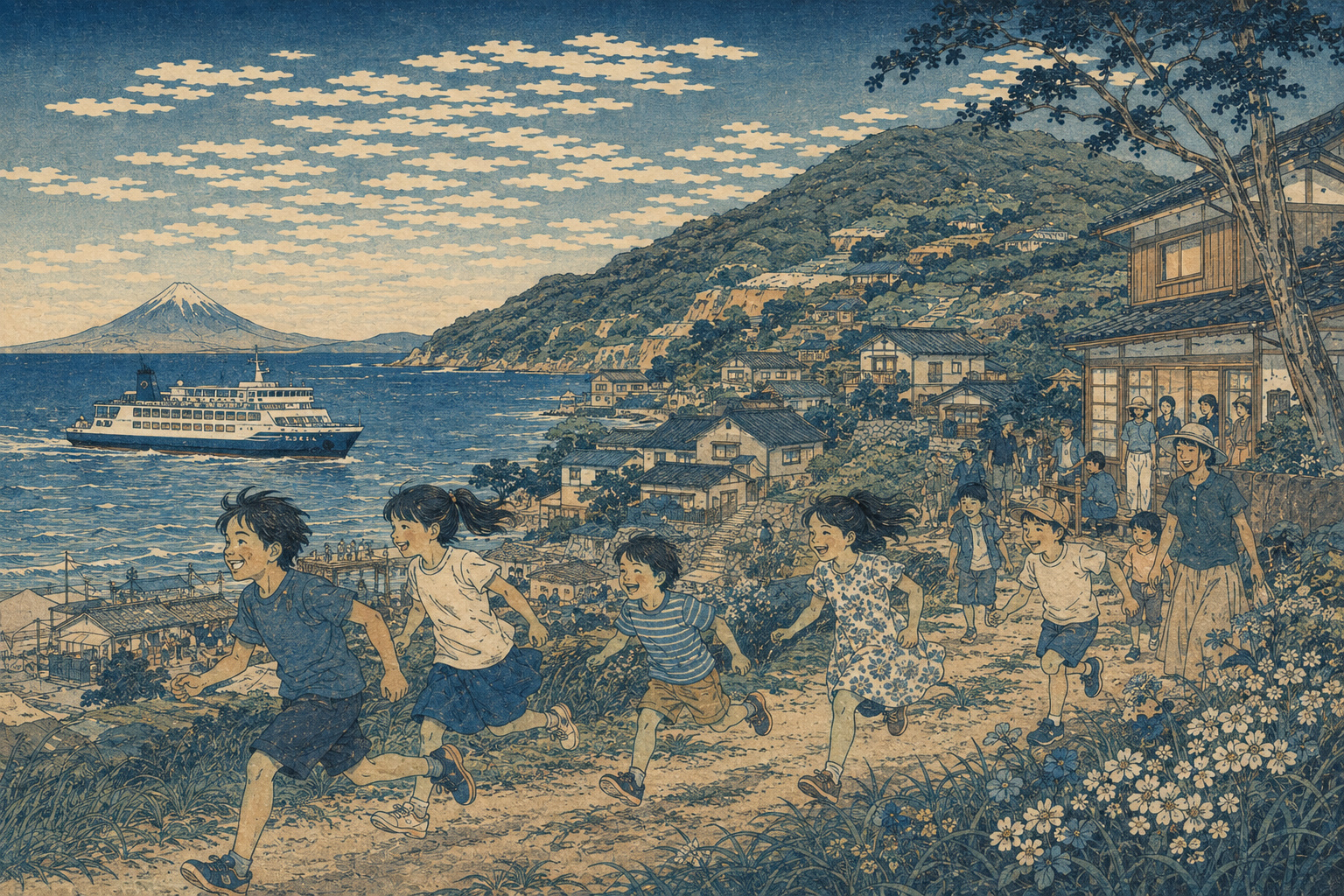
A teenager on Suo-Oshima can cross the bridge to the mainland, graduate, find work elsewhere and still carry the island as home. The difficult part comes later: whether distance becomes permanent separation, or whether the town preserves a practical route back into its economy, schools and civic life.
On September 1, Suo-Oshima began a one-year experiment in that route. Satoyume Inc. assigned one of its assistant consultants to the town’s Policy Planning Division under Japan’s Regional Revitalization Entrepreneur program. The stated mission is to help establish a public-private consortium that brings residents, junior-high and high-school students, businesses, schools and other participants into the implementation of the town’s new strategy.
The announcement is easy to market as an uplifting youth initiative. The harder story is institutional. Suo-Oshima already has a thick plan for fiscal 2026 through 2030. What it lacks is proof that residents and students can influence which problems are chosen, which proposals receive money, who is responsible for delivery and how the town explains decisions that reject their ideas.
This is a governing experiment, not a youth workshop
The Japanese program name, Chiiki Kasseika Kigyojin, can be mistaken for an entrepreneur scheme. In its corporate-dispatch form, it places an employee of an urban-area company inside a local government for a defined period so that the employee can apply private-sector knowledge to public problems. It is closer to an embedded specialist than to a founder arriving to open a start-up.
The specialist’s announced work is organizational: help build the consortium, plan and coordinate its operation, advise participants and connect the parties needed to move proposals forward. That does not transfer public authority to one outside employee. The town and council remain responsible for budgets; schools and the board of education retain educational duties; public contracts and policy decisions remain subject to public rules.
What the placement may provide is an intermediary. Suo-Oshima’s strategy acknowledges a familiar failure on both sides of public-private development. Government can be slowed by annual budgets, procedural fairness and departmental boundaries. Private projects can move faster but narrow their field of vision to activities that pay. The plan imagines an intermediary linking local operators, outside companies and individuals, financial supporters, the prefecture and national government.
That is the real test of the one-person placement. Can it create a durable operating system, or will the operating system remain the person?
Why children are being moved closer to the design table
Children usually appear in regional-development plans as beneficiaries: people to educate, protect or persuade to remain. Suo-Oshima’s new strategy also treats them as potential contributors to design. Town council documents describe the proposed consortium as a place to incorporate the views of residents and children—including junior-high and high-school students—while addressing shared problems that the administration says it cannot solve alone.
The strategy’s third pillar is formally titled “Building a Place of Learning That Makes People Want to Return.” Its measures connect elementary, junior-high, high-school, technical-college and university students; strengthen community-school links; expand career education and local work experience; support student ideas; and maintain communication with graduates. An “education attractiveness” program is designated as the leading project, with a consortium of companies and school stakeholders intended to support it.
The ethical line matters. Participation cannot become a campaign telling young people that leaving is disloyal. No island can provide every university course, occupation or life path. A credible return strategy allows young people to leave, learn and build careers, while preserving relationships and making a later return plausible at moments such as a job change, marriage, child-rearing, business creation or care for parents.
Listening is only the first step
Japan’s Basic Act on Children’s Policies was enacted in June 2022 and took effect in April 2023. It requires national and local governments to take necessary measures to reflect the views of children and young people when formulating, implementing and evaluating policies directed at them. Not every part of Suo-Oshima’s regional strategy can automatically be classified as a measure governed by that provision, but the consortium sits within the same national shift: young people should not be consulted only after adults have decided.
The Children and Families Agency’s guidance treats participation as a process rather than an event. Officials must prepare understandable information, create conditions in which different young people can speak safely, use more than one method, consider how views affect policy and report back. For Suo-Oshima, five practical questions follow.
Five tests for meaningful youth participation
- Reach: Will participation extend beyond a small group nominated by schools to different ages, districts, abilities and family circumstances?
- Agenda: Can young people raise transport, places to gather, education, housing and work—not only react to tourism projects selected by adults?
- Authority: Is there a visible route from a student proposal to a department, operator, budget and deadline?
- Feedback: Will the town explain what was adopted, changed or rejected, including reasons?
- Protection and continuity: Are consent, privacy, photography, travel, pressure to agree and post-placement ownership addressed?
None of those details was visible in the public material reviewed for this article. Publishing them would be a more important first-year achievement than producing a large number of colorful ideas.
An island that has lost roughly seven in ten residents since 1960
Suo-Oshima’s population challenge did not begin with the current strategy. Census population fell from 49,739 in 1960 to 14,798 in 2020—a loss of 34,941 people, or about 70 percent, over six decades. The resident-register count stood at 12,933 on July 1, 2026, in 7,751 households. Those figures come from different statistical systems and should not be treated as a single seamless series, but the direction is unmistakable.
The town’s third population vision models what happens if recent patterns persist: 12,987 people in 2025, 11,383 in 2030, 8,564 in 2040 and 7,385 in 2045. These are planning scenarios built from official demographic projections, not certainties.
Suo-Oshima chose 8,000 as its 2045 target after consulting a national model suggesting that, below that population scale, the probability of retaining certain services—including a general hospital and forms of community and home care—falls below 50 percent. That does not make 8,000 a cliff. Service viability depends on geography, travel patterns, operators, subsidies, nearby municipalities and technology. The threshold is a warning device, not a guarantee.
The age profile explains the return strategy
The town’s age pyramid contains an unusual bulge. Because Suo-Oshima High School and the National Institute of Technology, Oshima College are located on the island, the 15-to-19 group is relatively substantial. The 20-to-24 group then narrows sharply as students graduate and leave for university or employment.
The strategy does not assume that all departures can or should be prevented. Instead, it proposes maintaining contact with graduates, expanding local internships and work experience, and building affection for place before students leave. Its “one-percent homecoming strategy” illustrates the cumulative logic: if one percent of each year’s graduates returned, the modeled total would reach 639 by 2050. The calculation is based on the two institutions for which the town had data and is not a forecast or a performance claim.
The number is useful precisely because it is small. Regional policy often hunts for one transformative project. Suo-Oshima’s own model suggests a different approach: repeated, modest decisions by people who retain a relationship with the island.
Four pillars, one chain of consequences
Satoyume’s announcement named four priority areas. The formal town plan includes the word gojo—informal mutual help—in the fourth title, which the corporate release omitted. The official structure is below.
| Official pillar | Primary purpose | Connection to young people | Risk to watch |
|---|---|---|---|
| Building a Town Chosen by Young People | Support families, jobs and income; improve the balance of people aged 20–44 moving in and out | Let future residents describe the transport, housing, work and child-care conditions they would actually use | Counting newcomers while neglecting the conditions of existing residents |
| Building a Second Hometown | Turn one-time visitors into people who return and maintain a relationship with the island | Connect learning, events and alumni networks to continuing participation from outside | Equating clicks, visits and event attendance with durable relationships |
| Building a Place of Learning That Makes People Want to Return | Strengthen local attachment and keep U-turn migration available to students and former residents | Local study, career education, student-led ideas, internships and communication after graduation | Turning affection for home into an obligation to stay |
| Building a Town of Self-Help, Informal Mutual Help, Community Support and Public Support | Maintain mobility, community functions and intergenerational support | Design transport and shared spaces around the actual lives of children, parents and older residents | Shifting government responsibility onto unpaid family and community labor |
The pillars only make sense as a chain. Learning can create a connection. Continued contact can keep the island in a graduate’s field of options. Work, housing and child care can make return feasible. Transport, medicine, shopping and care determine whether daily life remains possible. Affection cannot compensate for missing infrastructure.
The town’s strategy captures this interdependence with a revealing tourism phrase: it prefers a place that 100 people want to visit 100 times over one visited once by 10,000 people. The logic also applies to former residents. A durable relationship may matter more than a one-time recruitment campaign.
Migration to Hawaii and the bridge to Honshu
Suo-Oshima is centered on Yashirojima and includes five inhabited and 25 uninhabited islands. During Japan’s government-contracted migration era, 3,913 people left the area for Hawaii. The island formed a sister-island relationship with Kauai in 1963. Its modern identity as the “Hawaii of the Seto Inland Sea” rests not only on climate and tourism but also on a history of difficult departures and enduring ties across the ocean.
The Oshima Bridge opened in 1976, joining the island to Honshu by road. It moved to a prefectural public corporation in 1987 and became toll-free in 1996. The present town was formed in 2004 through the merger of Kuka, Oshima, Towa and Tachibana. Better physical access changed daily life, but it did not reverse long-term depopulation.
It would be sentimental to treat migration as evidence that the island has always welcomed outward mobility. People often left because opportunity at home was limited. Yet the resulting networks also carried knowledge, capital, culture and visitors back toward the island. Today’s policy term “relationship population” gives modern administrative language to a much older reality: people can matter to a place without currently residing there.
What the two population scenarios do—and do not—say
The population vision works backward from the 8,000 target. Scenario One assumes that each year the combined effect of additional in-migration and prevented out-migration equals 15 child-rearing-age households. It reaches 8,025 in 2045, then continues to decline. Scenario Two adds an assumed rise in the total fertility rate to 2.07 by 2045. It reaches 8,531 in 2045 and 5,688 in 2100.
Those numbers describe the scale of change required under a model. They do not prove that either scenario is achievable, and they are not predictions of births, marriages or household decisions. Treating the fertility rate as a municipal score would be especially dangerous, placing responsibility for demographic targets on women and families. Jobs, earnings, housing, care, health services and personal choices all shape the outcome.
Youth participation matters because it can challenge the assumptions inside the model. Young people can identify why a return seems impossible, what might make a continuing relationship useful, and which services matter to people who want to remain. They can also say that returning is not their plan. A legitimate process must be able to hear that answer.
The company that helped write the plan is now helping implement it
Satoyume says it has supported preparation of Suo-Oshima’s latter-half comprehensive plan and regional strategy since fiscal 2025. It now supplies the employee assigned to help implement that work. Continuity can be valuable: the company already understands the documents, actors and discussions, reducing the time lost between planning and action.
Continuity also makes transparency more important. There is no evidence in the reviewed record of wrongdoing or an improper arrangement. The public nevertheless needs to know where the secondee’s role ends, which decisions remain with town officers, how projects and contractors are selected, and how the value of outside support will be evaluated.
The strategy contemplates subsidies, donations and investment, bank financing, and potentially PPP or PFI arrangements. The first-year consortium budget and financing route for individual projects were not located. Once ideas move toward business plans, disclosure should cover selection standards, ownership, local procurement, revenues, losses and exit responsibility.
The first-year scorecard should not be population
Demographic outcomes are slow. It would be unreasonable to judge a one-year placement by whether the island’s total population rises by September 2027. The first-year scorecard should measure whether the town has become better at turning participation into accountable decisions.
| Test | What should be disclosed after one year | What is not enough |
|---|---|---|
| Who participated | Age, district, school, recruitment channel and efforts to reach absent voices | A single total attendance number |
| What children changed | Proposals, revisions, decisions, reasons and responsible departments | A statement that discussion was lively |
| What became deliverable | Projects with owners, users, budgets, schedules, risks and stopping rules | Counts of ideas, events or social-media posts |
| What the island can continue | Local staff, organizations, procedures and funding that remain after the placement | Dependence on one secondee’s contacts and effort |
| What changed early | Local attachment, alumni contact, internships and practical improvements to transport or places to gather | Demanding visible population growth in one year |
The town’s strategy already promises annual evaluation, combining a larger policy cycle with faster adjustment of individual projects. Consortium minutes, decisions, spending and revisions should enter that same system rather than operate as a promotional program outside it.
A reason to return is not a promise to return
Suo-Oshima should not ask its children to guarantee that they will come home. It should build the conditions that make returning a real option: work, housing, mobility, health care, child care and a civic culture in which their judgment has consequences. It should also preserve ways to contribute for those who live elsewhere.
The consortium will not be validated by photographs of smiling students around a workshop table. It will be validated when a young person’s concern changes a municipal choice; when the town explains why another proposal cannot proceed; when an idea acquires an owner, budget and deadline; and when the process survives the departure of the employee sent to establish it.
Suo-Oshima has long been shaped by people who left. The coming year will test whether leaving the island can cease to mean disappearing from its future.
Sources and documentation
- Satoyume Inc., announcement of the Regional Revitalization Entrepreneur placement in Suo-Oshima (September 1, 2026)
- Satoyume press release (agreement purpose, work scope and statements by participants)
- Suo-Oshima Town, adoption page for the latter-half comprehensive plan, third regional strategy and third population vision (May 27, 2026)
- Suo-Oshima Town, latter-half comprehensive plan and Third Regional Revitalization Strategy (public-private implementation, four pillars, education project, consortium and evaluation)
- Suo-Oshima Town, Third Population Vision (demographic trends, 2045 scenarios, 8,000 target and one-percent return model)
- Suo-Oshima Town Assembly, fiscal 2026 committee report (town explanation of a consortium including residents and students)
- Suo-Oshima Town Assembly, 2026 first regular session minutes (Regional Revitalization Entrepreneur program and strategy discussion)
- Suo-Oshima Town official website (July 1, 2026 population and household count)
- Suo-Oshima Town Sustainable Development Plan for Depopulated Areas (population history, Oshima Bridge and municipal history)
- Suo-Oshima Tourism Association (island geography, 3,913 government-contracted migrants to Hawaii and Kauai relationship)
- Children and Families Agency, Basic Act on Children’s Policies
- Children and Families Agency, Guidelines for Reflecting the Views of Children and Young People in Policy, second edition (revised May 29, 2026)
The English edition was written independently from Japanese primary documents; it is not a translation of the Japanese article. The July 2026 count of 12,933 is based on the resident register, while the 2020 census total and future scenarios use different statistical foundations. The figures 7,385, 8,025, 8,531 and 639 are planning scenarios—not forecasts, promises or outcomes of the secondment. The 8,000 target is a policy threshold informed by a national probability model, not a guarantee that particular services survive. The official town plan includes informal mutual help in the title of the fourth pillar; this article follows the official wording rather than the shortened corporate-release version.
Image rights: © 2026 Japan.co.jp. This AI-assisted editorial illustration may not be reproduced or reused without permission. For licensing, use the contact page.