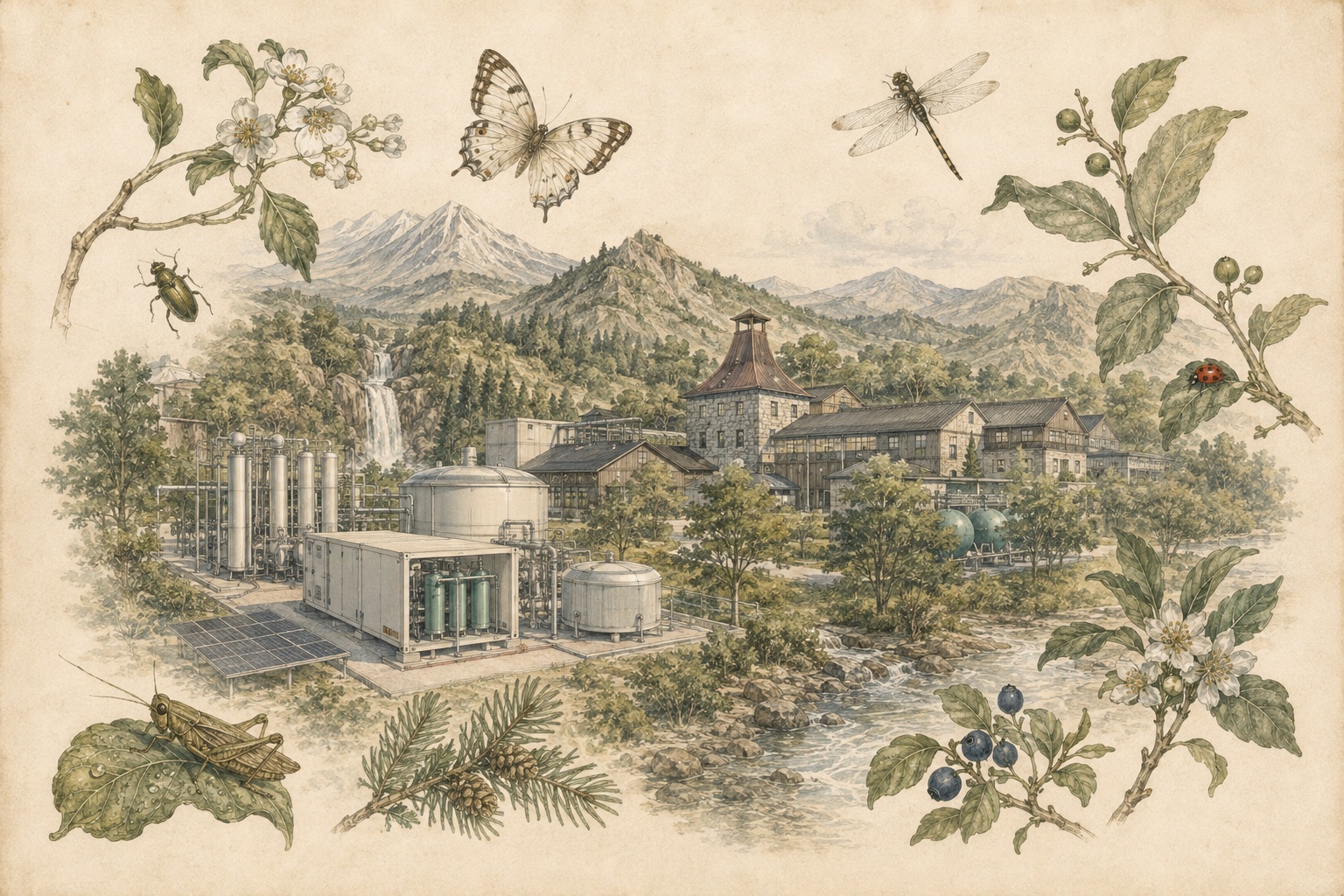
At Hakushu, every hydrogen story eventually returns to water. Rain and snow fall on the forests of the Japanese Southern Alps, seep underground, move slowly through rock and emerge as the water used for whisky and Suntory Tennensui. Now, on the same site, electricity is splitting water into hydrogen so that the hydrogen can be burned to make steam.
This is a very different hydrogen story from a filling station for fuel-cell cars. The main customer at Green Hydrogen Park Hakushu is industrial heat. A bottled-water plant does more than put water in a bottle. Sanitation requires heat. Production systems need washing, sterilization and temperature control. A whisky distillery depends on heat through mashing, fermentation support and distillation, and in some processes the way heat is applied can be part of the product’s character.
Decarbonization is often described as an electricity problem because renewable electricity is relatively easy to visualize. Factory heat is less visible. Replacing a natural-gas boiler means solving questions of temperature, steam pressure, response to changing load, equipment life, fuel safety and fuel price.
Hakushu enters that problem directly. Hydrogen is not being treated primarily as a futuristic transport fuel. It is being asked to do the extremely ordinary job of producing steam every working day. That makes the project less glamorous—and more relevant to industrial decarbonization.
In 1973 and in 2025, Hakushu was chosen because of water
Hakushu Distillery was completed in 1973, half a century after Suntory began building Yamazaki. It became Suntory’s second malt-whisky distillery. Keizo Saji, Suntory’s second president and master blender, wanted a place capable of producing a whisky character different from Yamazaki.
According to Suntory’s own history, the search placed unusual emphasis on water suitable for whisky and on a natural environment capable of nurturing that water for generations. Hakushu, at the foot of Mount Kaikomagatake in the Southern Alps and surrounded by high-elevation forest, matched that idea.
The distillery is still marketed as the “Mountain Forest Distillery.” Its roughly 820,000-square-meter site, water, climate, washbacks and still configuration help create spirits distinct from Yamazaki.
Nearby sits Suntory’s Minami Alps Hakushu Water Plant, developed in the 1990s for mineral-water production. The two facilities depend on the same broader mountain-water environment. Since 2008 Suntory has managed surrounding source areas as the Natural Water Sanctuary Minami Alps; the conservation area now covers about 2,027 hectares.
Half a century ago, water was the reason to make whisky here. In the 2020s, the question is whether the same resource can also help make the site’s energy.
Yamanashi’s hydrogen story did not begin at Suntory
Green Hydrogen Park Hakushu is easy to misunderstand as a Suntory corporate project. Its technical ancestry lies in years of Power-to-Gas development by Yamanashi Prefecture and partners at Mount Komekura.
Power-to-Gas, or P2G, uses renewable electricity to split water and store the energy as hydrogen. Solar and wind vary with weather. Electricity that cannot be consumed immediately can, in principle, be converted into a molecule that can be stored, transported and later used for heat, electricity or industrial processes.
Yamanashi Prefecture, TEPCO, Toray and partners developed PEM electrolysis step by step at Komekurayama, moving from smaller equipment toward a 1.5 MW-class P2G system. NEDO’s program evaluation says the project began integrated year-round production, transport and use of hydrogen in June 2021 and achieved its target overall system efficiency of 74 percent.
The next challenge was to move P2G from a research site to the doorstep of a major industrial consumer. At Komekurayama, hydrogen production and demand were separated. At Hakushu, the electrolyzer sits beside a factory that can absorb large quantities of fuel.
The 16 MW Hakushu plant is therefore more than a larger Komekurayama machine. It is an attempt to turn P2G from demonstration infrastructure into factory utility infrastructure.
Yamanashi plus ten companies: no single firm builds this system
The Hakushu project is supported by NEDO’s Green Innovation Fund and brings together Yamanashi Prefecture and ten participating companies: Suntory Holdings, Toray, TEPCO Holdings, TEPCO Energy Partner, Kanadevia, Siemens Energy K.K., Kaji Technology, Miura, Nichicon and Yamanashi Hydrogen Company.
The breadth is revealing. A functioning green-hydrogen plant needs membrane materials, renewable-power procurement, grid and control engineering, electrolyzers, compression and gas equipment, boilers, power electronics, storage and operating know-how.
Hydrogen is not one machine. It is an interface between electricity, water, chemistry, pressure, heat and process control.
That is also why hydrogen is difficult to commercialize. A factory buying natural gas can rely on an enormous pre-existing supply system. Green hydrogen asks the industrial user to build a new energy chain around the factory—sometimes including power procurement, electrolysis, storage, piping and end-use equipment.
Why 16 MW is large—and why maximum output is not the whole story
The 16 MW figure describes the electrical scale of hydrogen production, not electricity generated by the site. Suntory and Yamanashi say that if the equipment operated at rated output continuously for 24 hours a day and 365 days a year, it could produce around 2,200 tonnes of hydrogen annually and enable roughly 16,000 tonnes of CO₂ reduction.
Real green-hydrogen operation is more complicated. The project has to procure low-carbon renewable electricity, and renewable supply varies. Solar rises during the day and disappears at night; hydropower has different operating characteristics. Meanwhile the factory’s steam demand follows production schedules.
The objective is not merely to keep a 16 MW electrolyzer permanently full. The system has to decide when electricity is sufficiently renewable and economical, when hydrogen should be produced, when it should be stored and when the boiler needs fuel.
High utilization spreads electrolyzer capital cost over more kilograms. But operating at times of expensive or carbon-intensive power can undermine both economics and environmental performance. The most important number may therefore be not peak MW but annual operating strategy.
Why sterilization is hydrogen’s first job at the water plant
Thermal sterilization is a core part of safe beverage production. Steam and process heat are needed for equipment, piping, product treatment and sanitation. These loads occur repeatedly and are relatively predictable.
From the perspective of a new hydrogen supplier, that can make a factory boiler an attractive anchor customer. A retail hydrogen station waits for drivers to arrive. An operating beverage plant knows that tomorrow’s production schedule will require heat.
Suntory says high-efficiency low-NOx hydrogen boilers have been developed so that part of the water plant’s heat energy can shift from fossil natural gas to hydrogen. The immediate product of the hydrogen is not mobility—it is steam.
This is where hydrogen may have a role in industrial heat. Some low-temperature heating can often be electrified efficiently with heat pumps or electric boilers. But existing steam networks, temperature requirements, pressure, variable load and equipment-replacement cycles can make low-carbon combustible fuels attractive in specific plants.
Burning hydrogen avoids fuel CO₂—but NOx is a separate problem
Hydrogen contains no carbon, so its combustion does not create fuel-derived carbon dioxide. High-temperature combustion can still form nitrogen oxides, or NOx, from nitrogen and oxygen in the air.
Hydrogen also burns more rapidly than natural gas, creating design challenges around flame stability, flashback and local flame temperature. Converting a boiler is therefore not simply a matter of changing the gas connection.
Miura, one of the Hakushu partners, commercialized a once-through steam boiler capable of 100% hydrogen combustion in 2017. In 2021 its low-NOx hydrogen boiler became the first hydrogen steam boiler certified under Tokyo’s low-NOx/low-CO₂ small combustion-equipment scheme. In 2023 Miura announced a further hydrogen-only model achieving NOx below 40 ppm across its operating range.
Those products should not automatically be assumed to be identical to the exact boiler configuration at Hakushu; the project’s published materials do not justify that claim. But the timeline shows that industrial hydrogen-steam technology existed before the Hakushu demonstration and has been maturing over several years.
- Fuel price: How a still-expensive fuel can compete with natural gas over time.
- NOx: No fuel-carbon CO₂ does not eliminate high-temperature combustion emissions.
- Load response: Steam supply has to follow changing production demand.
- Renewable matching: Variable renewable power, electrolysis, storage and hydrogen consumption must be coordinated.
- Equipment transition: Existing gas boilers cannot all be replaced at once.
- Hydrogen carbon intensity: The electricity used to produce the hydrogen matters as much as emissions at the burner.
The harder question: hydrogen direct-fired whisky distillation
In its 2025 Green Hydrogen Vision, Suntory said it would study the use of hydrogen for “direct-fired distillation” at Hakushu Distillery.
That single line is culturally more intriguing than the water-plant boiler. In a sterilization boiler, the primary engineering requirement is stable steam at the needed conditions. In whisky distillation, how heat is applied can be part of the production process itself.
As of August 2026, Suntory has not announced that commercial Hakushu whisky is already being distilled using hydrogen direct fire. Its language remains a plan to study the method.
If it proceeds, the project would confront a difficult form of industrial decarbonization: change the fuel without changing the product. Heat flux, still response, operating practice and potential effects on spirit character would all have to be understood.
That is relevant well beyond whisky. Many high-value industries cannot simply replace a heritage process with an electrically different process if that risks changing quality. Their challenge is to decarbonize the energy while preserving the craft.
“Born from water, returning to water” is compelling—but environmental accounting still matters
Suntory describes hydrogen as energy “born from water, returning to water.” The phrase fits the company’s water-centered corporate identity almost perfectly.
But environmental performance has to be measured, not narrated. Water electrolysis requires both water and electricity. Stoichiometrically, producing one kilogram of hydrogen consumes roughly nine kilograms of water as reactant; real plants may require additional water for purification, cooling and other systems.
Hakushu is a site where Suntory has spent years emphasizing water-source protection, so hydrogen water demand deserves to be evaluated within the same watershed-management framework rather than dismissed because the region is water-rich.
On the electricity side, Suntory says the project combines Yamanashi’s renewable resources, including hydro and solar, with water to produce green hydrogen without CO₂ emissions in the production process.
The key word is not “hydrogen.” It is the actual electricity used to split the water.
October 2025: supply and demand finally met on the same site
On October 11, 2025, Green Hydrogen Park Hakushu began its demonstration. The 16 MW production equipment started making green hydrogen and the adjacent water plant began using it.
Adjacency matters. Trucking compressed or liquid hydrogen over distance adds containers, drivers, roads, compression and handling. Producing next to a major user removes much of that logistics chain.
Construction materials published in 2024 showed a roughly two-kilometer hydrogen-gas pipeline connecting the production system and Suntory facilities. Hydrogen is generated, moved by pipe, burned in boilers and delivered to manufacturing as steam.
It is an unusually direct version of local energy production: renewable electricity from the region, water in the region, hydrogen produced in the region and a major industrial user immediately next door.
Suntory is trying to move from self-consumption to selling hydrogen
Suntory’s ambition does not stop at lowering emissions inside its own plant. Its June 2025 Green Hydrogen Vision says that from 2027 onward it intends to work with partners on the full value chain from production to sales, using Yamanashi Hydrogen Company for production and Tomoe Shokai for distribution, with customers considered both inside Yamanashi and in Tokyo.
On March 27, 2026, that second phase became more concrete. A green-hydrogen supply project involving Suntory, YHC and Tomoe Shokai was certified by Japan’s Ministry of Economy, Trade and Industry under the Hydrogen Society Promotion Act’s price-gap support scheme.
Under the certified project, a manufacturing special-purpose company to be established by YHC and Suntory will make low-carbon hydrogen by electrolysis on land adjacent to the water plant. The hydrogen will be used mainly as a heat source for sterilization at the water plant, with additional supply to surrounding users through Tomoe Shokai.
The plan states annual supply of 1,607 tonnes during the support period and an implementation period from April 2028 through March 2055. The support mechanism can cover the difference between the benchmark price for low-carbon hydrogen and the reference price of conventional fuel for 15 years.
The figures should not be mixed. The current 16 MW equipment’s theoretical maximum of 2,200 tonnes per year assumes rated operation around the clock. The 1,607 tonnes per year is the planned supply in the separately certified commercial-support project.
Why support the price gap for 15 years?
Because green hydrogen is still expensive. Mature natural gas benefits from extraction, shipping, pipelines, terminals, trading markets and decades of sunk infrastructure. Green hydrogen requires renewable electricity, electrolyzers, compression, storage, dedicated safety systems and often new end-use equipment.
If customers wait for hydrogen to become cheap before committing, and producers refuse to invest until customers commit, the market cannot scale.
Price-gap support is designed to break that deadlock by giving suppliers a long-term revenue framework and users more predictable fuel economics.
Hakushu makes the policy tangible. A one-year boiler demonstration proves engineering. A supply plan extending into the 2050s forces the project to become an operating business—with maintenance, power procurement, production scheduling and customer contracts.
Should hydrogen replace every form of industrial heat?
No. Industrial heat can be decarbonized with heat pumps, resistance heating, electric boilers, biomass, solar thermal, geothermal energy and other technologies. The best option depends on the temperature, process, local resources and existing equipment.
For lower-temperature heat, direct electrification can often be more efficient than using electricity to make hydrogen and then burning the hydrogen. Each conversion step loses energy.
Hydrogen becomes more interesting where processes require combustion-like heat, steam, difficult temperature profiles, long-duration storage or compatibility with existing burner-based equipment. Japan’s government explicitly identifies hydrogen as one option for heat uses and hard-to-abate sectors that are difficult to electrify.
Hakushu’s value is therefore not proving that “factory heat should use hydrogen.” It is showing, in one specific beverage plant, which parts of factory heat can make technical and economic sense with hydrogen.
Can hydrogen turn variable renewable electricity into stable factory steam?
Solar power peaks on sunny days and falls with clouds. Hydropower is steadier but still has hydrological constraints. A factory follows its production schedule, not the weather.
P2G is a way to separate those clocks. Make hydrogen when suitable renewable electricity is available. Store the molecule. Burn it when the factory needs steam.
If the system can absorb surplus renewable electricity, it may reduce curtailment and store energy for industrial use. But if the electrolyzer sits idle too often, capital cost per kilogram rises. If it operates during expensive or high-carbon grid periods, economics or emissions deteriorate.
The optimization problem is therefore three-dimensional: use renewable electricity intelligently, keep expensive equipment productive and never starve the factory of steam.
That integrated control challenge has been at the heart of the Yamanashi P2G model from the beginning.
What does it mean when a water company starts selling energy?
For Suntory, green hydrogen is no longer simply an equipment retrofit. The company’s 2025 vision says it intends to participate in production, logistics and sales—an unusual expansion for a beverage producer.
The water plant has traditionally sent bottled water out through the gate. A future Hakushu energy business could use regional water and renewable electricity to send hydrogen to nearby industrial customers as well.
The two products are obviously governed by entirely different safety, infrastructure and commercial systems. Yet they share a corporate logic: protect a water source, turn that source into value and keep the regional cycle viable.
Brand narrative cannot make expensive hydrogen economical. But if the business case works, the narrative becomes powerful. Hydrogen made in Yamanashi, used to produce Yamanashi water and whisky, then sold to Yamanashi industry is local energy in a form consumers can understand.
Would whisky made with hydrogen become “green whisky”?
Even if hydrogen eventually enters distillation, the lifecycle footprint of a bottle of whisky is not determined by distillery fuel alone. Barley cultivation, malting, cooperage, warehouses, glass bottles, packaging and international shipping all matter.
Suntory’s broader goal is net-zero greenhouse-gas emissions across its value chain by 2050. Hydrogen is one component of that effort, not the entire solution.
Still, moving a signature production step toward lower-carbon heat could have substantial symbolic value. It would show how a premium manufacturing industry can cut direct emissions while preserving product quality and process identity.
That requires three things at once: do not change the taste, do not interrupt production and eventually make the fuel economics durable.
Hakushu cannot simply be copied everywhere
Hakushu has advantages that many plants do not: water, renewable-energy resources, support from Yamanashi Prefecture, a large anchor customer, land, corporate capital and NEDO funding.
An urban factory may not have room for a 16 MW electrolyzer. Another region may lack affordable renewable power. Small users may not create enough hydrogen demand. Existing boilers will reach replacement age at different times.
Scaling the Hakushu model therefore does not mean copying a 16 MW plant onto every factory. It means copying design principles: size hydrogen production around credible demand, modularize equipment, coordinate renewable electricity with hydrogen consumption and integrate the electrolyzer with the user’s existing heat system.
NEDO’s broader development program explicitly aims for modular systems that can scale from several megawatts toward tens of megawatts and eventually 100 MW-class applications.
The real Hakushu experiment is proving why hydrogen deserves to be used for heat
Low-carbon hydrogen will be scarce and expensive for some time. Steel wants it. Chemical plants want it. Heavy transport may want it. Power systems may want it. Industrial heat may want it.
That means hydrogen use will eventually have to be prioritized according to alternatives, cost, infrastructure and emissions avoided.
Hakushu provides one very concrete use case: steam in a beverage factory. If hydrogen can operate the boiler reliably, follow renewable electricity, displace natural gas and survive the economics of a long-term supply contract, the lessons can extend to food, beverage, pharmaceuticals, washing, sterilization and other steam-using industries.
If a heat pump or electric boiler is cheaper and more efficient for another process, there is no reason to force hydrogen into it.
Hydrogen commercialization is not only the task of finding more places to use hydrogen. It is the task of finding the places where hydrogen is genuinely worth using.
Success may mean Hakushu looks almost exactly the same
Visitors come to Hakushu for forest, birds, mountain water, fermentation, copper stills and the smell of whisky casks—not for the spectacle of an electrolyzer.
A successful energy transition may leave that landscape largely unchanged. The boiler fuel changes from natural gas to hydrogen. An electrolyzer operates nearby. The product tastes the same.
For a manufacturer, that is often the ideal transition: lower emissions without changing the product or stopping production.
The people who chose Hakushu for a distillery in 1973 may not have imagined that half a century later the site would use water not only to make whisky but also to make fuel.
Yet there is a strange continuity. The site was chosen because of water, protected because of water and made famous because of water.
Now it is asking whether water can also help decarbonize the heat required to turn raw materials into products.
The test of Green Hydrogen Park Hakushu will not ultimately be the impressive number “16 MW.”
It will be whether renewable hydrogen can produce ordinary steam every day, narrow its cost gap with natural gas, preserve product quality and eventually become reliable enough to sell beyond the factory gate.
If that happens, Hakushu will have done something more important than demonstrate green hydrogen. It will have made hydrogen boring enough to become an industrial fuel.
1923 Suntory founder Shinjiro Torii begins construction of Japan’s first malt-whisky distillery at Yamazaki.
1973 Keizo Saji establishes Hakushu Distillery in the forests of the Southern Alps.
1996 Suntory completes its dedicated Minami Alps Hakushu mineral-water plant.
2008 Suntory establishes the Natural Water Sanctuary Minami Alps in the source areas serving the distillery and water plant.
2016–2020 Yamanashi Prefecture, TEPCO, Toray and partners develop P2G technology at Komekurayama, expanding from smaller PEM equipment toward a 1.5 MW system.
June 2021 Integrated year-round production, transport and use of hydrogen begins in the Komekurayama demonstration.
February 2022 Yamanashi Prefecture, TEPCO Holdings and Toray establish Yamanashi Hydrogen Company.
September 2022 Suntory and Yamanashi announce a basic agreement to install a 16 MW P2G system at Hakushu.
February 20, 2024 Construction of the Hakushu P2G system begins.
June 11, 2025 Suntory announces its Green Hydrogen Vision, including hydrogen boilers, study of hydrogen direct-fired whisky distillation and plans for sales from 2027 onward.
October 11, 2025 Green Hydrogen Park Hakushu begins demonstration operation and green-hydrogen use at the water plant.
March 27, 2026 The Suntory-YHC-Tomoe Shokai supply project is certified for price-gap support under the Hydrogen Society Promotion Act.
Through end-2026 The demonstration tests renewable-power procurement, hydrogen production and conversion of factory steam heat.
April 2028–March 2055 Implementation period of the certified supply project, with 1,607 tonnes per year planned during the support period.
Reporting notes and principal sources
This article uses public information checked through August 9, 2026, 12:50 a.m. JST. The 16 MW plant’s “2,200 tonnes per year” and “16,000 tonnes of CO₂ reduction” figures assume operation 24 hours a day, 365 days a year and describe theoretical capacity; they are separate from the 1,607-tonne annual supply plan certified in 2026. Hydrogen direct-fired whisky distillation remains a Suntory study plan rather than an announced commercial operation. The exact boiler model used at Hakushu is not identified in the public materials reviewed here, so it is not equated with any specific Miura commercial product.
- Suntory: Start of 16 MW P2G energy-demand conversion demonstration at Hakushu, October 11, 2025
- Suntory: Green Hydrogen Park Hakushu — “Born from Water, Returning to Water”
- Suntory: Green Hydrogen Vision, June 11, 2025
- Suntory: YHC / Tomoe Shokai supply project certified for price-gap support, March 27, 2026
- Yamanashi Prefecture: Hakushu P2G energy-demand conversion demonstration
- NEDO: Japan’s largest-class water-electrolysis hydrogen production site begins operation, June 18, 2026
- NEDO: interim evaluation of Komekurayama P2G development
- Suntory: construction begins on the Yamanashi Model P2G System at Hakushu, February 2024
- Miura: low-NOx hydrogen once-through steam boiler certification, 2021
- Miura: hydrogen-only AN-2000BS and low-NOx development, 2023
- House of Suntory: Hakushu Distillery history
- Suntory: Natural Water Sanctuary Minami Alps
- Agency for Natural Resources and Energy: Hydrogen Society Promotion Act and hard-to-abate sectors