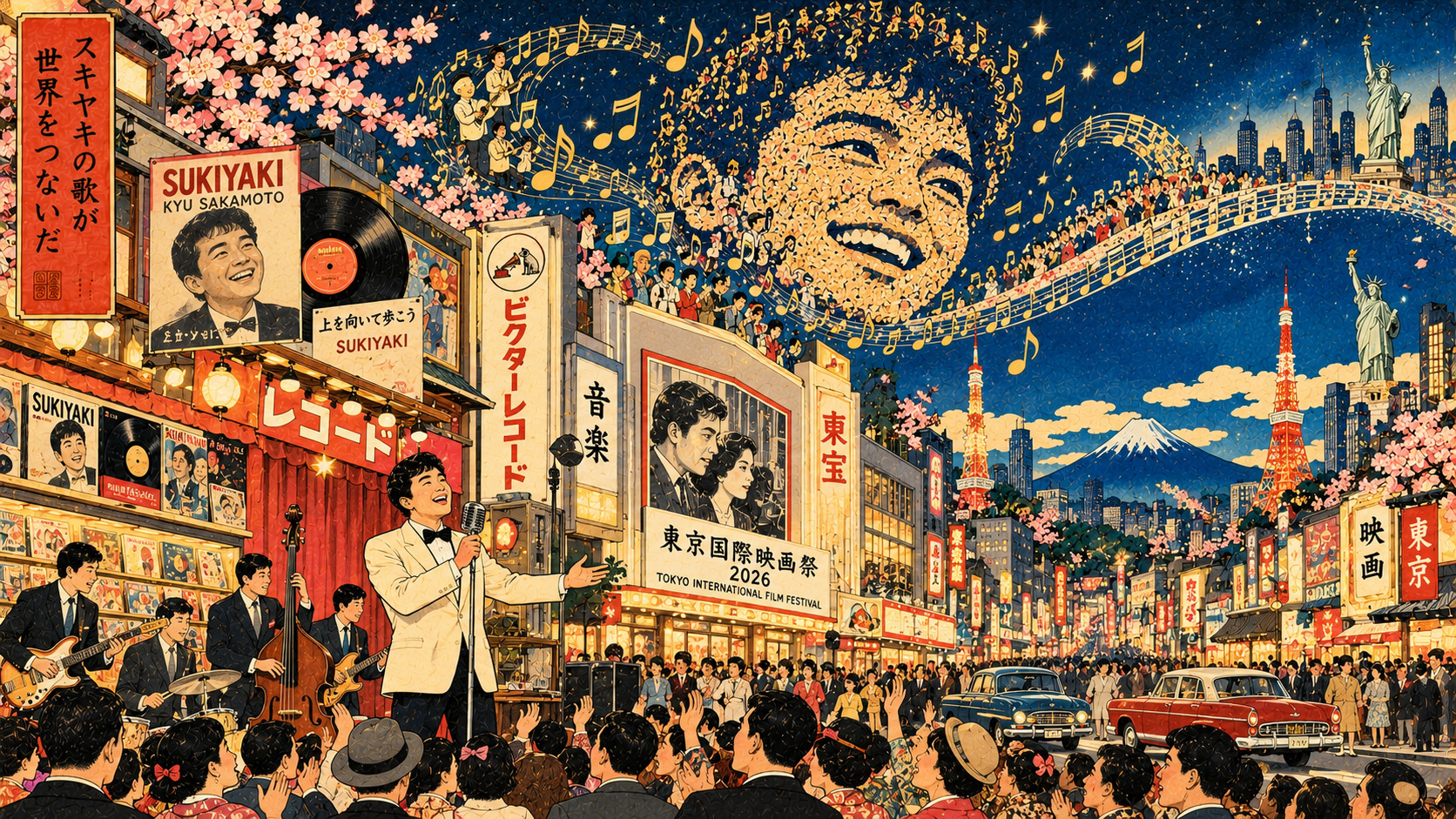
The world called it “Sukiyaki.” Sakamoto never needed to sing it in English.
A red carpet opens onto a 1963 record
Tokyo's 39th International Film Festival opened October 26 with a film about a song that once achieved an almost unimaginable feat: a Japanese-language recording led the American Billboard Hot 100 for three weeks. Director Takahisa Zeze's SUKIYAKI reconstructs the creative partnership behind “Ue o Muite Arukō,” known internationally as “Sukiyaki.” At the Tokyo ceremony, lead actor Junichi Okada joined Tori Matsuzaka, Nana Seino and the director. The public theatrical release in Japan is scheduled for December 25; the festival screening was a premiere, not a nationwide opening.
Three creators, not a single miracle
The story begins with composer Hachidai Nakamura, lyricist Rokusuke Ei and vocalist Kyu Sakamoto—widely described in Japan as the roku-hachi-kyū trio, or the “689” trio. Each supplied a different ingredient. Nakamura carried an understanding of jazz and popular composition; Ei brought a distinctive command of language and broadcast culture; Sakamoto had the voice and stage presence to make the song an intimate encounter. The film casts Okada as Nakamura, Matsuzaka as Ei, and Taiga Nakano as Sakamoto. It is explicitly described by festival organizers as fiction based on real events, not a documentary transcript.
The Japanese record before the American sensation
The song originated in a 1961 Nakamura recital, according to the official Japanese record-label history. It soon entered the mass-media ecosystem of postwar Japan, particularly NHK's popular television show Yume de Aimashō. A commercial Japanese single followed in October 1961 and reportedly exceeded 300,000 copies within three months. This was an era in which a TV appearance, a radio request, and a 45-rpm disc could turn a new song into shared national memory. The title “Ue o Muite Arukō” is usually rendered “I Look Up as I Walk.”
How a song acquired a name that meant nothing like its lyrics
The title “Sukiyaki” refers to a Japanese hot-pot dish. It is not a translation of the lyrics. Nakamura's official biography recounts how Louis Benjamin of Britain's Pye Records heard the song while in Japan and commissioned a recording by Kenny Ball and His Jazzmen. A familiar Japanese food name was chosen for overseas marketing. Ball's instrumental interpretation became a British hit. The original recording subsequently found American listeners, including through regional radio airplay, before Capitol Records issued it nationally. The details of which US broadcaster first broke the record vary among later accounts; the reliable common thread is that airplay and listener response preceded its national climb.
The week an untranslated voice topped the Hot 100
On the Billboard chart dated June 15, 1963, Sakamoto reached No. 1. He stayed there for three consecutive weeks. Japan's Universal Music and Billboard Japan both document that chart run. The triumph came amid an American pop landscape dominated by English-language hits. Rather than converting the song into English, the original Japanese recording reached listeners who often understood none of the words. The melody mattered, but so did the institutions that carried it: radio programmers, labels, records, stores and audiences willing to hear something new.
Postwar Japan, American audiences and the politics of a pop hit
A US public-television essay published by PBS places the song in the fraught cultural setting of postwar US–Japan relations. A Japanese performer becoming an American teen idol signaled changing perceptions of a former wartime adversary and a rapidly rising economy. Yet the seemingly harmless “Sukiyaki” label also illustrates the tendency to package unfamiliar Asian culture as a consumable curiosity. These two readings do not cancel each other out. Listeners could genuinely embrace the performance even when the marketing obscured its meaning. The distinction remains relevant to today's debates about cultural exports and localization.
The new film brings a wider musical generation onstage
The production reaches beyond its central trio. Nana Seino portrays Nakamura's wife Junko; Motoki Ohmori plays singer Hiroshi Mizuhara; Lilas Ikuta plays Michiyo Azusa. The screenplay is by Takehiko Minato, with music direction by Taisei Iwasaki and music credited also to Masaki Hayashi. The filmmakers are depicting a connected entertainment culture of studios, television networks, concert stages, songwriters and ambitious performers. Their creative reconstruction may convey the pulse of an era. Individual scenes, arguments and dialogue still require corroboration before they can be cited as historical fact.
A life cut short, a recording that kept traveling
Sakamoto died at 43 in the 1985 Japan Airlines Flight 123 disaster. His death gives the story a gravity the first chart statistics cannot convey. The song, meanwhile, acquired further lives: A Taste of Honey adapted it for American audiences in 1981, reaching No. 3 on the pop chart, and subsequent recordings circulated across genres and decades. New lyrics in later adaptations are not the same text as Ei's original. This is not just a tale of one recording conquering a foreign market; it is a history of changing meanings attached to a recognizable melody.
What the festival did—and did not—establish
The official October 26 festival report confirms the premiere and public remarks by the participating artists. Okada spoke of the honor of opening the festival, while Matsuzaka discussed the film's sense of live musical experience. Zeze described the postwar movement from devastation toward growth and peace as an important historical setting. Those remarks describe intentions and reactions; they do not independently verify every dramatic incident or establish critical consensus. Japan.co.jp did not attend the screening, interview the filmmakers or independently review the completed feature.
A story about translation without translation
Most contemporary cultural exports are planned with subtitles, multiple territories and global platforms in mind. “Sukiyaki” circulated through an older, less predictable network. Its American identity was transformed by its title, even as its singer kept the original Japanese words. The new film, arriving on an international festival stage more than six decades later, invites an unusually timely question: when a work crosses borders, which parts of it remain the creator's, and which meanings are supplied by its new audience? The history offers no tidy answer. Its fascination is that this Japanese song traveled so far while remaining so unmistakably itself.
Sources and verification
Based on festival and film-company announcements, record-label archives and independent historical commentary. No original screening, interview or firsthand film review is claimed. Dramatized film scenes are not treated as established facts.
- Tokyo International Film Festival: October 26 opening report
- Tokyo International Film Festival: film and screenings
- Official film website: cast and release
- Stardust Pictures: production credits
- Universal Music Japan: recording and international release chronology
- Nakamura Hachidai official biography: overseas circulation
- Billboard Japan: chart history and subsequent covers
- PBS American Experience: US cultural context
- Japan Institute of the Moving Image: director commentary
- Universal Music Japan: Kyu Sakamoto biography