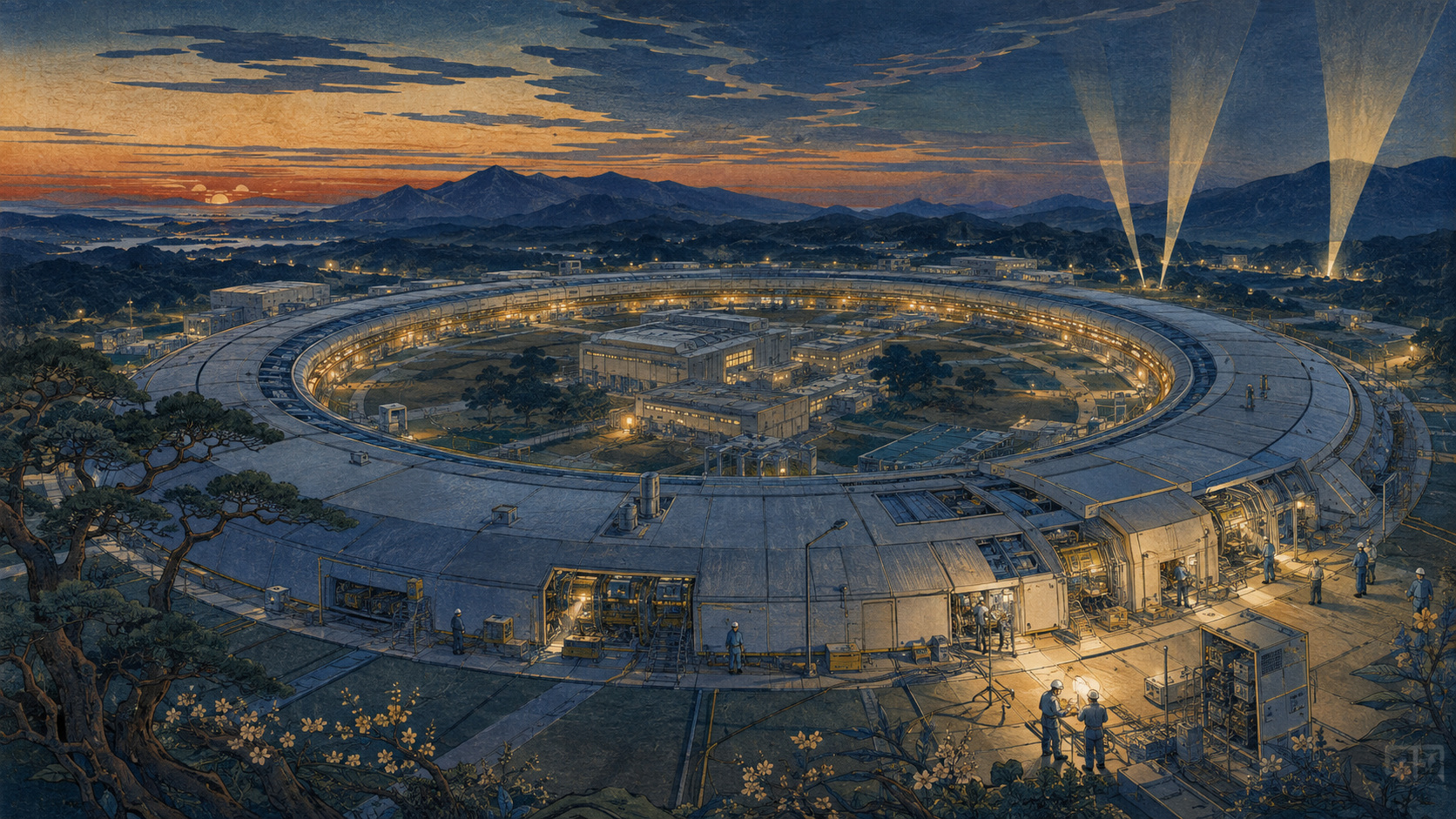
A synchrotron does not announce its discoveries with a bang. It hums behind concrete.
Inside a circular tunnel in the hills of western Hyogo, bunches of electrons travel so close to the speed of light that another lap of the 1,436-meter ring takes only a few millionths of a second. Magnets bend their path. At dozens of points, the particles shed exquisitely controlled X-rays into beamlines that fan outward toward laboratories. There, a battery can be watched while it charges, a protein can be reconstructed atom by atom, a meteorite can be opened without a knife, and stress can be mapped inside metal that appears solid and still.
In August 2027, that light will stop. Workers will open the ring, remove the magnetic lattice that has guided electrons since SPring-8 began shared use in 1997, and install a machine of a different generation within the same tunnel. It is surgery on national infrastructure: the concrete body remains; the circulatory system is replaced.
The proposed reward is an X-ray source with spectral brilliance around 10 kiloelectronvolts roughly two orders of magnitude above today’s machine. RIKEN summarizes the promise as “100 times more brilliant.” SPring-8-II is also designed to use nearly half as much electricity while extending spatial resolution from today’s roughly 50 nanometers toward less than one nanometer in suitable experiments.
Those numbers deserve excitement. They also need translation.
The year-long closure has more than one clock
The August 4 notice is brief because the installation choreography is still being finalized. It establishes four milestones, not one. Operations stop in August 2027. The storage-ring replacement takes approximately a year. Commissioning of the accelerator and beamlines starts in early 2029. Shared use returns during fiscal 2029, which runs from April 2029 through March 2030.
Between mechanical completion and a user’s first publishable dataset lies a chain of proof. Vacuum systems must hold. Thousands of magnets must produce the intended fields. Electrons must be injected, captured and kept circulating. The orbit must be corrected to micrometer scales. Radiation shielding must be verified. X-rays must find their old paths through front ends and optics. Monochromators, mirrors, detectors, controls and safety interlocks must be commissioned. Each beamline then has to show that it can produce calibrated, reproducible measurements.
This is why “first electron,” “stored beam,” “first light,” “first user” and “full operation” are separate dates. The European Synchrotron Radiation Facility shut its old ring in December 2018, stored beam in its replacement one year later and resumed user service in August 2020. The U.S. Advanced Photon Source stopped in April 2023, delivered first X-rays to a scientific beamline in June 2024 and began a limited first user run in September, while other beamlines continued commissioning.
SPring-8’s notice is prudent rather than evasive. It gives researchers the one date they need immediately—the loss of 2027B beamtime—while refusing to promise a day that only commissioning can earn.
August 2027 · Operation stops and replacement begins.
About one year · Old storage-ring components are removed and the new ring is installed.
Early 2029 · Accelerator and beamline commissioning is scheduled to begin.
Fiscal 2029 · Shared use is planned to start; the exact date remains open.
What “100 times brighter” actually measures
Brightness is an ordinary word with a technical job. In synchrotron science, the central quantity is usually brilliance: how many photons are packed into a small source area, a narrow cone of angles, a short interval of time and a defined slice of photon energy. A floodlight may emit more total light than a laser, yet the laser concentrates photons into a far more useful beam. SPring-8-II aims for the X-ray equivalent of that concentration.
The peer-reviewed accelerator design projects spectral brilliance above 1022 photons per second per square millimeter per square milliradian per 0.1% bandwidth around 10 keV from an undulator. That is roughly two orders of magnitude above the current source in the design comparison. It does not mean every beamline gets exactly 100 times as many photons, every measurement runs 100 times faster, or every sample yields 100 times more information.
Performance depends on photon energy, insertion device, beamline optics, detector, sample and technique. Some experiments will spend the gain on a smaller spot. Others will collect faster, obtain better statistics, exploit coherent illumination or reduce the dose delivered per useful image. Samples can also be damaged by concentrated X-rays, and optics can be distorted by heat. Brilliance creates choices; it does not abolish experimental limits.
- It is a design target: the machine must still be built, commissioned and demonstrated.
- It is spectral brilliance: photon concentration in phase space and bandwidth, not visible brightness.
- It is energy-dependent: the “about 100” comparison is most meaningful around the hard-X-ray region used in the design.
- It reaches the sample through a beamline: mirrors, monochromators, apertures and detectors determine the delivered gain.
How a ring turns speed into a microscope
An electron moving in a straight line at constant speed would not radiate. Force it to turn, and it accelerates sideways; a relativistic electron then emits radiation forward in a narrow cone. A storage ring repeats that act billions of times while radio-frequency cavities replace the energy lost as light.
Bending magnets keep the beam on its circular course and can themselves produce X-rays. More intense and tunable beams come from insertion devices—alternating rows of magnets in straight sections. An undulator makes an electron wiggle through a carefully repeated pattern. Radiation from successive wiggles interferes constructively at selected wavelengths, forming a narrow, brilliant beam.
The ring is therefore not a microscope by itself. It is a light factory feeding around 60 specialized instruments. One beamline diffracts X-rays from crystals; another measures absorption around the edge of a chosen element; another performs tomography; another follows dynamics through coherent scattering. The same electron beam becomes many kinds of question.
The decisive limitation is not merely how many electrons circulate. It is how much their positions and directions spread. Accelerator physicists combine those two spreads in a quantity called emittance. Lower emittance means a smaller, less divergent source—light that can be focused more tightly and used more coherently. SPring-8-II’s target is to reduce horizontal emittance from about 2,400 picometer-radians to 50, a factor of 48.
From an unwanted blue glow to “dream light”
The light began as a nuisance. On April 24, 1947, technicians at General Electric’s laboratory in Schenectady saw a bright arc from the company’s 70-MeV electron synchrotron. Theory had predicted that accelerating charges would radiate, but the direct laboratory sight was memorable: a blue-white glow escaping through a transparent section of the vacuum chamber.
Particle physicists initially regarded the radiation as energy stolen from their beam. Other researchers asked to use it. That produced the first generation of light sources, where experiments parasitized accelerators built for high-energy physics. The second generation brought storage rings designed specifically to supply light. The third generation—SPring-8, the ESRF in France and the APS near Chicago among them—made straight sections and undulators central to the machine.
The phrase “fourth generation” can describe free-electron lasers such as SACLA and also the new family of diffraction-limited or multi-bend-achromat storage rings. Their time structures differ, but both pursue brightness and coherence far beyond the classic third-generation source. Sweden’s MAX IV pioneered the modern multi-bend approach; ESRF’s Extremely Brilliant Source and the upgraded APS demonstrated that large existing hard-X-ray rings could be rebuilt around it.
SPring-8-II belongs to that global turn. Japan is not replacing a failed facility. It is replacing a scientifically productive one because accelerator design has learned how to squeeze an electron beam by almost two orders of magnitude inside a ring of similar size.
How Harima built Japan’s giant ring
SPring-8’s history began before its name. In 1988, the Japan Atomic Energy Research Institute and RIKEN formed a joint project team for a large synchrotron source. Harima Science Garden City in Hyogo was selected in June 1989. JASRI—the Japan Synchrotron Radiation Research Institute—was established in December 1990. Construction began in November 1991.
The location was part of the engineering. A large ring needs stable ground, space for radial beamlines and freedom from urban vibration. The facility rose on a greenfield site in Sayo, far from the universities and corporate laboratories that would depend on it. Researchers would travel to the beam, often carrying precious samples and working through the night during a tightly allocated shift.
Synchrotron radiation circulated in March 1997; public user service opened that October. The name compresses the ambition: Super Photon ring-8 GeV. At the time, the 8-billion-electron-volt storage ring was built to produce exceptionally hard X-rays—penetrating photons able to probe thick metals, high-pressure cells and dense materials.
Its governance also mattered. RIKEN owns and operates the accelerator complex; JASRI promotes shared use and supports users under Japan’s large-facility framework. University groups, national institutes and companies compete for beamtime, with different routes for open publication and proprietary industrial work. SPring-8 became not one laboratory but a national marketplace of questions.
1988 · JAERI and RIKEN form the project team.
1989 · Harima Science Garden City is selected.
1991 · Construction begins.
March 1997 · Synchrotron radiation is generated.
October 1997 · Shared user operation opens.
2020 · SACLA begins time-sharing as the injector, allowing the old injector chain to close.
A machine that learned to read matter
The most compelling record of SPring-8 is not the ring but the diversity of objects placed in its beams. Structural biologists used BL41XU to resolve photosystem II’s oxygen-evolving complex at 1.9 ångström resolution, revealing the manganese-calcium cluster at the heart of the reaction that splits water and sustains oxygenic life. The work turned a biological process familiar from schoolbooks into an atomic arrangement that chemists could test.
When Hayabusa2 returned grains from asteroid Ryugu, SPring-8 microtomography helped examine the samples in three dimensions without consuming them. Minerals, pores and inclusions inside particles smaller than a millimeter could be mapped before other analyses. The value was not only resolution but restraint: a unique extraterrestrial sample survived the look.
Industry has used the facility with equal seriousness. Tire makers have studied how rubber, silica and internal voids deform under load, connecting nanoscale structure to rolling resistance and wear. Semiconductor developers examine buried interfaces. Battery teams watch oxidation states change during operation. Metallurgists map residual strain beneath surfaces that ordinary microscopes cannot reach.
Archaeology and art history enter the same ring. Penetrating X-rays can distinguish alloys, corrosion layers and manufacturing structures inside objects too valuable to section. RIKEN’s 2026 overview points to Kofun-period bronze mirrors as one example. The scientific common denominator is hidden structure; the human questions range from Earth’s first solids to a factory’s next process.
That breadth explains why the shutdown cannot be treated like the closure of a single university instrument. It interrupts a network of experiments with different deadlines, sample lifetimes, students, commercial secrecy and international competition.
Five bends where two once stood
The present ring uses a double-bend achromat lattice: two principal bending magnets in each repeating cell, with quadrupoles and sextupoles that focus and correct the electron beam. SPring-8-II replaces it with a five-bend achromat. Distributing the turn among more, gentler bends suppresses the quantum-driven spreading that sets the natural emittance.
“Five bends” understates the density of the object. A cell is a carefully ordered magnetic sentence: dipoles curve the path, quadrupoles focus horizontally or vertically, sextupoles correct energy-dependent focusing, correctors trim the orbit, and diagnostics report where the beam actually is. Strong focusing lowers emittance but shrinks the safe region in which injected electrons can survive. The machine becomes more capable and less forgiving at the same time.
The design therefore uses damping wigglers in two long straight sections to reduce emittance further. It also relies on highly stable power supplies, fast orbit feedback and a dense array of beam-position monitors. The target beam is so small that ground motion, temperature drift and magnetic errors that were once tolerable can blur the X-ray source.
Top-up injection adds another difficulty. Electrons are continually lost, so small batches must be injected without interrupting measurements. The design seeks transparent top-up: users should not see a disturbance each time SACLA sends fresh electrons into the ring. Low emittance is valuable only if it is available stably, shift after shift.
| Parameter | Present SPring-8 | SPring-8-II design | Why it matters |
|---|---|---|---|
| Lattice | Double-bend achromat | Five-bend achromat | More bends reduce electron-beam emittance. |
| Energy | 8 GeV | 6 GeV | Reduces synchrotron-radiation loss and electricity demand. |
| Current | 100 mA | 200 mA | More stored charge supports photon flux. |
| Horizontal emittance | ≈2,400 pm·rad | 50 pm·rad target | Smaller source, tighter focus and greater coherence. |
| Undulators | Existing long-period devices | Shorter-period IVU-II program | Preserves hard-X-ray reach at lower electron energy. |
Why 8 becomes 6 without surrendering hard X-rays
The counterintuitive line in the plan is hidden in the name. SPring-8-II will no longer store 8-GeV electrons; it is designed for 6 GeV. If energy alone defined performance, this would be a downgrade. But a modern light source is a system of electron quality, current and insertion-device geometry.
Lowering the electron energy sharply reduces the power radiated on every turn. The design then doubles stored current from 100 to 200 milliamperes and installs short-period in-vacuum undulators. Bringing magnetic poles closer together and repeating them more frequently allows the undulator to produce high-energy harmonics with 6-GeV electrons. More of the available performance is shaped into useful beam rather than spent maintaining an unnecessarily energetic orbit.
Japan has particular experience here. SPring-8 developed in-vacuum undulators so the magnetic gap could be small without inserting a thick vacuum chamber between the magnets and the electron beam. The new IVU-II series makes that technology more compact and efficient. The design paper estimated that more than 30 such devices would be required and described a production program already under way before the shutdown.
Damping wigglers can also supply very high-energy radiation, above 100 keV, for thick samples and extreme-pressure work. The design’s claim is therefore not that 6 GeV magically equals 8. It is that a lower-energy, lower-emittance, higher-current ring paired with modern magnets can deliver more useful hard X-rays at lower operating cost.
The green upgrade hidden inside the brilliance
A storage ring is a power plant in reverse: electricity is converted into a controlled beam of particles and then into light. Magnets, radio-frequency cavities, cooling water, vacuum pumps, data systems and building services run for thousands of hours. For a national facility, efficiency is not a footnote; it determines how much science can be afforded over decades.
The SPring-8-II design attacks demand in several places. Lower electron energy reduces radiation loss. Many electromagnets are replaced with permanent magnets that need no continuous coil power or cooling. The radio-frequency system is simplified, with half as many cavities in the design comparison. And the separate injector chain has already been retired: since 2020, the neighboring SACLA X-ray free-electron laser’s linac has injected electrons into SPring-8 between its own pulses.
Time-sharing SACLA eliminated roughly five megawatts associated with the old dedicated 1-GeV linac and 8-GeV booster, according to the accelerator paper. The combined changes are intended to bring SPring-8-II’s electricity use to nearly half that of the legacy configuration even as stored current doubles.
Permanent magnets bring tradeoffs. Their fields cannot be adjusted with a simple turn of electrical current, and magnetization changes with temperature. Engineers must sort magnetic material, shape pole pieces, add mechanical tuning and control the tunnel environment. “No power cable” does not mean “no precision.” It shifts complexity from daily electricity into design, manufacture and thermal management.
One year to replace a 1.4-kilometer machine
The project’s budget scale reflects the constraint. A MEXT committee record describes a ¥49.9 billion program extending through fiscal 2028. The plan does not build a second ring beside the first and switch between them. It reuses the existing tunnel, shielding, experimental hall and most beamlines. That saves money and preserves a mature scientific ecosystem, but it creates a hard interval in which the old machine must leave before the new one can be fully assembled.
Preserving the photon-beam axes is one of the design’s quiet achievements. Dozens of beamlines extend outward from source points, some for tens or hundreds of meters. If the new ring moved those sources substantially, every optical system would face reconstruction. The lattice has been designed to fit the old geometry closely enough that much of this capital can remain.
The shutdown still demands industrial choreography. Components must be disconnected, surveyed for radiation, removed from a confined tunnel and routed away without blocking incoming modules. New girders arrive in an installation sequence. Vacuum chambers, magnets, cables, cooling, supports and diagnostics must connect within tight tolerances. Survey teams align the ring; electrical teams test thousands of channels; vacuum teams bake and condition the system.
The ESRF and APS rebuilds show what preparation can accomplish: modules fabricated and pretested before the dark period, practice installations, digital surveys and parallel work fronts. They also show why commissioning cannot be compressed by optimism. A machine assembled on schedule still has to discover its own small errors under beam.
The scientific blackout and Japan’s relay network
The most immediate casualty is already administrative. SPring-8 will not issue a normal call for 2027B proposals, and later calls are suspended until the new schedule is ready. Experiments must move earlier, wait, change method or find another source.
Japan is not without alternatives. MEXT and JASRI are building a relay among NanoTerasu in Sendai, KEK’s Photon Factory and Photon Factory Advanced Ring in Tsukuba, SACLA next door to SPring-8, and regional sources such as AichiSR and SAGA-LS. In March 2026, JASRI mapped industrial methods to candidate beamlines: imaging, X-ray absorption fine structure, hard-X-ray photoelectron spectroscopy, diffraction, protein crystallography and small-angle scattering.
The map also exposed holes. High-resolution imaging between roughly 40 and more than 100 keV is difficult to reproduce domestically. Some ultra-small-angle scattering and specialized hard-X-ray work may need the ESRF or other overseas facilities. PETRA III in Germany is itself approaching an upgrade period, making international scheduling less simple. Export controls and economic-security rules may prevent sensitive industrial samples from leaving Japan.
Capacity is as important as technical compatibility. Five beamlines that can perform XAFS are not a substitute if they do not have enough operating hours, staff or proposal access to absorb SPring-8’s users. A researcher who knows how to run an experiment at one facility still needs local support at another. MEXT’s committee discussion therefore turns on unglamorous but decisive matters: common application routes, travel, proprietary access, staffing and extended operation.
SACLA remains available during the ring shutdown, but a free-electron laser is not a drop-in copy of a storage ring. Its ultrashort, intense pulses enable experiments SPring-8 cannot do; they can also destroy a sample and require different detectors, timing and analysis. The relay will reduce the damage. It cannot make the blackout disappear.
- NanoTerasu: growing soft- and tender-X-ray portfolio, with new hard-X-ray shared beamlines under construction.
- Photon Factory / PF-AR: broad, experienced domestic capacity for diffraction, spectroscopy and structural biology.
- SACLA: remains in operation and can back up selected imaging and spectroscopy after feasibility work.
- Regional sources: AichiSR and SAGA-LS may absorb techniques within their energy and capacity ranges.
- Overseas: ESRF and other high-energy facilities for capabilities Japan cannot fully duplicate during the gap.
After the shutdown, the real test begins
If the ring reaches its targets, SPring-8-II will not simply make familiar pictures sharper. Coherent X-rays can reconstruct objects without a conventional lens. Nanometer beams can map chemical and strain variation across next-generation transistors. Faster acquisition can follow catalysts and batteries while they work rather than before and after. RIKEN anticipates three-dimensional semiconductor structures and fuel-cell reactions observed at atomic scales.
More light also means more data. A detector that records finer images at higher frame rates can turn one shift into terabytes or more. Network, storage, calibration, reconstruction and machine-learning pipelines must improve with the accelerator. Otherwise, the bottleneck moves from photons to files. Automated experiments may choose the next measurement while the beam is still running, turning a beamline into a closed loop between hypothesis, sample and computation.
Success should be measured in layers. Did the ring achieve 50 pm·rad? Can it store 200 mA reliably? Is injection transparent? Are source positions stable enough for nanofocusing? Do representative undulator beamlines reach the predicted brilliance? Is total electricity use nearly halved under comparable operation? How many beamlines return, and how quickly? Can ordinary users—not only accelerator experts—turn the new beam into reproducible science?
There are risks on both sides of the dark period. Before it, users may crowd final proposal rounds. During it, students can lose the experiment around which a degree was planned, and companies can move urgent work overseas. After it, concentrated beams can expose weaknesses in optics, detectors and samples. The project’s benefit is not banked when the last magnet bolt is tightened.
Yet the history of synchrotron light is a history of productive inconvenience. Radiation that once stole energy from particle physicists became a tool. A remote ring in Harima became a laboratory for oxygen, asteroids, tires and antiquities. Now the same facility must abandon the feature embedded in its own name—8 GeV—to preserve the larger purpose behind it.
One evening in August 2027, the last scheduled bunch will disappear and a ring that has illuminated matter for thirty years will become a construction site. The next important light will not be the brightest flash. It will be the first stable beam that follows the old path into a waiting instrument—and, months later, the first user who can trust it enough to ask a question no previous SPring-8 could answer.
Reporting notes and principal sources
This article reviews public information available through August 16, 2026 at 6:00 AM JST. The timetable, performance figures and project cost are official plans or design targets, not guarantees. “About 100 times” refers primarily to projected undulator spectral brilliance around the hard-X-ray design region; delivered gains will vary by beamline and experiment. Technical interpretation and comparisons with overseas rebuilds are Japan.co.jp analysis.
- SPring-8: August 2026 notice of operational suspension and proposal-call halt
- RIKEN: SPring-8-II will transform the way we do science
- Journal of Synchrotron Radiation: Green upgrading of SPring-8
- SPring-8: official construction and operations history
- SPring-8: facility size, energy and beamline features
- SPring-8/SACLA 2026 facility brochure
- MEXT committee record: SPring-8-II budget and project period
- MEXT: policy issues created by the upgrade interruption
- MEXT March 2026 minutes: domestic and overseas substitute facilities
- Science Japan/JST: early SPring-8-II upgrade plan and energy rationale
- Lightsources.org: the first direct laboratory observation of synchrotron light in 1947
- ESRF: storage-ring replacement and EBS commissioning
- Argonne: the APS shutdown and one-year installation plan
- Argonne: first scientific X-rays from the upgraded APS
- Advanced Photon Source: limited user operations resumed September 2024
- SPring-8 Research Frontiers: 1.9-ångström photosystem II structure
- SPring-8: non-destructive imaging of returned asteroid samples
- SPring-8: industrial tire-rubber structure and durability research
- SPring-8: industrial application case studies
- Brookhaven National Laboratory: accelerator optics and the Chasman–Green lattice