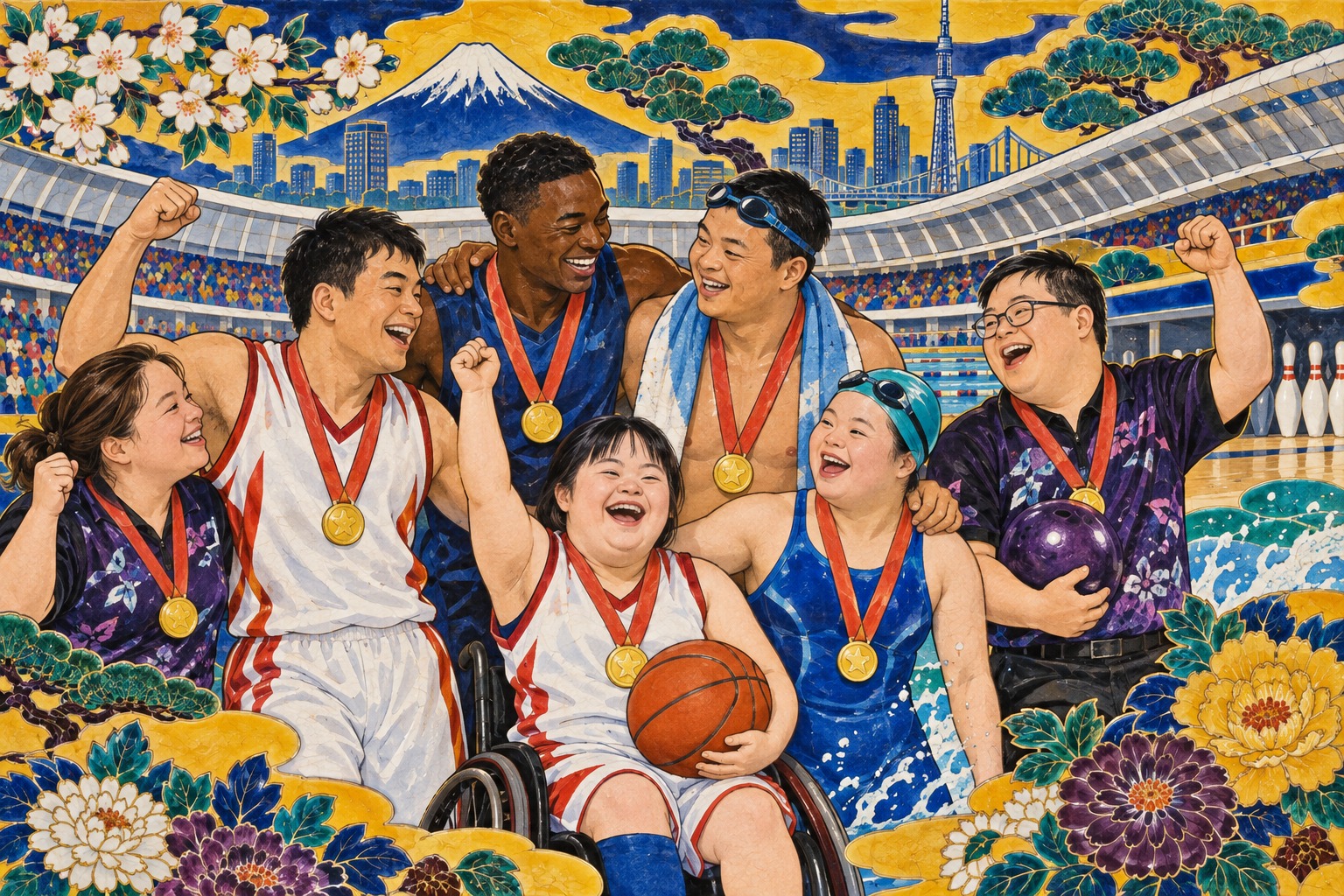
The final began before anyone competed for a medal. On September 5, organizers used preliminary performances and ability information to place athletes and teams into competitive groups—a process Special Olympics calls divisioning. Finals and awards followed on September 6. The sequence is not administrative housekeeping. It is the mechanism that makes a meaningful contest possible for athletes whose performance levels may vary widely.
Three Sports Closed a Two-Part Tokyo Games
The formal Japanese title was the 2026 Dai-9-kai Special Olympics Nippon Kaki National Games Tokyo—the ninth Special Olympics Nippon Summer National Games, abbreviated by the organizer as Special Olympics 2026 Tokyo. The single Tokyo-hosted event was divided into June 5–7 and September 4–6 blocks, with competition on June 6–7 and September 5–6.
The September program put Traditional basketball and swimming at KEIO ARENA TOKYO and bowling at Tokyo Port Bowl. Day one was designated for preliminary competition and divisioning; day two for finals and awards. An updated September 1 outline projected, across both blocks, participation by organizations from all 47 prefectures, about 1,200 athletes, 100 Unified partners, 750 delegation officials and coaches, 750 games officials and referees, 3,250 volunteer participations and 15,000 spectators. Those are whole-event plans, not verified September attendance.
Divisioning Does Not Remove the Result
Special Olympics rules consider gender, age and competitive ability when assembling divisions, with ability the primary factor. Preliminary performances and submitted results help determine the groups. The aim is to avoid matches or races so lopsided that neither side has a real competitive test.
International guidance generally seeks no more than a 15 percent ability spread within a division, although participation numbers and sport-specific realities can make that impossible. Once a division is formed, athletes compete for places. Those who complete an event are recognized with medals or ribbons, subject to disqualification and other rules. This is not an exhibition in which everybody receives the same result; it is a system designed to make different results worth earning.
Two Kinds of Basketball, Two Routes to Inclusion
The Tokyo event displayed two distinct Special Olympics formats. June basketball used Unified Sports®, in which athletes with intellectual disabilities and partners without intellectual disabilities compete as teammates. September basketball was Traditional, meaning the competing teams were composed only of athletes with intellectual disabilities.
Unified competition creates direct, sustained cooperation across disability status. Traditional competition preserves and expands athlete-only opportunity. Neither is a more authentic form of inclusion; they solve different participation problems. Swimming and bowling, meanwhile, provide visible measures of individual development and can be sustained in community facilities long after a national event leaves the city.
What the June Block Established
The first block staged athletics, soccer, table tennis, flying disc, badminton, tennis and Unified basketball around Tokyo. Special Olympics Nippon’s completion report said delegations from 46 area organizations took part, with roughly 1,400 people across athletes, Unified partners, coaches and officials. June recorded 2,251 volunteer participations, while an opening ceremony combining sport and music drew about 6,000 delegation members and general spectators.
The 1,400 figure is not an athlete count. It describes the broader June delegations and therefore cannot be compared directly with the updated whole-event projection of 1,200 athletes and 100 partners. The split format dispersed venue and operating demands, but it also asked organizers to preserve the coherence of one national gathering across a three-month interval.
| Competition block | Sports | Basketball format |
|---|---|---|
| June 6–7 | Athletics, soccer, table tennis, flying disc, badminton, tennis, basketball | Unified Sports® |
| September 5–6 | Swimming, bowling, basketball | Traditional |
Japan’s Movement Grew From Kumamoto
The global movement traces its modern beginnings to Eunice Kennedy Shriver’s early-1960s summer camp in the United States. Chicago hosted the first International Special Olympics Summer Games in 1968. In Japan, momentum grew after an athlete and coach from Kumamoto attended the 1991 World Games in Minnesota. Sports programs began in Kumamoto in 1993; Special Olympics Nippon was established there and recognized by the international organization in 1994. A Tokyo area organization was founded that October.
Kumamoto hosted Japan’s first Summer National Games in 1995 with 137 athletes. Kanagawa followed in 1998 and Tokyo in 2002. The 2005 Winter World Games in Nagano brought the global movement to Japan on a much larger scale. The 2020 Summer National Games were canceled during the COVID-19 pandemic; Hiroshima staged the eighth edition in 2022. The 2026 event was the ninth, and Special Olympics Nippon described it as Tokyo’s first hosting in “about 20 years.”
1968 — First International Summer Games in Chicago
1994 — Special Olympics Nippon established; Tokyo area program founded
1995 — First Japanese Summer National Games in Kumamoto
2002 — Third Summer National Games in Tokyo
2026 — Ninth edition returns to Tokyo in two blocks
Not the Olympics or Paralympics
Special Olympics is separate from both the Olympic and Paralympic movements. Its defining structure is not a quadrennial spectacle alone but year-round training and competition for people with intellectual disabilities. Ability-based divisioning makes that broad participation compatible with serious competition. The National Games are a summit within a continuing program, not the entirety of it.
That distinction should also discipline the language used to describe athletes. They are not props in a story about “overcoming” disability, and their purpose is not to inspire spectators. They train, develop technique, learn tactics, win and lose. Respect begins with reporting the sport rather than turning intellectual disability into a sentimental plot.
A Selection Event for Chile—and More
The Tokyo games also serve as part of the selection process for Japan’s delegation to the 2027 Special Olympics World Summer Games planned for Chile. It would be unsafe, however, to treat every domestic gold medal as an automatic World Games berth. Eligibility, delegation composition and the organizer’s formal selection procedures still govern the final team, which requires a later official announcement.
A national event concentrates attention, sponsorship and volunteers. Its harder job is to send those resources back into weekly programs. Did more training slots open? Were coaches retained? Did travel, equipment and facility costs become more manageable? Did athletes gain a durable role in program leadership and public communication? Those measures determine whether a closing ceremony becomes infrastructure.
The Legacy Is the Next Practice
Special Olympics Nippon planned a nationwide event with approximately 1,200 athletes and 15,000 spectators across its two blocks. Hitting a head count would not by itself describe success. A stronger test is whether a person with an intellectual disability can begin a sport nearby, train consistently, choose among disciplines and return without placing an unsustainable operating burden on family members.
The September 6 awards marked an achievement. The movement’s center of gravity, however, returns immediately to community gyms, pools and bowling centers. Tokyo showed the visible end of a long training cycle. Its value will be measured by whether athletes find a fair contest—and a reliable place at the next practice—after the national stage has been dismantled.