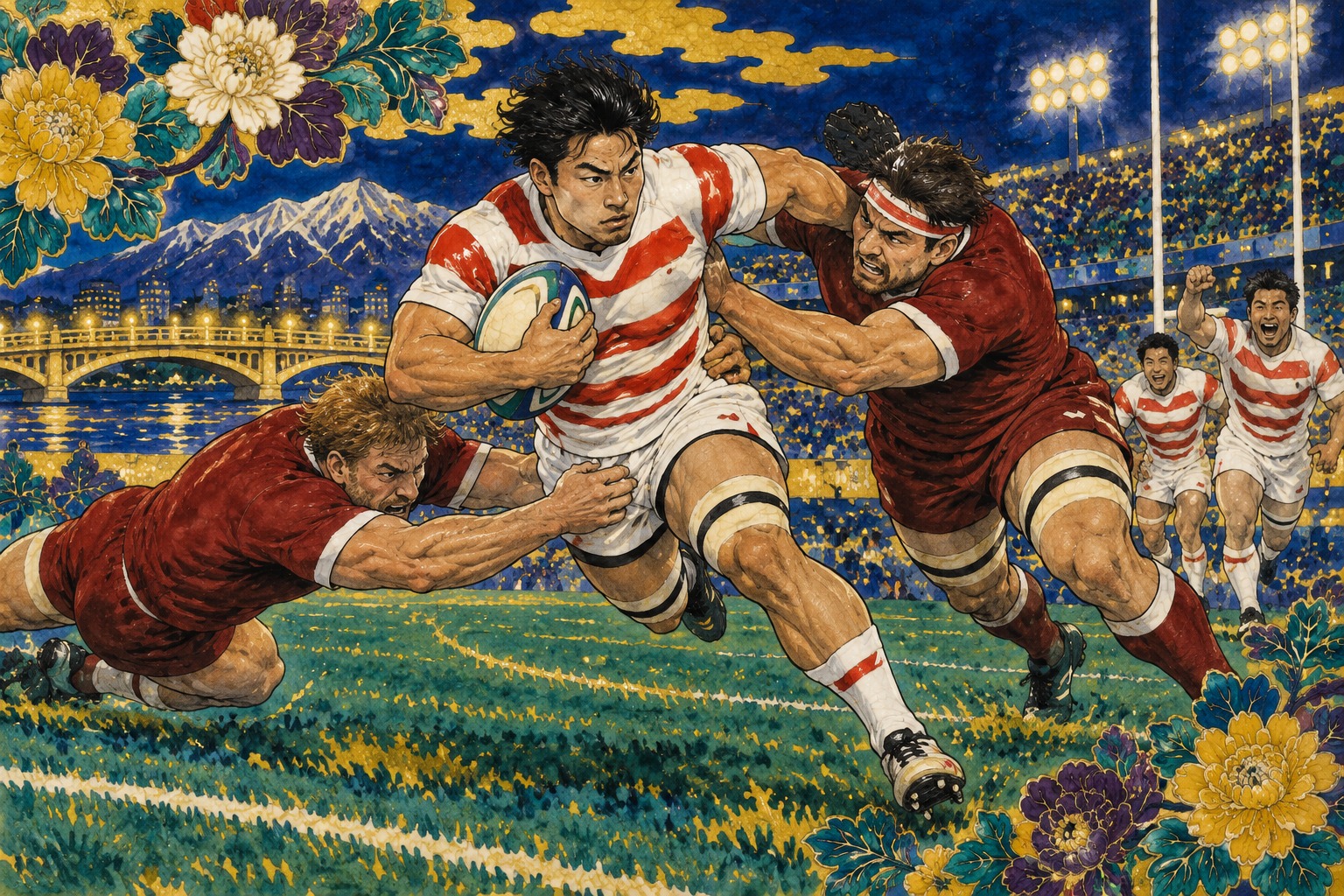
Japan did not need long to turn the Denka Big Swan Stadium scoreboard into a statement. Takato Okabe crossed after five minutes; Mamoru Harada followed after 15. By halftime, Japan had five tries and 31 points. By full time, eight scorers had produced nine tries in a 57–12 victory over Canada before an official crowd of 18,045.
The temptation is to call it a showcase of speed. Yet speed was the result, not the whole mechanism. Japan first generated front-foot possession through its forwards, drew defenders into the contest around the ball and then widened the point of attack. For a team about to enter a Pacific Nations Cup with no pool-stage margin for error, the most useful outcome was not 57 points. It was evidence of a sequence that can be attempted again.
Five First-Half Tries, Not Four
The Japan Rugby Football Union's official record is unambiguous. Japan scored five tries and three conversions in the first half. Okabe scored in the fifth minute, Harada in the 15th, Ben Gunter in the 22nd, Yuya Hirose in the 27th and Kanji Shimokawa in first-half stoppage time. Takuro Matsunaga converted three of them. That yields the official interval total of 31.
Canada briefly narrowed the score to 12–7 when Takoda McMullin scored and converted in the 19th minute. Japan answered in three minutes through Gunter, then again through Hirose. Shimokawa's late try denied Canada the psychological relief of reaching halftime with the game merely difficult. The correct five-try count matters because it changes the reading of the half: Japan did not just start quickly; it renewed its pressure after Canada's response and again before the break.
A Scoreboard Distributed Across the Team
Harada was the only player to score twice, adding his second try one minute into the second half. The other tries went to Okabe, Gunter, Hirose, Shimokawa, Harry Hockings, replacement prop Takumi Inaba and replacement back-rower Tiennan Costley. Five starting forwards scored; two replacements added the last two tries.
An official scoring log cannot reveal every tactical cause. It does, however, show the breadth of the finishers. Japan was not dependent on one wing finding space or one rehearsed strike. The scoring moved from the front row to the back row, into midfield, and eventually onto the bench. That distribution suggests the attack had multiple ways to turn territory and pressure into points.
The Bench Restored the Scoring Rhythm
After Hockings scored in the 58th minute, Canada's Ben LeSage answered two minutes later to make it 45–12. Japan then went without another score until the closing minutes. Inaba crossed in the 77th minute; Costley followed in the 80th, with Sam Greene converting both. A match that might have drifted after mass substitutions ended with renewed accuracy.
The selection carried a developmental edge. Meiji University fly-half Ryunosuke Ito started at No. 10. Inoke Burua began on the right wing with zero caps listed at selection, and Inaba came from the bench with the same status before scoring. Naoto Saito, marked by the JRFU as game captain, supplied experience at scrum-half. This was not a veteran side simply protecting a lead; it was a mixed group asked to keep the game recognizable as personnel changed.
| Match phase | Japan scorers | Score reached |
|---|---|---|
| 5'–16' | Okabe try; Harada try; Matsunaga conversion | 12–0 |
| 22'–27' | Gunter and Hirose tries; Matsunaga conversion | 24–7 |
| 42'–43' | Shimokawa try; Matsunaga conversion | 31–7 |
| 41'–42' | Harada try; Matsunaga conversion | 38–7 |
| 58'–59' | Hockings try; Greene conversion | 45–7 |
| 77'–81' | Inaba and Costley tries; Greene two conversions | 57–12 |
What 57–12 Proves—and What It Cannot
The match belonged to the Lipovitan D Challenge Cup, not the Pacific Nations Cup itself. Its points do not transfer into a table, and 57–12 does not guarantee the same space or possession against the United States. It does establish three usable facts: Japan repeatedly converted pressure into tries; it scored at decisive moments around halftime; and its replacements added rather than merely consumed the final quarter.
There are still blank spaces in the evidence. A runaway victory cannot show how this side will close a one-score match, escape sustained defensive pressure or alter its plan when the set piece stalls. The gap between Harada's early second-half try and Hockings' score, and the period surrounding Canada's second try, will be valuable on film precisely because the scoreboard was already forgiving. Winning provides room to diagnose without turning diagnosis into crisis.
The PNC Begins With an Elimination Match
The 2026 Asahi Super Dry Pacific Nations Cup has been reshaped into a four-team knockout competition. World Rugby's official schedule sends Fiji and Canada into the first semifinal at Hanazono Rugby Stadium in Osaka on September 12. Japan meets the United States at 7:05 p.m. The third-place game and final follow at Prince Chichibu Memorial Stadium in Tokyo on September 19.
Samoa and Tonga are absent from this edition after joining the inaugural World Rugby Nations Cup in July. For Japan, that creates a very different assignment from a pool campaign. There is no preliminary round in which form can develop while standings remain recoverable. One poor semifinal ends the title pursuit. The Canada match was therefore a rehearsal in time and selection, but not part of the competitive ledger.
- September 12, 4:00 p.m.: Fiji v Canada, Hanazono
- September 12, 7:05 p.m.: Japan v USA, Hanazono
- September 19, 4:00 p.m.: Third-place play-off, Chichibunomiya
- September 19, 7:05 p.m.: Final, Chichibunomiya
A Rivalry Entwined With Japan's First Test
Canada occupies an unusual place in Japan's rugby history. The JRFU identifies Japan's 3–3 draw with British Columbia on the 1930 Canadian tour as the national team's first test match. Before the 2026 Niigata match, Japan and Canadian opposition had met 33 times, with Japan recording 19 wins, 10 losses and four draws. Adding Saturday's result produces an editorial total of 20–10–4 from 34 matches.
The most resonant meetings were stalemates. Japan and Canada drew 12–12 at the 2007 Rugby World Cup and 23–23 in 2011. Canada appeared at every World Cup from 1987 through 2019 and reached the quarterfinals in 1991, before its nine-tournament run ended in qualifying for 2023. The team has qualified for Australia 2027. Japan's commanding recent results belong within that longer record, not outside it.
1930 — Japan draw 3–3 with British Columbia in their first recognized test
1991 — Canada reach the Rugby World Cup quarterfinals
2007 — Japan and Canada draw 12–12 at the World Cup
2011 — Another World Cup draw, 23–23
2026 — Japan win 57–12 in Niigata
Niigata Waited 18 Years for This Test
Niigata Prefecture had not staged a Japan men's test since the match against Hong Kong on May 18, 2008. The return came on a clear day and a good surface, according to the official record. The attendance of 18,045 gave the occasion scale without requiring the claim that it set a record.
Taking the national team beyond the largest metropolitan centers can make international rugby tangible to a different public. Yet a single crowd figure cannot demonstrate a lasting regional effect. That would require evidence about repeat fixtures, local participation and links with schools and clubs. The defensible conclusion is narrower: after an 18-year absence, Niigata again hosted the national side, and more than 18,000 people watched.
The Process, Not the Margin, Must Travel to Osaka
Japan does not need to reproduce a 45-point victory against the United States. It needs to reproduce the order of operations: establish forward momentum, keep the ball available, make the defense compress, and preserve attacking clarity when replacements arrive. Against a different opponent, the points may come through penalties, territory or fewer chances. The quality of the sequence matters more than the final arithmetic.
Fiji beat Japan in the 2024 and 2025 PNC finals. In 2026, Japan must first earn the right to return. Niigata offered encouraging ingredients—young decision-makers, experienced carriers, debut-stage players and a bench that scored late—but not a trophy. The 57–12 result will become meaningful evidence of progress only if the same underlying habits remain visible under semifinal pressure.