A quiet little museum in a Japanese home
Somewhere in Japan, there is a quiet little museum inside a family home. In the back of a closet, an old game console is waiting. In a drawer, a stack of trading cards sits in sleeves. On a shelf, a boxed figure has never been opened. In a wardrobe, a jacket from another era is suddenly becoming fashionable again.
Once, these things were called clutter. Now, they may be treasure.
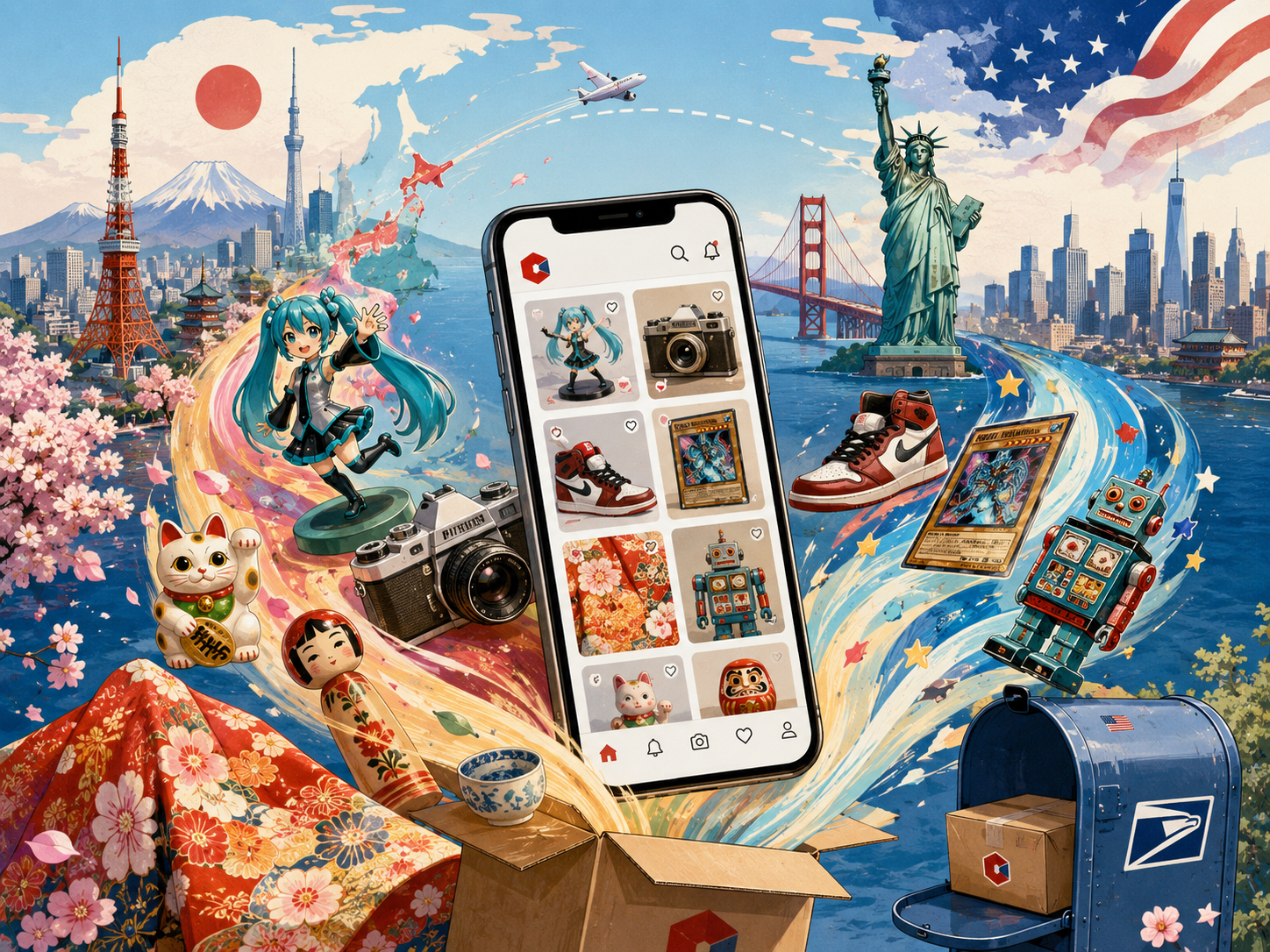
Mercari’s launch of a new U.S. app called Mercari Japan is more than another e-commerce announcement. It is a signal that Japan’s secondhand market, collector culture, anime and game fandom, fashion resale, and the old Japanese instinct not to waste useful things are moving into a new phase: direct, app-based export.
American buyers will be able to browse and purchase items listed in Japan through Mercari and Mercari Shops. The app is designed to reduce the usual friction of cross-border shopping: language, payment, shipping, tracking, and uncertainty. Mercari is not simply putting products in front of foreign customers. It is exporting the pleasure of discovery.
The product is discovery
Mercari’s power was never just that it sold used goods. Its power was that ordinary people’s belongings could suddenly appear in public view.
A conventional e-commerce store is orderly. Products are sorted by size, color, model number, availability, and price. That order gives buyers confidence. But it rarely gives them surprise.
A person-to-person marketplace offers a different thrill. You may find the thing you were looking for. You may also find the thing you did not know existed. An old poster. A discontinued video game. A concert-only towel. A toy from childhood. A corporate giveaway that makes no sense outside Japan but immediately makes sense to someone who grew up there. As a market, it can look messy. As a cultural experience, that messiness is the point.
Japan had secondhand culture long before Mercari
Japan’s secondhand economy did not begin with an app. Pawnshops, used bookstores, antique markets, recycle shops, vintage clothing stores, flea markets, and specialty hobby stores have long been part of Japanese urban life.
Jimbocho’s bookshops, Akihabara’s used game stores, Nakano Broadway’s collector culture, Harajuku and Shimokitazawa vintage shops, and local recycle stores all helped turn used objects into a form of culture.
But the older secondhand market had limits. To sell something, you usually had to bring it somewhere. A shop would judge it. A shop would set the price. The buyer had to physically find that shop. The system was reliable, but it was not fully personal.
The internet changed that. In the United States, eBay became a pioneer. In Japan, Yahoo Auctions became a major force. People could sit at a computer, upload photos, write descriptions, wait for bids, ship the item, and build reputation through feedback.
Mercari changed the equation by making resale smartphone-first. Take a photo. Write a short description. Set a price. List the item. The simplicity mattered.
Mottainai becomes a digital marketplace
Japan has a famous word: mottainai. It is often translated as “what a waste,” but the feeling is broader than thrift. It suggests hesitation before throwing away something that still has use. It carries respect for objects, practical wisdom, and a quiet discomfort with waste.
Mercari turned that feeling into a smartphone economy. An unwanted item becomes a listing. Cleaning out a closet becomes income. Children’s clothes move to another family. Books, games, fan goods, shoes, bags, tools, hobby equipment, and old electronics return to the market instead of disappearing into storage or trash.
This is partly an environmental story. But it is also a story about memory. A new product has a manufacturing history, a retail history, and a brand history. A used product also has a human history. Someone kept it. Someone opened it, or did not open it. Someone bought it at a time when that character, band, game, brand, or fashion trend mattered.
For collectors, that is part of the charm.
Oshikatsu turns fandom into physical movement
To understand the appeal of Mercari Japan, it helps to understand oshikatsu. Oshikatsu means activities built around supporting one’s favorite idol, actor, anime character, VTuber, voice actor, mascot, athlete, or other beloved figure.
It can mean going to concerts, buying goods, taking acrylic stands to cafes, traveling with plush dolls, placing birthday ads, buying multiple versions of the same item, or collecting limited products. To outsiders, it can look excessive. To participants, it is joy, identity, ritual, and community.
Fan goods are often defined by missed timing. A regional exclusive. A limited campaign. A random blind-box item. A concert-only item. A lottery prize. A preorder bonus. The person who wants it and the person who has it are often not the same person. Mercari connects them.
For American fans, Japan’s fan-goods market is not just a shopping category. It is a piece of Japanese cultural atmosphere. Streaming delivers the anime. Social media delivers the fandom. But the objects — the cards, plush toys, badges, figures, and little pieces of event culture — are harder to obtain.
Why the United States matters
The United States is a special market for Japanese culture. Anime, manga, games, Pokémon, Nintendo, Studio Ghibli, Dragon Ball, One Piece, Naruto, Demon Slayer, Hatsune Miku, VTubers, J-pop, Japanese streetwear, and retro game collecting have all shaped American fan culture.
But the larger the demand, the larger the problem. American fans worry about authenticity. Shipping can be expensive. Proxy buying services can be useful, but fees and steps can feel complicated. Japanese item descriptions are difficult to read. Condition can be hard to judge. Delivery can feel uncertain.
Mercari Japan’s U.S. app is aimed at that gap. Payments in U.S. dollars, AI translation, shipping management, tracking, inspection before final shipment, and protection services all reduce psychological friction. Instead of asking American users to force their way into a Japanese marketplace, Mercari is creating a doorway built for them.

Old things can look new overseas
One reason Japanese secondhand goods are interesting abroad is cultural time lag. An item that feels slightly old in Japan may feel fresh in the United States. A 1990s game, 2000s fashion piece, Heisei-era character good, old mobile device, cassette, magazine, idol photobook, local keychain, or discontinued toy may be nostalgic at home but exotic overseas.
New goods now launch globally. The ad campaign, release date, and online buzz may all be synchronized. But secondhand goods move differently. They are born in Japan, purchased in Japan, stored in Japan, forgotten in Japan, rediscovered in Japan, listed in Japan, and then shipped overseas. The journey itself becomes part of the value.
For an American collector, a used item from Japan is not merely imported. It has Japanese time attached to it.
The problems are real
The story is charming, but the secondhand market has serious challenges. Counterfeits, scalping, price spikes, poor condition descriptions, intellectual property issues, shipping damage, customs questions, returns, and country-by-country sales restrictions all matter.
In high-value collector categories, trust becomes essential. Cards, sneakers, branded goods, figures, and limited items often require some level of authentication or buyer protection.
That is why features such as authentication, auction-style listings, preorder functions, and category-specific tools matter. International buyers need more confidence than domestic users. It is not enough for an item to be cheap or rare. It must feel safe, understandable, trackable, and protected.
The age of exporting everyday Japan
For decades, Japanese exports meant cars, electronics, machinery, semiconductors, anime content, and video games. Large companies made products, ships moved them, and foreign markets received them. There were factories, ports, trading companies, and global brands.
The export created by Mercari is smaller and stranger. A person in Japan cleans a room. Takes photos. Lists an item. Someone in the United States finds it. The app translates, processes payment, organizes shipment, and tracks delivery. A cardboard box crosses the ocean.
This is the export of everyday life. What is being exported is not private life itself, but the objects that passed through it. Those objects show how Japan stores, collects, loves, preserves, and eventually releases things.
The second life of objects
Mercari’s new U.S. app can be described as a cross-border e-commerce feature. That description is accurate. It may help Japanese goods sell abroad. It may make life easier for American users. It may expand channels for Japanese sellers and shops. It may grow a valuable market.
But that explanation misses the poetry. The more interesting story is that Mercari is globalizing the second life of things.
An item that has finished its role in a Japanese room may begin again in an American room. A fan good released by one person becomes another person’s treasure. Something ordinary in Japan becomes rare overseas. Someone’s “I do not need this anymore” becomes someone else’s “I have been looking for this forever.”
The secondhand market is an economy. It is also a traffic system for memory.
When Mercari crosses the ocean, it does not carry only products. It carries Japanese rooms, Japanese hobbies, Japanese time, and Japanese attachments in cardboard boxes.
And when the buyer in America opens the package, the feeling may be simple: It is not new. That is why it matters.
- Mercari’s U.S. app is not just cross-border commerce; it is the export of Japan’s resale culture.
- Oshikatsu, anime, games, fashion, cards, cameras, and small Japanese objects can gain global value.
- AI translation, USD payments, inspection, tracking, and shipping protection lower anxiety for overseas buyers.
- The resale market still faces issues of authenticity, scalping, price spikes, shipping, customs, and returns.
- Objects from Japanese daily life may begin a second life in American homes.
Sources and references
This feature is based on public information from Mercari, Japan’s Ministry of Economy, Trade and Industry, Nippon.com, Reuters, and related public sources.