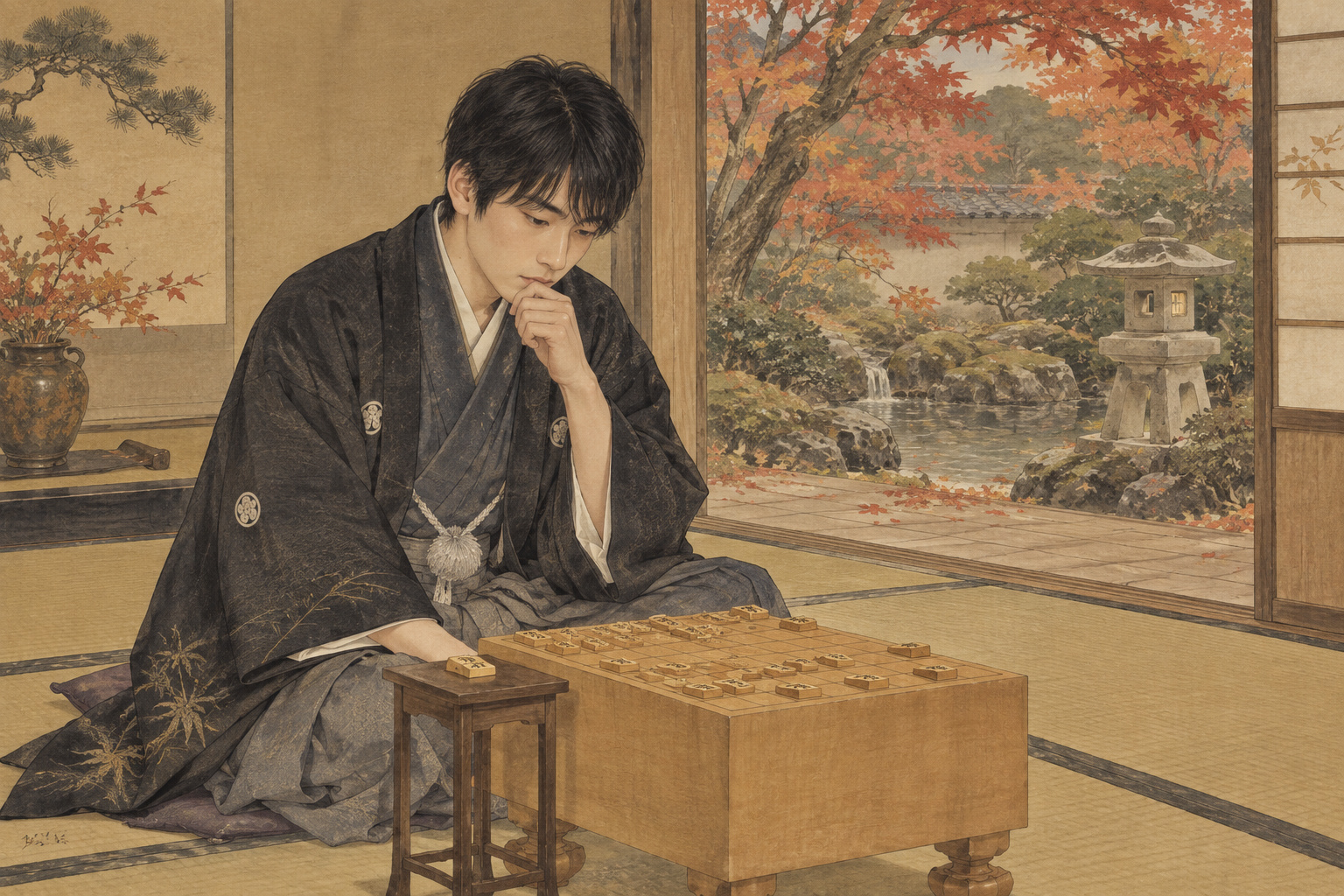
Sota Fujii’s seventh consecutive Oi title was settled at 7:42 p.m. on September 9, after a game lasting 140 individual moves. Both players had used seven hours and 59 minutes of their allotted thinking time. Fujii, playing second, defeated Takumi Ito at Motoyu Jinya in Hadano, Kanagawa Prefecture, to complete a 4–2 defense. The result extended an uninterrupted reign that began in 2020; the struggle behind it showed why continuity at the top is so demanding.[1][2]
This was a contest against an opponent who had already taken two different titles from Fujii. Ito’s challenge was not merely a test of whether a younger rival could make the champion uncomfortable. He had demonstrated that he could finish the job. Fujii’s achievement was to win another long match against someone whose threat had become concrete.[11][12]
A defense decided after the match returned to level
Ito won the opening game in Hamamatsu on July 4–5. Fujii responded with victories in Kobe and Noboribetsu, before Ito won Game 4 in Nagasaki to level the match at 2–2. Fujii then took the final two games played, in Tokushima and Hadano. The scheduled seventh game was unnecessary.[1]
The sequence matters more than the apparent comfort of the final margin. After four games, both men still needed two wins from the remaining three. Fujii’s eventual success should not erase that point of balance. A champion can dominate the record of a competition without controlling every stage of a particular defense.
An ending that neither player found straightforward
In the official post-game interview, Fujii described being constrained and struggling to identify the critical points in the ending. Ito, discussing the complex position arising from both sides’ early silver development, also acknowledged shortcomings in his calculation. Their accounts describe uncertainty persisting deep into the game, rather than a winner executing a plan whose outcome had long been clear.[3]
The contemporary commentary reinforces that picture. An official blog update at 7:09 p.m. described the initiative changing as Ito pressed Fujii. An update seven minutes later highlighted Fujii’s knight jump to 1c as a counterattacking opportunity. These were the live observers’ assessments, not definitive numerical evaluations of the position. They nevertheless show how rapidly the practical questions were changing close to the finish.[13][14]
For a reader new to shogi, the distinction between material and initiative is useful. Possessing a valuable captured piece does not automatically make one’s king safe. A forcing threat may matter more than a nominal advantage in pieces, because it determines whose problem must be solved next. The deciding game offers a reason to resist reducing elite shogi to a single score or a story of inevitable victory.
How Ito became a rival capable of taking titles
The two players were born in 2002: Fujii on July 19 and Ito on October 10. At the time of the deciding game they were 24 and 23. Their professional starts were four years apart, however. Fujii reached fourth dan in October 2016; Ito did so in October 2020. They belong to the same school-year cohort, but arrived at championship contention by different timelines.[5][6]
Their earlier title matches favored Fujii heavily. He defended the 2023 Ryuo title against Ito 4–0. In the 49th Kio match, he won three games without a loss after an opening drawn game, recorded as jishogi. Those results established the scale of the task facing Ito; they did not establish a permanent limit on what he could achieve.[9][10]
Ito then won the ninth Eio title match 3–2, and in 2025 took the Oza crown by the same score. In each case he won the deciding game. By the Oi challenge, his title successes against Fujii were part of the rivalry’s history, not a hypothetical future. September’s defense returned a match victory to Fujii without making those earlier reversals disappear.[11][12]
That is what gives repeated championship meetings their interest. Preparation changes after every encounter. A position that once produced a comfortable result can become the subject of the opponent’s next investigation. The relationship is cumulative, but it is not static: both players carry information from previous games while trying to prevent that information from becoming an advantage for the other.
Seven summers, changing opponents
| Year | Opponent | Fujii’s score |
|---|---|---|
| 2020 | Kazuki Kimura | 4–0 |
| 2021 | Masayuki Toyoshima | 4–1 |
| 2022 | Masayuki Toyoshima | 4–1 |
| 2023 | Daichi Sasaki | 4–1 |
| 2024 | Akira Watanabe | 4–1 |
| 2025 | Takuya Nagase | 4–2 |
| 2026 | Takumi Ito | 4–2 |
Source: JSA. Fujii captured the title in 2020 and defended it each year thereafter.[7][8]
Fujii captured the Oi title by beating Kazuki Kimura in four straight games in 2020. The subsequent defenses have required him to face a changing cast rather than repeatedly overcome one challenger. Winning a title establishes that a player can prevail in a particular campaign. Retaining it year after year requires renewing that achievement while opponents have the champion’s published games to study.[8]
The Oi competition has a long history of extended reigns. Its official records begin in 1960, with Yasuharu Oyama winning the first twelve editions. Yoshiharu Habu later won nine consecutively, from 1993 through 2001. Fujii’s seventh straight crown belongs in that tradition, while remaining short of those longer sequences. It is a substantial historical achievement without being the event’s longest winning streak.[17][18]
Two different kinds of title count also need separating. This victory brought Fujii’s career total to 37 title wins; that does not mean 37 simultaneous championships. Following the defense, his six held titles were Ryuo, Meijin, Oi, Kisei, Kio and Osho. His official profile also recognizes his qualification for the lifetime Oi distinction, normally assumed after retirement. September’s result extends his active reign rather than inaugurating a new lifetime title.[5][16]
Why eight hours do not remove time pressure
The Oi match gives each player eight hours of thinking time for a game played over two days. It is not eight hours each day. The deciding game’s final time records illustrate the problem: even this generous allowance can leave almost no reserve. Time spent investigating an early decision is time unavailable for a later crisis, and the player must decide how much certainty to seek before committing.[1][2]
The format places different demands on preparation and execution. A player has scope to explore complicated alternatives, but an opponent can use the same time to create unfamiliar problems. The task is therefore not simply to remember more opening analysis. It is to recognize when that preparation no longer settles the practical decision and to calculate accurately in the position that has actually appeared.
Fujii’s comments after the defense connect those demands. The official press-conference report says he was conscious of Ito’s deep preparation and sought to remain persistent to the end. It also records his sense that the difficult games had been instructive. The champion’s account makes learning part of the successful defense, rather than something required only of the defeated challenger.[4]
The calendar adds another layer. This match ran from July into September, moving among six host cities. The practical challenge is to prepare for the next game while drawing useful conclusions from the last. Winning can conceal a weakness that an opponent notices; losing can expose a repairable problem. Sustained success depends on judging which lessons matter, not simply carrying confidence or disappointment from one venue to another.
The championship system behind the encounter
The Oi challenger emerges through preliminary competition and a league divided into red and white groups, followed by a contest between the group winners. The titleholder then faces that challenger in a best-of-seven match. The structure makes a defense more than an encounter with an arbitrarily selected opponent: it brings the incumbent together with the player who has survived the qualifying process.[7]
For international readers, this helps explain why one title does not exhaust the season. Separate championships have their own competitive paths, and a player can hold some while challenging for or losing others. Fujii’s Oi continuity and Ito’s successes in Eio and Oza can coexist. Each title measures a particular campaign within the larger contest for supremacy.
The work continued after resignation
According to the official blog, the post-game analysis lasted about an hour. The result was settled, but the two players continued examining what had happened. That review turns a completed contest into material for future decisions: which alternatives were overlooked, where an assessment changed, and which apparent opportunities could actually withstand a reply.[15]
Fujii’s seventh Oi title demonstrates sustained dominance. The manner of the deciding game gives that phrase substance. Dominance need not mean freedom from doubt or uninterrupted control. Against Ito, it meant continuing to find decisions in positions that remained difficult even for the players themselves—and reaching the fourth win before his rival could do so.
Sources and references
- Japan Shogi Association: 67th Oi match results and schedule
- Official Oi blog: Fujii retains the title, September 9, 2026
- Official Oi blog: post-game interviews, September 9
- Official Oi blog: Fujii press conference, posted September 10
- JSA: Sota Fujii, official player profile
- JSA: Takumi Ito, official player profile
- JSA: Oi historical results and competition structure
- JSA: 61st Oi match, 2020
- JSA: 36th Ryuo match, 2023
- JSA: 49th Kio title match
- JSA: 9th Eio title match
- JSA: 73rd Oza match, 2025
- Official Oi blog: the initiative changes, September 9 at 19:09 JST
- Official Oi blog: the knight counter, September 9 at 19:16 JST
- Official Oi blog: post-game analysis, September 9
- JSA: official title-defense announcement, September 10
- JSA: Yoshiharu Habu, title history
- JSA: Yasuharu Oyama, title history
Evidence reviewed September 14, 2026, Japan time. The 67th Oi match concluded September 9. Results, history and attributed observations are based on Japan Shogi Association records and official match coverage. Interpretations are Japan.co.jp analysis unless otherwise attributed.