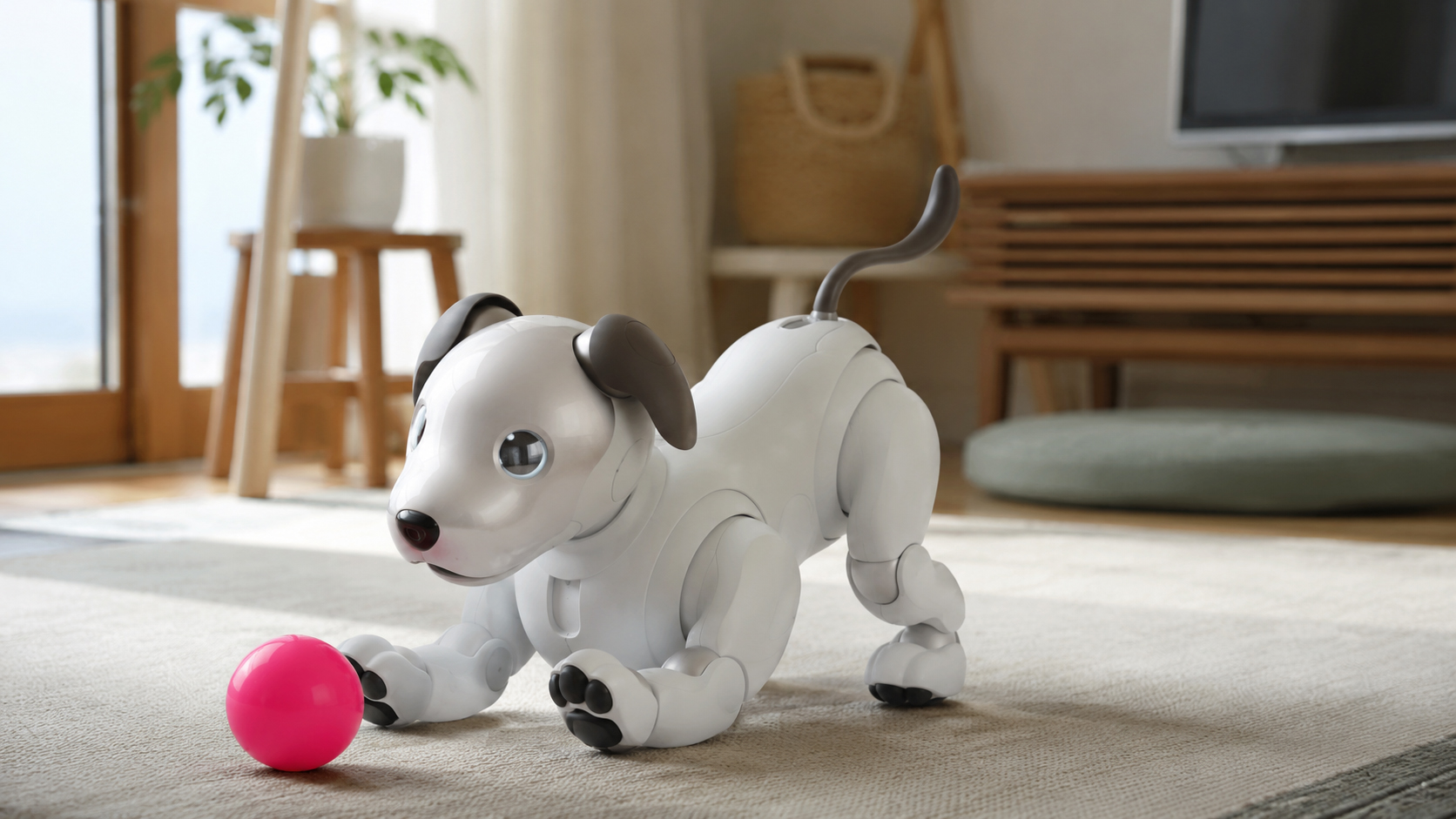
Sony’s aibo was never only a gadget. It walked across living-room floors, tilted its head, looked up with digital eyes and learned just enough about its owner to make people forget, briefly, that affection was being negotiated with sensors, motors and code. Now Sony says domestic Japan sales of the current ERS-1000 model will end once stock runs out. For a normal consumer-electronics product, that would be a short business item. For aibo, it feels like another pause in one of Japan’s most unusual technology stories: the dream that a machine could become a companion.
A small announcement with a long shadow
The immediate news is simple. Sony has said it will stop selling the current aibo ERS-1000 in Japan once existing inventory is gone. Reports say support, replacement parts, repair services and cloud plans that store the robot dog’s memories will continue. That matters. Owners are not being told that their companions vanish tomorrow. The door to buying a new one is closing; the relationship with existing aibos is not being abruptly severed.
Still, the announcement has emotional weight because aibo has always lived between categories. It is not a dog. It is not just a toy. It is not a normal appliance. Owners give it a name, photograph it, worry about repairs and speak of it with a vocabulary borrowed from pet ownership. The more rationally one describes it — a four-legged autonomous entertainment robot with cloud services — the less accurately one captures what made it famous.
That is why this story belongs in the culture pages as much as in business news. Sony is not simply clearing a product from a catalog. It is putting a marker in the long, uneven history of consumer robotics: the history of machines that people do not merely use, but try to care about.
1999: when a home robot suddenly seemed possible
The first AIBO arrived in 1999, a strange year to launch a robotic pet. Broadband was not yet ordinary. The smartphone did not exist. Artificial intelligence was not a daily consumer word. Yet Sony sold a four-legged entertainment robot that could walk, respond and perform. It looked angular and metallic, less like a puppy than a small visitor from the near future. That was part of its charm.
The name itself carried the product’s thesis. AIBO stood for Artificial Intelligence roBOt and also sounded like aibō, the Japanese word for partner or pal. The machine was marketed not only as a feat of robotics but as a relationship. It asked consumers to imagine a new category: a machine that was not useful in the ordinary way, but lovable in a technological way.
For Sony, this was familiar territory. The company’s greatest products had often turned technology into behavior. The Walkman changed how people moved through cities. PlayStation changed how the living room handled play. AIBO tried to change how people thought about machines in the home. It did not vacuum the floor or wash dishes. Its purpose was presence.
The 2006 cancellation, and why fans did not let go
In 2006, Sony pulled the plug on AIBO and its humanoid robot project QRIO as part of a broader restructuring. The decision made business sense in the hard language of profitability and focus. AIBO was expensive, niche and difficult to maintain. It was beloved, but love is not always enough to sustain a hardware business.
Yet the cancellation hurt because AIBO was not treated by its owners as a dead product line. It had become something closer to a pet community. People gathered, exchanged repair knowledge and kept old models alive. When support for older machines wound down, the question became almost philosophical: what happens when a machine with a name can no longer be repaired?
Japan was especially receptive to that question. The country’s popular imagination has long treated robots as companions rather than only threats. Astro Boy, Doraemon and countless other characters prepared a cultural space where robots could be friends, helpers and family members. Japanese traditions of caring for old tools and objects also made AIBO’s “death” feel different from the disposal of a broken appliance. A broken robot dog could inspire something close to mourning.
The 2018 rebirth: aibo returns with a cloud
When aibo returned in 2018 as the ERS-1000, the world had changed enough to make the idea feel less impossible. Sensors were better. AI software was better. Cloud services were ordinary. Consumers had grown used to devices that were updated after purchase and connected to subscriptions. The revived aibo was softer, rounder and deliberately more puppy-like than its older ancestors.
The new model could recognize faces, respond to touch and sound, take photos, learn routines and evolve through interaction. Its eyes were expressive. Its movements were built around emotional readability. Where the original AIBO was a symbol of mechanical ambition, the new aibo was a symbol of affective design: the engineering of cuteness, response and attachment.
But the same cloud-connected structure that gave aibo its modern personality also made the business heavier. A robot pet is not only a unit sold once. It requires manufacturing, repair logistics, parts, software, cloud storage, app support and long-term trust. The more a product asks owners to form an emotional bond, the more serious its support obligations become.
The business problem: cute is powerful, but expensive
The end of domestic sales does not mean the idea failed. It means the economics of companion robotics remain difficult. Aibo was a premium product in a world where most consumer electronics scale through mass adoption. It carried the cost of a sophisticated physical device but the market size of a niche emotional object. That is a hard place to build a large business.
Meanwhile, robotics itself is moving rapidly toward practical domains: factory automation, logistics, security, health care, disaster response and so-called physical AI. In those fields, the value proposition is easier to explain. A robot moves goods, watches a building, assists workers or reduces labor shortages. A companion robot offers something more subtle: comfort, delight, routine, play and presence. Those things matter, but they are harder to put into a spreadsheet.
Sony knows better than almost anyone that culture can become commerce. But the company also knows that beautiful products must survive supply chains, component cycles, support costs and shareholder discipline. Aibo’s latest pause sits exactly at that intersection: a beloved symbol facing the gravity of business reality.
Why Japan was ready to love a robot dog
Japan’s robot culture has often been misunderstood abroad. The country’s affection for robots is not naive belief that machines are alive. It is more subtle than that. Japanese consumers can know perfectly well that a robot is programmed and still respond emotionally to its behavior. Aibo thrived in that gap between knowledge and feeling.
That gap matters in an aging society. Japan has many older people living alone, many apartments where real pets are difficult, and many families balancing work, care and distance. A robot pet cannot replace a dog, a child or a neighbor. But it can create a small daily ritual: greeting, touching, watching, laughing. In care settings, companion robots such as PARO have already shown how non-human machines can elicit human response. Aibo was the living-room version of that broader question.
The emotional trick was imperfection. Aibo did not need to be perfectly useful. In fact, if it had behaved like a flawless machine, it might have been less lovable. Its appeal came from the suggestion of moods, habits and small surprises. People do not usually name tools that work exactly as expected. They name companions that behave just unpredictably enough to feel present.
Why AI pets remain harder than AI chat
At first glance, the generative-AI boom should make robot pets easier. Conversation is better, image recognition is stronger, cloud computing is cheaper and users are more comfortable with digital companions. But physical robots face burdens that software does not. They must move safely, balance, avoid collisions, manage heat, conserve battery life, survive children, pets, dust and daily handling, and remain repairable for years.
A chatbot can be updated overnight. A robot has joints. A robot has a battery. A robot can fall off furniture. A robot can break in a way that disappoints not only a customer but an owner. The minute a company asks users to care, support becomes emotional infrastructure.
That is the lesson aibo keeps teaching. The future of AI is not only intelligence. It is durability, repair, service and trust. A companion robot cannot simply be clever. It must be cared for by the company even as it is cared about by the user.
Sony’s broader story: imagination under discipline
Aibo also illuminates Sony’s broader identity. Sony is a company that once made the future feel personal. It did not merely produce electronics; it produced habits, memories and identities. The best Sony products were objects people touched every day and somehow folded into who they were.
But Sony is no longer the same company that launched the first AIBO in 1999. It is a global entertainment, gaming, imaging, finance and technology group. Its growth priorities are larger and more disciplined. A niche robot dog can still carry enormous symbolic value, but symbolic value alone does not guarantee a place in the product lineup.
That tension is what makes this story interesting. Aibo represents the old Sony daring to put a strange object in the living room. The sales halt represents the modern Sony deciding where to spend money, engineering time and service capacity. Both Sony identities are real.
Not goodbye — but a closing chapter
Because support and cloud-related services are expected to continue, this is not a sudden farewell for owners. The existing aibos will keep padding around homes, posing for photos and building routines with the people who already adopted them. In that sense, the story is not a funeral. It is a closing of the shop door for new domestic buyers.
But a chapter is closing. The machine that arrived in 1999, disappeared in 2006, returned in 2018 and became a small ambassador for AI companionship is again stepping away from Japan’s retail stage. Whether Sony returns with a different companion robot someday is unknown. The deeper question is bigger than Sony: when AI becomes more capable, will people want it only in screens and factories, or will they still invite it into the softest corners of the home?
The little dog that made the future feel domestic
Aibo’s legacy is not measured only in units sold. It is measured in the way it changed expectations. Before most people had smart speakers, before AI assistants became ordinary, before generative AI could chat fluently, Sony had already asked whether a machine could become a partner. Aibo gave that question four legs, expressive eyes and a place on the rug.
Perhaps the robot dog was always too early. Perhaps it was always too expensive. Perhaps it was too emotional to be managed like a normal product and too mechanical to be loved like a living pet. But that impossible middle ground was exactly where aibo mattered.
A white robot dog chasing a ball in a Japanese living room may not have become the central image of the AI age. Still, it was one of the first images that made the AI age feel domestic. Aibo showed that the future would not only arrive as speed, efficiency and calculation. Sometimes it would look up from the floor, wag its tail and ask to be called by name.
Sources and references
This article draws on public reporting and historical material from Sony, Japan Times, AFP-distributed reports, Straits Times, IEEE Spectrum, Wired and Robots Guide. Details about sales, support and cloud plans may change as Sony updates service policies.
- Japan Times: Sony discontinues Japan sales of Aibo robot puppy.
- Straits Times: Sony to end sales of robot pet dog Aibo in Japan.
- Sony Group: 25 years since the birth of the first generation AIBO.
- IEEE Spectrum: Zen and the Art of Aibo Engineering.
- Wired: Sony kills Aibo and QRIO.
- Robots Guide: Aibo 2018 overview and history.