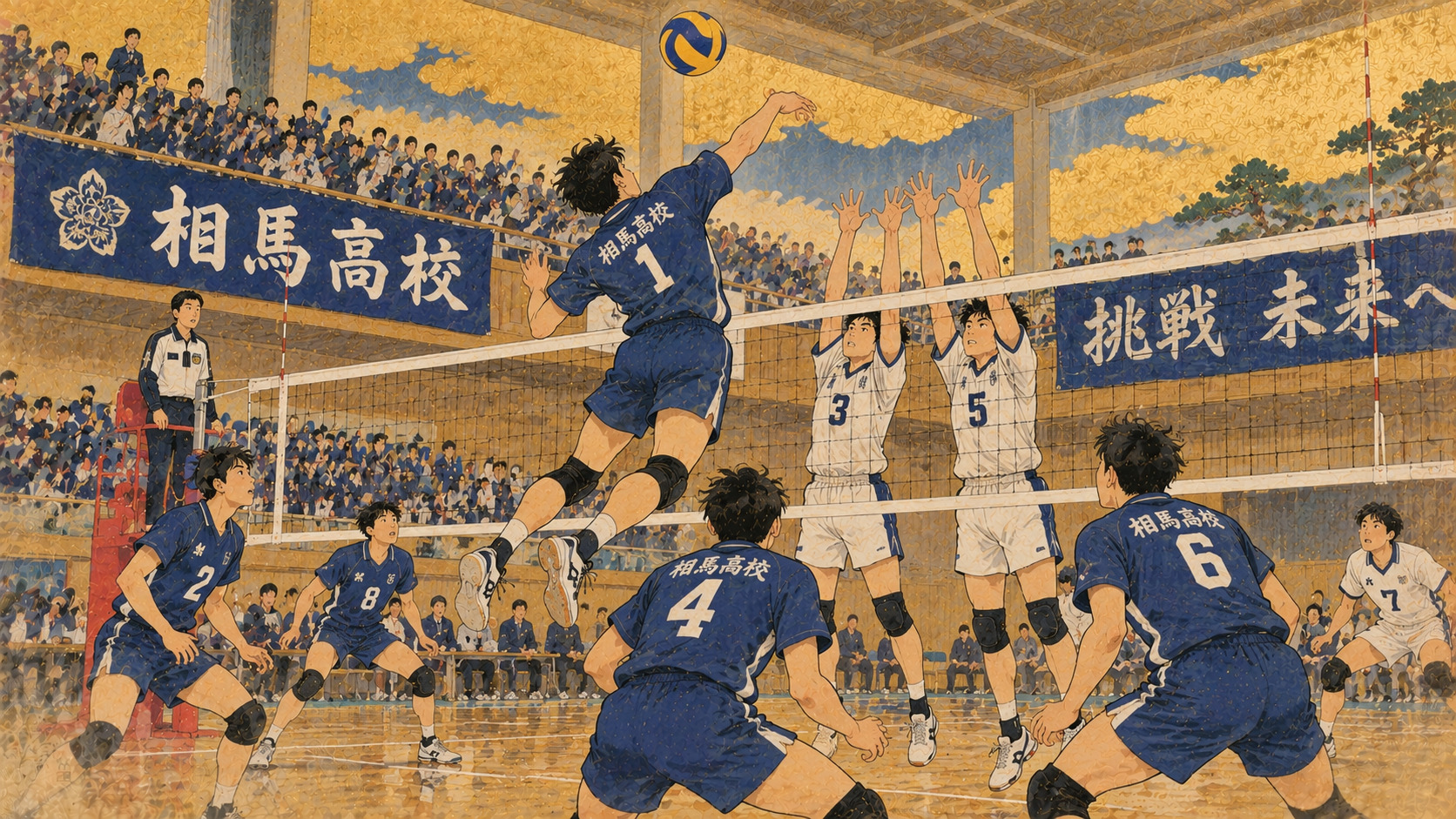
The fourth set that changed everything
For a high-school volleyball team, four years can mean an entire generation of players. That was the weight behind the finish at Fukushima Toyota Crown Arena on October 28, when Soma High School edged Koriyama Kita Technical High School 28–26 in a tense fourth set. Soma won the Fukushima boys’ representative final three sets to one and qualified for the national Spring High Volleyball championship for the first time in four years—and the 23rd time in the school’s history.
A final with no easy passage
Soma took the opening set 25–22; Koriyama Kita answered 25–23. Soma moved ahead again by winning the third 25–22, only to face a fourth set that went beyond the usual 25-point target. Local broadcaster Fukushima TV described third-year Soma middle blocker Tomohiro Abe, whose Japanese name is written 阿部智優, contributing through both central attacks and back-row offense. Koriyama Kita’s third-year ace Shiga helped sustain the challenge. The set scores—25–22, 23–25, 25–22, 28–26—show why a bare “3–1” result understates the contest.
The value of defeating the incumbent
Koriyama Kita had been seeking a fourth consecutive national berth. Soma was not merely winning an isolated game; it was displacing the team that had controlled Fukushima’s recent boys’ qualifying cycle. A high-school roster changes quickly. Players who had endured the previous defeats were no longer necessarily the players on court, yet the accumulated frustration formed part of the program’s story. In post-match remarks reported by Fukushima TV, Abe spoke about winning on behalf of predecessors who had repeatedly fallen short, and set his sights on reaching at least the last 16 nationally.
What the score tells us—and what it cannot
Four tight sets are evidence of an extraordinarily competitive final, not a substitute for a full tactical breakdown. There were 96 points available to Soma in its winning sets, but the published result alone does not establish individual kill totals, reception percentages or the frequency of successful blocks. Those questions require verified match statistics or a complete video review. The available account nonetheless identifies an important tactical feature: a middle blocker who contributed from behind the attack line, making his role less predictable than a traditional front-row assignment.
A two-day route to Tokyo
Eight boys’ teams and eight girls’ teams contested the Fukushima representative tournament on October 27 and 28. Soma advanced past Aizu Xaverio Gakuen and Taira Technical High School before facing Koriyama Kita in the final. The compressed knockout schedule demands rapid adjustment from one opponent to the next. The competition’s official Japanese name is the Fukushima representative qualifying round of the 79th All Japan High School Volleyball Championship, commonly called Haruko Volley, or Spring High Volleyball.
A school older than modern volleyball in Japan
Soma Prefectural High School traces its establishment to 1898, when it opened as Fukushima’s Fourth Ordinary Middle School. It adopted its present postwar name in 1948 and later became coeducational. The school’s educational ideal, 至誠 (shisei), conveys sincerity and wholehearted effort. This history matters because the athletic program sits within an institution that has educated generations of Soma residents. Its 23 national qualifications are not an overnight phenomenon, nor does one victory by itself define the school.
An achievement in a community shaped by disaster
Soma is part of Fukushima’s coastal Hamadori region, which experienced the devastating 2011 earthquake and tsunami. The high school has acknowledged interruptions to normal education and support received from its community after the disaster. The current athletes should not be assigned personal memories or experiences that have not been established. Nor should a volleyball win be offered as a simplistic measure of recovery. It does, however, show a longstanding educational institution sustaining opportunities for a new generation to pursue national ambitions.
What comes next
The Japan Volleyball Association schedules the national championship at Tokyo Metropolitan Gymnasium for January 4–7 and January 9–10, 2027. The draw is expected on November 29, 2026. As of this report’s November 1 edition date, neither Soma’s opening opponent nor its path through the bracket has been determined. Abe’s stated last-16 ambition is a goal rather than a result. Reaching it will require the same composure Soma demonstrated when its opponent kept the decisive set alive.
The overlooked importance of local sport
Major national tournaments are often covered through television highlights and rankings. What those summaries omit is how regional schools maintain a competitive culture across annual graduations, different coaches and changing enrollment patterns. Soma’s win offers an opportunity to ask about training, student support and the school’s long volleyball history. Those questions deserve further reporting rather than invented interviews, unverified team budgets or imagined scenes from the locker room.
One match ends; another story begins
The outcome is clear: Soma returned to the national stage after a four-year absence, beating the team that had stood between it and qualification. The future is not. There will be a new draw, unfamiliar opponents and pressure that no Fukushima final can perfectly recreate. For now, the defining image is the fourth-set finish: two teams refusing to yield until Soma found the final point—and with it, a journey back to Tokyo.
Sources and reporting notes
Cross-checked tournament organizers, the prefectural association, school materials and local reports. No firsthand interviews or independent on-site reporting.
- 福島県バレーボール協会/Fukushima Volleyball Association
- 福島テレビ・10月28日決勝報道/Fukushima TV final report
- 大会ハイライト/Official match highlight distributor
- 相馬高校・学校沿革/Soma High School history
- 日本バレーボール協会・第79回大会/JVA tournament
- 春高バレー・大会概要/Official tournament outline
- 福島テレビ・代表決定戦開幕/Fukushima TV preview
- 相馬高校・学校運営ビジョン/School educational policy