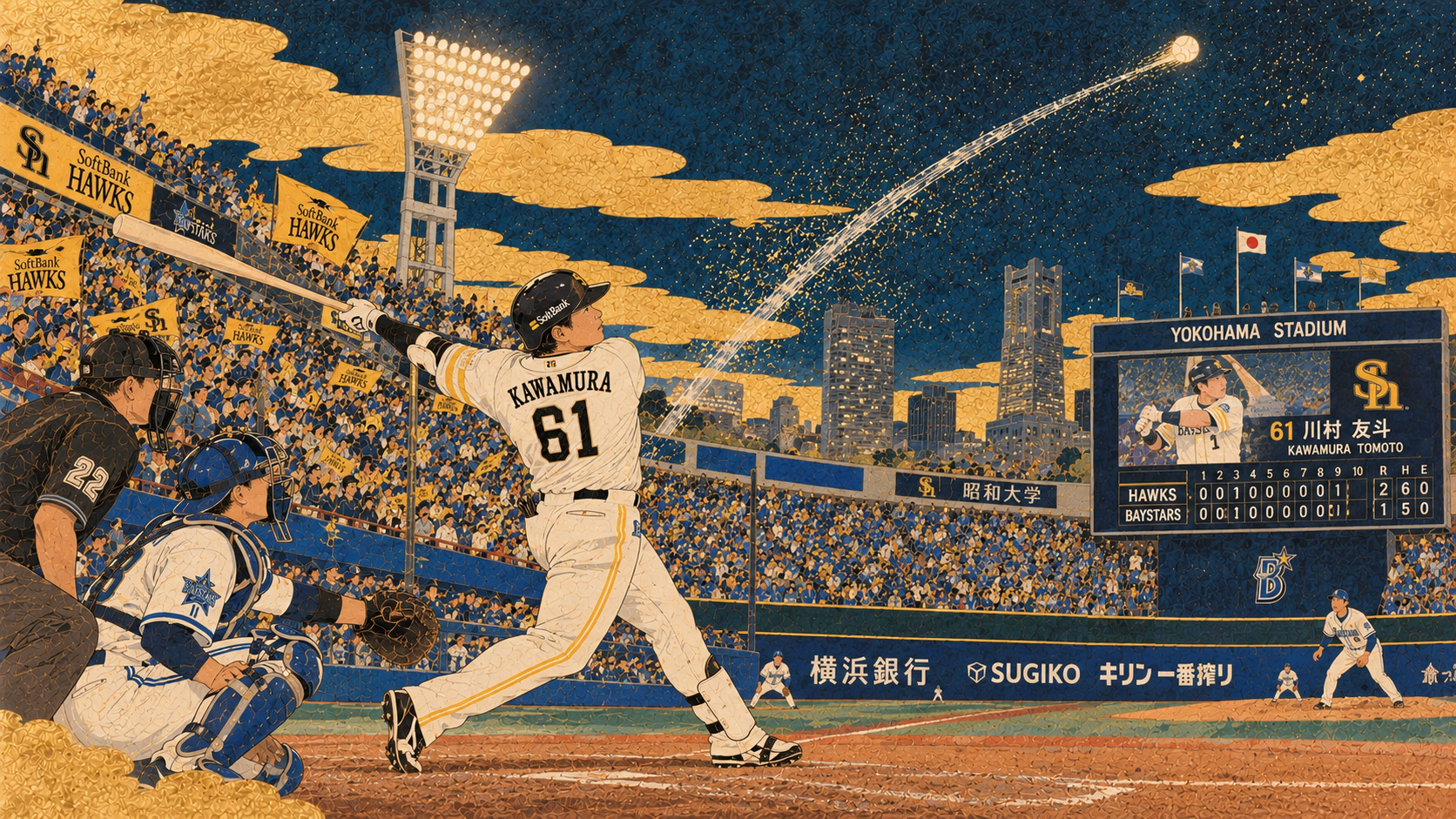
It was the swing nobody expected. It was not the end of the Series: two years earlier, the Hawks opened 2–0 against these same opponents and lost four straight.
One swing the box score could not predict
In the top of the tenth inning on October 25, with the Japan Series tied at three, SoftBank outfielder Yuto Kawamura faced DeNA reliever Hiromu Ise at Yokohama Stadium. Kawamura was not the obvious candidate to decide a championship game. He had played in 103 regular-season games in 2026, batted .095 and hit no home runs. Yet in his first Japan Series plate appearance he connected on a changeup, sending the ball over center field for a 4–3 lead. The Hawks held on, departing Yokohama with two extra-inning victories and a 2–0 series advantage.
Two games beyond regulation
The 2026 championship has opened with unusual tension: both Games 1 and 2 required extra innings, something that had happened at the start of a Japan Series only once before, in 2011. On October 24, SoftBank and Yokohama DeNA were scoreless through six innings. A run on a Yudai Shoji groundout gave SoftBank the lead in the seventh, but Shugo Maki homered to tie it in the eighth. Shoji drove in the winning run with a double in the eleventh and Tatsuru Yanagimachi added a sacrifice fly. SoftBank won 3–1; the following evening would offer even more violent swings in momentum.
The script was rewritten in the eighth
Game 2 began with SoftBank applying controlled pressure. Tomoya Masaki homered in the third; Shoji delivered an RBI double in the fourth. Starting pitcher Liván Moinelo worked seven scoreless innings with eight strikeouts. But the 2–0 lead vanished in the bottom of the eighth when DeNA veteran Yoshitomo Tsutsugo hit a three-run homer. SoftBank, seven outs from a second victory when the inning began, was suddenly behind 3–2. For the home crowd, it was a comeback worthy of the Series. It was not the final reversal.
A power hitter rescues the visitors
One out into the ninth, slugger Hotaka Yamakawa emerged as a pinch hitter. He drove a solo home run to left, tying the game 3–3. The sequence mattered because Yamakawa’s reputation rests on the capacity to alter a game with one swing. Manager Hiroki Kokubo later praised his response to the moment. But with the score tied again, SoftBank’s next decisive figure would be an outfielder best known for speed and defense, someone who had entered in the eighth inning as a pinch runner.
Kawamura and the changeup
Kawamura came up with one out and nobody aboard in the tenth against Ise. The DeNA club’s play-by-play records the count at no balls and one strike before the center-field home run. The ball reached the batter’s eye behind the fence. Kawamura had not gone deep in 45 regular-season plate appearances in 2026, and his only previous top-flight regular-season homer came against Rakuten in September 2024. The contrast made the swing startling, but it did not make it accidental. A player still has to recognize and drive an off-speed pitch under championship pressure.
A road that began in development baseball
SoftBank’s official player biography lists Kawamura’s name as 川村友斗, pronounced Kawamura Yuto. Born in Hokkaido on August 13, 1999, the left-handed hitter attended Hokkai High School and Sendai University before being selected in the second round of the 2021 developmental draft. He joined the organization in 2022 and wears No. 61. In Japan, the developmental draft creates a separate route into the professional system; a player can spend years proving he belongs on the top-flight roster. Kawamura’s Series appearance was not the sudden arrival of an unknown talent but the visible result of a longer path.
Why a zero matters
There is a precise way to describe Kawamura’s feat: he hit no home runs during the 2026 NPB regular season, and then homered in his first Japan Series at-bat. Postseason statistics are separate, so it would be misleading to call the blast an additional regular-season homer. Sports writers naturally gravitate toward players with impressive offensive totals. Yet the full value of a baseball roster also includes baserunning, defense, substitutions and the flexibility to deploy specialists. Kawamura’s unlikely power provided a memorable demonstration without erasing the skills for which he normally plays.
The unusual place in Series history
Japanese record-keeping lends the moment an extra distinction. Sports Hochi reported that seventeen players, including Kawamura, have homered in their first Japan Series plate appearance. His was the first such homer hit in extra innings. It was also reportedly the first decisive first-at-bat homer since Orestes Destrade’s three-run shot for Seibu in the opening game of the 1990 Series. Those qualifications are important: he did not hit the first debut-plate-appearance home run in the competition’s history. He produced a specific, and substantially rarer, variation of the feat.
DeNA’s version of the story
Two defeats conceal genuine opportunities for the BayStars. Maki’s home run forced extra innings in Game 1. Tsutsugo’s three-run drive gave DeNA the lead late in Game 2, and the home team was within three outs of evening the Series. The pitching staff was then unable to protect that lead, as Yamakawa went deep in the ninth and Kawamura punished Ise in the tenth. A complete account cannot frame this as two effortless SoftBank wins. It was a pair of close contests in which DeNA made significant in-game recoveries but failed to finish.
The warning from 2024
The same clubs met in the 2024 Japan Series. SoftBank won the opening two games on the road in Yokohama, apparently positioning itself for another title. DeNA won the next four games and took the championship. That is history, not a forecast for 2026. It does provide a useful warning against mistaking a two-game lead for a final result. Pitching matchups, bullpen demands and bench decisions can change sharply over a best-of-seven series, even after one team has escaped twice on hostile ground.
Decisions from the dugout
The first two games also show why baseball managers carry so much scrutiny in October. In Game 1, Kokubo allowed starter Naoyuki Uwasawa to bat in a potential scoring situation rather than using a pinch hitter, betting on the value of his pitching. In Game 2, the pinch-hitting choice of Yamakawa delivered a tying homer, and Kawamura—introduced as a pinch runner—eventually became the winner. One should not confuse a successful result with a guaranteed tactical principle. Kokubo provided the opportunities, while players had to complete the work.
What comes next in Fukuoka
The Japan Series is a championship contested by the representatives of Japan’s Central and Pacific Leagues, with the first team to four victories crowned champion. Monday, October 26, is a travel day in the official 2026 schedule. Game 3 is due to begin Tuesday, October 27, at 6 p.m. Japan time at Mizuho PayPay Dome Fukuoka. This article is written as a preview-day analysis of the first two games; it does not presume or report the result of Game 3. That distinction matters for a website read across time zones.
The star no one penciled in
The central characters of these two nights illustrate baseball’s resistance to tidy storytelling. Shoji delivered the Game 1 decisive hit. Yamakawa saved Game 2 with established power. Kawamura, a defender and runner with no homers in the regular season, ended it with a home run that very few saw coming. SoftBank has two wins, not a trophy, and DeNA has shown the capacity to fight back. Yet whatever happens in Fukuoka, Kawamura has already written one of the most improbable lines of this Japan Series: first plate appearance, extra innings, championship-stage home run.
Sources and verification
Based on NPB scheduling, team game accounts and player records, Pacific League reporting and Japanese sports coverage. Scores are through October 25; Game 3 on October 27 has not been played at publication time. No original interviews were conducted.
- NPB: 2026 Japan Series schedule and rules
- Pacific League Insight: Game 1 report
- Pacific League Insight: Game 2 report
- SoftBank Hawks: Kawamura’s official player biography
- DeNA BayStars: official game play-by-play
- SoftBank Hawks: club game account
- Sports Hochi: Kokubo’s postgame remarks
- Sports Hochi: Series record-book analysis
- Nikkan Sports: Kawamura’s home run and season figures
- TBS: the game from DeNA’s perspective