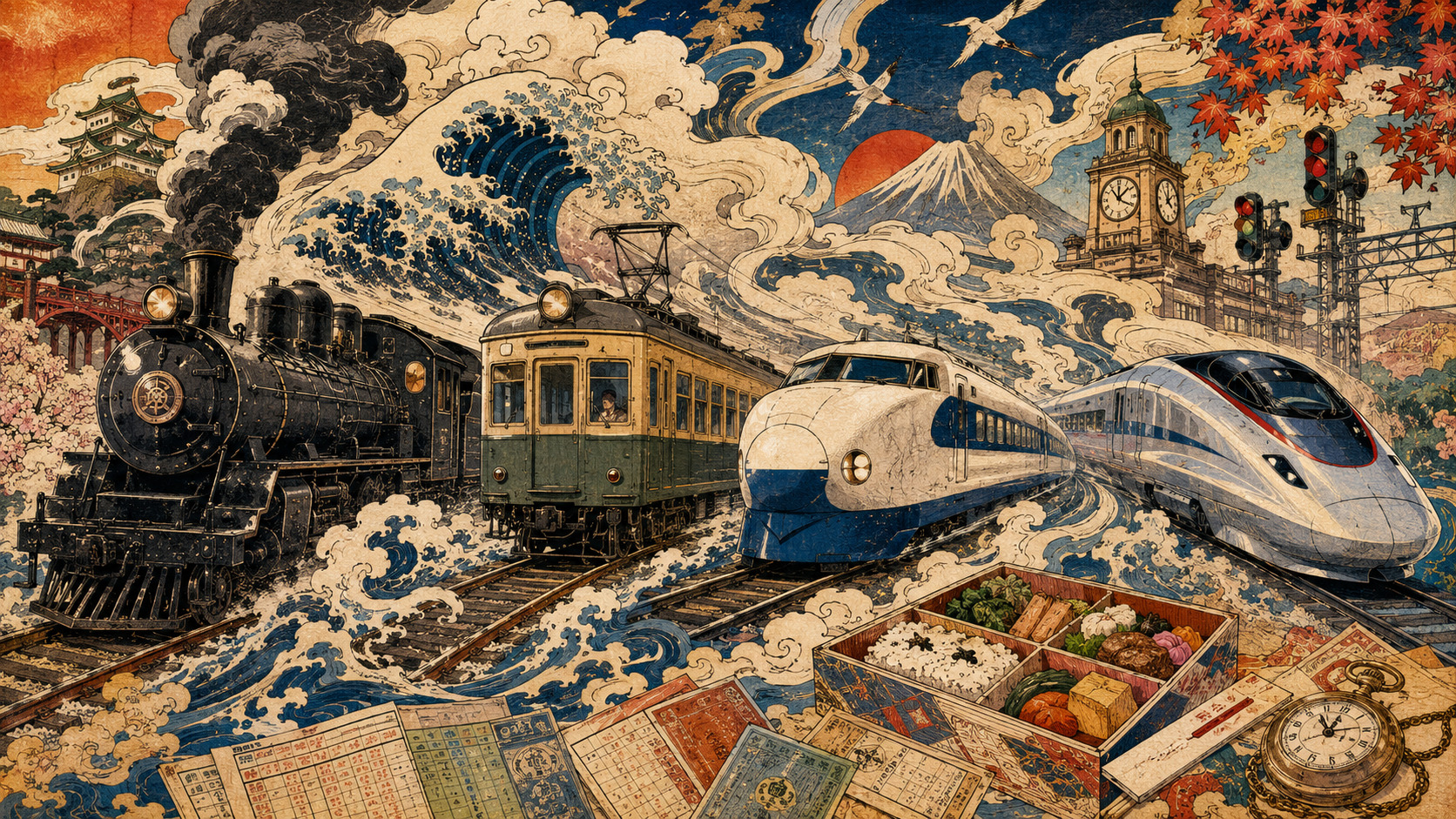
A railway map usually tells you where you can go. The most arresting map at Nihombashi Mitsukoshi tells you where Japan once could. Stretching more than ten metres, it carries the present network and the lines that disappeared from it: branches into mining country, narrow-gauge tracks across agricultural districts, streetcars overtaken by the motor city, and routes erased by war or disaster. Stand far enough back and the Japanese archipelago looks densely stitched. Move closer and absence becomes the subject.
That tension—between the railway as a machine of national connection and the railway as a collection of local losses—drives Reviving Japan’s Railways, the special exhibition that opened on July 22 at Nihombashi Mitsukoshi. It marks “Showa 100” with NHK archive film, photographs by the 90-year-old master Naotaka Hirota, a century of the JTB timetable, N-scale models, ekiben records and material on Mitsukoshimae Station. The main exhibition runs through August 3.
This is not simply a parade of famous locomotives. Its objects record changes in the scale of Japanese life. A timetable describes the size of a person’s reachable world. An ekiben turns a region into something that can be carried onto a train. A model makes a vanished consist move again. A photograph preserves not only rolling stock but platforms, clothes, gestures and industries. An abandoned-line map shows how national policy is finally experienced as local geography.
Why “Showa 100” falls in 2026
Showa began late in 1926 and ended in January 1989. The Cabinet Secretariat defines 2026 as the year in which one hundred full years have elapsed from Showa 1. That is why an exhibition held in Reiwa 8 can carry the label “Showa 100,” even though the era itself lasted 64 numbered years and ended more than a generation ago.
The anniversary is more than arithmetic. Showa contained militarization, total war and defeat; occupation and reconstruction; rapid economic growth, mass consumption and severe pollution; the oil shocks, mature affluence and the bubble’s ascent. Railways were implicated in every phase. They moved soldiers and munitions as well as evacuees and food. They bore the overload of postwar survival, then the pressure of metropolitan commuting. They delivered tourists to newly marketed destinations and commuters to expanding suburbs. They also lost traffic to cars and aircraft, accumulated debt and withdrew from places where population and industry were declining.
The exhibition’s seven-part journey
The curators divide the archipelago into Hokkaido, Tohoku, Kanto-Koshinetsu, Tokai-Hokuriku, Kinki, Chugoku-Shikoku and Kyushu-Okinawa. NHK footage brings back lines and systems that no longer operate. The selection is deliberately plural: industrial railways, light railways, state lines, city trams and a monorail appear in one national frame.
| Region | Railways represented in archive film |
|---|---|
| Hokkaido | Yubari Railway; JNR Konpoku Line; JNR Hiroo Line |
| Tohoku | Hanamaki Electric Railway; Shonai Kotsu Yunohama Line |
| Kanto-Koshinetsu | Tokyo streetcars; JNR Shinetsu Main Line; Kusakaru Electric Railway |
| Tokai-Hokuriku | Shizuoka Railway Sun’en Line; Meitetsu Gifu city lines |
| Kinki | Kojaku Railway; Hokutan Railway; Kyoto city trams; Himeji municipal monorail |
| Chugoku-Shikoku | JNR Ujina Line; Iyo Railway Morimatsu Line |
| Kyushu-Okinawa | Takachiho Railway; Okinawa Prefectural Railways |
These are not interchangeable stories of “decline.” Yubari’s railway belonged to a coal economy. Kyoto’s tram system faced a city reorganized around road traffic. Okinawa’s light railway carried civilians and goods, was drawn into military logistics, and was destroyed in the Battle of Okinawa; it never returned after 1945. The Takachiho Railway survived privatization but not the physical and financial damage set in motion by Typhoon No. 14 in 2005. A map may render each as a thin discontinued line. History restores the difference.
Before Showa: the network and the book
Japan’s first railway opened between Shimbashi and Yokohama on October 14, 1872. By the time Showa began, rail had already reorganized distance, standardized time and created the station as a new kind of public place. Tokyo Station had opened in 1914; the national network was extensive; private urban and interurban railways were building another geography around the cities.
The exhibition’s 1925 first issue of Kisha Jikan-hyo, or Train Timetable, is therefore a perfect threshold object. Published by the Japan Travel Culture Association, a predecessor of JTB, and compiled by the Railway Ministry’s Transportation Bureau, it arrived one year before Showa. It used Arabic numerals and symbols for stations with porters, telegraph service, washrooms and boxed meals. The Yamanote Line had not yet become a complete loop. The book did not merely list departures; it encoded the infrastructure a traveler could expect.
Today a phone answers a narrow question—what is the fastest route from here to there? A paper timetable made the whole system visible at once. Its reader could discover an overnight connection, a ferry, a remote branch or an unintended stopover. The exhibition’s centenary display asks visitors to see the timetable as a national operating system printed on paper.
Early Showa: speed, the underground—and war
The new era opened with technological confidence. On December 30, 1927, Tokyo’s first subway began service over 2.2 kilometres between Asakusa and Ueno. In 1930, the super express Tsubame linked Tokyo and Kobe in nine hours. Mitsukoshimae Station opened in 1932 as the Ginza Line extended, becoming Japan’s first station to carry a corporate name. That is why the exhibition’s location is part of its subject: the department store and the railway helped produce the modern consumer city together.
But steel rails have no politics of their own. Under mobilization they served the wartime state. Passenger comfort and leisure contracted; freight, troops and military priority remade the schedule. In 1942 the timetable adopted the 24-hour clock. By 1944 limited expresses had vanished and express services were sharply reduced. Paper rationing and the destruction of printing facilities reduced the July 1945 national timetable to a single folded sheet.
That sheet is one of the clearest measures of collapse. The network still existed in ink, yet the abundant world imagined by earlier schedules had narrowed to the minimum that war allowed. JTB’s September 1945 postwar issue, published despite acute paper shortages, is the inverse object: a fragile declaration that civilian movement and ordinary time were returning.
Railway as postwar lifeline
After defeat, trains were overcrowded, damaged and indispensable. They carried demobilized soldiers, repatriates, food seekers and workers through cities whose stations often opened onto ruins and black markets. In 1949 the government railway was reorganized as the public corporation Japanese National Railways—JNR. The same year a dining car returned to limited-express service and the Heiwa, or Peace, began running between Tokyo and Osaka.
Reconstruction soon became acceleration. Full electrification of the Tokaido Main Line was completed in 1956; the sleeping limited express Asakaze connected Tokyo and Hakata. The electric limited express Kodama followed in 1958, covering Tokyo to Osaka or Kobe in roughly six hours and fifty minutes. Beginning in the 1960s, JNR pushed electrification and dieselization and shifted passenger service toward electric and diesel multiple units—power distributed through the train rather than concentrated in one locomotive. That suited Japan’s grades, curves, close station spacing and need for rapid acceleration.
Growth exacted a price. The Mikawashima collision in 1962 and the Tsurumi collision in 1963 exposed the cost of running an intensely used railway near its limits. The first accelerated deployment of automatic train stop systems; the new Shinkansen would use automatic train control. Showa’s celebrated speed was built alongside a less glamorous revolution in signalling, maintenance and disciplined operations.
1964: a new clock for the nation
On October 1, 1964—nine days before the Tokyo Olympics opened—the Tokaido Shinkansen began service between Tokyo and Shin-Osaka. At first, Hikari made the run in four hours and operated 14 round trips a day. The rounded blue-and-white 0 Series became a visual shorthand for a country that wanted to be seen as reconstructed, peaceful, precise and technically modern.
The achievement was not only a fast train. It separated high-speed intercity traffic from the conventional narrow-gauge corridor, applied automatic train control, and turned Tokyo-Nagoya-Osaka into a tighter economic space. In JR Central’s modern account, the opening reduced the fastest Tokyo-Osaka journey from the conventional railway’s six and a half hours to four; later improvements cut it further. The railway changed what could count as a day trip, a business territory or a national market.
Models in the Mitsukoshi exhibition make that transformation graspable at tabletop scale. Their precision matters. A model fixes the livery, formation and proportion of a train that memory otherwise simplifies. Blue trains, expresses and workaday rolling stock can occupy the same field, correcting the tendency to remember an era through one heroic nose cone.
The timetable invents mass travel
By the late 1960s and 1970s, railway travel was no longer only a necessity. It became a democratic consumer practice: family visit, school excursion, honeymoon, company trip, solitary escape. For Expo ’70 in Osaka, extra trains converged on Kansai and the timetable supplied budgets, model itineraries and estimates for touring the pavilions. JNR’s Discover Japan campaign, launched the same year, invited urban travelers—especially young women—to find regional landscapes and selves through rail.
The thick timetable was the technology that made such wandering possible. So was the ekiben. A station box meal condensed place into wrapping paper, ceramic, wood, rice and preserved local food. It was practical because long-distance trains lacked today’s speed and onboard choices; it was cultural because each station could offer a distinct edible identity. The exhibition wisely treats meal labels and containers as railway documents. They record agriculture, fisheries, packaging, graphic design, tourism and the changing time available at a platform stop.
Nostalgia can make this world appear frictionless. It was not. Metropolitan commuters endured crushing crowding; stations and tracks divided neighborhoods; rail construction displaced people; railway labor was dangerous; access and comfort reflected class, gender and physical ability. A rich history holds both the romance of the dining-car window and the pressure of the rush-hour carriage.
The camera as a second timetable
Naotaka Hirota’s photographs are the exhibition’s emotional archive. Born in Tokyo in 1935, he made his first railway photograph in junior high school, became a freelance photographer in 1960 and held his landmark exhibition Steam Locomotives in 1968. He helped establish railway photography as an expressive field, not merely a method of identifying rolling stock.
The works selected at Mitsukoshi range across lines and landscapes: the Soya Main Line in 1973, the Takamatsu-Kotohira Electric Railway in 1975, the Kajiya Line and Misumi Line in 1983, among others. Hirota’s importance lies in the territory around the train—the geometry of track and sky, the posture of people on a platform, weather, industry, a line’s relationship to a settlement. A roster says what ran. A photograph suggests what it felt like for that train to belong there.
At 90, Hirota spans most of the period being commemorated. His archive reveals a paradox: a photograph can make a railway look timeless precisely because the shutter has stopped time. The abandoned-line map supplies the missing afterword.
The JNR break: one railway becomes seven
The Shinkansen’s opening year was also the first in which JNR recorded a net loss. Motorization and domestic aviation eroded rail’s share in some markets, while JNR carried enormous capital, pension and network obligations. Four reconstruction plans failed to reverse the deterioration. The political answer was the 1987 breakup and privatization of JNR into six regional passenger companies and one nationwide freight company.
The reform is often told either as rescue or rupture. It was both. The new JR companies sharpened service and commercial management, diversified station businesses and created strong regional brands. But the geography they inherited was unequal. Dense metropolitan corridors and the Tokaido axis could generate returns that sparsely populated local lines could not. The abandoned lines on the exhibition wall are therefore not debris outside the success story; they are evidence of the choices and demographic conditions inside it.
Showa’s final full year supplied an extraordinary coda. In 1988 the Seikan Tunnel rail link opened and the train ferry across the Tsugaru Strait ended; the Seto-Ohashi Line began carrying trains across the Inland Sea. For the first time, Japan’s four main islands were tied together by continuous fixed transport links. At nearly the same moment that the unified national railway had been divided institutionally, the physical network reached a new archipelagic coherence.
A living system, not a sealed period room
The exhibition looks backward, but the argument reaches the present. The transport ministry’s 2026 white paper says rail accounted for 73.5 percent of domestic passenger-kilometres in fiscal 2024. On the great urban and intercity corridors, Japan remains a railway society. The Tokaido Shinkansen grew from about 60 trains per day at opening to an average 383, including extra services, in fiscal 2024.
Local rail tells another story. Ministry data show regional-rail ridership peaked in fiscal 1991, fell steeply through the early 2000s, stabilized for a time and then took another shock during the pandemic. Fiscal 2023 data presented to the ministry’s railway policy council counted 80 of 96 regional operators in deficit. Aging infrastructure, shrinking school-age populations, car dependence and labor shortages make preservation an operating question, not merely a cultural wish.
That makes the exhibition’s objects politically alive. A closed line can be mourned, converted to a trail, remembered in film or partially revived for tourism. An operating line requires drivers, inspectors, bridges, snow clearance, accessible stations, fares, public money and riders. Preservation begins with memory, but service survives through institutions.
How to read the exhibition critically
The show’s title promises revival, not a complete national history. Its center of gravity is the domestic railway, especially the JNR era, and its mode is deliberately nostalgic. Visitors can deepen the experience by asking four questions of every object:
- Who could move? A train expands freedom, but fares, class, disability, gender and wartime control shape access.
- What economy did the line serve? Coal, forestry, factories, commuting, military logistics and tourism produce different railways.
- What lies outside the frame? A beautiful photograph may omit labor, pollution, displacement or the reason a line later closed.
- Who keeps the memory? Broadcasters, photographers, timetable editors, model makers, railway workers, local archives and passengers preserve different evidence.
Those questions do not drain pleasure from the show. They make the pleasure more durable. A blue train can be elegant and a record of national spatial policy. An ekiben wrapper can be charming and a document of regional branding. A model can be a toy and a rigorous three-dimensional citation. Nostalgia becomes history when affection is joined to explanation.
Visitor guide
| Item | Confirmed details for the July 23 edition |
|---|---|
| Main exhibition | Showa 100: Reviving Japan’s Railways, July 22–August 3, 2026; Nihombashi Mitsukoshi Main Building, 7th-floor event hall; no closed days. |
| Hours | 10:00 a.m.–7:00 p.m.; closes 6:00 p.m. on the final day. Last admission 30 minutes before closing. |
| Admission | Adults ¥1,000; university and high-school students ¥800; junior-high students and younger free. Listed cardholder and accessibility concessions apply. |
| Free companion display | Railway Model Culture Exhibition and introductions to railway towns, New Building 1st-floor M Stage, July 22–August 3. |
| Ekiben festival | Main Building basement food collection, July 29–August 4. This begins one week after the main exhibition opens. |
| Stamp rally | Three exhibition-related locations; a reproduction hard-ticket keepsake for the first 3,000 people who complete it, while supplies last. |
| Photography | Personal still photography is allowed except where prohibited. Flash, tripods, selfie sticks, video and commercial use are barred; follow current venue signs. |
Programs and merchandise can change. The official Mitsukoshi page is the controlling source for same-day conditions. The Hirota–Miki Murai talk took place on opening day; later scheduled programs include a gallery talk on ekiben culture on August 1.
At the end of the line
A department store may seem an unusual railway museum. In this case it is exactly right. Mitsukoshi and the Ginza Line grew inside the same modern city of circulation, display and desire. Mitsukoshimae Station’s 1932 corporate name turned destination and merchant into one word. Ninety-four years later, visitors emerge from that station to examine the system that brought the station into being.
The most compelling exhibit may ultimately be the relationship among all the exhibits. The timetable promises a departure. Hirota’s camera holds an arrival. The ekiben marks the interval between them. The model repeats the motion. The archive film lets the dead line run. The giant map reveals that every route—famous or forgotten—was part of a larger argument about what Japan should connect.
Sources and method
Exhibition contents and visitor information were checked against the organizer and venue pages current for the July 23 edition. Historical interpretation is based on government, museum, railway-company, archive and publisher records. “Showa 100” follows the Cabinet Secretariat’s elapsed-years definition; it does not mean the Showa era lasted one hundred years.
- Nihombashi Mitsukoshi: official exhibition page, exhibits, events, admission and photography rules
- NHK Enterprises: exhibition announcement and principal objects
- Cabinet Secretariat: official “Showa 100” portal
- Ministry of Land, Infrastructure, Transport and Tourism: major railway chronology
- MLIT transport history: postwar growth, motorization, JNR finances and 1987 reform
- MLIT: 2026 Transport White Paper, passenger shares and regional-rail trends
- MLIT Railway Policy Council: 2025 regional-rail operating data
- JTB Publishing: railway history through a century of the timetable
- Tokyo Metro: corporate chronology from the 1927 subway opening
- JR Central: Tokaido Shinkansen history and journey-time development
- Railway Museum: transition from locomotive haulage to electric and diesel multiple units
- Canon: Naotaka Hirota biography and retrospective
- Okinawa Prefectural Archives: the prefectural light railway through 1945
- Japan Transport Safety Board record: Mikawashima, ATS and Shinkansen ATC