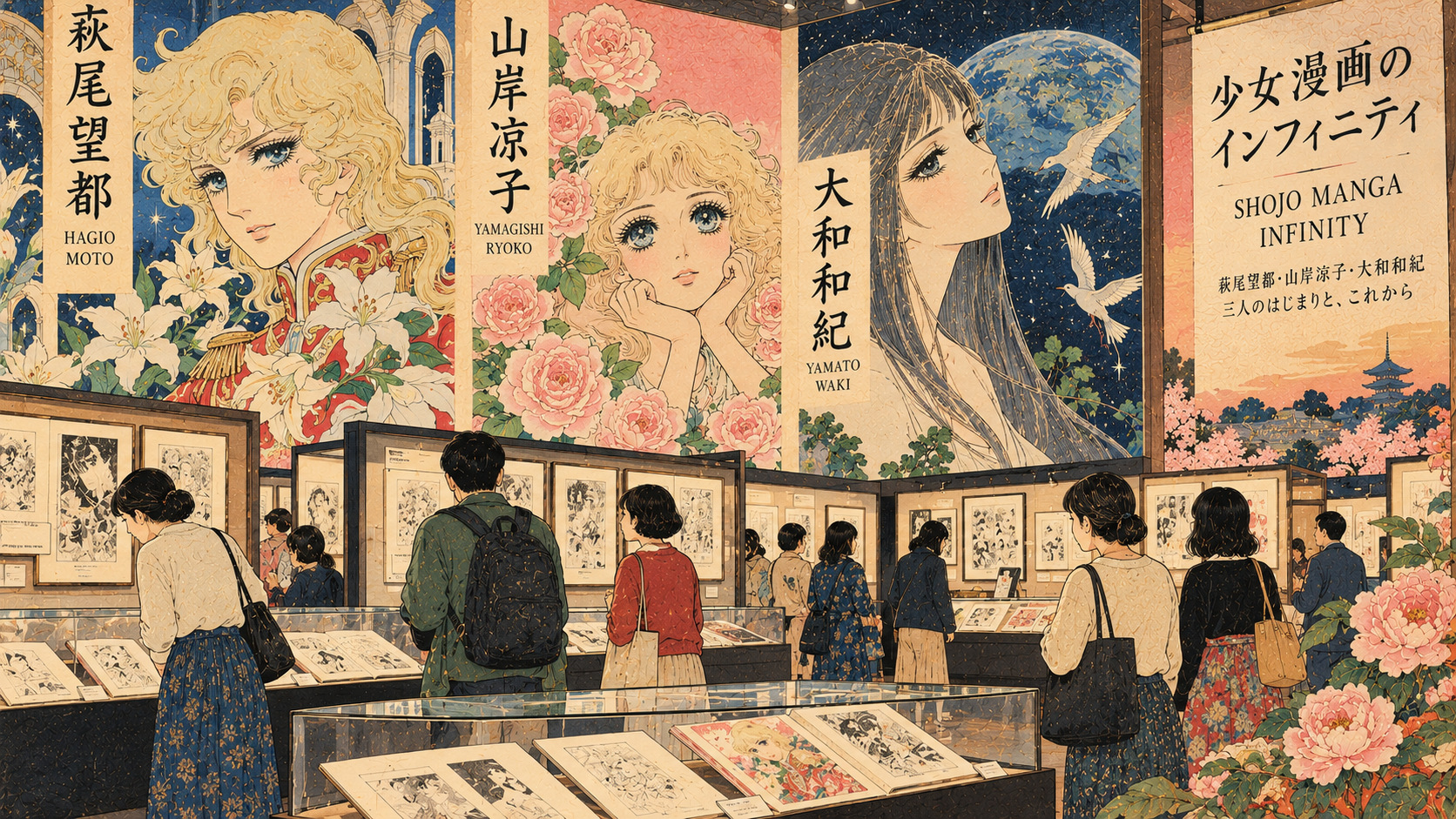
Shojo manga did more than expand the subjects of comics. It changed the visual language through which stories could be told.
When manga steps into the national art museum
On October 28, Tokyo’s National Art Center will open Shojo Manga Infinity, a three-artist exhibition devoted to Moto Hagio, Ryoko Yamagishi and Waki Yamato. Running until February 8, 2027, it is part of the institution’s twentieth-anniversary program. The museum calls it the first large-scale exhibition of shojo manga mounted by a national art museum in Japan. That claim is attributed to the organizer, not treated as proof that manga has never previously appeared in a museum. The greater story is the way mass-circulation comics developed expressive techniques worthy of sustained close looking.
A category that never meant a single kind of story
Shojo manga is often loosely translated as “girls’ comics.” It is also a publishing tradition shaped by magazines, editors, readers and changing social expectations. Its audience designation does not adequately describe its range. By the 1970s, artists working within and around that tradition were telling stories about identity, death, desire, historical power, science fiction and the difficulty of understanding other people. Panels could dissolve into atmosphere; flowers and empty space could communicate emotions more efficiently than captions. The work of these three artists makes a compelling case for studying those formal achievements rather than simply admiring nostalgic covers.
Moto Hagio and the freedom of impossible worlds
Born in Fukuoka Prefecture in 1949, Moto Hagio debuted in 1969 with Lulu to Mimi. Her influential works include The Poe Clan, Thomas no Shinzō, often known internationally as The Heart of Thomas, and They Were Eleven. Vampiric longevity, the fragile inner lives of boys and the tension of a spaceship examination seem like radically different subjects. They share an interest in vulnerability, belonging and the identities people must invent to survive. Hagio’s achievements have been recognized with Japan’s Medal with Purple Ribbon in 2012, recognition as a Person of Cultural Merit in 2019 and an Eisner Hall of Fame honor in 2022, according to the museum’s biography.
Ryoko Yamagishi: grace can be unsettling
The lines of classical ballet and the uncertainties of human psychology coexist in the work of Ryoko Yamagishi. Her Arabesque explores the disciplined world of dance. Hi Izuru Tokoro no Tenshi—often rendered as The Son of the Rising Sun—uses Prince Shōtoku as the basis for a psychologically ambitious historical narrative. That is a fictional interpretation, not an illustrated substitute for scholarly history. Across ballet, mythology, horror and historical fiction, Yamagishi complicates familiar images of beauty and nobility. Her pages reward viewers who look beyond costume and spectacle toward gesture, unease and the shifting balance between characters.
Waki Yamato puts women in motion through history
Waki Yamato, born in Hokkaido in 1948, debuted in 1966. Her beloved Haikara-san ga Tōru sets a spirited heroine, Benio Hanamura, against the demands and opportunities of Taishō-era society. Its romantic comedy also grapples with the question of what independence could mean for a young woman. Asaki Yumemishi adapts the long narrative world of The Tale of Genji, allowing modern readers a visually immersive route into classical literature. That bridge matters especially to overseas readers: the adaptation is a distinct creative work, and should not be confused with Murasaki Shikibu’s original text.
How 1970s pages changed what comics could express
Manga historians often discuss the experimentation of the 1970s as a transformation in visual grammar. Conventional sequences of boxed action were joined by layered faces, thought, decorative elements, irregular panel borders and different emotional rhythms on the same page. These devices did not spring fully formed from any single artist. Yet Hagio, Yamagishi and Yamato provide unusually clear opportunities to see how a commercial storytelling medium made room for complexity. Their output also resists the idea that one uniform “shojo style” explains everything: a psychological chamber drama, a ballet sequence and a historical epic demand different solutions.
What the original drawing can reveal
Readers usually encounter manga after reproduction, reduction, editing and printing. An original sheet can expose physical choices that disappear from the finished book: corrections, line weight, painted color and spatial planning. The exhibition promises color pieces, original pages from memorable scenes and archival documents spanning the artists’ careers. A museum display will not replicate the experience of reading an entire serialized narrative. It can, however, redirect attention to the labor and invention hidden inside a familiar printed page. The show should be approached as an exhibition of creative processes, not merely a parade of popular characters.
A two-part exhibition, not one unchanging display
The exhibition has two phases: October 28–December 14 and December 16–February 8. The organizers explicitly note changes to the color work on display. Their highlights page identifies some featured works as belonging to the first part and others to the second. Visitors seeking a specific drawing should therefore check the current official list rather than assuming that every reproduction in a publicity announcement will be on view throughout the run. The distinction is especially important for travelers making a single visit to Tokyo.
From Japanese magazines to international cultural history
These works have traveled through translation, licensing, adaptation and the devotion of readers. Hagio’s recognition by the Eisner Awards illustrates one form of international visibility; Yamato’s Genji adaptation was presented in connection with a Metropolitan Museum of Art exhibition in 2019, according to the organizer. Visibility is not uniform. Some titles are easy to obtain in English or other languages, while others remain scarce, and availability changes with licensing arrangements. Rather than claiming that the three artists dominate every overseas market, the exhibition invites a more interesting question: which kinds of Japanese storytelling cross cultural boundaries, and what gets lost along the way?
The uneasy usefulness of the word “girls”
The term shojo records a particular history of magazines and readers. It need not dictate who is permitted to find meaning in the work today. Stories of political ambition, family bonds, identity and loss are not confined to one age or gender. Equally, saying that shojo manga became “serious” only when museums accepted it would diminish decades of readers and critics who already took it seriously. A national art institution can expand the public conversation about the work without claiming to have created its value.
Plan a visit, and mind the rotation
The show is at the National Art Center, Tokyo, in Roppongi, Gallery 2E. Hours are normally 10 a.m.–6 p.m., extended to 8 p.m. on Fridays and Saturdays, with final entry thirty minutes before closing. Standard same-day adult admission is ¥2,200; advance adult tickets are ¥2,000 through October 27. Student prices and exemptions apply. Tuesdays are generally closed, with listed exceptions, and the museum closes on November 4 and for its year-end break. The exhibition runs through February 8, 2027; visitors should confirm schedules and the display rotation on the official site.
Three signatures, and many ways to read
The show’s title suggests infinity, but the three careers are most illuminating when their differences remain intact. Hagio turns time and belonging into narrative architecture. Yamagishi uses poised bodies and psychological disturbance to examine power. Yamato animates historical worlds through humor, feeling and determined protagonists. Their approaches cannot be reduced to one formula or represented by an AI-generated approximation of a copyrighted page. The exhibition opens an opportunity for readers to return to the books, argue about the works themselves, and appreciate how much artistry a mass medium has carried for half a century.
Sources and reporting method
An advance feature based on the museum and exhibition organizer’s published materials. The show has not opened as of October 26; no first-hand gallery review or original artist interviews are claimed.
- National Art Center: exhibition and artist biographies
- Official exhibition: highlights and exhibition rotations
- Official exhibition website and artist histories
- Official exhibition: Waki Yamato bibliography
- Official exhibition: tickets and admission
- Official exhibition: visitor information
- Official exhibition: audio guide