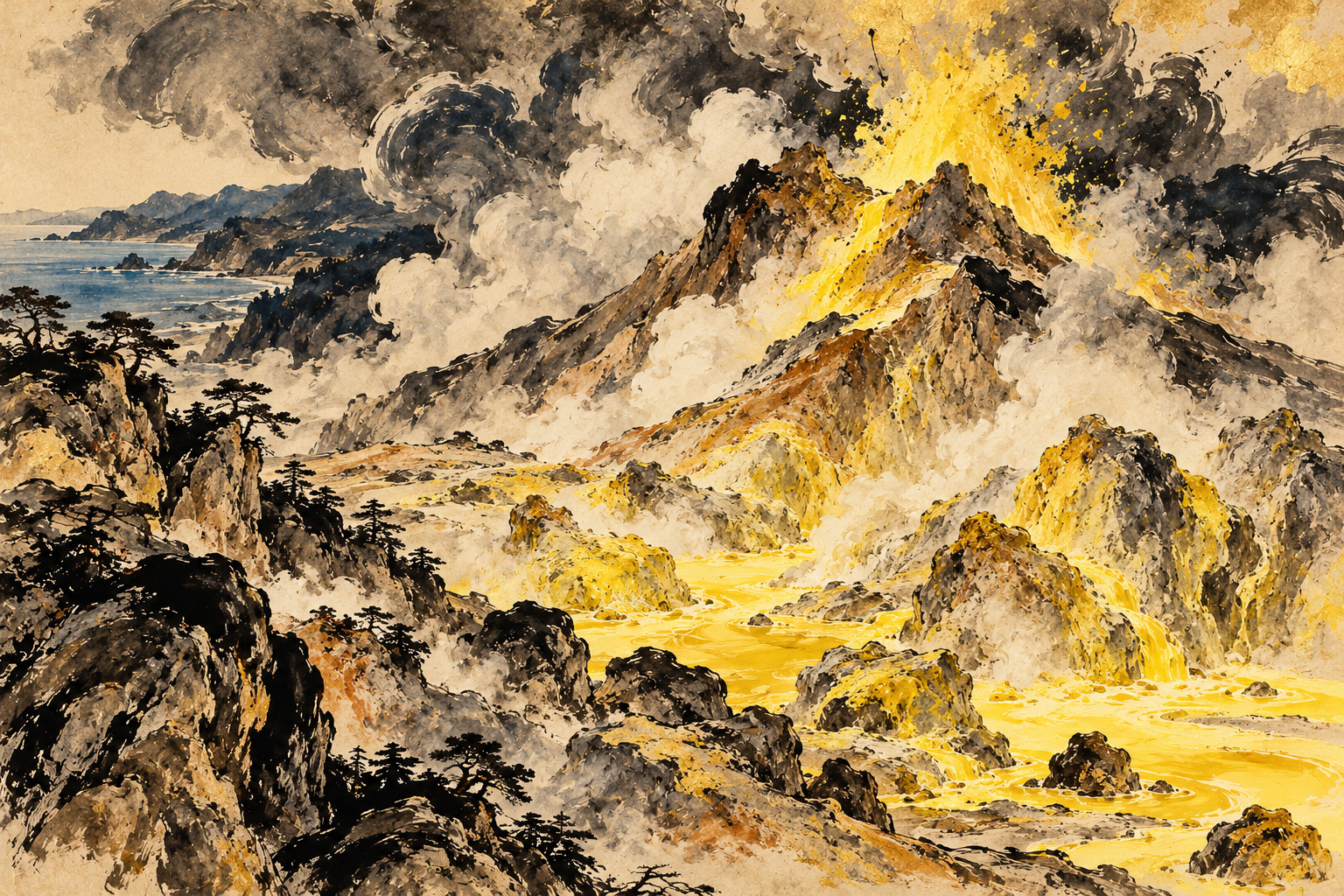
The volcano did not merely erupt rock. It revealed an underground chemical system capable of sending liquid sulfur to the sea.
The day a river ran with sulfur
In 1936, a river on Japan’s remote Shiretoko Peninsula carried something extraordinary toward the Sea of Okhotsk: molten sulfur. The flows descended the Kamuiwakka River amid repeated explosions of hot water and steam. Japan’s Meteorological Agency describes activity cycling through sulfur discharge, explosive hydrothermal bursts, intermittent boiling-water emissions and quiet periods every three to six days from May into late October.
The agency’s historical compilation estimates about 200,000 metric tons of sulfur over the eruption episode. This was not a river of conventional basaltic lava, nor a recent disaster. It was an exceptional manifestation of the chemistry and plumbing of a hydrothermal volcano, one that has challenged researchers for decades.
An old mystery gets a new investigation
A research announcement from Kyoto University on October 15, 2026, brought new attention to this unusual event. The underlying peer-reviewed paper had appeared on July 8 in the Journal of Volcanology and Geothermal Research. It does not describe a newly observed eruption. It tests how water and sulfur may circulate, accumulate and ultimately escape from the volcano’s underground system.
The authors include Mutsunori Yamamoto of the Osaka Museum of Natural History, Kyoto University researchers Koki Kashiwaya, Brenda Ariesty Kusumasari, Yohei Tada and Katsuaki Koike, and Tada-nori Goto of the University of Hyogo. Their account builds a physical and chemical explanation for a phenomenon known from the historical record.
Water carries a geological fingerprint
The team investigated the hydrogen and oxygen isotope composition of river and hot-spring waters. Because isotopic signatures shift with precipitation, elevation, mixing and thermal processes, they can help reconstruct the hidden routes that water takes inside a mountain. The researchers combined this evidence with self-potential measurements and an analysis of the underground aquifer.
According to the published paper, the recharge elevation of hot-spring water was estimated near 860 meters above sea level, and a deeper portion of the aquifer was estimated to reach about 176°C. These are research-derived estimates—not thermometers or cameras installed throughout the interior of the mountain. Together, they offer constraints on where sulfur-bearing fluids might have originated and collected.
Sulfur has its own strange physics
Sulfur is familiar as a yellow mineral around fumaroles, but its behavior as a liquid is less intuitive. Its viscosity varies sharply with temperature and composition. The study suggests that dissolution of hydrogen sulfide under hot conditions could have helped keep molten sulfur mobile enough to move through the volcanic hydrothermal system.
That matters because producing sulfur and transporting it are separate problems. Researchers must explain both how an extraordinary volume became available and how it flowed out. The paper’s deliberately qualified title—“Possible source and mechanism”—is a reminder that geological reconstructions remain models constrained by evidence, not complete replays of an eruption.
A volcano with a long, unusual memory
Japan’s official eruption chronology includes activity in 1857–58, 1876, 1889–90 and 1935–36. Sulfur outflows were recorded in 1857 and 1889, while the 1936 episode produced the most memorable modern account. The historical sequence argues against treating the event as an isolated geological freak; rather, unusual sulfur discharge appears to be a recurring characteristic of this particular volcanic system.
Shiretoko-Iozan rises to 1,562 meters. The JMA describes an andesitic stratovolcano with activity extending back at least 240,000 years. Explosive craters, lava domes and ancient slope failures testify to a geological history much longer than the observations of the nineteenth and twentieth centuries.
A World Heritage landscape with another story underground
Shiretoko was inscribed on UNESCO’s World Heritage List in 2005, chiefly for the exceptional productivity and connectedness of its marine and terrestrial ecosystems. Seasonal sea ice, nutrient-rich water, salmon, forests and wildlife form the internationally celebrated story. The volcano reveals another dimension: the water, rock and heat that have shaped the peninsula beneath those ecosystems.
That scientific dimension should not become an invitation to visit dangerous hydrothermal areas. Hot water, unstable terrain and volcanic gases are genuine hazards. Nor does the paper establish a forecast for a future sulfur eruption. Readers and visitors need to consult present-day JMA information and local access restrictions rather than infer safety from a geological research announcement.
Why the historical quantity needs care
Kyoto University’s release describes the 1936 event as producing more than 100,000 tons of sulfur; the JMA historical synopsis estimates approximately 200,000 tons. Those statements are not necessarily contradictory—one is a lower-bound description and the other an estimate—but they should not be conflated into a measurement of spurious precision.
Other uncertainties remain: the geometry of the ancient reservoir, the changing chemistry during the eruption, and the extent to which present-day samples reproduce the subsurface conditions of 1936. The research advances an explanation, not a full resolution of every detail.
The volcano that was also a chemical laboratory
It is tempting to picture a volcano simply as a mountain with molten rock beneath it. Shiretoko-Iozan asks us to imagine something more elaborate: rain and snow infiltrating rock, heated water moving through an aquifer, dissolved gases reacting, sulfur accumulating, and pressure eventually releasing an unexpected liquid at the surface.
The extraordinary part of this story is not merely that sulfur once flowed to the sea. It is that scientists can interrogate the event using traces left in water and rock, decades after the last eruption. Hidden beneath a landscape famous for its wildlife is a continuing lesson in Earth’s remarkable inventiveness.
This report is based on the published research, university releases and official eruption history; it does not claim an exclusive interview or new field observation.
Sources and further reading
- Kyoto University / 京都大学 工学研究科 — 2026-10-15
- Original research — Journal of Volcanology and Geothermal Research
- Japan Meteorological Agency — Shiretoko-Iozan volcano
- Japan Meteorological Agency — Historical eruptions
- UNESCO World Heritage Centre — Shiretoko
- Osaka Museum of Natural History — Research release