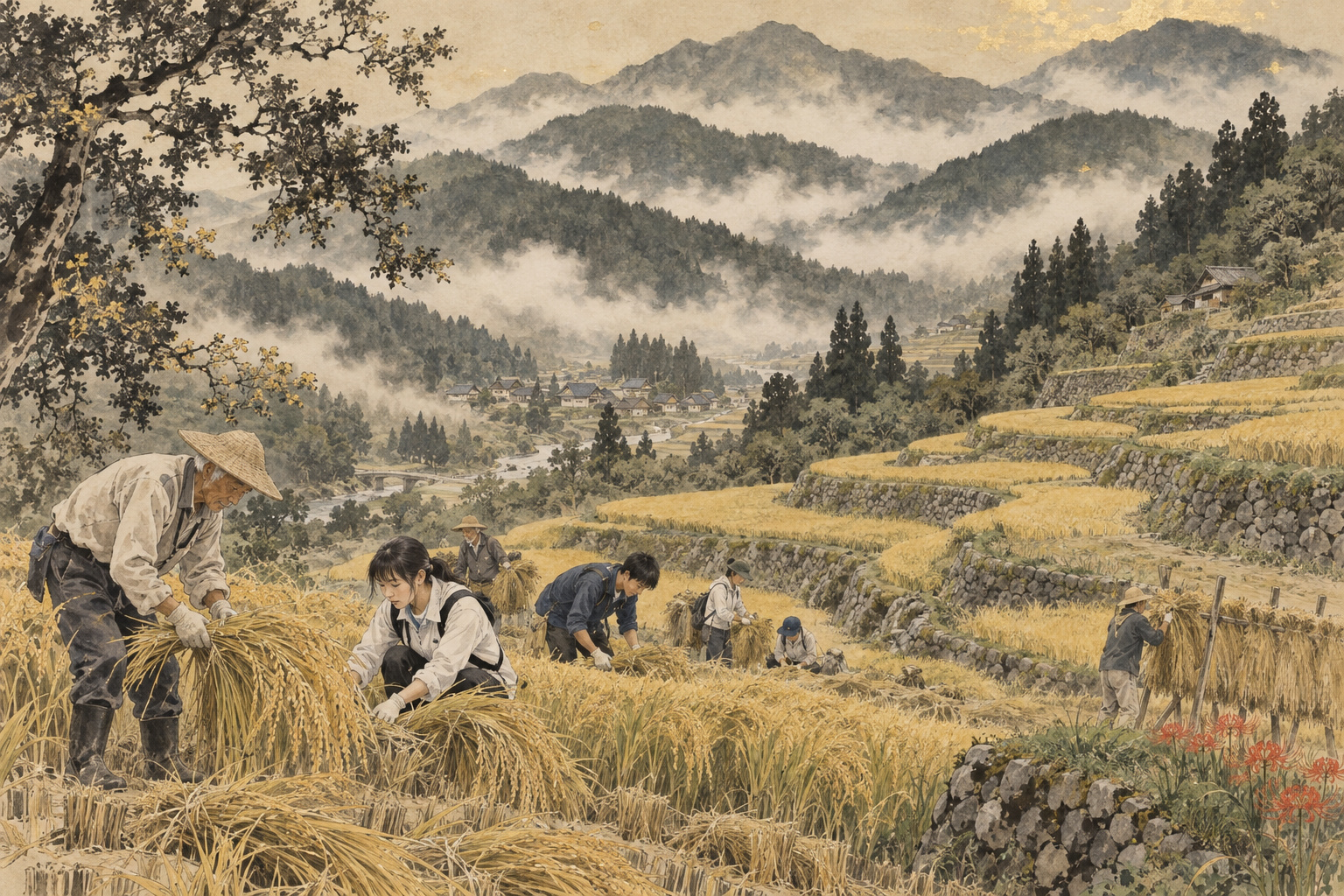
The future of Aichi’s Yotsuya rice terraces may depend on an unglamorous question: who comes back to cut the grass? At Yotsuya in Shinshiro, a July newsletter records collective mowing along farm roads, waterways, slopes and adjoining woodland. It is a small entry, but it describes the work that keeps a cultivated landscape usable between the occasions when visitors come to admire it.[6]
This year, a university project is bringing another group into that work. Aichi Prefecture announced on September 9 that nine first-year Aichi University students, working in three teams, would present conservation proposals on September 24 at the university’s Nagoya campus. The prefecture identifies a shrinking pool of people to sustain the terraces and increasing crop damage from wildlife as local problems.[1]
The students’ involvement creates an opening. The harder task is to turn an encounter with the place into a commitment that survives a presentation, a semester and the inconvenience of the farming calendar. Yotsuya needs people who can help keep land in cultivation—and arrangements that make their help dependable.
A landscape made, lost and rebuilt
Yotsuya no Senmaida means Yotsuya’s thousand rice paddies. The agriculture ministry traces cultivation here to at least the Muromachi period and says there were once more than a thousand plots. Its undated local profile describes roughly 420 cultivated paddies. That figure conveys the scale of the terraced mosaic; it should not be mistaken for a freshly verified 2026 count.[3]
The terraces also carry the memory of a rupture. According to Shinshiro City’s historical account, prolonged rain and a typhoon caused a landslide on July 10, 1904. Eleven people died, ten homes were swept away and the paddies along the stream were destroyed. With help from neighboring settlements, residents rebuilt the terraces in about five years.[2]
That history changes how the landscape should be read. Its survival was an act of reconstruction as well as inheritance. Keeping the terraces has repeatedly meant deciding to invest labor in a place where the work could be undone. Today’s preservation debate belongs to that history of decisions, although its circumstances are different.
Residents formed the Kurakake Sanroku Senmaida Preservation Society in 1997. National recognition followed: selection among Japan’s hundred notable rice-terrace landscapes in 1999, and selection for the agriculture ministry’s Tsunagu Tanada Isan heritage initiative in 2022. The latter recognizes efforts to sustain terrace communities and their wider functions, extending attention beyond the scenic view itself.[3] [4]
An award can explain why a place matters to people beyond its immediate community. It cannot determine who will take responsibility for the next season. Heritage status and a workable succession plan answer different questions.
The work between planting and harvest
Yotsuya’s July mowing was organized through its community agreement under Japan’s direct-payment program for hilly and mountainous areas. The newsletter’s list of work sites matters: roads, channels, slopes and nearby woodland. The crop occupies the paddy, but the effort to keep producing it reaches beyond the paddy boundary.[6]
The national program began in fiscal 2000. Its sixth phase started in fiscal 2025, with changes that the agriculture ministry describes as taking account of aging participants. The preservation society’s April 2026 newsletter records a Yotsuya agreement meeting and distribution of payments. Public support is already part of the local picture.[10] [9]
Yet financing work and finding someone able to perform it are separate challenges. A useful conservation plan has to connect the two. Paying for materials will not, by itself, transfer a farmer’s knowledge of the site. Bringing newcomers in will not automatically reduce the time residents spend explaining tasks and coordinating visits.
These are practical tests for any proposal: what job will it make easier, at what time of year, and for whom? A project that attracts participants can be valuable. A project that also leaves residents with fewer hours of work has achieved something more specific.
Students enter an existing farming calendar
The prefecture’s Shinshiro-Shitara regional office and Aichi University jointly organize the new project. Its March announcement set out fieldwork, meetings with local-government staff and agricultural tasks. A cooperating local figure is Shunji Koyama—小山舜二, read Koyama Shunji—chair of the preservation society.[8]
The society’s June newsletter confirms that nine students weeded rice paddies on May 30. Their first reported field session therefore involved maintenance, not simply looking at the scenery. The original program also scheduled harvesting and threshing in September, with alternative dates depending on weather and crop development.[5] [8]
That qualification contains a lesson of its own. A university can timetable an activity; a crop may demand a change. Reliable participation requires enough flexibility to meet the place on its own terms. For students, that may be as instructive as the agricultural technique.
The prefecture frames the project around creating new kankei jinkō: people who develop continuing connections with a community. In this project, the aim is to deepen students’ engagement with residents and local issues. It does not mean that the participants have become successor farmers.[1]
There is room between an occasional visitor and a full-time farmer for useful commitments: returning for agreed tasks, helping organize future groups, or maintaining a relationship after graduation. Those are possibilities for the project, rather than outcomes it has already demonstrated. The important measure will be whether residents can rely on the resulting help.
Nature is both a responsibility and a pressure
Koyama’s August newsletter describes efforts to maintain the terraces as habitat, including work involving frogs and fireflies. It also raises concern that aging and wildlife damage will erode cultivators’ motivation. The same community is trying to sustain wildlife habitat and protect a harvest from animals.[7]
This makes preservation more demanding than a simple appeal to leave nature alone. Farming, habitat management and crop protection have to coexist. The people being asked to maintain a valued landscape must also be able to grow something in it.
The August account raises another concern: declining spring water. That is a local warning, not, on its own, a scientific assessment of long-term flow or its causes. It nevertheless shows why the farmer’s perspective matters. A landscape praised for its water can also be a place where those working it worry about future supply.[7]
Conservation would be better judged by a range of results: land remaining in cultivation, functioning waterways, manageable workloads and habitat condition. Visitor totals cannot stand in for all of them. Nor should a successful educational visit be made to carry the entire burden of agricultural renewal.
Building on relationships that already exist
Outside participation did not begin with this year’s students. The society’s April newsletter says employee training involving Yokohama Rubber’s Shinshiro plant began in 2006. Its July issue describes support from confectionery company Maruhachi Seika, including product development, and participation in the local terrace-promotion council. These are different ways of connecting economic and community life to the fields.[9] [6]
The lesson is to examine what each relationship supplies. A buyer, a repeat volunteer and a company that organizes staff participation need not contribute in the same way. A durable arrangement can combine their strengths while leaving local cultivators a clear voice in the work they actually need.
It must also recognize the cost of hosting. An event can be enjoyable and well attended while leaving preparation and cleanup to the same small group. Measuring success from the residents’ side—time saved, useful income, tasks completed—would make support easier to assess and improve.
September’s presentations offer a chance to put such questions on the table. The longer test will come when another season needs organizing. Who returns, what can they do, and who can count on them? Yotsuya’s terraces will endure through those repeated agreements, one working relationship at a time.
- Aichi Prefecture: conservation project final presentations, September 9, 2026
- Shinshiro City: Yotsuya no Senmaida, place name and disaster history
- MAFF: Yotsuya terraces, historical background and preservation society (statistical reference date unspecified)
- Shinshiro City: selection for the Tsunagu Tanada Isan initiative in 2022
- Kurakake Sanroku Senmaida Preservation Society: newsletter no. 273, June 15, 2026 (PDF)
- Preservation society: newsletter no. 274, July 15, 2026 (PDF)
- Preservation society: newsletter no. 275, August 15, 2026 (PDF)
- Aichi Prefecture: project plan and Koyama’s name, reading and role, March 25, 2026
- Preservation society: newsletter no. 271, April 15, 2026 (PDF)
- MAFF: direct payments for hilly and mountainous areas, program history and sixth phase