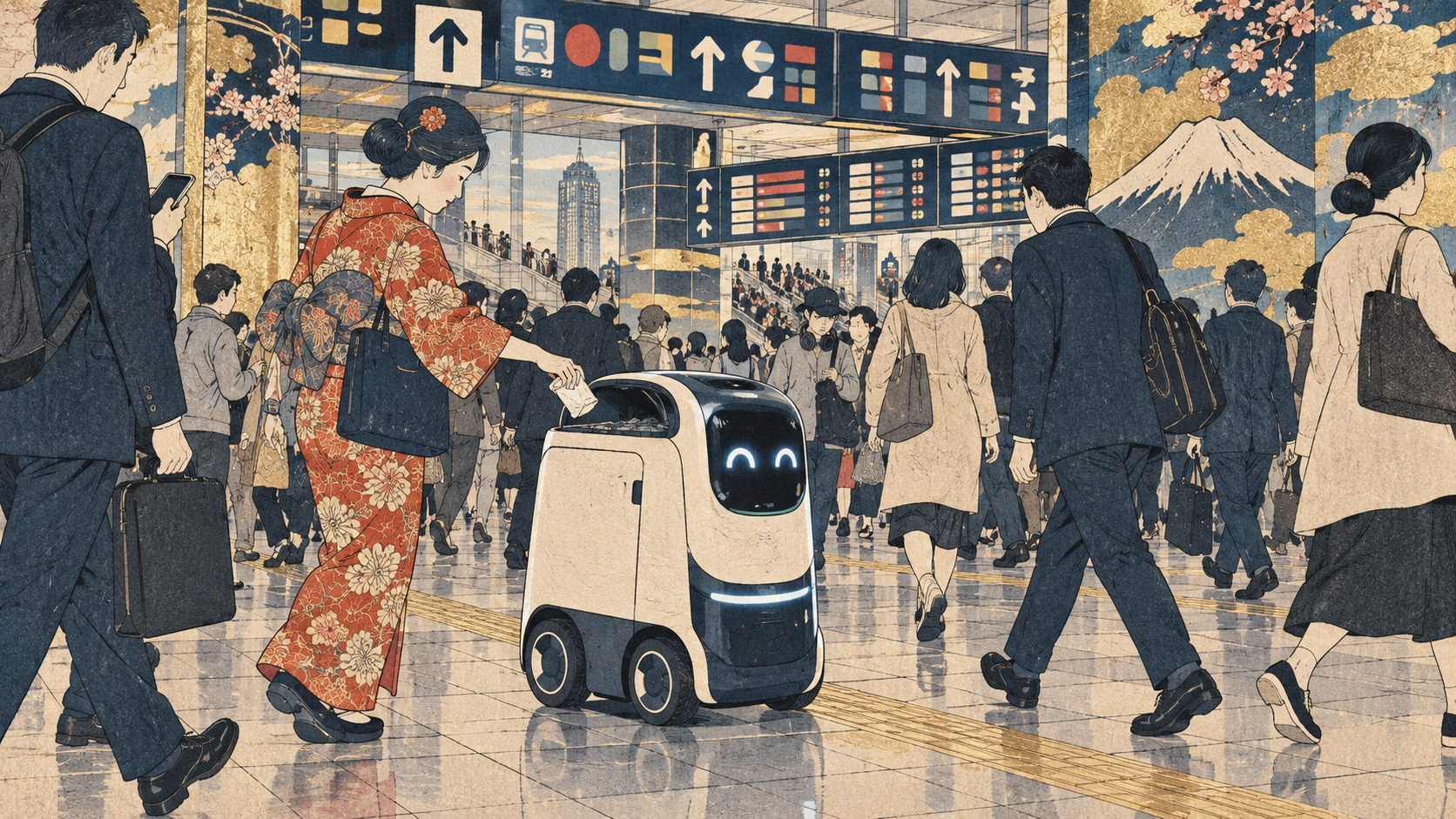
After the morning rush begins to loosen its grip, a wheeled box wrapped with Shinjuku Station’s bear mascot, Shinjukuma, is due to appear on the basement concourse. It will autonomously patrol a designated area and collect refuse, bringing a receptacle toward passengers instead of making every passenger find a fixed bin. The modest inversion turns a piece of station furniture into a moving service.
East Japan Railway Company—JR East—plans to run the experiment on weekdays from September 8 through November 20, normally between 10 a.m. and 5 p.m. The operating area is the B1 paid concourse inside the East, West, Central East and Central West ticket gates. Existing stationary bins will remain available. The robot is an additional option, not their replacement.
A social test disguised as a technical one
JR East names four principal questions: whether the robot can travel safely using sensors; what problems emerge in crowded conditions; how it affects passenger movement in the paid concourse; and whether the public accepts a mobile trash-can robot. The fourth turns the project from a navigation demo into a test of social choreography. Avoiding an obstacle is not the same as belonging in a station.
A concourse has no neat lane discipline. A traveler looks up at a departure board and changes direction. A suitcase follows half a step behind its owner. Children approach unfamiliar machines. A wheelchair user needs reliable clearance; a blind passenger reads the floor with a cane. A delayed train can redraw density and direction within minutes. A robot that stops may be safe in one sense, yet if it stops indefinitely it can become the obstruction.
Shinjuku is an exacting laboratory. In fiscal 2024, JR East recorded an average 666,809 passenger entries per day there, the highest figure in its network. That statistic counts only people boarding JR East services: it excludes exits, transfers within JR and passengers using other railways and subways. The trial covers only part of the station, but the number still explains why small effects on movement matter.
A Cartken robot, with key specifications withheld
The platform is an indoor-outdoor autonomous delivery robot developed by the American company Cartken. Mitsubishi Electric Corporation and Melco Mobility Solutions Corporation are the operators named for the trial. Cartken says it was founded in 2019 by former Google engineers and operators, first for last-mile delivery and later for short-distance movement inside and between facilities.
Across its product line, Cartken describes an autonomy system using artificial intelligence, camera-based perception and sensor fusion. Vehicles localize within predefined areas using high-definition maps, can work where GPS is unavailable, and may notify remote operators when an edge case requires assistance; the company says an operator can override autonomy through LTE or 4G. Those are platform-wide descriptions, not a confirmed specification sheet for Shinjuku.
JR East has not disclosed the model, fleet size, maximum speed, bin volume, range, charging arrangement or remote-supervision setup. Its published route diagram is expressly provisional. Claims about how often a robot will arrive, whether it detects a full compartment, or how many units are circulating would therefore be premature.
| Confirmed | Not disclosed |
|---|---|
| An indoor-outdoor Cartken delivery robot adapted as a mobile trash can | Model, number of robots, speed, capacity and battery performance |
| Autonomous patrol and refuse collection on the B1 paid concourse | Exact stops, patrol frequency and behavior when full |
| Operated by Mitsubishi Electric and Melco Mobility Solutions | On-site staffing, remote-intervention rules and emergency procedures |
| Fixed bins remain in use | Cost, numerical targets and threshold for permanent deployment |
A moving receptacle—not a litter-picking machine
The official Japanese name, idō-shiki gomibako robotto, means “mobile trash-can robot.” JR East does not describe a cleaning robot that finds litter on the floor and picks it up with an arm. It describes a delivery robot repurposed as a receptacle that patrols and collects waste. Nothing in the release says sorting, liner changes, removal, washing or other back-of-house work will be unmanned.
The efficiency opportunity lies less in motion itself than in redesigning workers’ routes. If capacity can be brought nearer to where waste is produced, staff may spend less time checking distant stationary bins. But cleaning, charging, fault recovery and supervision create new tasks. JR East states a goal of making cleaning work more efficient; it has published no target for labor hours or headcount.
The company places the test under its group management vision, 「勇翔2034」—a coined Japanese title carrying the idea of courageously taking flight—and its programs for value creation with robots and work-style reform. Automation in public space, however, is rarely a simple substitution of machine for person. Its value depends on which repetitive work the machine handles, which exceptions remain human judgments and how well the two are connected.
What the cameras see—and what the release does not say
JR East says it will film the robot’s patrol in the paid concourse for verification and use that footage only to analyze the experiment. That purpose limitation is significant. The public notice, however, does not specify camera positions, retention periods, who may view the material, whether faces will be obscured or how deletion will be handled.
There is also a distinction between cameras recording the trial and sensor data used by a robot to navigate. Cartken describes camera-first perception across its systems, but JR East has not detailed what the Shinjuku unit will record or retain. Clear signs at the site, an accessible contact point and a plain account of data handling would all bear directly on the stated test of social acceptance.
- Can the robot repeatedly stop and restart safely as crowd density changes?
- Does it preserve space for wheelchairs, canes, strollers and large luggage?
- Can passengers understand the opening, accepted waste and operating status at a glance?
- Are filming and navigation-data practices explained clearly at the site?
A 140-year-old station makes room for a small machine
Shinjuku Station opened on March 1, 1885, as a stop on the private Nippon Railway’s Shinagawa Line, a predecessor of today’s Yamanote Line. Exactly 140 years later, JR Shinjuku introduced Shinjukuma as its official station character. The name folds Shinjuku into kuma, the Japanese word for bear; its signature detail is a “pearl” tail, a pun on shinju. Wrapping the robot in that friendly identity is also interface design: it may reduce wariness and invite people to notice what the machine is for.
Station robots are not new to JR East. When Takanawa Gateway Station opened in March 2020, the company trialled robots for guidance, security, cleaning and other services. Its securities report for that fiscal year says autonomous service robots were tested at several stations in the Tokyo metropolitan area. Shinjuku itself gained an east-west public passage in July 2020 and later hosted passenger-flow analysis, part of a continuing attempt to understand movement through an immense interchange.
March 1, 1885 — Shinjuku Station opens on the Shinagawa Line.
March 14, 2020 — JR East trials guidance, security and cleaning robots at Takanawa Gateway.
July 19, 2020 — Shinjuku’s east-west public passage opens.
March 1, 2025 — Shinjukuma debuts on the station’s 140th anniversary.
September 8, 2026 — The mobile trash-can experiment is scheduled to begin.
Cuteness and a completed lap will not be enough to establish success. Near misses, abrupt stops, remote interventions, blockages, deposits, overflow, uptime, staff walking time, complaints and feedback from disabled passengers all matter. Results become more useful if matched with crowd density, time of day and a stationary-bin baseline. JR East has not yet published its metrics or pass-fail thresholds.
What Shinjuku asks of this machine is behavior more than speed: yield to a traveler in a hurry, approach someone who needs it, retreat when it becomes the problem. A trash can’s short journey poses a larger question—who gets to occupy the station floor, and by what rules?
- JR East, “Experiment with a ‘Mobile Trash-Can Robot’ at Shinjuku Station” (Japanese, Sept. 4, 2026) — schedule, location, operators, tests, filming and fixed bins.
- JR East, FY2024 station passenger entries (Japanese) — Shinjuku total and statistical definition.
- Cartken, “Technology” — product-line perception, mapping and remote assistance.
- Cartken, “About Us” — founding and business history.
- Mitsubishi Electric, report on autonomous delivery robots (Japanese) — general account of monitoring and intervention in Japan.
- JR East corporate history (Japanese) — 2020 station-service robot trials.
- JR East FY2021 securities report (Japanese) — trials at multiple Tokyo-area stations.
- JRE Media, “Birth of JR Shinjuku Station’s Official Character Shinjukuma” (Japanese) — name, birthday and anniversary.
- JR East Group Management Vision 「勇翔2034」 (Japanese) — corporate policy on safety, technology and work.