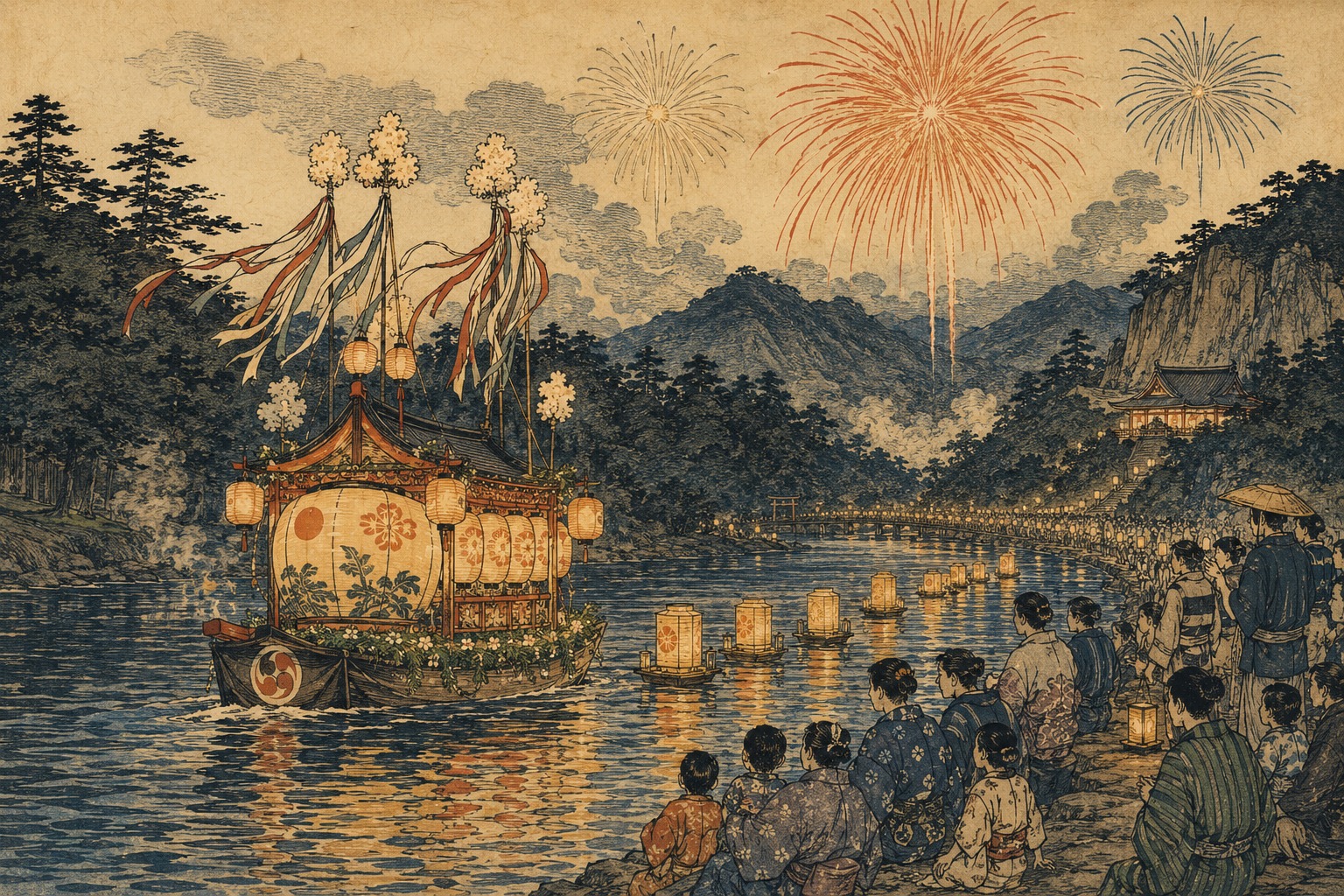
The day before the fireworks, there is no great detonation in central Shingu. Just east of JR Shingu Station, through the bright Chinese-style gate of Jofuku Park, a memorial ceremony is scheduled for 2 p.m. on August 12. The man being honored has no certain birth or death date. His arrival here has never been proved. Still, people speak his name, stand before the marker and carry the story of his crossing into another year.
At 7:30 the following evening, the setting shifts to the Kumano River floodplain. Wakayama Prefecture’s 2026 announcement calls for approximately 6,000 aerial fireworks and about 20 set pieces. Water starmines are to bloom low over the surface; a large “Niagara” installation is meant to form a curtain of fire across the river. Organizers say the event commonly draws about 50,000 people. The quiet grave and the crowded riverbank are held inside one name: the Kumano Jofuku Manto Festival.
Calling it a 2,200-year-old festival would be dramatic and wrong. The ancient Chinese voyage, a Kumano tradition documented in the Middle Ages, a grave marker carved in 1736, a postwar fireworks event and a park opened in 1994 did not happen in one continuous moment. The festival is more interesting when those gaps remain visible. Each time later communities needed Xu Fu, they added another layer to him.
One festival in two acts: a grave by day, a river by night
The official 2026 schedule is simple. August 12 at Jofuku Park; August 13 on the Kumano River floodplain. Admission is free and advance registration is not required. The river venue is described as roughly a 20-minute walk from Shingu Station. Parking is limited, and the prefecture recommends public transportation. Light rain does not automatically cancel the show; the severe-weather reserve date is August 20. Shingu says it will publish a go-or-no-go decision on its website and social accounts by around noon on the day.
The word manto—literally suggesting a multitude of lights—can tempt an outsider to imagine thousands of lanterns floating downstream. The city and prefecture’s published 2026 program lists the Xu Fu memorial and the fireworks, not a lantern-floating rite. The name should not be translated into an invented ceremony. For this edition, the confirmed lights are those of commemoration at the park and fireworks the next night.
Two forms of memorial should also be distinguished. August 12 specifically honors Xu Fu and the virtues local tradition attributes to him. The fireworks fall at the opening of the Obon season, and a regional tourism guide says the Shingu display also commemorates people facing their first Obon after death. One remembers a legendary voyager; the other gives families a public form for recent grief. They are not the same rite, though both gather around people who did not return.
- Xu Fu ceremony: Wednesday, August 12 at 2 p.m., Jofuku Park, beside Shingu Station.
- Fireworks: Thursday, August 13 at 7:30 p.m., Kumano River floodplain; about 6,000 fireworks and 20 set pieces are planned.
- Weather: Light rain may not stop the show. The severe-weather reserve date is August 20. Check Shingu’s official notice around noon.
- Safety: Expect crowding, summer heat and dark, uneven ground. Bring water, wear suitable shoes and follow official traffic and exclusion-zone directions.
What Sima Qian wrote: an eastern sea and three spirit mountains
The story’s first surviving words are not Japanese. They appear in the Shiji, or Records of the Grand Historian, assembled by the Han historian Sima Qian around the first century BCE. In 219 BCE, soon after Qin unified China, a man of Qi called Xu Shi and others petitioned the First Emperor. Three spirit mountains—Penglai, Fangzhang and Yingzhou—stood in the eastern sea, they said, and immortals lived there. Xu asked to purify himself and go in search of them with young boys and girls.
The emperor dispatched thousands. In a later scene, after the medicine had not been found, Xu blamed enormous sharks for preventing access to the islands and asked for skilled archers and repeating crossbows. Another chapter, the “Biography of the Kings of Huainan and Hengshan,” says the emperor provided 3,000 young men and women, seed grains and many kinds of craftsmen. Xu Fu found pingyuan guangze—“broad plains and extensive marshes”—stayed there as a ruler and never returned.
The episode compresses the ambitions of an empire. The man who unified China in 221 BCE could not command death to spare him. A fangshi like Xu Fu was not simply an “alchemist” in the modern chemical sense. The term covered specialists in ritual techniques, divination, longevity regimens and encounters with immortals. His expedition was not a private yacht voyage. As the text tells it, the state mobilized young people, seed, crafts, weapons and ships. It reads as a search for medicine and, simultaneously, as a migration or colonizing party.
What Sima Qian did not write: Japan, Kumano or Shingu
The most important place names are absent. The Shiji does not say “Japan,” “Wa,” “Kumano” or “Shingu.” Nothing in “broad plains and extensive marshes” securely identifies Kyushu, the Kii Peninsula, the Korean Peninsula, Taiwan or any other destination. The terse record also cannot settle whether Xu Fu was one historical individual, a name gathering several maritime expeditions, or a figure already shaped by story.
An ancient Chinese account of a voyage is not evidence of a Kumano landing. A marker in modern Shingu does not mean 2,000-year-old remains were found beneath it. Archaeology around Asuka Shrine and Mount Horai has produced settlement remains and ritual objects dating from the Yayoi through Kofun periods. Shingu’s own heritage explanation treats them as evidence that the hill attracted belief in ancient times. No inscription or direct find publicly ties them to Xu Fu’s party.
| Layer | What can be established | What cannot |
|---|---|---|
| Ancient Chinese text | The Shiji records Xu Shi/Xu Fu, an eastern voyage, young people, spirit mountains and a party that did not return | That the destination was Japan or Kumano |
| Kumano tradition | Literary evidence links Xu Fu with Kumano by the 13th century | An unbroken oral transmission beginning in the third century BCE |
| Material culture | A 1736 grave marker, 1940 stele, 1994 park and 1997 statue exist | That the marked place is an ancient burial containing Xu Fu’s remains |
| Living culture | Memorials, plants, tourism, international exchange and fireworks keep the legend active | That specific local technologies can be archaeologically attributed to Xu Fu’s party |
Why Kumano could become Penglai
Shingu offers a landscape capable of receiving the story. Near the Kumano River’s mouth, Mount Horai is a rounded, evergreen hill only about 38 meters high. Asuka Shrine stands at its southern foot. Known in the Heian period as Asuka-oji, it became an important subsidiary shrine on the Kumano pilgrimage and treated the hill behind it as sacred.
When the Chinese island-paradise Penglai met Kumano’s religious geography, the destination could move from an empty space in an old text to a named sacred place. A traveler arriving from the sea sees a green hill at a river mouth and recognizes the spirit mountain he was seeking: the terrain itself makes the legend narratively plausible. But modern place names and religious meanings cannot simply be projected backward into 219 BCE. The landscape explains why later people found the story compelling; it does not prove the landing.
The Kumano River is equally more than scenery. Pilgrims on the Nakahechi route often traveled by boat from Hongu toward Shingu and Kumano Hayatama Taisha. The river is recognized as a “water pilgrimage route” within the Sacred Sites and Pilgrimage Routes in the Kii Mountain Range. Asuka Shrine and Mount Horai are included as the former Asuka-oji. UNESCO did not thereby certify Xu Fu’s arrival. The World Heritage value concerns the sacred landscape, its routes and its fusion of religious traditions.
A 13th-century refugee sees himself in Xu Fu
The Kumano version becomes visible in surviving writing about 1,500 years after the expedition described by Sima Qian. Shingu says it appears in Kamakura-period documents, and scholarship concludes that the Xu Fu–Kumano association had become established in literary works by the 13th century. One of its early voices is especially revealing: a Chinese monk who crossed the sea after losing his political world.
Wuxue Zuyuan—Mugaku Sogen in Japanese—left the collapsing Southern Song realm under pressure from the Mongol Yuan and arrived in Japan in 1279. He became a major Zen teacher in Kamakura. In a poem associated with Xu Fu and dated to 1281, the displaced monk compared himself with the ancient man who crossed the sea and did not go home. A commemorative stone at Asuka Shrine preserves the association. Xu Fu had become more than an imperial agent. He was a mirror for exile: someone who escaped Qin and made a life elsewhere.
Late in the 14th century, the Japanese monk Zekkai Chushin is said to have exchanged poems with the Hongwu Emperor of Ming that referred to Xu Fu’s shrine and medicinal herbs at Kumano. The legend did not stay sealed in Japanese folklore. Written in a shared classical Chinese literary language, it traveled back across the sea and received an answer. Xu Fu’s actual landfall remained unknown, but the story that placed him in Kumano had already become transnational.
In 1736, a legend became stone
The marker reading “Tomb of Qin Xu Fu,” roughly 100 meters east of Shingu Station, is not an ancient artifact. It is a 1.4-meter slab of green schist, about 50 centimeters wide. The founder of the Kishu Tokugawa domain, Tokugawa Yorinobu, had his Confucian retainer Li Meixi prepare the calligraphy; Wakayama’s historical guide says the marker was erected in 1736 under the sixth lord, Tokugawa Munenao. It represents an early-modern domain and its scholars giving authoritative form to a local tradition.
The commemorative stele beside it has an even more dramatic biography. In 1834, domain scholar Niida Koko composed the inscription and a stone was prepared. A typhoon sank it while it was being carried by sea. The text survived. The present stele was erected from that copy in 1940, during the imperial-calendar 2600th-anniversary observances. One monument therefore contains an Edo-period project, a shipwreck and the commemorative politics of modern Japan.
Legends do not become purer the older they look. Someone chooses words, cuts stone, transports it, loses it and builds again. Each act adds the values of its own era. Dating the marker to 1736 does not cheapen the Xu Fu tradition. It tells us something concrete: people in the 18th century already thought this story deserved a durable place in public memory.
219 BCE In the Shiji chronology, Xu Shi petitions to search the eastern sea’s three spirit mountains
210 BCE Xu blames giant sharks and seeks another departure; a separate chapter says he settled in “broad plains and extensive marshes”
13th century The Xu Fu–Kumano tradition is clearly present in literary evidence
1281 Date associated with Mugaku Sogen’s poem linking his own exile to Xu Fu
1736 The present “Tomb of Qin Xu Fu” marker is erected
1834 A commemorative stele is made and lost to a typhoon during sea transport
1940 The current stele is reconstructed from the preserved text
Early 1960s The numbered sequence of a fireworks festival said to have begun from the Xu Fu memorial starts
1994 The grave precinct opens as Jofuku Park
1997 A 1.9-meter, 1.5-ton stone statue of Xu Fu is installed
2026 The Xu Fu memorial and the 64th Shingu Fireworks Festival
How an imperial agent became a giver of culture
In Shingu’s tradition, Xu Fu arrives in Kumano with 3,000 young men and women. He finds the climate mild, the landscape beautiful and the inhabitants welcoming, and decides to stay. He teaches farming, fishing, whaling and papermaking. Nearby Hadasu, in Mie Prefecture’s Kumano City, has a different landing and settlement story. Saga, Kyoto, Kagoshima and other parts of Japan claim their own destinations.
Those accounts cannot simply be combined into proof that one migration party introduced all these technologies. The things Xu Fu is said to have taught vary by region, which reveals how the legends work. Communities assign the origins of important livelihoods to a wise visitor from across the sea. Xu Fu becomes a vessel in which each place carries an explanation of its own culture.
The transformation reverses the ancient imperial story. Sima Qian’s Xu Fu sails because a ruler fears death and mobilizes youth and resources to satisfy that fear. In Japanese local legend, he is no longer merely the servant who must bring medicine back to the throne. He refuses to return, opens land and gives knowledge to ordinary people. A quest for one emperor’s immortality becomes a story about a community’s beginning.
Tendai uyaku: a medicinal tree is not proof of immortality
A plant called Tendai uyaku sits at the legend’s center. It is an evergreen shrub in the laurel family and Shingu’s official city tree. Local tradition says Xu Fu found it around Mount Horai and recognized it as the elixir he had sought. Seven specimens grow beside the “Pond of Eternal Youth” in Jofuku Park. Tea, bath preparations and soap made with the plant are sold as local products.
A history of herbal use is not the same as evidence of immortality. Studies have examined antioxidant activity and other properties of the plant, but there is no clinical evidence that it halts human aging or grants unlimited life. Legend must not become an unsupported health guarantee. Tendai uyaku is more accurately understood today as a cultural resource connecting botany, storytelling, products and civic identity.
Shingu found a different form of what the emperor could not. Not bodily immortality, but a memory that is tended, discussed, drunk and exchanged year after year. The roots of the plant matter less as a medical promise than as a metaphor for a story taking hold in one place.
Obon fireworks: remembering immortality with a flame that dies
The numbered Shingu fireworks sequence is postwar, not ancient. At the planning meeting for the 57th edition in 2019, the mayor described it as a fireworks festival that began from the memorial for “Mr. Xu Fu.” The 2026 event is the 64th. It is a modern community festival that extended commemoration into mass public spectacle, not a fire rite continuously performed since the Qin dynasty.
Its date nevertheless matters. August 13 opens the Obon season, and regional tourism information says the event commemorates people facing their first Obon as well as Xu Fu. The first summer after a death can make absence newly sharp. When a family places a name or memory inside a public display, the same explosion can be entertainment and a prayer for the dead. The Xu Fu memorial and the first-Obon memorial do not honor the same person, but they meet emotionally in the act of receiving back, through memory, someone who did not return.
That creates the festival’s most beautiful contradiction. A man sent to find immortality is remembered through an art form defined by its briefness. A firework begins moving toward extinction the instant it is born. Precisely because it cannot remain, each burst makes time visible. Rather than possessing eternity, people watch something vanish together and tell the story again the following year. That is the practical immortality culture can make.
The technology and responsibility of using a river as a stage
The announced 2026 program centers on roughly 6,000 fireworks and around 20 set pieces. Water starmines open close enough to the surface that reflected light becomes part of the image. The Niagara installation is designed as a curtain of fire across the river. With mountains close to the floodplain, sound rebounds through the landscape; the audience receives sky, water and vibration together.
But the Kumano River is not scenery. It is a pilgrimage route, an ecosystem, a flood-bearing river and a prefectural boundary. The event requires floodplain preparation, explosives control, plans for debris and fire, crowd routing, sanitation, transport and heat safety. The official warning about dark footing and heatstroke is a reminder that beauty exists only on top of disciplined management.
The August 20 reserve date is more than boilerplate. In 2019 a typhoon moved the display from the 13th to the 20th; bad weather also caused a postponement in 2024. Preserving a tradition does not mean forcing it to happen on schedule. It includes reading the river and the wind and, when necessary, waiting a week.
Even a legend has a budget
A night of fire cannot be paid for with story alone. In 2026 Shingu opened a hometown-tax crowdfunding project for the fireworks festival. Donations are accepted from July 1 through September 29, with a target of ¥1 million. The city identifies fireworks, floodplain preparation, consumable supplies and crowd security as uses for the money.
That ¥1 million is a fundraising target, not the festival’s total budget. The city notice does not reveal total cost or establish how much had been raised by this article’s cutoff. But the expense categories explain how a legend becomes a public event. People clean a monument, grade the riverbank, manufacture and set pyrotechnics, mark safety lines, direct traffic and remove waste. Culture does not simply “survive.” Every year, someone pays in time, labor and money to carry it forward.
The same applies to the 1994 redevelopment of the grave precinct as Jofuku Park and the installation in 1997 of a 1.9-meter, 1.5-ton granite Xu Fu statue. The pond, carp and stone columns representing seven retainers, the bright gate and the souvenir shop are not reconstructions of a Qin encampment. They are a late-20th-century Shingu translation of an older tradition into the languages of tourism, education and Sino-Japanese cultural exchange.
A legend can become a low bridge across borders
Xu Fu is remembered as a traveler from China to Japan, but not as the hero of a Japanese military victory. In both countries he can be understood as a civilian voyager, a technician or the leader of a migrant party rather than as a conqueror. That ambiguity has supported research meetings, delegations, memorial ceremonies and plant exchanges. The activity records of the Shingu Xu Fu Association list contacts with Xu Fu groups in China, Korea and other Japanese communities.
Being useful as a symbol of friendship does not prove a legend historically true. Indeed, politically useful legends are especially vulnerable to being narrated as fact. Yet the value of exchange does not depend on both sides accepting that Xu Fu definitely reached Shingu. Different places can set different stories in the same blank sea and meet by comparing them.
The story’s durability comes partly from refusing closure. Was Xu Fu a fraud, explorer, refugee, colonizer or migration leader? Did he reach Japan, or another coast? Questions allow historians, folklorists, literary scholars, botanists and tourism workers to keep reading the same person differently.
What remains after the fire goes dark
If the program goes ahead on August 13, the Niagara will fall toward the Kumano River and water starmines will make brief semicircles. Within seconds, darkness will return. It is the opposite of the permanence Xu Fu was sent to obtain.
What lasted more than two millennia was not an elixir. It was Sima Qian’s short account, a displaced monk’s poem, a marker made by domain scholars, a stone lost at sea, a replanted medicinal tree, families thinking of the dead, and workers preparing a floodplain. Fact, legend, monument and festival are not interchangeable. Keeping them separate reveals the particular work each has done to preserve the story.
Immortality may not mean refusing to change. Xu Fu changed from imperial emissary to refugee’s mirror, culture-giver and emblem of friendship. The festival changed from a memorial into postwar fireworks and a public event partly supported through crowdfunding. The meanings change, but the name returns to the river. What Shingu protects is not proof of a landing. It is the power to bring someone who never came home back through story.
- Shingu City, “FY2026 Kumano Jofuku Manto Festival / 64th Shingu Fireworks Festival” (updated August 12, 2026; official schedule, venues and day-of decision)
- Wakayama Prefecture, 2026 festival announcement (6,000 fireworks, approximately 20 set pieces, water starmines, Niagara, access and safety)
- Wakayama Official Tourism, Kumano Jofuku Manto Festival (weather reserve date and organizer-reported attendance scale)
- Shingu City, hometown-tax crowdfunding projects (fundraising period, ¥1 million target, fireworks, site preparation and security uses)
- Chinese Text Project, Shiji, “Basic Annals of the First Emperor of Qin” (Xu Shi, the three spirit mountains, thousands of young people and the shark episode)
- Chinese Text Project, Shiji, “Biographies of Huainan and Hengshan” (3,000 young people, grains, craftsmen, “broad plains and extensive marshes,” and no return)
- Shingu City, “Xu Fu: A Legend Dwelling in the Land of the Gods” (local legend, park, grave marker, stele, statue and Tendai uyaku)
- Wakayama Historical Stories, “The Xu Fu Legend” (Mount Horai, Asuka Shrine, Mugaku Sogen and the traditional landing place)
- Koichi Muramatsu, “The Road Traveled by the Xu Fu Legend” (2025; formation of the tradition and medieval Chinese-language poetry)
- “The Xu Fu Legend in Kumano and Its Background” (literary evidence for establishment by the 13th century)
- Shingu City, Sacred Sites and Pilgrimage Routes in the Kii Mountain Range (river pilgrimage, Asuka-oji, Mount Horai archaeology and faith)
- Wakayama–Kumano Area Tourism, event guide (Xu Fu commemoration and first-Obon memorial)
- Kumano Shimbun, planning committee for the 57th festival (2019 mayoral statement that the fireworks began with the Xu Fu memorial)
- Shingu Xu Fu Association, activity record (cultural contacts in China, Korea and Japan)
Editor’s note: This article cross-checked municipal and tourism materials, Chinese classical texts, heritage descriptions, scholarship and regional reporting available by August 12, 2026 at 9:18 a.m. JST. Japan.co.jp did not independently interview organizers, temples, pyrotechnicians or scholars. The 2026 ceremony and fireworks remained scheduled events and could change for weather or safety. The organizer-reported figure of about 50,000 annual attendees was not independently verified. We do not treat the Shiji voyage as evidence of a Kumano landing. The landing, transmission of technologies and identification of Tendai uyaku as an immortality drug are explicitly presented as legend. We do not infer a lantern-floating ceremony from the word manto or claim medically demonstrated anti-aging effects.