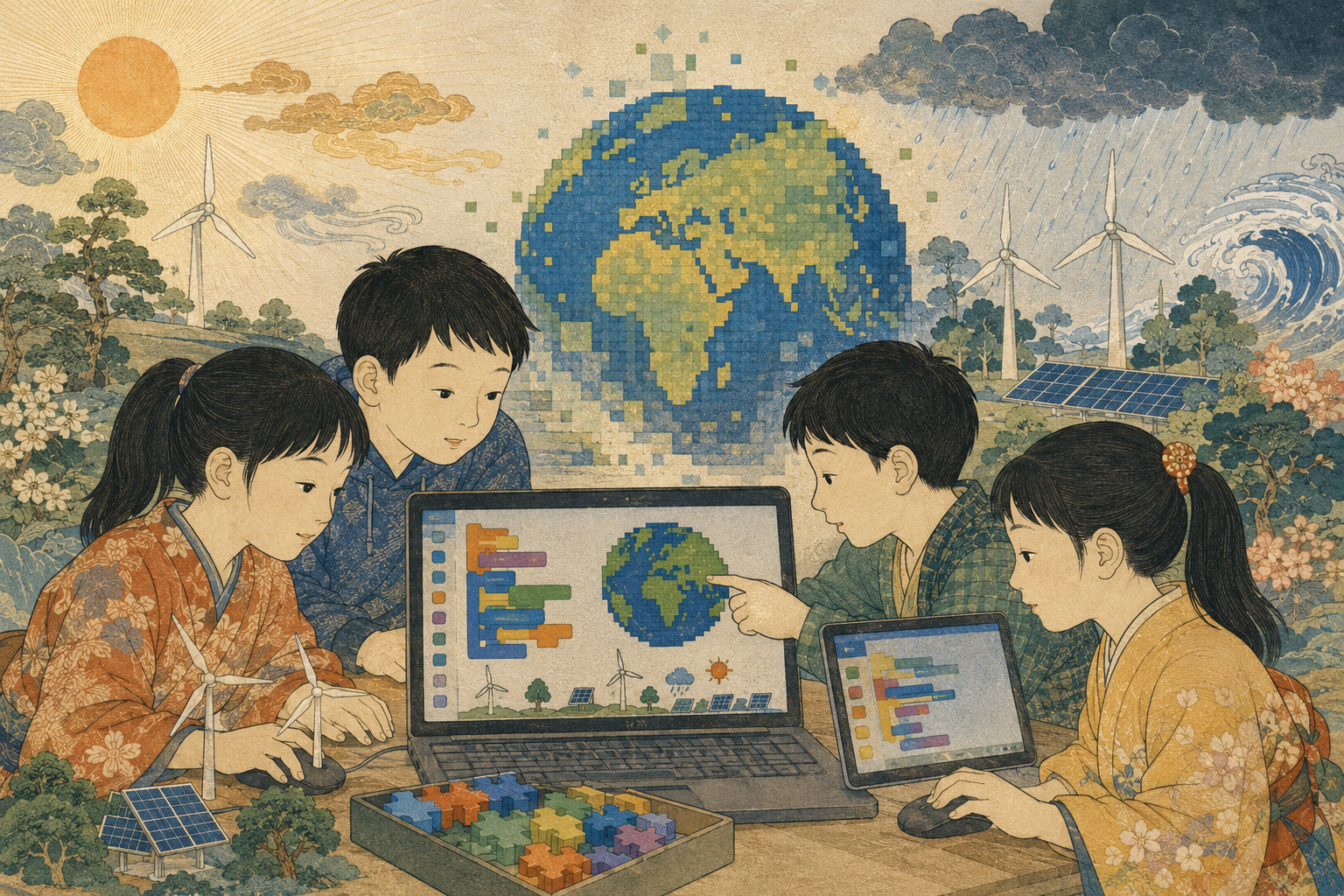
A game is a pocket-sized theory of the world. Give the player a switch and say that darkness protects an apple, and the theory is that household electricity use connects to greenhouse-gas emissions, warming and fruit. Give the player a wind turbine and the theory gains an energy system. Make the player plant trees, sell apples, choose a destination and live with both the income and carbon consequences, and the theory becomes an economy.
That progression appeared in a children’s programming contest created by Shinano Mainichi Shimbun, Nagano’s daily newspaper. Its theme was direct enough to fit on a classroom poster: “Save the Future of Shinshu Apples.” Individual students from first grade through the third year of junior high used Scratch, the visual programming environment built around colored blocks, to make games about protecting apples, protecting Earth or reducing carbon dioxide.
The youngest grand-prize winner, a second grader at Mure Elementary School in Iizuna, built Turn Off Wasteful Electricity and Protect the Apples! Switch OFF! A fifth grader at Seimei Elementary School in Ueda won the upper-elementary division with Connect Shinshu Apples with Renewable Energy! The junior-high prize went to a third-year student at Sugano Junior High School in Matsumoto for Apple Town Maker, a simulation in which planting trees costs money, shipping fruit raises revenue and the distance to market changes both income and carbon emissions.
Those three projects can be read as a ladder: act, connect, model. It would be unfair to rank the children’s understanding solely by age or game complexity. A simple mechanic can be beautifully communicated; a complicated one can be scientifically confused. But the ladder reveals an important difference between being told a climate fact and building a causal system that another person can test. Code forces a young designer to decide what changes what, by how much, in what order and with what consequence.
What the contest did—and what it did not establish
The contest was part of Shinano Mainichi’s “Apples and a Decarbonized Society—Go! Zero Carbon!” campaign. The newspaper began that project in 2024, using the prefecture’s signature fruit as a route into an enormous problem. Its first year included a public “one action” campaign and sales of apples grown with biochar. In year two, the project turned to children’s game design.
Students could start with a blank project or remix a supplied game. Even free-build entries had to use at least one official sprite. The rules permitted multiple submissions and optional presentation video. Nagano’s bear mascot Arukuma could appear under specified credit and animation conditions. The theme was broad; eligibility was national. The published qualifiers came not only from Nagano but also Hokkaido, Gunma, Tochigi, Tokyo, Kanagawa and Aichi.
The newspaper’s office conducted the first review for theme and rule compliance and planned to select about 30 projects. A second review considered overall content and whether the game operated. The jury chair was Tomoyuki Ote, representative director of game developer Asobism, which co-organized the contest. DIC JAPAN was the special sponsor; Nagano Prefecture and the prefectural board of education were supporters. Asobism’s involvement was locally rooted: the company has a Nagano branch, began a youth co-learning project there in 2014 and develops commercial games.
Each age group received one ¥50,000 grand prize and three ¥10,000 excellence prizes—approximately $314 and $63 at this page’s reference rate. The 30 first-round projects were published as playable works, and the grand prizes were promised newspaper and digital coverage.
| Published contest fact | Verified record | Important limit |
|---|---|---|
| Entry period | August 1–September 30, 2025 | The call is closed; this is not a 2026 entry notice |
| Eligibility | Individuals in grades 1 through junior-high year 3 | The published rules do not describe access support or participant demographics |
| Formats | Free build or remix; official sprite required | A common asset lowers entry barriers but also shapes the creative field |
| Published results | 3 grand, 9 excellence, 18 other first-round projects | Thirty published qualifiers are not the total number of applications |
| Judging | Compliance first; then overall content and operation | No detailed scoring weights, judge notes or science-validation method were located |
| Organizational status | Newspaper-led, company co-organized and sponsored, prefecture-supported | Support is not a school-system evaluation or public certification of outcomes |
That distinction is more than legal housekeeping. A competition rewards selected artifacts. An education evaluation asks what changed for participants, including those who did not win. It would compare prior and later knowledge, inspect misconceptions, examine design journals and interviews, ask who had equipment and mentoring, and follow whether students could transfer their reasoning to a new problem. None of that public evidence was found.
The contest can therefore support a modest, defensible conclusion: it elicited a diverse public collection of child-made climate games, including at least one unusually thoughtful systems model. It cannot establish that making the games improved climate knowledge across all entrants, changed household emissions or created durable programming skill.
Three winning games, three theories of agency
The lower-elementary grand prize makes one behavior visible: turn off an unnecessary light. For a seven- or eight-year-old, that clarity has power. The player receives immediate feedback. The designer connects an ordinary movement of the hand to a distant orchard. The child’s published message emphasized the accumulation of small daily effort.
But immediacy creates a teaching risk. Electricity does not have a single carbon consequence. Emissions depend on when power is used, what generators are operating and how the system changes over time. Homes are only one part of energy demand. A game that ends at the switch can accidentally teach that climate change is mainly a matter of children remembering better, while power producers, building owners, manufacturers, transport networks and governments remain outside the frame.
The upper-elementary winner adds renewable energy and family conversation. The creator said the project helped reveal the condition of the planet and hoped families would play together. That is an important expansion: climate learning is social. A game can become a prompt across generations rather than a worksheet completed and forgotten. Yet a turbine sprite still leaves questions. Where is it built? How is electricity stored or balanced? Who approves the project? Who benefits, who bears local impacts and what replaces the fossil generation?
Apple Town Maker goes further because it gives the player incompatible goods. Trees cost money. Apples provide money. Nearby and distant destinations change emissions and earnings. Farm size affects which choice makes sense. The student’s published explanation explicitly said that real environmental problems involve many connected factors and that the game was designed to express this difficulty.
The model is still an abstraction. Shipping distance alone does not determine a food’s climate footprint; transport mode, load factor, refrigeration, packaging, production method, waste and storage matter. Planting a tree is not an automatic carbon offset, and an orchard is managed agriculture, not a permanent forest. Revenue is not the same as farmer income. Those omissions do not invalidate a junior-high game. They create the lesson after play: identify the assumptions, ask which are consequential and revise the model.
| Grand-prize mechanic | What it can make thinkable | Question for the debrief |
|---|---|---|
| Switch off unused lights | Personal agency, energy conservation, repeated small actions | How does the power system determine the emissions actually avoided? |
| Connect apples to renewables | Energy substitution, family dialogue, collective imagination | What infrastructure, policy and local consent turn an icon into electricity? |
| Balance trees, sales, distance and CO₂ | Trade-offs, feedback, resource limits, local consumption | Which life-cycle factors and social consequences are absent from the model? |
Many other published entries used the language of defense: defeat CO₂, protect the apple, save Earth. That is understandable game design. An enemy gives the player direction. Scientifically, however, carbon dioxide is not a moral creature. It is also part of natural cycles; the problem is the human-driven increase in heat-trapping gases and the systems that produce it. A teacher can preserve the fun of a “carbon buster” while asking students to replace a villain with sources, stocks, flows and decisions.
From the Logo turtle to the Scratch cat
The contest belongs to a longer history of treating programming as a medium for thought, not merely preparation for software employment. In 1967, a team led by Wallace Feurzeig at Bolt, Beranek and Newman, working with Seymour Papert, created the first version of Logo. Papert had studied with developmental psychologist Jean Piaget. Logo’s famous turtle let a learner move an object by giving it instructions: go forward, turn, repeat.
The turtle was powerful because geometry became an action. A child could imagine being the turtle, predict a movement, run the command, see the mistake and revise. “Debugging” was not punishment for being wrong. It was how an idea became inspectable.
Scratch inherited that constructionist tradition. A team at the MIT Media Lab led by Mitchel Resnick launched Scratch publicly in 2007. Instead of typing every command with exact punctuation, a creator snaps colored blocks together, moves characters called sprites, sets variables, sends messages, makes loops and conditions, records sounds and draws scenes. In 2019, stewardship moved from MIT to the independent nonprofit Scratch Foundation.
The removal of syntax barriers is not the removal of thinking. A working climate game may require events, sequence, parallel action, conditional logic, iteration, variables, collision detection, coordinate systems, state and debugging. It also requires writing, drawing, sound, narrative, scientific selection and an idea about the player.
Karen Brennan and Resnick’s 2012 framework divides computational thinking into concepts, practices and perspectives. Concepts include the structures visible in code. Practices include testing, debugging, reusing and abstracting. Perspectives concern how a young person sees themself and the world: not only as a consumer of digital systems, but as someone who can express, question and connect through them.
That framework cautions against scoring a Scratch project by counting sophisticated blocks. The code alone cannot show whether the child understood it, copied it, received extensive adult help or can explain why the model behaves as it does. Brennan and Resnick recommended portfolios, interviews and design scenarios alongside artifact analysis. A climate contest that judges only polish and operation may miss the student whose unfinished simulation contains the sharper causal question.
1873 — Shinano Mainichi traces its founding to July 5, becoming part of Nagano’s civic infrastructure.
1874 — Nagano says state-distributed seedlings begin the prefecture’s apple cultivation.
1967 — The first Logo language is created for learning.
1977 — The UNESCO–UNEP Tbilisi conference establishes an international foundation for environmental education.
2002 — Japan proposes the UN Decade of Education for Sustainable Development.
2007 — Scratch launches publicly from the MIT Media Lab.
2019–2021 — Scratch Foundation stewardship and Japan’s one-device-per-student rollout broaden the digital context.
2020 — Programming education becomes required across Japanese elementary schools.
2024 — Shinano Mainichi begins its apple-and-decarbonization project.
2025–2026 — Children enter the Scratch contest; results and newspaper features follow.
Japan made programming part of general education
Japan’s elementary programming requirement began in the 2020 school year. It did not create a stand-alone coding subject or require every child to master a particular language. The Ministry of Education framed programming experiences inside existing subjects and broader learning, with an emphasis on “programming thinking”—breaking an intended result into logical steps and adjusting those steps.
The timing overlapped with the GIGA School initiative, which accelerated provision of one device per student and high-capacity networks. From April 2021, the ministry described one-to-one devices in elementary and junior-high schools as entering full-scale use. Junior-high technology education strengthened programming, networks and data; compulsory high-school Information I followed under the revised curriculum.
That policy context helps explain why a regional newspaper could expect children and families to recognize Scratch. It does not mean access is equal. A device may exist but be slow, filtered or shared at home. Internet quality, keyboard familiarity, disability access, teacher confidence, after-school time and an adult who can help with a stubborn bug remain uneven.
The climate theme has an equally deep educational history. The 1977 Tbilisi conference argued for environmental education that connects knowledge, values, skills and participation. At the 2002 Johannesburg summit, Japan proposed a UN Decade of Education for Sustainable Development; the UN General Assembly adopted it for 2005–2014 with UNESCO as lead agency. ESD later entered Sustainable Development Goal target 4.7 and the 2020–2030 framework.
In principle, programming and ESD fit well. Both resist a world divided into memorized boxes. A climate game can connect science, mathematics, agriculture, economics, language, art and civics. It asks not only “what is warming?” but “what can change, who can act and how would we know?”
In practice, the fit requires instruction. UNESCO’s curriculum review found that climate change was absent from more than half of nearly 50 national education plans and frameworks it examined, and that social-emotional and action-oriented competences were often neglected. Adding the word “climate” to a coding event does not solve those gaps. Teachers need time, scientific resources and ways to guide emotion without manufacturing either panic or false reassurance.
Why an apple is an honest climate instrument
Nagano’s apples are not an arbitrary mascot. The prefecture says cultivation began in 1874 when seedlings were distributed by the national government. When the silk industry suffered during the global depression in the early Showa period, apples were promoted as an alternative crop. Orchards became landscape, livelihood, brand and memory. Nagano now describes apples as its largest fruit crop by cultivated area and production, roughly one-fifth of Japan’s output and second nationally after Aomori.
An apple tree also registers weather across years. It needs winter chill, spring conditions for flowering and pollination, a long growing period, water, light and suitable temperatures as fruit matures. A factory can change a production line; a grower cannot move a mature orchard each summer. New cultivars, rootstocks and sites take years to prove.
Heat changes both fruit and labor. Red apple color depends partly on anthocyanin formation, which is inhibited by high temperatures, especially when nights stay warm. Strong sun and high fruit-surface temperature can cause sunburn. Heat and rainfall patterns influence maturation, acidity, firmness, storage, pests and disease. Earlier bloom can increase exposure to frost even as the average climate warms.
The contest’s two most visible claims—poor red color and sunburn—are supported by local observation. In August 2025, the Nagano Prefecture Fruit Tree Experiment Station reported widespread sunburn after high temperatures from June and severe heat in late July. Shade materials were already used but cost labor and money and could be difficult on large trees. The station compared irrigated and unirrigated plots, observed lower tree-surface temperatures with ground irrigation and said it would assess fruit sunburn and color. In October, it again noted that unstable weather was making shape and color problems more likely.
The national climate signal is also clear. The Japan Meteorological Agency says Japan’s 2025 summer was the hottest in records beginning in 1898, with a June–August anomaly of +2.36°C against the 1991–2020 average. The country’s annual temperature has risen at 1.44°C per century through 2025. Human activities, principally greenhouse-gas emissions, have unequivocally caused global warming, the IPCC concludes; it also emphasizes unequal contributions and that each increment of warming intensifies multiple hazards.
This is why “save the apple” cannot mean mitigation alone. Emissions must fall, but trees already in the ground need adaptation. A richer game could let a player test shade, irrigation, canopy management, heat-tolerant color traits, harvest timing, insurance, storage, higher-elevation sites, water limits and labor. It could add late frost, hail, pests and a budget. It could make one solution reduce one risk while increasing cost or creating another.
| Orchard response | Climate logic | Trade-off a game could expose |
|---|---|---|
| Shade net or fruit protection | Reduces radiation and fruit-surface heat | Material, installation labor, wind risk and effects on color |
| Ground irrigation | Can cool the tree environment and ease water stress | Water availability, energy, infrastructure and timing |
| Canopy and leaf management | Balances light for coloring against sunburn exposure | Labor, fruit quality, disease conditions and heat |
| New cultivar or rootstock | May improve heat response, color or phenology | Years of testing, buyer acceptance and brand identity |
| Move or expand uphill/northward | Seeks cooler future conditions | Land, water, roads, community, soil and loss of established orchards |
| Lower emissions | Limits the magnitude of future warming | Requires action across energy, transport, land use and consumption—not orchards alone |
A better game makes its assumptions playable
Every model excludes most of reality. Good model-making is not the fantasy of including everything; it is the discipline of making important exclusions visible. A student should be able to say: “In my game, distance stands in for freight emissions,” or “this score counts electricity but not the materials in the solar panel.” The statement converts a hidden simplification into a testable design decision.
Climate games become more educational when cause and effect are separated by time, when actions have opportunity costs, when more than one actor exists and when outcomes are uncertain. Immediate green points can motivate a young player. Delayed heat, cumulative emissions, crop cycles and political decisions teach a different truth: systems remember.
| Design element | Shallow version | Stronger learning version |
|---|---|---|
| Carbon | Enemy sprites disappear when clicked | Sources add to a stock; sinks remove part; accumulated stock affects risk |
| Energy | Renewable icon awards points | Demand varies; supply, storage, cost and grid limits interact |
| Agriculture | Planting trees always wins | Orchards need years, water, labor, land and markets |
| Choice | One obviously correct button | Several defensible options distribute costs and benefits differently |
| Time | All effects are immediate | Delays, thresholds and future scenarios reveal path dependence |
| Assessment | Score equals knowledge | Player explains assumptions, evidence, uncertainty and revisions |
Research supports cautious optimism. Reviews of serious games in environmental education commonly find gains in engagement, knowledge or attitude, but studies vary in design and many do not measure long-term behavior. A 2026 review of 175 environmental-resilience studies found that evaluation often stops at motivation; dynamic disruption, feedback and resource trade-offs were more likely to support higher-order resilience thinking. One 2024 qualitative climate-game study involved only one teacher and eight students—useful for insight, far too small for a universal claim.
The educational mechanism is not “games are fun, therefore children learn.” It is a sequence: build or play; predict; observe; explain; compare with evidence; revise; and transfer the reasoning to another system. The debrief is part of the game.
Access, prizes, sponsorship and children’s privacy
Competitions can open a door. A deadline focuses attention; public play gives a child an audience; prizes tell families that creative technical work matters. Remixing lowers the first step. A student can inspect a working project and alter one rule instead of staring at a blank canvas. Scratch was designed around this culture of making and sharing.
Competitions also select for resources that may be invisible on the results page: a fast device, stable internet, a coding club, a parent who understands Scratch, a quiet room, spare weekend hours and confidence in written Japanese. “Individual entry” does not mean “unaided creation.” Fair judging should ask entrants to disclose forms of help without shaming collaboration, and organizers should provide loan devices, accessible templates, beginner clinics and offline or school-based submission routes.
The official scoring language emphasized game completeness, overall content and operation. Those are reasonable qualities, but they can favor polish over inquiry. Future rounds could publish separate scores for climate reasoning, model transparency, player experience, accessibility, originality, iteration and explanation. A short artifact interview would help judges distinguish decorative complexity from understood code.
Sponsorship deserves daylight, not suspicion by default. A newspaper, game company and commercial sponsor can contribute distribution, expertise, staff time, prizes and tools that schools cannot easily fund. The safeguards are disclosure and independence: identify who wrote the climate material, who selected assets, whether sponsor products appear, whether judges see entrant identities, how conflicts are handled and whether critical ideas—including structural regulation, not only consumer action—are welcome.
Privacy needs special care because the creators are children and Scratch is public. The contest required guardian consent and prohibited privacy violations. Its result page nevertheless pairs winners’ schools, grade levels and Scratch usernames, while Scratch’s community guidelines advise users not to share real names, hometowns, schools or contact information. Consent may cover publication, and the contest page does not publish the children’s full names, but combining school, grade, project and platform identity can increase linkability.
- Explain before entry exactly which school, grade, display name, username, image, video and quotation may be published, for how long and where.
- Let a family choose a contest-only pseudonym and avoid linking a child’s school directly to a persistent platform profile unless necessary.
- Separate guardian contact data from public judging files and set retention/deletion dates.
- Moderate comments and provide a route to remove or anonymize a result later without forfeiting the award record.
- Record the platform terms and reuse license effective at submission; do not rely on an older explanation after terms change.
- Provide an accessible, private judging route for children who should not publish a project to the open community.
None of these measures requires hiding children’s achievement. It means celebrating the work with the minimum personal data needed. A child’s model should remain discoverable because its idea is good, not because an internet search permanently joins a school and username.
Do not hand children an adult debt
Climate education often walks a narrow ridge. On one side is helplessness: the crisis is too large, so nothing a child does matters. On the other is moral outsourcing: adults praise children for switching off lights while continuing to design carbon-intensive energy, transport, housing, agriculture and finance.
The IPCC’s language matters here. Historical and ongoing contributions are unequal. Climate risk is produced by systems and distributed unevenly. A responsible contest can build agency without pretending responsibility is equal. It can place household conservation beside corporate investment, public infrastructure, regulation, voting-age decisions, international cooperation and agricultural adaptation.
One game could assign different players the roles of orchardist, utility, town government, household, transporter and retailer. Each would have a budget, powers and constraints. No player could win alone. Another could ask the player to compare a low-emissions pathway with a high-warming pathway while adapting the same orchard. A third could make fairness visible: which neighborhood loses land, who pays for irrigation, who receives renewable revenue and whose work increases during a heat wave?
Children should be allowed joy, weirdness and imaginative excess. A climate game need not become a municipal spreadsheet. The task is to preserve play while adding questions that resist easy virtue.
What a second edition should measure
As of the reporting cutoff, Japan.co.jp did not locate an announced 2026 edition. If the project returns, the strongest advance would not be a larger prize or more entries. It would be a clearer learning architecture and a public results report.
| Claim | Evidence to collect | Why it matters |
|---|---|---|
| The contest reaches broadly | Total starts and submissions by region, age, school setting, access route and accommodation—reported without identifying children | Shows who could participate, not only who won |
| Climate understanding improves | Short pre/post concept maps, misconception checks and retained learning months later | Separates excitement from durable knowledge |
| Programming thinking grows | Design journals, code snapshots, debugging stories and artifact interviews | Captures process and understood authorship |
| Games model real systems | Published rubric, climate/agriculture reviewer notes and creator assumption statements | Makes scientific quality inspectable |
| Participation is safe | Consent choices, data-retention report, moderation response and removal requests | Treats privacy as an outcome, not paperwork |
| The project benefits the region | Orchard visits, farmer feedback, classroom reuse, teacher training and open lesson materials | Connects a media event to continuing public learning |
Shinano Mainichi is unusually well placed to do this. Founded in 1873, it has spent more than a century and a half turning local events into a shared record. A newspaper can convene schools, researchers, growers, game makers, businesses and readers. It can also do what a contest organizer rarely does: report critically on its own project, including gaps and unpopular findings.
The best next step would bring children into that reporting. Let them interview orchardists about sunburn, workers about heat, scientists about uncertainty and power companies about the grid. Let them publish model cards beside each game: data source, main assumption, excluded factor, surprising bug and one revision they would make. Let players send back not only a score but a question.
The lasting image of this contest is not a child defeating a cloud of CO₂. It is the student who decided that an apple cannot be protected without thinking about money and distance. That design move refuses two comforting fictions: that environmental choices are costless, and that the economy sits outside nature.
Scratch makes such a system small enough to hold on a laptop. The newspaper makes it public. An orchard makes it local. Education begins when the adults do not stop at applause—when they ask what the model omitted, improve the real system it represents and give the child evidence that serious attention can travel both ways.
Reporting notes and principal sources
This article reviews public information available through August 11, 2026 at 8:06 AM JST. Contest descriptions, rules, prize details, creator statements and results are attributed to Shinano Mainichi’s official project pages. Thirty is the number of published first-round works, not a reported total entry count. The article does not reproduce children’s platform usernames. No claim of learning impact is inferred from winning or publication.
- Shinano Mainichi official contest results: 30 published projects, winners, creator statements, rules, prizes and organizers
- Official contest feature: entry dates, free/remix routes, judging process, sprite rules, privacy statement and ceremony
- Shinano Mainichi release, August 21, 2025: project background, national call, optional video and 2024 campaign history
- Official feature archive: January 22–23, 2026 newspaper pages
- Shinano Mainichi corporate history: July 5, 1873 founding and company profile
- Asobism profile: Tomoyuki Ote, Nagano branch, youth project history and game-development business
- Nagano Prefecture: apple cultivation since 1874, silk-industry transition and national production position
- Nagano Fruit Tree Experiment Station, August 2025: apple sunburn and irrigation cooling trial
- Nagano Fruit Tree Experiment Station, October 2025: heat injury and unstable-weather color/shape problems
- Nagano Fruit Tree Experiment Station: cool-temperature and light requirements for red coloring
- Journal of Agricultural Meteorology: synthesis of warming effects and adaptation constraints in Japanese apple cultivation
- Japan Meteorological Agency: 2025 was Japan’s hottest summer in the 1898–2025 record
- Japan Meteorological Agency: 2025 annual anomaly and 1.44°C-per-century national trend
- IPCC Sixth Assessment Synthesis: causes, unequal contributions and observed impacts of global warming
- Logo Foundation: the 1967 origins of Logo and its learning purpose
- Scratch Foundation: 2007 MIT development, 2019 transition and creative-learning mission
- MIT Media Lab: Brennan and Resnick’s computational-thinking framework
- Scratch Community Guidelines: respect, remixing, safety and keeping personal information private
- Scratch Team, January 2026: announcement of updated terms and parental-permission changes
- Ministry of Education: programming education required in elementary schools from 2020
- Ministry of Education: full-scale one-device-per-student use from April 2021
- Ministry of Education: Japan’s ESD proposal, SDG 4.7 and ESD for 2030
- UNESCO–UNEP: 1977 Tbilisi environmental-education conference report record
- UNESCO: climate education, mitigation, adaptation and resilience
- UNESCO curriculum review: climate, biodiversity, teacher-training and action-competence gaps
- Integrative Conservation systematic review: serious games in environmental education
- 2026 systematic review: game-based learning, systems thinking and environmental resilience