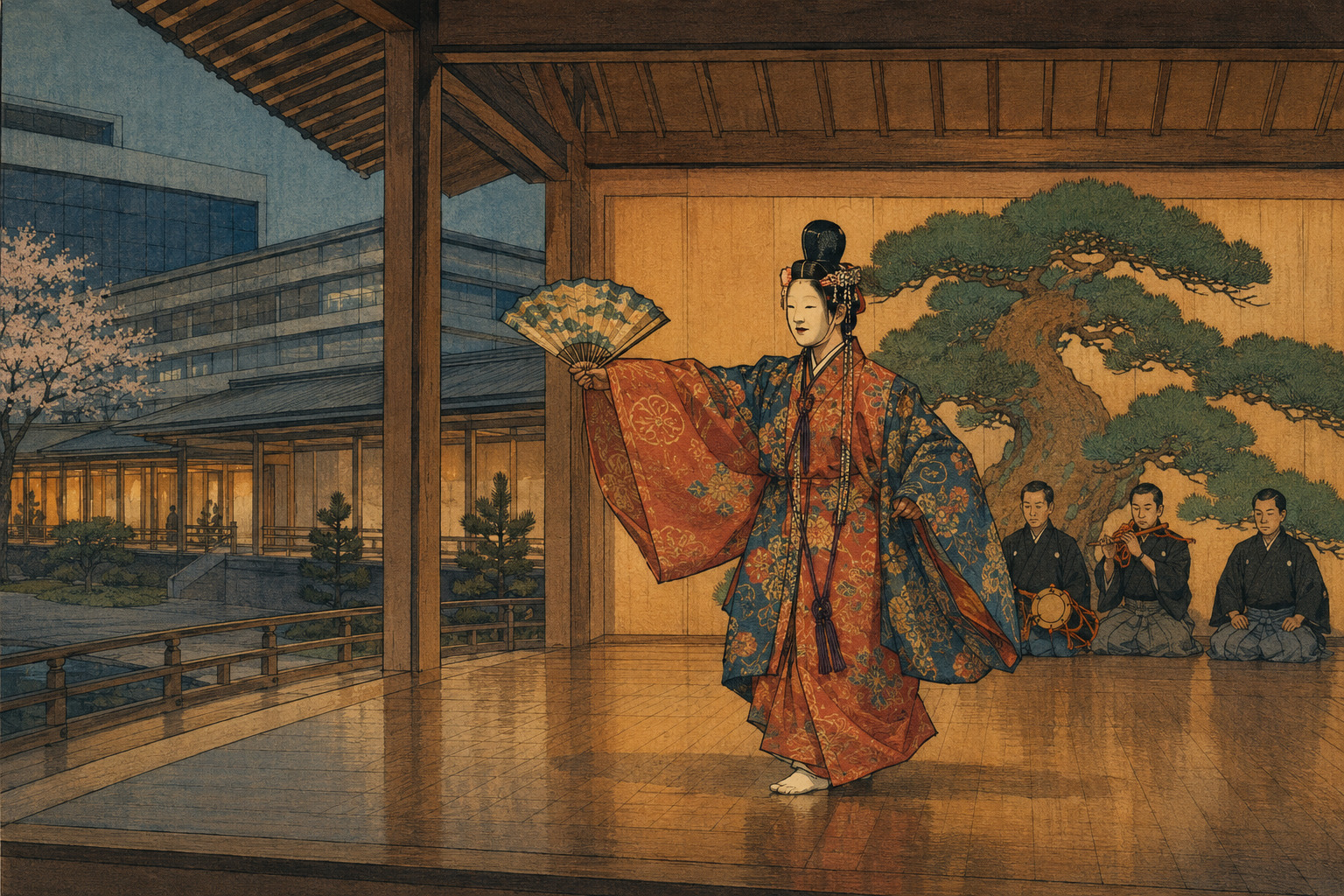
Casting a younger actor gives that person visibility. Letting the actor choose the repertory gives something harder: responsibility. The eighth year of Shibuya-Noh is built around that distinction. Its three principal performers are not handed a uniform season theme; each selects a work through which to test and present an established practice.
The annual project began in fiscal 2019 at the Cerulean Tower Noh Theatre, the venue’s official English name. The organizer describes it as both a place for younger Noh professionals to refine their art and a way for audiences to follow those performers over time. The 2026–27 cycle consists of four Friday evenings from August 28 through March 26.
“Across schools” requires a careful reading. The Komparu, Kongo and Kanze performers do not merge their performance systems into one new hybrid. Each of the first three nights preserves a school identity. The curatorial boundary is crossed by presenting those nights within one sustained series, then placing all five shite schools together in shorter forms at the finale.
One season, three sharply different dramatic worlds
| Date | School and featured performer | Program |
|---|---|---|
| August 28, 2026 | Komparu Masahiro Nakamura | Kamo, in which the ancestral deity Mioya and the thunder deity Wakeikazuchi appear to bless the harvest and protect the land. |
| January 22, 2027 | Kongo Tatsushige Udaka | Kazuraki, a winter work of deep snow, a mountain ascetic and a goddess released from suffering who performs a Yamato dance. |
| February 26, 2027 | Kanze Hikaru Uzawa | Sumidagawa, the tragedy of a mother who reaches the Sumida River while searching for her abducted child and learns of his death. |
| March 26, 2027 | All five shite schools Izumi-school Yuki Nomura | Shimai, maibayashi, kyogen and a closing talk. The individual works and complete cast remain unannounced. |
The sequence moves from divine celebration to a snow-covered goddess and then to devastating parental grief. That contrast demonstrates the emotional and theatrical range contained within Noh. It should not be treated as a declared season narrative, however: the organizer has not announced a common theme linking the three selections.
The opening night shows what “next generation” means here
Masahiro Nakamura of the Komparu school chose Kamo. In the official cast, he performed the village woman in the first part and Wakeikazuchi, the thunder deity, after the interval. Yudai Amemiya took the corresponding woman and the deity Mioya. The arrangement brings two divine presences to the later section, with celestial dance followed by vigorous movement that celebrates agricultural abundance and protection.
Nakamura was born in 1978 and first appeared onstage as a child in Sakuragawa in 1985. His official biography records completion of demanding works including Shakkyo, Midare, Dojoji and Okina. He has also run a Noh classroom for students from preschool through high school for more than 15 years. The label “younger performer” therefore identifies his place in cultural succession, not a lack of professional maturity.
As of the reporting cutoff, the theatre had not published an opening-night report, attendance figure or account of how the performance unfolded. Japan.co.jp did not attend, so this article describes the verified program and institutional design rather than reviewing the August 28 performance.
The schools remain distinct—and become easier to compare
Noh’s principal actors belong to five shite schools: Kanze, Komparu, Hosho, Kongo and Kita. School affiliation carries repertory, vocal practice, movement and inherited staging decisions. A cross-school platform becomes valuable when it makes those differences legible rather than flattening them.
The closing night is designed for that comparison. Shimai extracts a dance passage and ordinarily presents it without mask, full costume or instrumental ensemble, supported by chant. Maibayashi presents a larger danced portion with chant and the Noh flute and drums. Their relative compression places attention on movement, rhythm and vocal structure.
The March program will also include Izumi-school kyogen with Yuki Nomura and a closing discussion. The organizer has not yet named the shimai and maibayashi works, the five shite performers, Nomura’s kyogen piece or the discussion participants. Those omissions matter because they prevent a detailed assessment of how evenly the finale represents the schools.
Interpretation is built into the evening
Each performance begins with an explanation by Noh critic Naoki Kaneko. The theatre says audiences also receive a program containing a synopsis, related reading and the shisho—the sung and spoken text. After the performance, an artist talk returns the featured performer to the stage to discuss impressions and future intentions outside the role.
The featured artists also lead advance sessions for the first three nights. Admission is free with the corresponding performance ticket or ¥500 without it, and reservations are required. Nakamura’s session took place on August 21. Dates for the Udaka and Uzawa sessions have not yet been announced.
The first three nights offer the Noh-Sup caption system for ¥500 per device, subject to limited availability. The official page specifically confirms English explanations and describes synchronized, automatically scrolling guidance intended to assist first-time spectators as well as older and disabled visitors. It does not publish a complete list of available languages or guarantee devices for every requested seat.
Four Friday evenings near Shibuya Station
The Cerulean Tower Noh Theatre is on basement level two of the Cerulean Tower Tokyu Hotel at 26-1 Sakuragaoka-cho, about five minutes on foot from Shibuya Station. Every Shibuya-Noh performance is scheduled to begin at 6:30 p.m., with doors opening at 6.
Single-performance prices are ¥7,500 for S seats facing the stage, ¥6,500 for A seats at stage right, ¥5,500 for B seats and ¥3,500 for unreserved student seating on the tatami area. Student tickets require identification and are sold only through the theatre. Preschool-age children are not admitted.
General sales are scheduled to open November 22 for the second night, December 25 for the third and January 26, 2027, for the finale. Four-performance passes and hotel dining packages were sold earlier, but their published sales window and August 28 exchange date have passed. Their present availability cannot be inferred from the remaining listing.
Reporting note: This report uses official Japanese material from the Cerulean Tower Noh Theatre, Tokyu Bunkamura, the Nohgaku Performers’ Association and performer organizations published through 12:15 p.m. JST on August 29. It is not a firsthand review of the first night.
- Cerulean Tower Noh Theatre — complete Shibuya-Noh season, purpose, dates, ticket terms and related programs
- Cerulean Tower Noh Theatre — first-night cast, Kamo synopsis and Masahiro Nakamura biography
- Tokyu Bunkamura — official eighth-year announcement and descriptions of all four nights
- Cerulean Tower Noh Theatre — official English venue and Shibuya-Noh names
- Cerulean Tower Noh Theatre — official English access information
- Cerulean Tower Noh Theatre — official glossary for shite-kata, shimai and maibayashi
- Nohgaku Performers’ Association — Tatsushige Udaka, Kongo school and collective designation
- Nohgaku Performers’ Association — Hikaru Uzawa, Kanze school and collective designation
- Nohgaku Performers’ Association — Yuki Nomura and Izumi-school kyogen
- Nohgaku Performers’ Association — Kamo repertory entry
- Nohgaku Performers’ Association — Kazuraki repertory entry
- Nohgaku Performers’ Association — Sumidagawa repertory entry