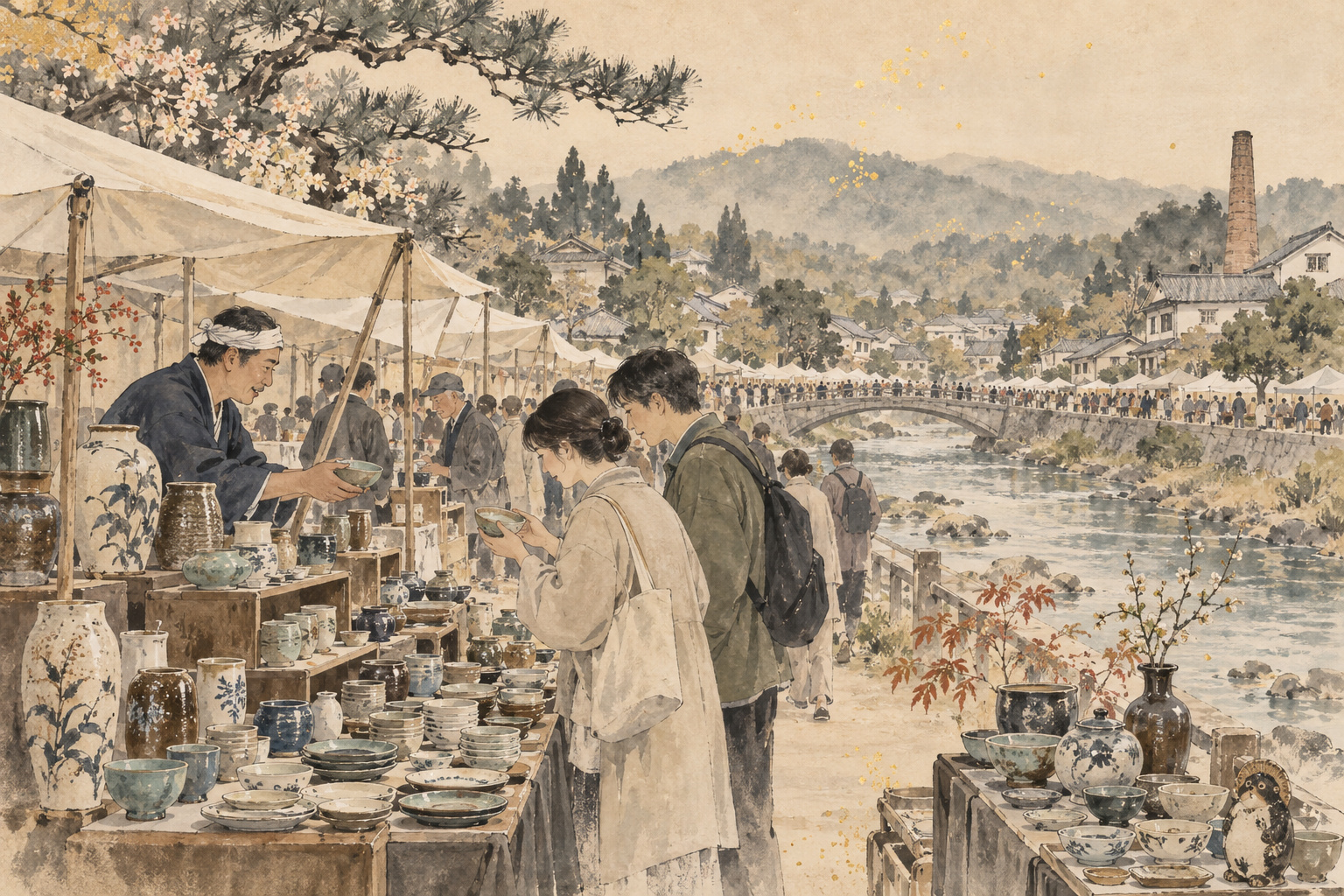
A bowl can be a useful place to begin the history of a city. At the 95th Setomono Festival, scheduled for September 12–13, Seto’s streets around Owari Seto Station and the Seto River become a marketplace for ceramics. The city’s visitor information anticipates about 200 pottery sellers at the main bargain market. Sunday’s published hours are 9 a.m. to 5:30 p.m. [1]
The immediate attraction is straightforward: look, compare and find something worth taking home. But the objects also raise a larger question. How did one place become associated with both ordinary tableware and ambitious ceramic art, with pottery and porcelain, with inherited skills and repeated technical change? The festival brings those histories within reach of a shopper’s hand.
A bargain market born in hard times
The commercial character of the festival is part of its history. According to the account maintained by the Seto ceramics wholesalers’ cooperative, the Setomono Festival name came into use in 1932, when a bargain sale was held alongside commemorations of potter Katō Tamikichi. The account links the sale to efforts to clear accumulated stocks during the Depression and help an industry under pressure. [2]
Selling was therefore central to the occasion. A ceramic industry needs people who use and buy its products, as well as people who admire their workmanship. The festival’s combination of commemoration and trade makes that relationship unusually visible.
This year’s program names the Dai Setomono Matsuri Kyōsankai as organizer and lists participating bodies spanning municipal government, the chamber of commerce, ceramic manufacturing, wholesaling, silica-sand mining and shopping streets. A producing town is a network of occupations. The market is one moment when that network meets its customers. [3]
Tamikichi and the work of learning
The potter commemorated by the festival is remembered in Seto as its “porcelain ancestor,” or jiso. Yet the municipal account of Katō Tamikichi’s career is more interesting than a simple story of a lone founder bringing an entirely unknown material home.
Seto City explains that Tamikichi and his father had already learned porcelain-making methods and undertaken trial firings before his Kyushu journey. Seeking better techniques, he travelled in 1804 and learned in places including Amakusa and Saza. He returned in 1807 and contributed to the development of Seto’s porcelain production. The city also identifies support from Seto village and the Owari domain for the journey. [4]
That history gives tradition an active meaning. Knowledge had to be sought, practised and adapted within an existing industry. Seto’s continuity depended in part on its capacity to absorb something new.
Before porcelain, centuries of kilns
By Tamikichi’s time, ceramic production in Seto already had a long past. The official Six Ancient Kilns account places ash-glazed pottery kilns in the area in the late tenth century and the emergence of the glazed wares known as Ko-Seto around the late twelfth and early Kamakura period. Local deposits of kibushi and gaerome clay, together with the surrounding landscape and fuel resources, supported production. [5]
Seto is counted among Japan’s Six Ancient Kilns, alongside Tokoname, Shigaraki, Tamba, Bizen and Echizen. Its products circulated so widely that setomono became a general Japanese word for ceramics. The word carries a place inside an everyday category of things. [6]
That does not make every ceramic sold in Japan a Seto product, or every festival purchase identical in origin. It does help explain why this market has a particular cultural weight. Here, a common word returns to the producing town from which it took its name.
Blue brushwork—and a connection to Baiitsu
Seto sometsuke ware offers a particularly clear meeting of painting and ceramic technique. The Association for the Promotion of Traditional Craft Industries describes its development through the interaction of porcelain-firing knowledge and pictorial instruction, with its techniques established by the middle of the nineteenth century. [7]
The association names Yamamoto Baiitsu and Yokoi Kinkoku among the painters associated with the development of its ceramic painting. Baiitsu, the artist chosen for this Sunday’s art feature, consequently has a connection to Seto beyond the visual style of our accompanying illustration. Painting on paper and painting on vessels were not entirely separate worlds. [7]
Sometsuke generally involves painting with cobalt-based gosu pigment before applying glaze and firing. Attention to the blue’s density, the rhythm of a line and the space left around it can make a vessel more rewarding to examine. The craft association also notes that Seto sometsuke includes decorated pottery as well as porcelain; a blue-and-white appearance alone does not settle the material. [7]
Look beyond the finished object
The Seto-Gura Museum provides another route into the town’s work. Opened in 2005, it reconstructs elements of Seto in the later 1950s through the early 1970s, including the old station, a ceramic workshop called a moro, a coal-fired kiln and chimneys. An upper floor traces the longer ceramic history through objects and archaeological material. [8]
These industrial settings matter. A town’s ceramic culture is not explained solely by exceptional objects with famous signatures. It also includes the capacity to produce everyday wares, move them and sell them. A bowl seen in a market can be understood as the end of that chain of work.
There is a second anniversary to explore this year. Seto City Art Museum’s exhibition marking 90 years of the Seto Ceramic Art Association runs until September 27. The organizers describe a presentation of 125 works following the association established in 1936. Its ninetieth anniversary and the festival’s ninety-fifth edition are different milestones, but together they offer a way to think about artistic ambition and commerce in the same town. [9]
The next makers need more than a festival
Seto’s infrastructure also includes places for emerging makers to work. The Seto City New Century Crafts Museum provides training in ceramics and glass, with participants developing their own projects and production plans. Its account describes technical staff supporting work in the studios. [10]
The festival program, meanwhile, includes work by trainees and graduates of the Seto Sometsuke Crafts Center, along with opportunities to try ceramic painting. This creates a connection between learning and selling: a chance for makers to encounter responses to their work, and for visitors to see something of the experimentation behind a finished object. [3]
No two-day event can by itself secure a craft’s future. Access to equipment, skilled advice, space and customers has to continue through the rest of the year. The festival can make those relationships visible; sustaining them remains the longer task.
A Sunday visit with a purpose
Sunday’s main market is scheduled to finish at 5:30 p.m. The official program explains that designated sellers display shop numbers and attach shop-name labels to purchases. Keeping that identification is useful if a question arises after returning home. [1][3]
For someone choosing an everyday vessel, practical questions can deepen the encounter. How does its weight feel? Is the rim comfortable? Will it fit the cupboard or stack as needed? Ask the seller about microwave and dishwasher suitability instead of inferring it from appearance. Asking who made a piece, and where, can be as valuable as asking its price.
Travel information needs particular attention this weekend. The local tourism notice asks visitors to use public transport because parking is limited. Its September 11 update closes the Minase Junior High School parking area because of rain; the municipal Miyagawa car park is also unavailable. Check the official page before setting out for weather-related changes. [1]
The best purchase may be modest: a bowl used at breakfast, a small plate brought out repeatedly, something whose weight and decoration become familiar. Knowing a little about its making gives that ordinary use another dimension. Seto’s street market connects a producing place with daily life one such choice at a time.
- Seto official tourism: 95th festival and September 11 access updates
- Seto ceramics wholesalers’ cooperative: festival history and the 1932 sale
- Festival organizing association: official 95th festival program (PDF)
- Seto City: Tamikichi, his Kyushu study and porcelain development
- Six Ancient Kilns official site: Seto history, materials and production
- Seto official tourism: the Six Ancient Kilns and the word setomono
- Association for the Promotion of Traditional Craft Industries: Seto sometsuke, techniques and painters
- Seto City: Seto-Gura Museum and its displays
- Seto City Cultural Promotion Foundation: 90-year ceramic association exhibition, August 1–September 27, 2026
- Seto City Cultural Promotion Foundation: New Century Crafts Museum training