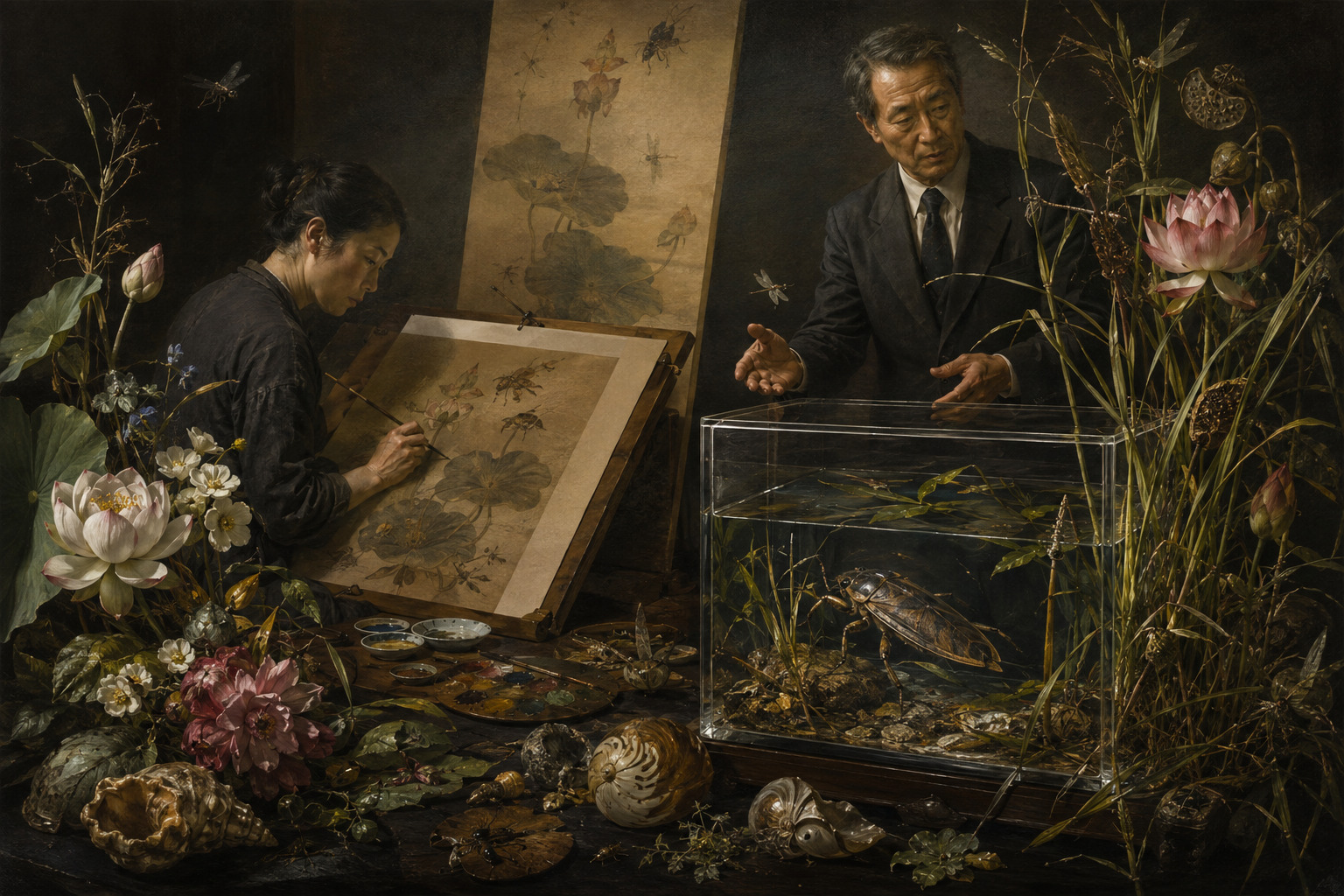
Three days after an art historian discusses why painters learn by copying, a natural-history curator will stand in the same gallery to explain a giant aquatic insect newly confirmed in Saga Prefecture. The subjects sound like a deliberately eccentric pairing. Institutionally, they reveal something more practical: one prefectural program opening two different kinds of curatorial work to the public.
The September 2 and September 5 events are separate 90-minute lectures, not a combined interdisciplinary seminar. They have different speakers and independent subjects. Both belong to the 2026 second-half 博物館・美術館セミナー series run by the Saga Prefectural Museum and Saga Prefectural Art Museum, and both will be held in the art museum’s second-floor gallery.
A Rare Insect, Newly Confirmed in Saga
Curator Kyōsuke Okuda will lead the Saturday lecture, officially titled 水生昆虫の王様、タガメの生物学—“The Biology of the King of Aquatic Insects, the tagame.” The museum says the presence of the species was confirmed in Saga Prefecture for the first time in April 2026. The talk will use that finding to introduce the animal, the pressures behind its decline, new biological findings and conservation work by museum curators.
“King of aquatic insects” is the program’s rhetorical title, not a scientific rank. Japan’s Environment Ministry lists the tagame in the family Belostomatidae under the scientific name Kirkaldyia deyrolli. It is categorized as Vulnerable on the national Red List and has been designated a 特定第二種国内希少野生動植物種, a special type of Class II nationally rare species, since 2020.
That designation targets commercial pressure while allowing room for habitat-based conservation. The ministry explains that species dependent on secondary environments such as satoyama can recover when their surroundings improve, but commercial mass collection can push them further toward extinction. Commercial capture, sale and distribution are therefore regulated.
Okuda’s public research record helps establish the subject expertise without resolving those undisclosed details. An official Saga research forum lists him as a museum curator and gives the reading of his name as おくだ・きょうすけ. The museum’s 2026 research journal also lists him as co-author of a review of published records for true bugs in Saga Prefecture. Neither source, however, serves as a full technical report on the April giant water-bug confirmation.
Copying as Study, Not Counterfeiting
Wednesday’s lecture, えがいて、まねぶ―「模写」の世界―, is led by Kōsuke Nonaka, head of the museums’ curatorial division. The official preview says copying earlier masterpieces was once widely used to learn technique and artistic sensibility. It cites Vincent van Gogh as one artist who learned from existing works and says the meaning and value assigned to copying have changed over time.
Copying in this context is not counterfeiting. The object is not to conceal authorship or manufacture a false provenance; it is to slow down observation and test how another image was built. Nonaka’s lecture will trace that practice mainly through examples from modern Japanese art.
The advance material does not name all of the artists or works that Nonaka will discuss. It also does not offer a universal theory of copying. Those specifics must wait for the lecture; preview copy should not turn a program description into conclusions the speaker has not yet presented.
What a Combined Museum Can Put in One Program
Saga’s second-half seminar calendar ranges beyond these two September talks. Later sessions cover Hizen swords, painter Saburōsuke Okada and Taiwan, impression fossils, Nihonga in Saga, seals in historical documents and the making of museum specimens. The series does not force those subjects under one conceptual theme. It uses a common public format to expose the breadth of the institutions’ research.
Both September sessions run from 1:30 to 3 p.m. at the Saga Prefectural Art Museum, 1-15-23 Jōnai, Saga City. Admission is free. Each is limited to the first 50 people, with no advance application; on-site reception begins at 1 p.m. The organizer warns that schedules or content may change or be cancelled and asks visitors to check its website or email notices before traveling.
| Art seminar | えがいて、まねぶ―「模写」の世界― |
|---|---|
| Date and speaker | Wednesday, September 2, 1:30–3 p.m.; Kōsuke Nonaka, head of the curatorial division |
| Natural-history seminar | 水生昆虫の王様、タガメの生物学 |
| Date and speaker | Saturday, September 5, 1:30–3 p.m.; Kyōsuke Okuda, curator |
| Venue | Second-floor gallery, Saga Prefectural Art Museum, 1-15-23 Jōnai, Saga City |
| Admission | Free; first 50 people for each session; no advance registration; reception from 1 p.m. |
Copying transfers sight into the movement of a hand. Natural-history research turns repeated observation into a defensible record of where a species lives. The methods and objects remain distinct. What connects them is the decision to let the public see knowledge being made—not only the finished painting on a wall or the labeled specimen in a case.
- Saga Prefecture: 2026 second-half Museum and Art Museum seminars (Japanese; August 27, 2026; schedule, speakers, venue, capacity and admission)
- Saga Prefectural Museum and Art Museum: art-copying seminar (Japanese; official title, preview, date and Nonaka’s role)
- Saga Prefectural Museum and Art Museum: giant water-bug seminar (Japanese; first Saga confirmation, preview, date and Okuda’s institutional affiliation)
- Saga Prefectural Museum and Art Museum: exhibition page (Japanese; official reading of Kōsuke Nonaka’s name)
- Saga Prefecture: fifth cultural-property research presentation (Japanese; official reading of Kyōsuke Okuda’s name and research topic)
- Saga Prefectural Museum and Art Museum: research publications (Japanese; Okuda’s co-authored review of true-bug records)
- Environment Ministry: nationally rare wild species list (Japanese; taxonomy, scientific name and special Class II designation)
- Environment Ministry: Japan Red List 2018 (Japanese PDF; Vulnerable status)
- Environment Ministry: 2020 Environmental White Paper (Japanese; habitat context, commercial collection and the special Class II system)
This report relies primarily on Japanese-language institutional material published by Saga Prefecture, the museums and the Environment Ministry and available by the morning of August 31, 2026 JST. The two events are separate lectures in the same series and venue, not one combined seminar. “King of aquatic insects” is treated as the organizer’s title, not scientific terminology. The precise Saga habitat, individual count, confirmation method, breeding status, site-specific conservation work, complete art-example list and post-event attendance or response were unavailable or had not yet occurred. The image is editorial illustration, not documentary evidence.