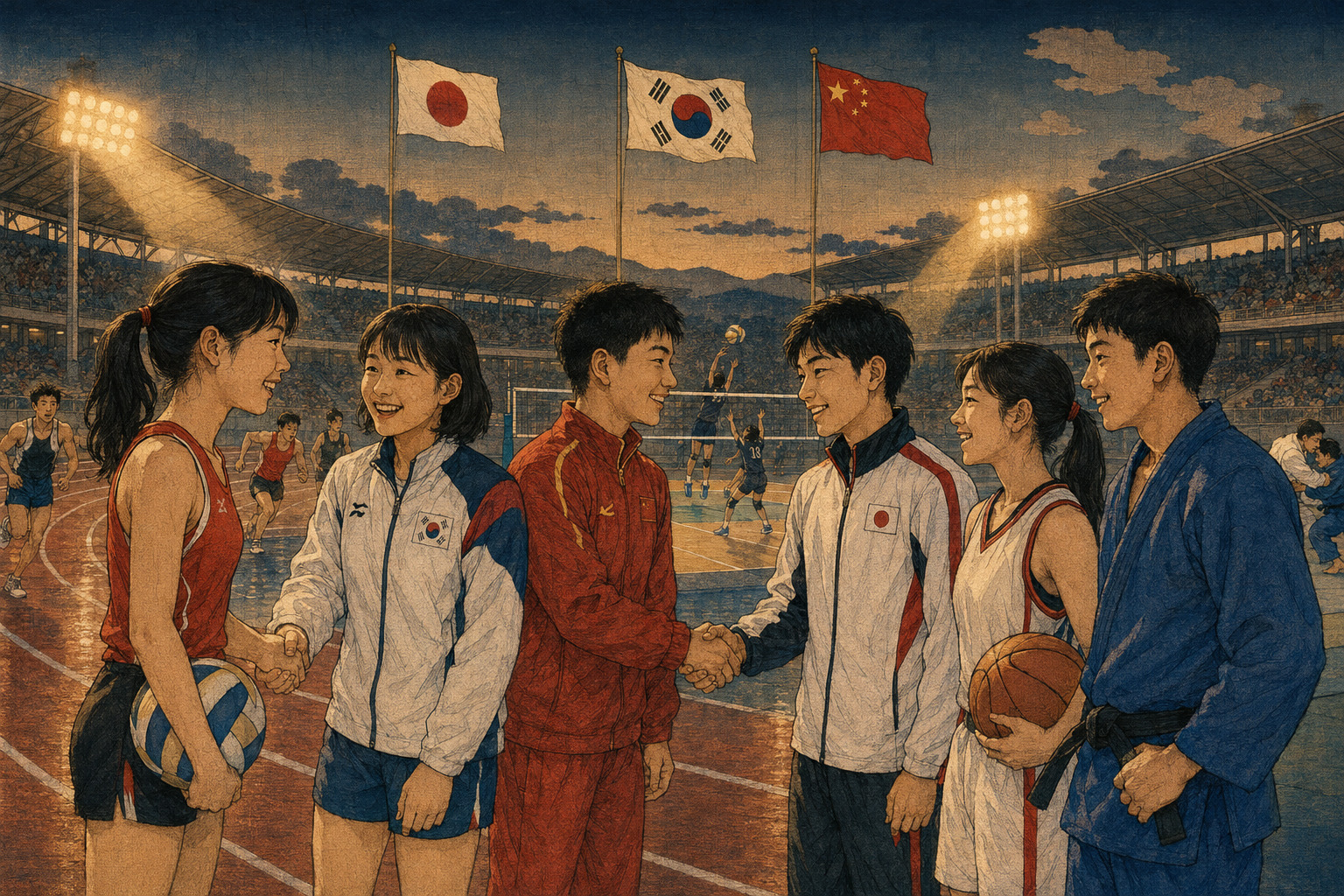
The most important number at Saga's junior sports meet was not a score. It was 902—and even that number needs a correction before it can explain anything.
The Japan Sport Association, or JSPO, listed 902 participants as of August 20 for the 34th Japan-Korea-China Junior Sports Exchange Meet. The figure covered four delegations—Japan, South Korea, China and a Saga Prefecture selection—and included observers and other delegation personnel. It was not the number of teenage athletes. Nor was it the 988 sometimes used in advance descriptions, which comes from the meet's standard ceiling of 247 members for each of four delegations.
Getting that denominator right changes the story. This was still a large, unusual gathering of high-school-age competitors: 11 sports, six municipalities, a seven-day official period from August 23 to 29, and an opening ceremony at SAGA Arena. But the meet was not a frictionless parade of almost 1,000 children representing three countries. It was a working sports program with coaches, officials, uneven rosters and late changes.
A fourth delegation changes the geometry
The title names three countries; the competition is built around four delegations. Alongside the Japan, South Korea and China teams sits a selection from the host region. This year that was Saga Prefecture. In 2025 it was Inner Mongolia, in 2024 Gyeongsangbuk-do, and in 2023 Wakayama.
That fourth place prevents the event from becoming only a meeting of national systems. It gives local teenagers an international benchmark without requiring a trip abroad, and it gives the host a direct development reason to accept the logistical burden. The Japan delegation is recommended through national sport governing bodies. The prefectural delegation comes through the host's sporting structure. Both may contain Japanese athletes, but they arrive by different pathways and play different institutional roles.
Japan's dispatch rules sharpen the definition. Eligible competitors must be Japanese nationals, no older than 18 and born on or after January 1, 2008. They are described as high-school students, but eligibility does not depend on enrollment in a conventional school team; club affiliation and other arrangements are permitted. Coaches and delegation officials fill the rest of the standard 247 places.
The structure also makes disparity visible. In rugby, the official record shows Japan beating South Korea 83-3 and South Korea beating Saga 49-5; China did not participate. That is not evidence that the exchange failed. A development meet that hides competitive gaps would have less value. But it is a warning against using the clean headline “four delegations across 11 sports” as if every draw were complete.
| Sport | Municipality | Official venue | Format note |
|---|---|---|---|
| Athletics | Saga | SAGA Sunrise Park — SAGA Stadium | Individual events over multiple days |
| Football | Ogi | Black Mont Blanc Football Center | Delegation fixtures |
| Tennis | Saga | SAGA Sunrise Park Tennis Field | Boys' and girls' competition |
| Volleyball | Tosu | Salonpas Arena | Boys' and girls' competition |
| Basketball | Saga | Morodomi Culture and Sports Hall Heartful | Boys' and girls' competition |
| Weightlifting | Arita | Honoo-no-Haku Memorial Hall | Weight classes for boys and girls |
| Handball | Yoshinogari | Yoshinogari Culture and Sports Hall | Three delegations in the girls' field after China's withdrawal |
| Soft tennis | Saga | Saga Prefectural Forest Park Tennis Courts | Team round robin was scheduled |
| Table tennis | Saga | SAGA Sunrise Park — SAGA Plaza | Joint practice scheduled between match days |
| Badminton | Takeo | CableOne Sports Park | Boys' and girls' competition |
| Rugby football | Saga | SAGA Sunrise Park Ball Field | Japan, South Korea and Saga; China did not enter |
The event has no useful single scoreboard
Athletics measures places and times. Weightlifting divides competitors by class. Team sports run their own fixtures, and racket sports use formats appropriate to their disciplines. JSPO publishes results by sport and date rather than turning them into a consolidated national medal race.
That matters because the event's second purpose would be distorted by an overall table. The stated goals are to improve sporting competitiveness and deepen mutual understanding through youth exchange. Competition supplies the first goal with hard evidence: a time, a score, an opponent's technique. A single national ranking would invite delegations to optimize for aggregate prestige, even though the host selection and national selection are not symmetrical units.
The meet instead creates repeated, close-range observation. Teenagers encounter not a highlight reel but an opponent's warm-up, tactical adjustments, sideline communication and response to defeat. Coaches see what their own development systems emphasize—and what they omit. The most useful comparison may occur in a joint table-tennis practice or between matches, not in a final.
Exchange needs a second encounter
International sport does not automatically create understanding. Opponents can share a court and leave with every prior stereotype intact. Ceremonial flags and group photographs document proximity, not learning.
The Saga schedule therefore placed a friendship exchange on August 27, after the final day of competition. Some disciplines also planned joint practice. The logic is simple: first give athletes a legitimate competitive reason to pay close attention to one another; then remove the score and create a second encounter.
An official JSPO account of the 2023 Wakayama meet shows how that can work. Local high school students presented the friendship program while interpreters carried Japanese into Korean and Chinese. Participants formed mixed teams drawn from all four delegations. They stacked paper cups, moved hoops and answered quizzes. Athletes reported relying on English and gesture to make a plan, asking names and experiencing an opponent as a teammate.
Those details belong to Wakayama, not Saga. They cannot be copied forward as proof of what happened in 2026. At the reporting deadline, organizers had not published a participant survey showing who interacted, whether perceptions changed or whether contacts continued. “A friendship exchange was held” and “mutual understanding deepened” are different claims. The first describes an activity. The second requires evidence after it.
- Did athletes have direct, mixed-delegation contact rather than parallel attendance?
- Did interpretation, joint practice and informal time allow more than ceremonial greetings?
- What technical lesson did each sport take back into training?
- Did participants report a change in knowledge or attitude after the week?
- Were incomplete fields, safety changes and withdrawals documented for the next host?
A 1993 circuit that survived a three-year break
JSPO established the junior meet in 1993 and rotates hosting among Japan, South Korea and China. It describes the event as unusual for the high-school age group because it brings multiple sports together internationally. The national teams are drawn largely from athletes who have already performed strongly in domestic competition, while the host selection adds a regional development layer.
The ordinal number conceals a rupture. The planned 2020 meet in Akita, the 2021 meet in Jeju and the 2022 meet in Wuhan were all cancelled during the COVID-19 pandemic. Wakayama restarted the circuit in 2023 after four years without an edition. Gyeongsangbuk-do hosted in 2024, Inner Mongolia in 2025, and the rotation returned to Japan in Saga this week.
1993 — The rotating Japan-Korea-China junior meet begins.
2017 — Ibaraki hosts 989 participants from four delegations and 11 sports.
2020–22 — Akita, Jeju and Wuhan editions are cancelled during the pandemic.
2023 — Wakayama hosts the return, with 998 participants recorded.
2024–25 — The circuit moves to Gyeongsangbuk-do and Inner Mongolia.
2026 — Saga hosts the 34th meet with 902 participants listed as of August 20.
The alumni list gives the competition credibility but must be read carefully. JSPO identifies volleyball player Saori Kimura and badminton player Ayaka Takahashi as former participants. Kimura later competed at four Olympics and won bronze at London 2012. Takahashi and Misaki Matsutomo won women's doubles at Rio 2016, Japan's first Olympic badminton gold. JSPO's 2024 preview also named Olympic champions Haruka Kitaguchi and other later medalists among former participants.
The meet did not necessarily cause those careers. It selected strong teenagers, so later elite success partly reflects who was invited in the first place. Its defensible contribution is narrower: it gave high-level adolescents an international comparison before senior careers were settled. That remains valuable even for the many participants whose names never appear on an Olympic roster.
Saga is testing what “legacy” means after 2024
Saga accepted the 2026 meet after a 2023 approach from JSPO. In the prefecture's explanation at the time, the timing mattered: facilities were being developed for the 2024 National Sports Festival and National Sports Festival for People with Disabilities, and those venues would remain available afterward.
The meet made that argument physical. The opening ceremony used SAGA Arena. Athletics ran at SAGA Stadium, table tennis at SAGA Plaza and rugby on the Sunrise Park ball field. Competition spread beyond the capital to Ogi, Tosu, Arita, Yoshinogari and Takeo. A national event's infrastructure became a regional international network rather than a one-off stage.
It also fits the prefecture's SAGA Sports Pyramid strategy, developed from 2018 around talent development, employment support and training environments. The strategy connects elite performance with a wider culture of playing, coaching, watching and supporting sport. A host-prefecture team, free public admission and facilities operating across six municipalities touch several layers at once.
But occupancy is not legacy. Saga will need to show what local coaches learned, how athletes' international comparisons alter development plans, whether volunteers and interpreters remain available for future events, and how heat and transport protocols performed. The official pre-meet release promised action based on WBGT, Japan's heat-stress index, including pauses or cancellation when necessary. Publishing how those safeguards were used would turn operational experience into an asset for the next host.
Sport is not diplomacy's substitute
No junior tournament can settle disputes over security, trade or history among governments. Teenagers should not be burdened with that expectation. A handshake is not an agreement between states, and a mixed-team game is not evidence that relations among three countries have improved.
The more modest claim is also the stronger one. The circuit is a repeatable institution. The host changes, so each national organization alternates between receiving visitors and depending on another country to receive its athletes. Participants meet contemporaries whose routines, ambitions and disappointments are recognizable even when language is not. That contact can make broad caricatures harder to sustain.
Continuity alone is insufficient. The gap between the 988-person template and the 902-person August figure, plus the incomplete fields in rugby and women's handball, shows how quickly a clean organizational diagram meets reality. Good exchange policy records those gaps. It does not hide them behind a photograph of three flags.
When the delegations leave Saga, the official results will remain as PDFs. Some records will matter for selection; many scores will soon recede. The deeper purpose of the week is smaller than peace and more practical than pageantry: a competitor entered the venue as “China,” “South Korea,” “Japan” or “Saga,” and left as a person whose name somebody else remembered.
That is not a solution to regional politics. It is a habit of encounter—limited, testable and worth repeating.
- Japan Sport Association — 2026 Saga dates, 902 participants, sports, venues and public access
- Japan Sport Association — current meet overview, delegation template and official results
- Japan Sport Association — official English description of the rotating exchange
- Japan Sport Association — Japanese delegation rules and eligibility
- Japan Sport Association — Saga competition schedule, updated August 19
- Japan Sport Association — previous editions and the 2020–22 cancellations
- JSPO Plus — official account of the 2023 Wakayama friendship exchange and alumni
- Japan Sport Association — official 2026 rugby record
- Japan Handball Association — Chinese women's team withdrawal and revised field
- Saga Prefecture — 2023 hosting decision and post-SAGA2024 venue rationale
- Saga Prefecture — SAGA Sports Pyramid strategy
- Japanese Olympic Committee — Saori Kimura's Olympic record
- Japanese Olympic Committee — Ayaka Takahashi and Misaki Matsutomo's Rio gold