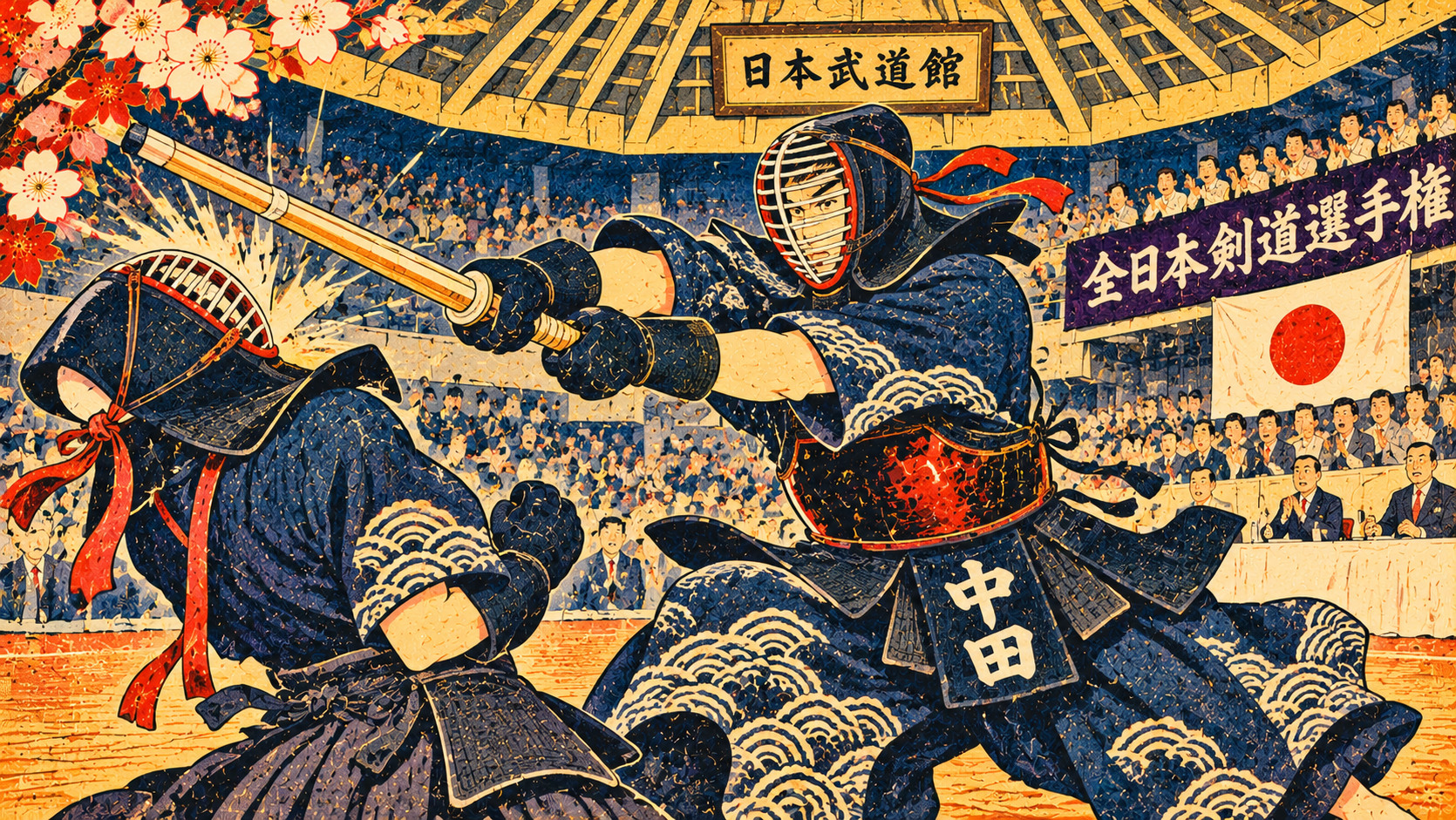
- A debut that ran through two former champions
- Meet Ryunosuke Nakada, not a newcomer to competition
- The two blows that decided the final
- Why a kendo point is not merely a touch
- The coordinated instant of mind, sword and body
- Sixty-four competitors and a national stage
- A sword discipline remade for modern Japan
- Why the police training world matters
- The women’s title told a different story of excellence
- A world championship returns to Budokan in 2027
- The significance of a small, exact result
A debut that ran through two former champions
The scoreline looks almost too compact for the scale of the occasion: Nakada, men-men; Natsumeda, none. On November 3, 2026, inside Tokyo’s Nippon Budokan, 23-year-old Ryunosuke Nakada won the 74th All Japan Kendo Championship on his first appearance. He finished the final with two valid strikes to the men, the protective helmet that is one of kendo’s designated targets.
What made the result remarkable was the opposition. In the semifinal, Nakada defeated Keita Hoshiko, the defending champion and a two-time winner, with a single men. In the final he faced Ryusuke Natsumeda, himself a national champion in 2023. The tournament did not merely introduce a newcomer. It made that newcomer beat established winners on the way to the title.
Meet Ryunosuke Nakada, not a newcomer to competition
The All Japan Kendo Federation lists his name as 中田竜之介, pronounced Nakada Ryunosuke—an important point when romanizing Japanese surnames. Born in Chiba Prefecture, Nakada studied at Kokushikan University and serves as a police officer with the Tokyo Metropolitan Police Department. He represented Tokyo and entered the tournament as a fourth-dan practitioner.
The official profile records a team victory at the Asia–Oceania competition and two team titles in the national police championship, along with an individual third place in police competition. His listed favorite technique is men, from a chudan, or middle, guard. “First appearance” therefore means first entry in this particular national championship, not that he arrived without experience against elite opponents.
The two blows that decided the final
The federation reports a men-men victory over Natsumeda. Kyodo News independently describes two men strikes in the final. The governing body also names the other semifinalists: Keita Hoshiko of Tokyo and Ryutaro Sugita of Osaka finished joint third. In the semifinal round, Nakada beat Hoshiko with one men, while Natsumeda progressed past Sugita in extra time.
Natsumeda was far from an easy opponent. The federation lists him as a 26-year-old fourth-dan officer in the Hiroshima Prefectural Police, a graduate of Nippon Sport Science University and the winner of the 71st championship in 2023. He also had a previous third-place finish. The publicly checked score does not, by itself, tell us the precise timing, sequence or tactical setup of Nakada’s two winning strikes, and this report does not invent those details.
Why a kendo point is not merely a touch
In many sports, crossing a line or making contact offers an immediate basis for a score. Kendo demands something more specific. Its valid strike, called yuko-datotsu, must combine committed spirit, appropriate posture, correct contact with the designated striking part of the bamboo sword, proper blade alignment and zanshin—continuing awareness and readiness after the blow.
The rules define targets including men (head), kote (wrist), do (torso) and tsuki (throat thrust). Contact alone is insufficient. Referees must judge whether the movement qualifies as a complete, valid attack. The difference is essential to understanding why the official record of two men strikes carries technical significance rather than describing two random impacts.
The coordinated instant of mind, sword and body
The Japanese phrase ki-ken-tai-itchi means the integration of spirit, sword and body. It describes an attack in which intent and expression, the sword’s operation and bodily movement act together. In 2024 the federation published an explanation of ken no riho—the principles of the sword—connecting the mental, technical and physical components of a valid strike.
This is not mystical decoration attached to an otherwise ordinary contest. It is a working standard for how technique is learned and judged. The moment a shinai lands cannot be separated entirely from the attacker’s footwork, distance, body position or what happens immediately afterward. That is why a world reader who has seen only a short highlight may miss much of what a championship match asks its judges to recognize.
Sixty-four competitors and a national stage
The 2026 event brought 64 men and 64 women representing Japan’s 47 prefectures to Nippon Budokan on Culture Day, November 3. The men competed in the 74th national championship and the women in the 65th. According to the official timetable, competition began in the morning, proceeded through the knockout rounds and culminated in finals late in the afternoon.
The prize for the men’s champion is the Emperor’s Cup. The event is often presented as a meeting between local representatives and a national elite, but many competitors also train within highly organized school, university, corporate and police environments. Winning a prefectural place is only the first threshold. Reaching the final requires surviving opponents who have done the same.
A sword discipline remade for modern Japan
Kendo’s current form cannot be understood only by projecting a romantic image of samurai combat backward in time. It emerged through the long development of sword schools, bamboo-sword practice and protective equipment, which allowed practitioners to exchange strikes without using live blades. In the modern period, educators and practitioners increasingly treated training as a means of physical cultivation and character formation.
The federation’s historical account identifies 1919 as a moment when Nishikubo Hiromichi advocated consolidating terms such as swordsmanship under the language of kendo and budo. After the Second World War, the practice was restricted during the occupation; the AJKF was founded in 1952, and kendo returned in a new postwar setting as a sport and educational activity. The federation formalized its statement of the concept of kendo in 1975.
Why the police training world matters
Nakada’s employer is not a detail to overlook. The federation’s tournament biographies show that he, semifinal opponent Hoshiko and finalist Natsumeda all serve in police organizations. Japan’s police kendo environment has long provided an arena in which accomplished practitioners can continue training and competing beyond their student years.
That fact should not be overstated. The official biographies establish the athletes’ affiliations and previous results, not the content of their daily training schedules, private motivations or coaching relationships. The connection is significant as an institutional route through elite kendo, but a reliable profile must distinguish the confirmed sporting record from details that would require interviews.
The women’s title told a different story of excellence
On the same day, 38-year-old Mari Suenaga of Wakayama won the 65th All Japan Women’s Kendo Championship. The federation identifies her as a seventh-dan practitioner holding the renshi teaching title. Her victory over Mayu Yokoyama of Osaka, also by two men strikes, gave her a fourth national crown and her first in four years.
Nakada’s emergence and Suenaga’s return sit side by side: a first-time entrant reaching the summit and an established champion finding her way back. Treating the second event as merely a footnote would miss part of what happened in Budokan. Both competitions attracted 64 entrants, and both crowned champions whose careers illustrate very different kinds of persistence.
A world championship returns to Budokan in 2027
The venue gives the 2026 title an international frame. In May 2027, Nippon Budokan is scheduled to host the 20th World Kendo Championships, with competition planned for May 27–30. The first World Kendo Championships took place at the same venue in 1970. In 2024, the 19th edition in Milan drew participants from 60 countries and regions, according to the federation.
Nakada’s triumph will naturally attract attention as Japan prepares to host the world event. But his national championship does not by itself prove that he has been selected for Japan’s world squad. Selection decisions, his future competition schedule and prospective results are still open questions. A compelling headline should not be allowed to turn tomorrow’s possibilities into today’s facts.
The significance of a small, exact result
A two-strike final could easily become the raw material for an extravagant story about destiny. The verified account is compelling without that embellishment: a 23-year-old Tokyo police officer, in his first All Japan Championship, defeated the defending champion and then a former champion; two valid men strikes settled the title.
Kendo asks competitors to be judged not only by whether a blow connects, but how it is delivered and what remains after it. Good sports journalism should display a similar discipline. The score is short. The history behind it is long. What Nakada does next remains unwritten, while the record of November 3 has already earned its place in the sport’s history.
Sources and reporting method
Official competition records and federation sources were checked through November 3, 2026. Japanese names, readings, ranks and results follow the federation. No additional interviews or independent video analysis are claimed.
- AJKF: official 74th All Japan Kendo Championship results and athlete profiles
- AJKF: November 3 championships announcement (published through Kyodo PR Wire)
- AJKF: official English-language championship results
- AJKF: 65th All Japan Women’s Kendo Championship
- AJKF: the history of kendo
- AJKF: valid strikes and the development of kendo footwork
- AJKF: the meaning of ippon in modern kendo
- AJKF: sword principles and coordinated mind, sword and body (2024)
- AJKF: official November 3 tournament schedule
- AJKF: announcement of the 2027 World Kendo Championships at Nippon Budokan
- Kyodo News: Nakada’s debut title and two men strikes in the final