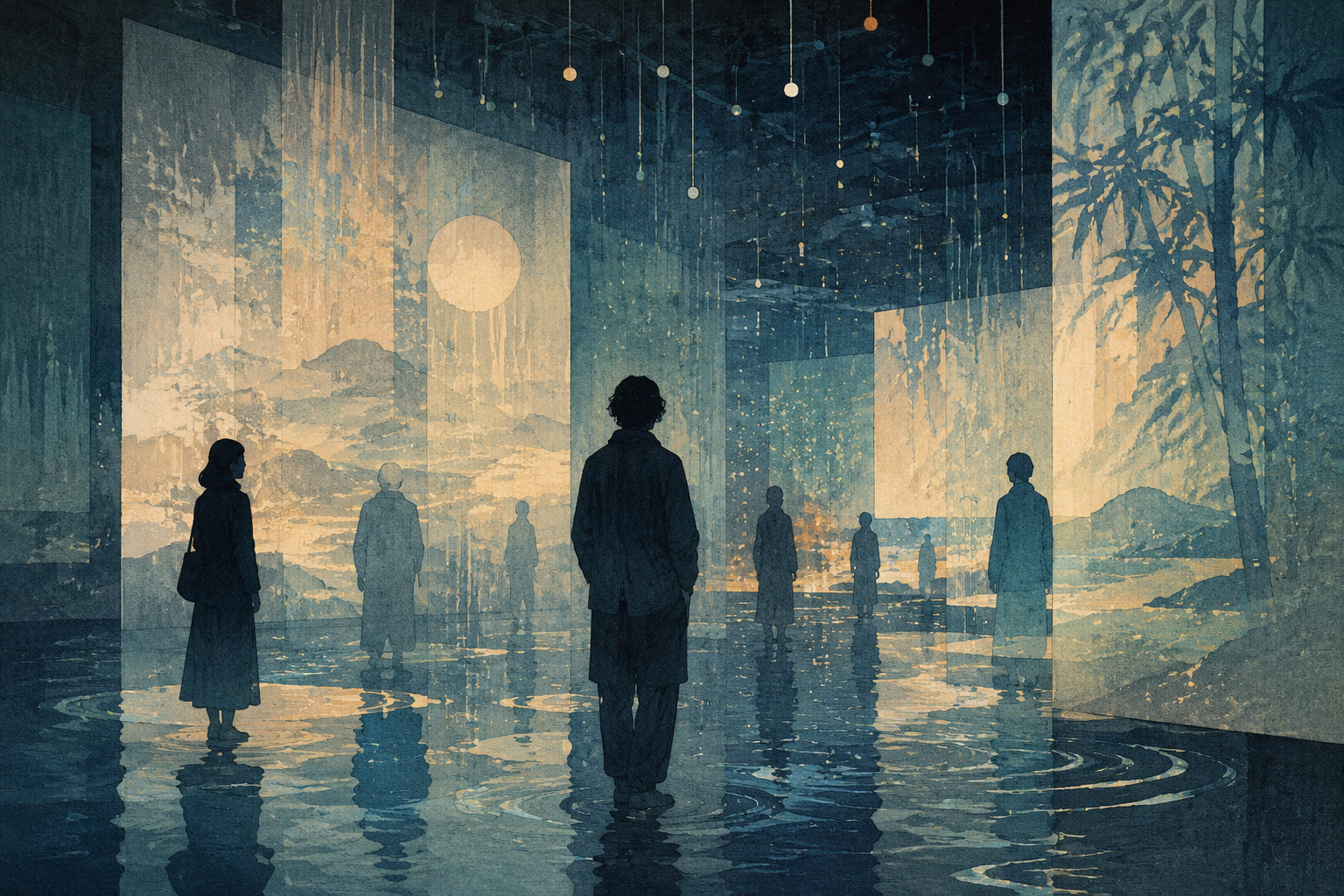
The exhibition that opened August 28 is not a survey of Ryuichi Sakamoto’s career. It gives the gallery to one work. “RYUICHI SAKAMOTO + SHIRO TAKATANI AMBIENT KYOTO - TOKYO” presents “async - immersion” through October 25, with no scheduled closing day during the 59-day run.
The installation begins with Sakamoto’s 2017 album async. Takatani supplies the images; sound director ZAK shapes the spatial acoustic field. The installation was first shown in the basement of the Kyoto Shimbun building in 2023. The Tokyo presentation retains a screen 26.4 meters wide while rebuilding the sound for the dimensions and acoustics of Azabudai Hills Gallery.
Five layers, one installation
| Layer | Credit or material | Function in the work |
|---|---|---|
| Music | Ryuichi Sakamoto, async | The foundation and the source of Sakamoto’s “installation music” concept. |
| Images | Shiro Takatani | Studio objects, natural phenomena, landscapes and a tsunami-damaged piano; generally not synchronized to the music. |
| Sound | ZAK | Spatial-audio direction and the venue-specific acoustic reconstruction. |
| Architecture | Azabudai Hills Gallery | The volume in which screen, sound direction, reflection and viewing positions operate. |
| Visitors | People occupying the room together | Named by the organizer as one of the elements that completes the spatial experience. |
Sakamoto’s music becomes a location
Sakamoto used the Japanese term setchi ongaku—installation music—for the idea of placing sound three-dimensionally in a room. A concert directs attention toward performers. A film normally fixes the audience in seats and binds sound to a screen. This installation instead asks the listener to enter an acoustic arrangement.
That changes the basic unit of listening. The same passage may sit in the foreground from one position and recede from another. A visitor can face the image surface, turn toward a sound arriving elsewhere, walk closer or remain at the edge. The architecture is no longer neutral housing for a recording; it determines how the recording is encountered.
This description is an interpretation of the credited design and the creators’ stated concept, not an on-site acoustic measurement by Japan.co.jp. The public material does not give the Tokyo system’s channel count, loudspeaker map or level design.
The images do not illustrate the soundtrack
Takatani says his footage includes equipment and a piano in Sakamoto’s studio, the garden, skies and clouds, ripples on water, and landscapes from Ireland, Morocco, Tokyo and Germany. It also includes the piano Sakamoto encountered after it had been damaged by the 2011 tsunami.
With limited exceptions for text, those images are not locked to musical cues. A cloud does not have to arrive on the same note; a machine, landscape or ripple can meet a different layer of sound during another cycle. The separation is intentional. “Async” names asynchrony, and the gap prevents image and music from settling into a permanent explanatory relationship.
In his official comment, Takatani compares the effect to watching waves or raindrop rings: patterns return, yet the same event never happens twice. The installation therefore uses repetition without promising an identical sequence of associations.
A nine-year path from album to Azabudai
2017 Sakamoto releases async. Takatani’s involvement expands from the album artwork to surround-version images, “async - drowning” and concert visuals.
2023 “async - immersion 2023” is first installed in the former printing floor beneath the Kyoto Shimbun building, with ZAK directing a multitrack spatial system.
2026 The work moves to Tokyo at the same 26.4-meter screen scale, while its sound is rebuilt for Azabudai Hills Gallery.
Calling the Tokyo edition a simple transfer would miss what changes. The sound no longer inhabits an old underground printing plant. It meets a purpose-built gallery with a different shape, surface and circulation pattern. Reconstructing the acoustic field is part of presenting the work, not merely a technical setup performed after the art is finished.
The credits resist a one-name story
Sakamoto’s celebrity could easily collapse the exhibition into a memorial listening room. The official title prevents that by placing Shiro Takatani’s name beside his. Takatani joined the Kyoto-based collective Dumb Type while studying at Kyoto City University of Arts in 1984 and has worked across moving images, performance and installation. His collaborations with Sakamoto also include the theater piece “TIME.”
ZAK’s credit matters for the same reason. The organizers identify him as sound director, continuing the role he held in Kyoto. A spatial work depends on decisions about source direction, apparent distance, layering and the room’s response. The installation emerges from Sakamoto’s music, Takatani’s images, ZAK’s acoustic direction and the gallery conditions acting together.
A shared work built from presence
The organizer describes music, images, sound, space and visitors as parts of a single work. That does not make “async - immersion” interactive in the ordinary push-a-button sense. Its participation is perceptual: where a person stands, how long that person remains and which other bodies occupy the room shape what can be heard and seen at that moment.
The shared room also separates the installation from a private album stream. Visitors do not simply receive identical copies of a file. They negotiate distance, sightlines, movement and attention in the same acoustic environment. The work is repeatable, but each encounter contains a different social and spatial arrangement.
- The number and placement of loudspeakers and subwoofers in Tokyo.
- The projection equipment, exact screen geometry and acoustic measurement data.
- The full-cycle duration, recommended approach for mid-cycle entry and room capacity.
- Attendance targets or a published method for assessing the Tokyo reconstruction.
Hours, admission and access
Azabudai Hills Gallery is on the MB floor of Garden Plaza A, 5-8-1 Toranomon, Minato Ward. It is directly connected to Kamiyacho Station’s Exit 5 at basement level and about a seven-minute walk from Roppongi-itchome Station’s Exit 4.
Weekday hours are 10 a.m.–7 p.m.; weekends and public holidays run until 8 p.m. Last admission is 30 minutes before closing. Adult advance tickets cost ¥2,200 on weekdays and ¥2,500 on weekends and holidays. Same-day prices are ¥2,500 and ¥2,800. Admission is free for high-school students and younger; junior-high and high-school students must show identification. Visitors with a disability certificate and one companion are also admitted free.
Prices and operations can change, so visitors should check the official same-day notice before traveling.
Reporting cutoff: This report uses organizer, gallery and Takatani materials available by 10:05 a.m. JST on August 29. Japan.co.jp did not conduct an on-site viewing; descriptions of the intended experience are separated from confirmed dimensions, credits and operating details.
- AMBIENT KYOTO - TOKYO official site — Exhibition, work, schedule, admission and venue
- AMBIENT KYOTO - TOKYO — Shiro Takatani’s official account of the images and asynchronous structure
- AMBIENT KYOTO - TOKYO — August 28 opening and 2026 installation photographs
- Azabudai Hills Gallery — Official event listing
- AMBIENT KYOTO Executive Committee — Production credits and 2023 installation record