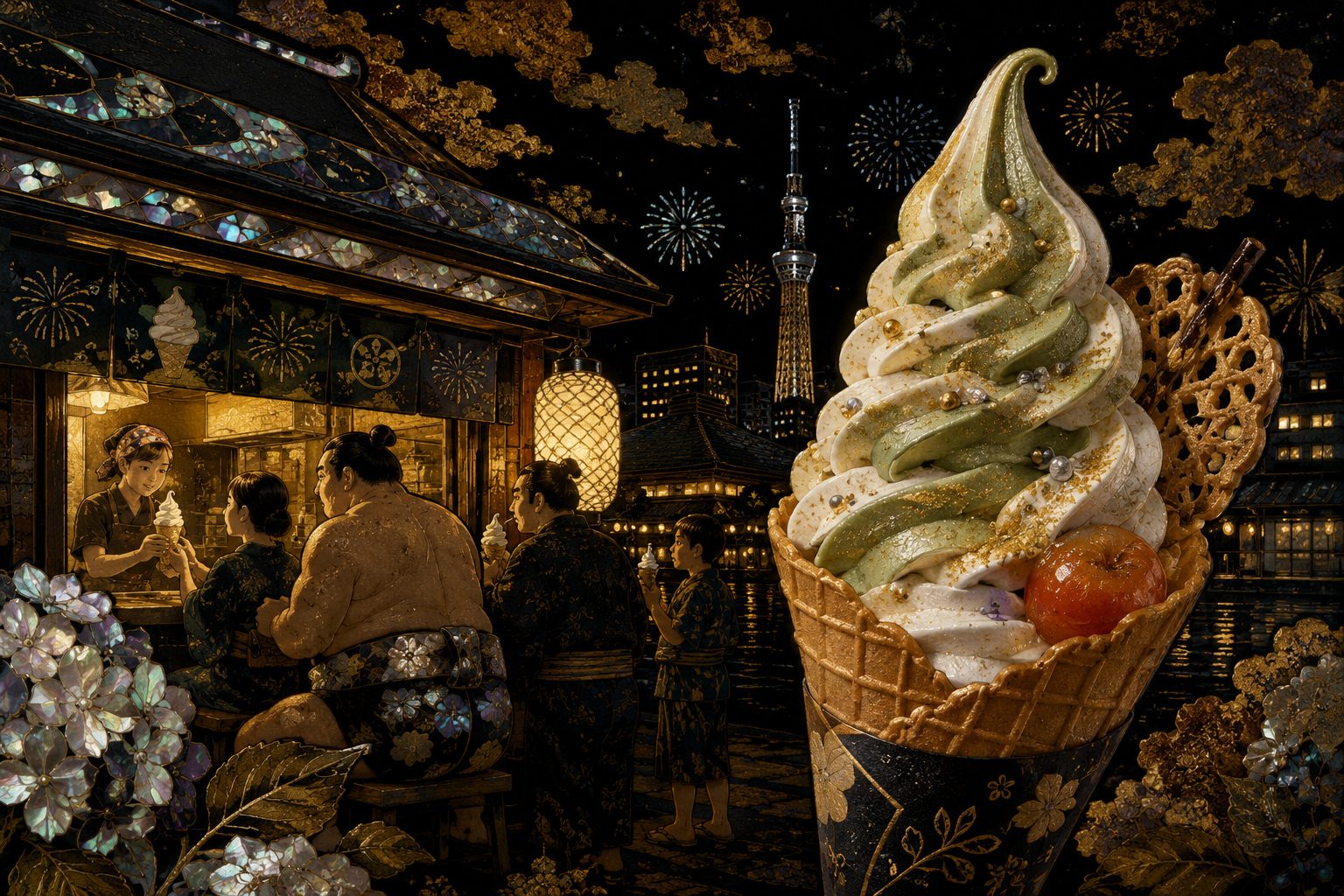
After 11 p.m. in Ryogoku, there is more than one way to close the night. A steaming chanko hot pot, the last drink at an izakaya, ramen by the station. In 2023, another possibility arrived: a neon sign resembling a cow from space and a rich cup of ice cream best eaten before it has time to melt.
Mayonaka Farm’s Ryogoku Yokozuna Yokocho shop marked its third anniversary on August 4. Its operator, otonomics Inc., is not a listed chain. It is a small, unlisted company established in 2020, with just two shops—the original in Oshiage and the second in Ryogoku, both in Sumida Ward. Its promise is modest and precise: “a small joy at the end of the day.” Business is concentrated in the narrow window from late afternoon to midnight.
For the anniversary, followers voted among ten former limited editions to choose a revival. The winner, “Masukaruppoine,” combines mascarpone, tiramisu and strawberry. The punning name is typical of the shop: it explains the flavor while inviting a smile. The company also advertised a lottery-based ice-cream-making session for ten groups of children at the Ryogoku shop on August 23. One branch has the birthday, but the program is designed to involve regulars at both.
A midnight farm born from one storefront
Mayonaka Farm opened its first shop on March 25, 2023, in Oshiage, northeast of Tokyo Skytree. From the beginning, its intended customer was not only a daytime tourist. It sought the person leaving work or school, the family after dinner, and anyone not quite ready to go home. A little more than four months later, on August 4, the company opened shop two on Yokozuna Yokocho, steps from the east exit of JR Ryogoku Station.
The contemporary opening announcement explicitly named people leaving events at the Kokugikan, work and school. The shop would be mainly takeaway, with only a few seats and tables. It did not need a large dining room. Pedestrian flow, photographs of elaborate cups and the late hours themselves became the storefront.
In March 2025, otonomics said the two branches had sold more than 100,000 servings and developed 47 original ice creams. By April 2026 it described roughly 80 original varieties, 17 regular menu items, seasonal specials and mini cups for children. The offer had also expanded to capsule toys, a picture book and a collaboration beer with Kiyosumi-Shirakawa’s BEER VISTA BREWERY. A shop selling one kind of dessert was becoming a small evening entertainment brand.
The small contradiction in the record
Records kept by small companies are not always perfectly aligned. A 2025 anniversary release says the Ryogoku second shop opened “the following year, 2024.” Yet the contemporaneous July 21, 2023 announcement says it would open on August 4, and restaurant listings record August 4, 2023. That date also matches the third anniversary in 2026. Japan.co.jp therefore gives priority to the contemporary source and uses 2023.
This is not pedantry. Covering small businesses with the rigor routinely applied to large ones means comparing dates, addresses, store counts and campaign periods, rather than copying a release. Company materials are valuable primary sources, but also the proprietor’s own story. Words such as “popular,” “rich” and “beloved” are promotional descriptions, not an independent audit of sales or customer sentiment.
Ryogoku has always eaten its entertainment
Before Ryogoku became shorthand for sumo, it was a place where people crossed the river and gathered. Development of the Sumida’s eastern bank accelerated after the Great Fire of Meireki in 1657. Ryogoku Bridge, traditionally dated to around 1659, joined Musashi and Shimosa provinces and became a busy boundary. The Sumida City Tourism Association describes Edo-period Ryogoku as one of the city’s liveliest districts, known for river-opening fireworks and fundraising sumo at Ekoin temple.
Show tents, teahouses, street stalls, fireworks and wrestling made spectacle inseparable from food. Today, three of professional sumo’s annual grand tournaments are held at Ryogoku Kokugikan; training stables and chanko restaurants remain around it. The Ryogoku Edo Noren complex, inside the old station building, stages Edo food around a full-size sumo ring. East of the station, narrow Yokozuna Yokocho receives the crowds flowing out of tournaments and concerts.
Mayonaka Farm does not claim to reconstruct Edo cuisine. Yet its basic behavior—buying a small luxury in the street to lengthen the afterglow of entertainment—fits the neighborhood’s old urban culture. Neon has replaced the paper lantern; a chilled dairy dessert has joined noodles and dumplings.
From aisukurīn in 1869 to a cup at midnight
The first commercial ice cream made by a Japanese producer is generally dated to Yokohama in 1869. Research published by J-Milk identifies Fusazo Machida, who learned the method from Matsuzo Dejima and sold it in the newly opened treaty port. Milk itself was unfamiliar to much of the population, and ice was costly to preserve. The early aisukurīn was less an everyday snack than a taste of Japan’s opening to the West.
Industrial ice-making, refrigerated transport, household freezers and convenience stores eventually turned a melting luxury into ordinary life. Ice cream shifted from a strictly summer purchase to a year-round product, even in heated winter rooms. But Mayonaka Farm is not selling a multipack for a home freezer. It sells a composed cup: sauce, fruit, cream, naming, presentation and the image shared afterward.
The company says the product is best within five minutes. That is a quality claim, but also a powerful business design. It shortens the acceptable journey home, keeps customers near the storefront and turns a few minutes of eating into a neighborhood experience. Melting is not merely a defect; it creates the reason to eat here, now.
1869 Fusazo Machida is credited with commercially making ice cream in Yokohama
March 25, 2023 Mayonaka Farm opens in Oshiage
August 4, 2023 The Ryogoku Yokozuna Yokocho shop opens
March 2025 The operator announces more than 100,000 cumulative servings
August 2026 Ryogoku turns three and revives a follower-selected flavor
“Night ice cream” sells a time of day
Japan’s late-night dessert culture became more visible through Sapporo’s tradition of shime parfait—a parfait to conclude the evening—and the later spread of night-parfait and night-ice-cream shops. The idea separates dessert from the restaurant course and makes it a destination of its own. Non-drinkers, families, students and solo visitors can all participate in the same after-dinner hour.
For a specialist shop, “night” is not just a schedule. It avoids a direct midday contest with cafes, supermarkets, convenience stores and national chains. It captures the moment when the customer’s motive shifts from hunger to reward. The product name becomes a tiny story built for conversation and social posts. Monthly editions create reasons to return; a popular vote turns old products from dead inventory into shared memory.
| Small-shop device | Customer meaning | Business meaning |
|---|---|---|
| Late afternoon to midnight | Available after dinner or an event | Narrows demand and avoids midday competition |
| Mainly takeaway | Fast and informal | Limits dining-room space and table management |
| Monthly and revived flavors | Choose, vote and return | Refreshes attention in small batches |
| Oshiage and Ryogoku | Skytree and Kokugikan journeys | Shares operating knowledge across two nearby markets |
Why two shops can be harder than one
Two shops are not merely “small.” They are one of the most difficult stages of growth. At one location, a founder can personally watch taste, service, stock and cleaning every evening. With two, the founder cannot stand in both places at once. Recipes, preparation, temperature control, training, procurement, cash and digital payments, and social-media notices must become reproducible.
Ice-cream demand moves with temperature and weather. Fruit and dairy prices, electricity and late-shift staffing add pressure. More limited editions create attention, but also more ingredients and training. A late-night business owes the neighborhood quiet, clean streets, safe queues and responsible waste handling. Cups sold are not the only measure of sustainability.
There is an advantage, too. Oshiage combines Skytree tourism with residential life; Ryogoku combines arena events with a restaurant district. Two nearby catchments allow the same brand to sit inside different flows of the night. The company can test products more finely than a franchise system while comparing more reactions than a single shop could.
What an anniversary is really for
A restaurant anniversary is not only a ribbon and a discount. It lets regulars say, “I was part of this place’s time,” while the business inventories its experiments and mistakes. Asking customers to select a revival, then inviting children to make ice cream, moves the audience slightly—from buyer to co-editor.
Social-media activity, however, should not be mistaken for permanent neighborhood roots. The questions after year three are whether customers return after the summer novelty fades, whether staff can sustain the late hours, and whether two locations can maintain quality. For a tiny operator, three years is not the finish line. It is the point at which an experiment begins to look like a durable trade.
- Ryogoku Yokozuna Yokocho shop: 3-22-8 Ryogoku, Sumida City, a short walk from JR Ryogoku Station’s east exit.
- The official site lists regular hours of 4:30 p.m.–midnight, subject to seasonal and event changes.
- Check the official social account for revival-product dates and availability.
- The children’s workshop was advertised as lottery-based; do not assume walk-in admission.
- Ask the shop directly about dairy, egg, wheat, nut and other allergens before purchase.
A new afterglow in an old district
Ryogoku is a district built around large spectacles: the wrestler’s body, the Kokugikan roof, fireworks above the Sumida. Yet neighborhood memory is not made only by giant institutions. Leaving the station, stopping on a narrow lane and eating a strangely named ice cream in five minutes can also redraw the night’s map.
Ice cream was an exotic novelty in Yokohama in 1869. A century and a half later, it functions in Ryogoku as a clock at the end of the day: lights on in late afternoon, shutters down at midnight. Precisely because there are only two shops, that light can feel less like a corporate strategy than part of the local street.
The third anniversary celebrates more than a rich cup. A very small Tokyo company has inserted a night out that does not require alcohol into the leftover space of an old entertainment district. Ryogoku’s new closing course melts. That is why it must be tasted while you are there.
Reporting notes and principal sources
This article reflects public information checked through August 5, 2026 at 9:41 a.m. Japan Standard Time. Campaign details follow official social posts. Company figures for servings and flavors are not independently audited.
- Mayonaka Farm: official site, locations and hours
- Mayonaka Farm: official Instagram and anniversary notices
- otonomics: Ryogoku opening announcement, July 21, 2023
- otonomics: Oshiage opening announcement, March 24, 2023
- otonomics: two-shop history and 100,000-serving claim, March 19, 2025
- otonomics: roughly 80 original varieties and 17 standards, April 23, 2026
- GO TOKYO: Ryogoku guide and sumo context
- Sumida City Tourism Association: Ryogoku area history
- J-Milk: history of milk and ice cream in Japan
- J-Milk: research on early ice cream in Yokohama