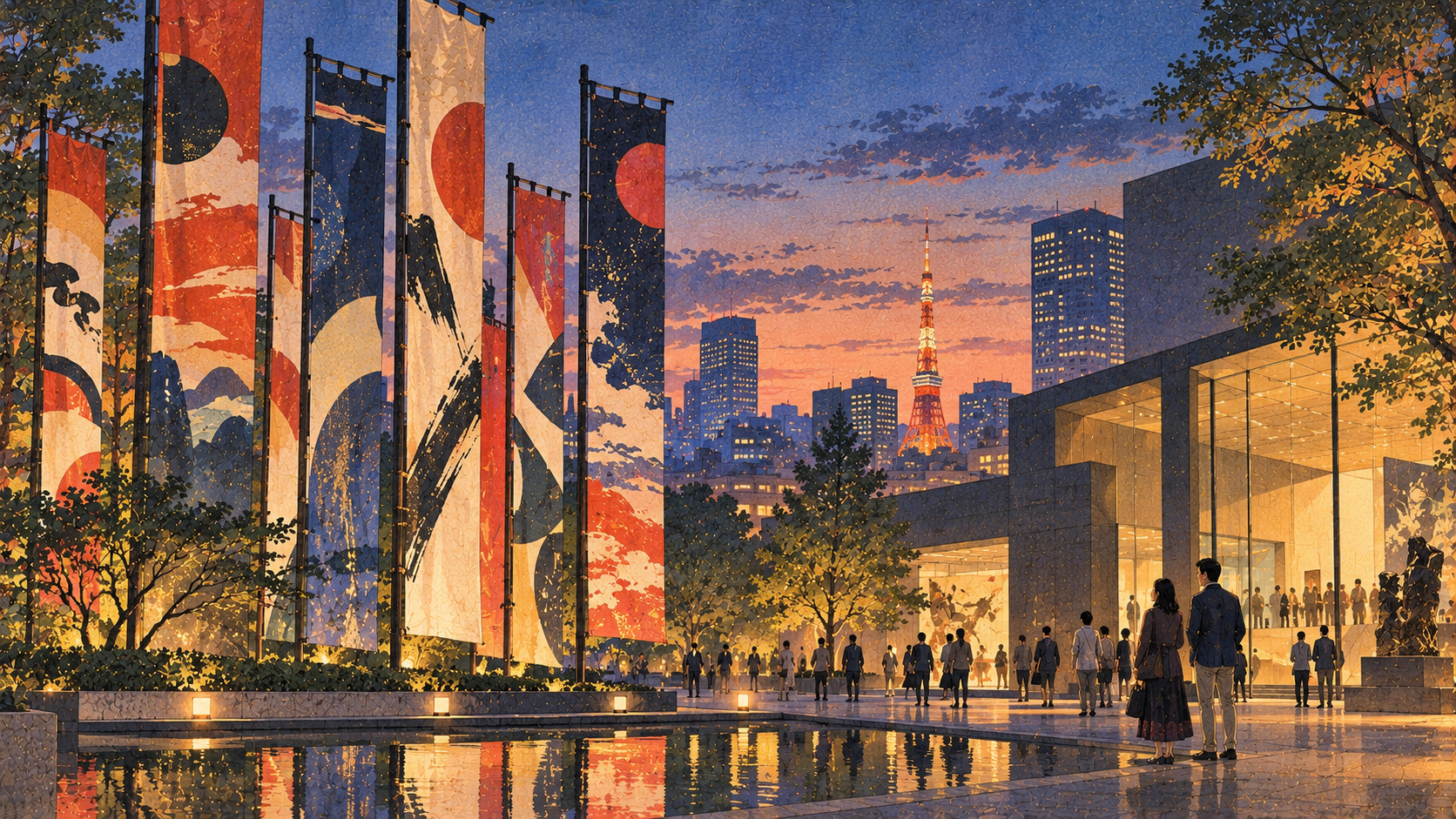
A banner is made to declare a single allegiance. These banners ask whether belonging can remain plural.
A flag is never just fabric
Outside Tokyo’s National Art Center, a familiar vertical Japanese banner has become a vessel for unusually difficult questions. Flags identify a team, a military force, a neighborhood business or a nation. What happens when one artist uses that same format to depict identities that refuse to fit inside a single emblem?
Aya Rodriguez-Izumi’s outdoor presentation, opened October 30 for Roppongi Art Night 2026, pairs the earlier Noboru (2021) with the newly created Concept Flags for an Intersectional Future (2026). The museum describes two groups of banners, not one newly unveiled work. That distinction matters to the story.
Two installations, two kinds of memory
The 2021 Noboru series is positioned around the museum entrance rotary. The National Art Center says its circular designs draw on nationality markings once carried by Japanese military aircraft. Circles in different colors share individual banners: a deliberate visual encounter between signs often expected to announce one identity.
The new 2026 flags are displayed along the building exterior. According to the museum, their colors and motifs take inspiration from Okinawa’s Ryukyuan bingata textile tradition. Seen close up, the individual designs differ; at a distance, the group creates the impression of a shared landscape.
Why choose the nobori?
Across contemporary Japan, vertical nobori banners advertise restaurants, shops, promotions and local events. Their format is instantly legible even to someone who cannot read the wording. Historically, banners also helped distinguish groups on battlefields. The exhibition’s official explanation explicitly links those uses.
Rodriguez-Izumi has chosen a medium whose force lies in making people recognize allegiances quickly. Instead of removing its associations with war and advertising, she makes those associations part of the encounter. The art is therefore about the language of belonging, not merely fabric design.
The uncomfortable history inside a circle
The aircraft references in Noboru make the imagery difficult to reduce to celebration or condemnation. A historically charged shape appears alongside other colors, holding different inheritances in tension. The University of Southern Indiana’s 2026 presentation of the artist’s work also discusses wartime aircraft imagery and the flag’s capacity to express cultural allegiance.
Neither source establishes that Rodriguez-Izumi endorses the militarism with which such markings have been associated. It is more accurate to say that she investigates the political and emotional weight carried by familiar signs. Any fuller account of her intention would require direct interview or more extensive artist statements.
Bingata: the history behind the color
The newest flags open a different historical route, to the Ryukyu Kingdom and the textile craft known as bingata. Japan’s Agency for Cultural Affairs describes the dyeing tradition as developing particularly strongly around the eighteenth century, with elaborate colors and motifs associated with Ryukyuan elite clothing. It is now recognized as an Important Intangible Cultural Property.
Traditional bingata involves resist-dyeing techniques that use stencils or applied paste, followed by meticulous coloring. The Kyoto National Museum traces its relationship to the island kingdom’s clothing and ceremony. Being inspired by bingata patterns is not the same as claiming that the banners themselves were produced through traditional bingata processes.
Okinawa’s craft is not a generic Japanese ornament
Okinawa’s own official accounts place the craft within centuries of exchange among Ryukyu, China, Southeast Asia and Japan. Its modern history also includes the end of the kingdom, the loss of state patronage, wartime destruction and postwar revival. Those experiences complicate any idea of a timeless decorative motif.
This is why the new work’s use of Okinawan visual traditions matters: their origins connect to separate political and cultural histories even while they inhabit the broader story of modern Japan. The museum describes the installation as imagining a future born from the intersection of cultures and histories rather than a single nation or ethnicity.
An artist between several worlds
Born in Okinawa in 1986 and based in New York, Rodriguez-Izumi has roots in Okinawa, Cuba and Puerto Rico, according to the National Art Center. Her practice spans sculpture, video, performance, installation and collaborative work, often addressing ritual, vulnerable histories and cultural identity. She earned an MFA at New York’s School of Visual Arts.
Her institutional record crosses the Pacific: a 2019 US–Japan artist exchange fellowship, participation in the Singapore Biennale 2025, and the exhibition Signals in New Harmony, Indiana, in 2026. Those are not mere résumé details. They help explain why fixed national categories may prove inadequate to describe her work.
From the 2021 series to an architectural commission
The Noboru series predates this edition of Roppongi Art Night. The Japanese museum identifies an earlier 2021 presentation, and the Indiana exhibition discussed the same flag vocabulary in 2026. What is new in Tokyo is the pairing of this established inquiry with the flags created for the National Art Center’s exterior.
Architecture changes how people read the work. The entrance rotary and facade create different distances and routes of approach. A viewer close to one banner sees its particularity; someone walking farther away may see a collective image. That near-and-far contrast is specifically described by the institution, although the changing experience itself remains a matter of individual perception.
The politics of an open-air museum entrance
Unlike artworks placed inside a ticketed gallery, the flags stand in the outdoor approach to a major cultural institution. Some viewers will encounter them while attending an exhibition; others may be passing through or meeting friends. The location allows the work to meet an audience that did not set out to see contemporary art.
This public setting reinforces the nobori’s everyday role as a signal. A city banner normally asks for instant attention; these ask for a second look. That interpretation follows the museum’s description of the works, not an unreported statement by the artist.
Roppongi Art Night and a city-sized audience
Roppongi Art Night began in 2009 and has made museums, commercial complexes and streets part of an urban art program. The 2026 edition’s main overnight period runs from the evening of October 31 into the morning of November 1, with the organizers describing the return of the all-night format after three years.
The flag presentation has its own longer schedule, October 30–November 16. That is worth emphasizing for readers planning a visit after the festival’s best-known overnight events have ended. The installation is not simply a one-night performance.
What visitors should know
The National Art Center lists the display outside its main entrance, with regular access hours of 10 a.m.–6 p.m., extending to 8 p.m. on Fridays and Saturdays. The institution states that it is closed November 4 and November 10; the special overnight gate opening applied only on October 31.
Readers should check the museum’s current information before traveling, particularly if weather or site operations affect access. The official listing does not state that a separate exhibition ticket is required to view this outdoor installation; fees for unrelated indoor exhibitions are separate.
A future made of differences
Flags are designed to simplify. Their colors and shapes tell viewers which group is which, often before a word is spoken. Rodriguez-Izumi’s pair of installations makes that simplicity difficult to sustain. An image rooted in military identification sits beside a new group of patterns drawn from a textile tradition shaped by migration, trade, power and survival.
The National Art Center’s own description offers the essential idea: the banners retain their differences while suggesting a collective landscape. Rather than proposing that cultures become identical, the work invites viewers to consider how a shared future might be constructed without erasing the histories within it.
Sources and verification
Institutional exhibition descriptions, artist records and cultural-heritage sources; no claim of an on-site interview or invented artist quotation.
- 国立新美術館:公式展示解説 / National Art Center exhibition description
- 六本木アートナイト2026:公式プログラム / Official programme
- 港区:開催概要 / Minato City festival announcement
- University of Southern Indiana, Signals (2026)
- 文化庁:重要無形文化財「紅型」 / Agency for Cultural Affairs
- 京都国立博物館:琉球とアイヌの染織 / Kyoto National Museum
- 沖縄県:工芸産業振興施策 / Okinawa Prefecture textile-craft history
- やんばるアートフェスティバル:作家紹介 / Artist biography
- Arts Council Tokyo: Roppongi Art Night 2026