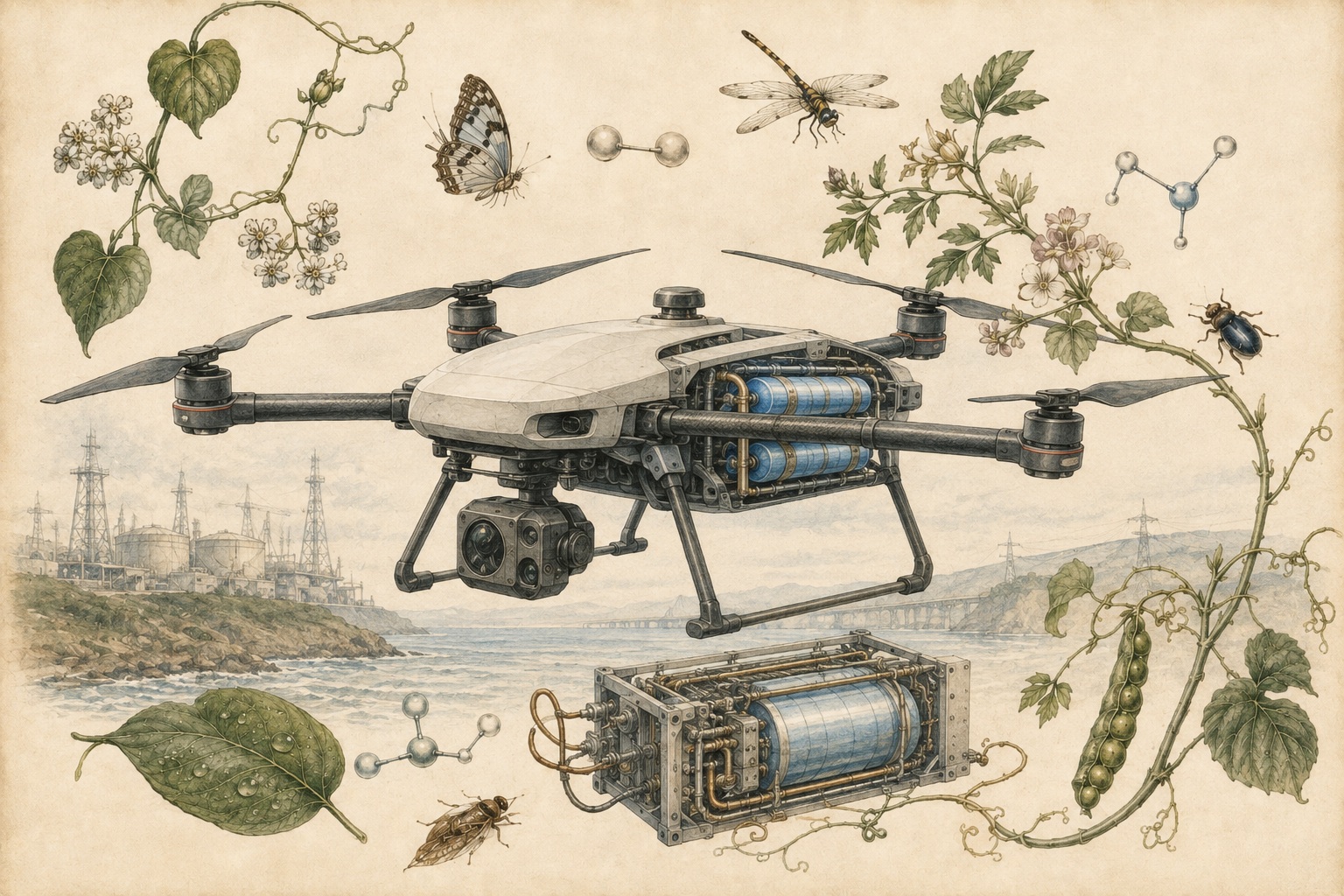
For drones, the sky may be open but time is scarce. Cameras have become smaller, AI smarter and autonomous flight more capable. Industrial multicopters still encounter the same boundary again and again: if the aircraft could remain airborne another thirty minutes, it could inspect another span of transmission line, circle a disaster site one more time or deliver medicine to an island and still have enough energy to return.
Battery state of charge becomes the border of the mission.
Hydrogen fuel-cell drones attempt to move that border. Instead of storing all energy electrochemically inside a battery, they store lightweight hydrogen in a pressure vessel and convert it into electricity during flight. More hydrogen can increase stored energy without scaling battery mass in the same way.
But hydrogen brings its own mass and complexity: a high-pressure cylinder, valves, regulator, piping, fuel-cell stack, cooling system, controls and safety hardware.
In 2026, a particularly Japanese industrial chain is forming around that tradeoff. Robodex is a Yokohama drone venture. TEPCO Holdings brings enormous infrastructure and years of operational drone experience. Nissin Manufacturing Group brings precision-manufacturing roots in Kyotango, Kyoto Prefecture.
This is not a national aerospace prime building a spectacular future aircraft. It is a small drone company, a utility with real inspection work and a regional manufacturer trying to make the fuel-cell heart of the machine locally.
The drone problem is not only power; it is stored energy
A multicopter consumes substantial power simply to stay in the air. Unlike a fixed-wing aircraft, it cannot rely primarily on aerodynamic lift from forward flight; several rotors must continuously accelerate air downward. Climb, payload and wind demand additional peak power.
Lithium-ion batteries are excellent at delivering large bursts of electrical power. But extending endurance by adding cells also means carrying the mass of those extra cells. At some point the aircraft consumes a growing fraction of the added energy just carrying the added battery.
A fuel cell creates a different architecture. Hydrogen reacts electrochemically with oxygen, producing electrical power while the aircraft flies. The mass of hydrogen required to add mission energy can be attractive compared with adding the equivalent battery energy.
Fuel cells, however, do not respond to sudden power transients as effortlessly as batteries. That makes a hybrid system attractive: the fuel cell handles long-duration baseline power, while a battery or capacitor handles takeoff, rapid climb, gust response and other short peaks.
Robodex’s early development used JTEKT high-temperature lithium-ion capacitors as an auxiliary power source. The concept was not “replace every battery,” but allow different electrical sources to do the jobs they do best.
November 18, 2021: 54 minutes beyond a regulatory barrier
Robodex’s first major hydrogen-drone milestone came on November 18, 2021.
Working with Teijin Engineering, the company took a special high-pressure composite hydrogen cylinder through a case-specific preliminary evaluation by Japan’s High Pressure Gas Safety Institute and obtained special approval from the Minister of Economy, Trade and Industry. It also obtained flight permission from the Civil Aviation Bureau and conducted the test in Chigasaki, Kanagawa.
The authorized flight lasted 54 minutes. Robodex also said it had previously achieved up to 80 minutes in testing. The aircraft had maximum takeoff weight of 15.5 kilograms, a 2,400-watt fuel cell, a 4.7-liter hydrogen cylinder and maximum filling pressure of 19–28 MPa.
The important milestone was not only endurance. The team had to solve a problem battery drones do not have: how to legally and safely lift a high-pressure gas cylinder into the air.
What happens if the aircraft crashes? How is the valve protected? Can impact damage the cylinder? What happens if hydrogen leaks after the fall? The drone wants every gram removed; high-pressure-gas safety wants robust containment. Those requirements pull the design in opposite directions.
A safety guideline had to exist before a market could exist
That challenge was broader than Robodex. METI studied safety evaluation for high-pressure cylinders aboard hydrogen fuel-cell drones and issued its Guideline for the Safety of High-Pressure Gas in Hydrogen Fuel-Cell Drones in April 2020.
The unusual issue is airborne containment. Drop tests, fire exposure, cylinder protection and pressure-relief behavior have to address failure modes different from stationary hydrogen equipment.
Regulation can appear to slow innovation. For new energy hardware, common safety rules are often what make mass deployment possible. A market in which every aircraft requires a bespoke argument for why its pressure vessel is safe is difficult to scale.
METI continues work in 2026 on technical standards and regulations for hydrogen and other high-pressure-gas containers. The drone product is therefore evolving together with the safety regime around it.
2022: Aigis One becomes a purpose-built hydrogen aircraft
At Japan Drone 2022, Robodex unveiled Aigis One, an original airframe designed specifically around hydrogen fuel-cell propulsion.
The published 2022 specification included a 1,528 mm diagonal dimension, 15 kg maximum takeoff weight, 5 kg payload, 35 km/h maximum speed, 8 m/s wind resistance, up to 90 minutes of flight, a 2,400-watt PEM fuel cell and a 4.7-liter composite hydrogen cylinder.
Robodex’s current product page shows an evolved platform: 1,580 mm diagonal size, 16 kg aircraft weight, 5–10 kg payload, 30 km/h recommended cruise speed, 8 m/s maximum wind resistance, 80–120 minutes maximum flight time and a 2,400-watt PEMFC.
Those are published specifications for the existing Aigis One lineage—not the final specifications of the new 2026 TEPCO joint-development prototype.
The difference matters. The value of the new project cannot yet be reduced to whether a published flight-time number grows from 120 to 130 minutes. The larger task is making a machine reliable, maintainable and operationally useful enough for an infrastructure company to deploy.
| 2021 test aircraft | 2022 Aigis One launch | Current Robodex published platform | |
|---|---|---|---|
| Flight time | 60–80 min stated / 54-min approved test flight | Up to 90 min | 80–120 min |
| Fuel cell | 2,400 W | PEMFC 2,400 W | PEMFC 2,400 W |
| Payload | Not published in cited test spec | 5 kg | 5–10 kg |
| Hydrogen storage | 4.7 L, 19–28 MPa | 4.7 L composite cylinder | Aluminum/carbon composite vessel |
| Purpose | Approved high-pressure hydrogen flight test | Purpose-built hydrogen drone | Current commercialization-oriented platform |
Why is a Japanese-made fuel cell news in 2026?
Robodex’s early aircraft used UAV PEM fuel-cell technology from UK-based Intelligent Energy. Robodex had partnered with the British fuel-cell company from 2019.
That was a rational way to enter the market. UAV fuel cells are highly specialized components where weight, power density, air supply, cooling and vibration have to work together. A startup does not need to reinvent every layer before proving an aircraft.
The shift in 2026 is that another Japanese manufacturer has entered the heart of the system. Nissin Manufacturing Group announced at Japan Drone 2026 that it is developing a domestic fuel cell specifically for drone use and collaborating with Robodex as a partner for social implementation.
Nissin has not published the new stack’s output, mass, efficiency, cell count or durability. There is no evidence yet that “domestic” automatically means higher performance.
The potential value is integration. Airframe vibration, cooling flow, packaging, center of gravity, voltage, peak demand and maintenance can be negotiated with the fuel-cell developer rather than accepted as constraints of an off-the-shelf imported module.
Kyotango: from sewing-machine parts to the heart of a hydrogen drone
Nissin’s history makes the project unusually compelling.
The company began in 1946 in Mineyama, now part of Kyotango City, manufacturing sewing-machine components. It entered vehicle-component manufacturing in 1959, machine tools in 1961 and high-speed automatic honing machines in 1972.
Honing is a precision finishing process used for internal surfaces such as engine cylinders. It belongs to a manufacturing world where microns, surface texture and geometric accuracy matter. A regional company that grew alongside Japanese automotive manufacturing is now entering hydrogen hardware.
Nissin says it is developing compact general-purpose fuel-cell modules using thin and lightweight cells, as well as hydrogen tank valves. In February 2025 it began prototype sales of a hydrogen-compatible tank valve with an integrated pressure-reduction mechanism. The design can eliminate a secondary regulator; Nissin describes it as among the lightest in Japan in its category and says it complies with accessory inspection under the High Pressure Gas Safety Act.
For a drone, shaving hundreds of grams from valves, regulators or power electronics can matter. Every lighter component can be traded for hydrogen, payload or safety margin.
This does not mean that jobs from internal-combustion automotive manufacturing simply transfer one-for-one into hydrogen. But precision machining, production engineering, quality control and valve manufacturing are capabilities that can migrate into new energy hardware.
Why is TEPCO developing a drone?
TEPCO Holdings brings something the drone startup does not: a massive real-world inspection problem and more than a decade of operational drone experience.
The TEPCO Group began using piloted drones in October 2014 to inspect high transmission towers and lines.
In 2017 TEPCO Holdings, Blue Innovation and TEPCO Systems agreed to jointly develop an autonomous flight-support system for inspecting electrical infrastructure. In 2021 TEPCO moved an autonomous transmission-line inspection system into operational use, solving problems including unstable navigation caused when drones fly close to electromagnetic fields around conductors.
Today TEPCO Power Grid cites aging transmission and distribution equipment and a shrinking inspection workforce as long-term challenges. It plans to establish 10,000 kilometers of autonomous drone routes for transmission equipment by FY2027.
At that scale, endurance stops being a brochure specification and becomes labor productivity. A drone that lands every twenty minutes changes vehicle movements, crew deployment and the number of line spans inspected in a day.
Is transmission-line inspection really a hydrogen mission?
Potentially—but endurance alone does not guarantee that hydrogen wins.
Transmission inspection can involve following conductors and photographing corrosion, damage or deterioration. Where the route is long and continuous, longer flight time can create obvious value.
Where crews can drive close to each tower and fly short local missions, several inexpensive battery aircraft with rapid battery swaps may still be economically superior.
Hydrogen is strongest where long endurance directly eliminates labor, vehicle travel or mission interruption: mountain transmission routes, wide-area disaster surveys, coastlines, long-distance logistics and large industrial sites.
For TEPCO, the most meaningful performance metric may therefore not be “maximum minutes.” It may be kilometers of transmission line inspected per worker-day.
- Long linear infrastructure: transmission lines, pipelines, coastlines and disaster-protection assets.
- Island and mountain logistics: round trips approaching battery-drone operational limits.
- Disaster response: wide-area reconnaissance or deliveries where roads and charging are unavailable.
- Persistent monitoring: patrol, security and surveying over large sites.
- Sensor-heavy inspection: missions that need both payload and endurance.
The next endurance bottleneck is refueling time
A two-hour aircraft is not productive if it needs two hours on the ground before the next sortie.
Battery drones can use spare battery packs and return to flight quickly. Hydrogen systems need an equally practical turnaround.
Robodex currently promotes a mobile hydrogen station mounted on a truck, including explosion-protected space and filling equipment. The company says the system has completed the required high-pressure-gas manufacturing notification in Yokohama and is designed to comply with Japan’s High Pressure Gas Safety Act.
The idea reverses the usual infrastructure model: do not take the drone to a hydrogen station; take the hydrogen station to the drone’s work site.
Transmission lines, islands and disaster zones will rarely sit beside a fixed fueling station. The commercial product therefore has to include more than an aircraft, stack and tank. It needs fueling, delivery, cylinder inspection, operator training and safe field procedures.
Hiroshima is already moving toward a permanent hydrogen-drone port
In March 2026 Robodex and Tokyu Land announced plans for a permanent hydrogen-drone port at the LOGI'Q Hiroshima property, aimed at connecting the mainland with Osakikamijima and other islands in the Seto Inland Sea.
Robodex says the system is intended to support round trips within a 35-kilometer radius and applications including medicines, daily goods and disaster response. A hydrogen supply system is planned alongside the drone port so aircraft can refuel and fly repeated missions.
The significant word is “permanent.” A demonstration proves that an aircraft can cross water once. Logistics begins when the aircraft, fuel and operator are there the next morning.
Recover rocket hydrogen, then use it to patrol the rocket site
On March 24, 2026, Robodex also entered a partnership with JAXA and Noshiro City in Akita to study recovery and use of hydrogen that boils off from liquid-hydrogen storage at rocket-development facilities.
Liquid hydrogen naturally generates boil-off gas during storage. The current study asks whether gas that would otherwise be vented can be recovered and used in hydrogen drones, small mobility systems and other local applications.
One early concept is particularly elegant: fuel a hydrogen drone with recovered hydrogen and fly it between research facilities for patrol and monitoring.
The economics still depend on recovery, purification, compression and storage cost. But the model demonstrates how a drone can become a small local hydrogen customer attached to another industry’s unused gas stream.
Dropping high-pressure hydrogen from the sky is the safety test that matters
The most serious commercialization metric for a hydrogen drone is not its endurance record. It is what happens in abnormal operation.
Multicopters can crash because of motor or propeller failures, communication loss, gusts, birds or human error. A battery aircraft already brings fire risk; a hydrogen aircraft adds a pressurized-gas cylinder.
A lighter tank helps endurance but can reduce structural margin. A heavier protective structure consumes the energy advantage. Optimizing that tradeoff—safe enough to survive plausible crashes, light enough to fly useful missions—is central to the technology.
Nissin’s work on integrated pressure-reducing tank valves illustrates why apparently small components matter. Reducing part count and mass can improve the entire aircraft architecture while retaining safety functions.
Nissin has not announced that its 2025 tank valve is the valve selected for the new 2026 TEPCO-Robodex aircraft. The relevant point is that drone fuel cells and hydrogen-valve technology are now developing within the same Japanese manufacturing group.
Domestic hardware also intersects with infrastructure cybersecurity
A drone is a flying sensor and a networked computer. Images of transmission equipment, substations, factories or disaster areas can be sensitive infrastructure information.
METI issued cybersecurity guidelines for unmanned aircraft in 2022, covering the need to think about flight control, communications, cloud systems and data protection alongside physical aircraft safety.
Robodex says its emphasis on domestic technology is linked to security and safety. Domestic assembly by itself does not make a system cybersecure; flight controllers, GNSS receivers, modems, software and cloud systems still have their own supply chains.
A Japanese fuel cell does not directly solve cybersecurity. But for infrastructure drones, the broader requirement to understand who built each mission-critical component, how it is updated and how quickly it can be repaired is part of the same operational-security mindset.
A hydrogen drone is not automatically a zero-carbon drone
A fuel cell emits no carbon dioxide when converting hydrogen to electricity during flight. Lifecycle emissions depend on where the hydrogen came from.
Hydrogen made from unabated natural gas carries upstream emissions. Hydrogen made by electrolysis using low-carbon renewable power can reduce them substantially.
Robodex has said it ultimately wants clean hydrogen for carbon-free flight and is exploring supply models such as recovery of boil-off hydrogen at JAXA’s Noshiro facilities.
The specific production pathway for hydrogen used by the 2026 TEPCO joint-development prototype has not been disclosed. It would therefore be inaccurate to write “hydrogen drone equals lifecycle zero CO₂.”
A mature evaluation needs hydrogen consumption per flight hour, carbon intensity of that hydrogen and energy used for compression and delivery.
Batteries keep improving, so hydrogen is competing with a moving target
The competitor for a 2026 hydrogen drone is not a 2021 battery drone. It is the battery aircraft available in 2027, 2030 and beyond.
Lithium-ion energy density, fast charging, lifetime and cost continue to improve. Automated battery-swapping at drone ports can also reduce ground turnaround.
Hydrogen must therefore win on total mission economics, not just flight time: fuel-cell replacement, cylinder inspection, hydrogen price, filling equipment, maintenance, transport and operator training all count.
If a battery aircraft improves from thirty minutes to forty-five while a mission requires two hours, hydrogen can still retain a strong niche. Technology choice is not a referendum on which energy carrier is “the future.” It is a question of how many minutes the mission needs.
TEPCO’s 10,000 kilometers could become a far tougher proving ground than an exhibition hall
TEPCO Power Grid plans 10,000 kilometers of autonomous drone routes for transmission equipment by FY2027.
That is not a plan to replace every inspection drone with hydrogen. TEPCO’s autonomous inspection system can use conventional drone platforms, and no deployment volume has been announced for the new hydrogen aircraft.
But if hydrogen is introduced into this type of real operating network, it would face a far more meaningful test than a trade-show flight.
Humidity, summer heat, winter cold, salt air, mountain wind, electromagnetic interference, remote landing sites and communications gaps will accumulate across hundreds or thousands of missions. Fuel-cell degradation, tank handling, filling frequency and maintenance hours become visible.
Hydrogen drones need less of a maximum-flight-time record and more of this boring operating data.
- Mission endurance: Flight time with a real inspection sensor payload, not empty hover.
- Payload curve: Endurance at 0, 5 and 10 kg payload.
- Hydrogen consumption: Grams per flight hour and per kilometer.
- Refueling turnaround: Minutes from landing to the next launch.
- Fuel-cell life: Operating hours and cycles before meaningful power degradation.
- System mass: Stack, cylinder, valves, cooling and buffer power combined.
- Mission cost: Cost per kilometer inspected or delivery completed versus battery aircraft.
- Reliability and safety: Performance of the high-pressure system across thousands of flight hours.
A regional manufacturer is moving from components into energy hardware
Nissin’s participation also illustrates a wider challenge for Japanese manufacturing.
Regional suppliers grew around automobiles, machine tools and precision production. Electrification, demographics and global production shifts are changing those markets.
Fuel-cell hardware may offer a new application for machining accuracy, production engineering, valves, heat treatment, surface finishing and quality assurance.
But the market is still small. If hydrogen drones sell only tens of units a year, automotive-scale manufacturing economics will not appear. Local production itself can be more expensive.
That is why integration with an aircraft developer and real users matters. A fuel-cell company cannot create demand by itself. A drone builder defines a product, a utility offers a real field and logistics or local governments define missions.
A hydrogen economy needs more than million-tonne steel and power projects. It also needs companies capable of making tens-of-watts and kilowatt-scale hardware cheaper and more repeatable for specialized applications.
The real test of “Made in Japan” is whether the machine can be repaired quickly
Industrial equipment is often judged less by whether it ever fails than by how quickly it returns to work.
If inspection demand surges after a typhoon and a fuel-cell failure requires weeks of waiting for an overseas replacement part, the endurance advantage disappears. If engineers can diagnose the problem domestically, replace a component and roll the design change into the next aircraft, availability becomes a competitive feature.
This is not an argument that foreign components are inferior. Aerospace, automotive and electronics industries routinely source the best parts globally.
The operational issue is visibility over supply risk, repair time, change control and quality for mission-critical components.
If Nissin’s drone fuel cell reaches field deployment, the most meaningful “Made in Japan” metrics will be mean time between failure and mean time to repair—not domestic-content percentage.
The aerial hydrogen market is tiny—and that can make its value clearer
Hydrogen policy is usually measured in million-tonne supply chains, 40,000 m³ ships and trillion-yen programs. Drone hydrogen demand is microscopic beside steel, chemicals or power generation.
But the value of one kilogram of hydrogen depends on the job it performs.
A kilogram burned in a power station and a kilogram that delivers medicine after a road is cut are not worth the same amount economically. If hydrogen avoids a helicopter flight, keeps workers out of dangerous terrain, accelerates restoration of a transmission outage or enables urgent delivery to an island, expensive fuel may still be rational.
That is an important early-market principle: do not ask only whether hydrogen is cheaper than petroleum or grid electricity. Ask whether it is the lowest-cost way to complete a particular mission.
The 2026 prototype is not the answer yet
The new aircraft and Japanese-made fuel cell shown at Japan Drone 2026 are a commercialization step, not a completion announcement.
Nissin’s detailed stack specification remains unpublished. TEPCO and Robodex have not published the final aircraft performance, price, fleet deployment or long-term durability data.
The story should therefore not be summarized as “Japan has finished its hydrogen drone.”
The significant progression is industrial: a small company that began with a UK fuel-cell partner in 2019 crossed high-pressure-gas and aviation approvals in 2021, built a dedicated aircraft in 2022, and by 2026 is jointly developing a new machine with a major utility while a Kyotango manufacturer develops a dedicated domestic stack.
The technology is moving from a performance curve toward a supply chain.
Drones will not make Japan’s hydrogen market huge—but they can make hydrogen usable
Even a successful hydrogen-drone industry will never consume the millions of tonnes demanded by steel, chemicals or power generation.
Its contribution is different.
Operators learn to handle hydrogen. Mobile stations deliver it. Cylinders are filled and inspected. Valves are serviced. Fuel-cell modules are replaced. Safety procedures become ordinary work outside giant industrial complexes.
The 2021 aircraft proved that a high-pressure hydrogen drone could legally and physically fly.
Aigis One showed that a purpose-built industrial platform could be designed around the fuel.
The 2026 machine has to answer a more demanding and less glamorous question:
Can a TEPCO inspector or logistics operator use it on a Monday morning as an ordinary tool?
If the answer becomes yes, the value of the Japanese-made fuel cell will not be that it was manufactured under a Japanese flag.
It will be that a small power generator built in Kyotango performs real work above transmission lines, islands in the Seto Inland Sea and a rocket-test site in Noshiro.
1946 Nissin begins in Mineyama, Kyoto, manufacturing sewing-machine components.
1959 Nissin enters vehicle-component manufacturing.
1961 Machine-tool production begins, adding precision production-engineering capability.
2014 TEPCO Group begins using piloted drones for transmission-tower and line inspection.
2017 TEPCO Holdings, Blue Innovation and TEPCO Systems begin joint development of autonomous inspection drone technology.
June 20, 2019 Robodex is established; during 2019 it partners with UK fuel-cell company Intelligent Energy for UAV systems.
April 2020 METI issues high-pressure-gas safety guidelines for hydrogen fuel-cell drones.
May 2021 TEPCO’s autonomous transmission-line inspection drone system reaches operational deployment.
November 18, 2021 Robodex conducts a 54-minute test flight after obtaining special high-pressure-cylinder approval and aviation permission.
June 2022 Robodex unveils purpose-built hydrogen fuel-cell drone Aigis One.
February 2025 Nissin begins prototype sales of a hydrogen tank valve with integrated pressure reduction.
March 2026 Robodex and Tokyu Land announce a permanent hydrogen-drone-port project in Hiroshima.
March 24, 2026 Robodex, JAXA and Noshiro City partner to study recovery of rocket-facility boil-off hydrogen for drone and mobility use.
June 3–5, 2026 Japan Drone 2026 shows the new TEPCO-Robodex hydrogen drone prototype and Nissin’s dedicated Japanese-made drone fuel cell.
By FY2027 TEPCO PG plans 10,000 kilometers of autonomous transmission-inspection routes—a large real-world environment in which longer-endurance aircraft could prove whether the economics actually work.
Reporting notes and principal sources
This article uses public information checked through August 9, 2026, 12:50 a.m. JST. Final endurance, fuel-cell output, hydrogen capacity, aircraft price, production timing and TEPCO fleet deployment have not been disclosed for the new 2026 TEPCO-Robodex joint-development aircraft. Nissin has not published output, mass, efficiency or durability for its new Japanese-made drone-specific stack. Figures such as 2.4 kW, 80–120 minutes and 5–10 kg payload describe Robodex’s currently published Aigis One-family platform, not the final specification of the new prototype.
- Robodex: new hydrogen drone with TEPCO Holdings and Japanese-made Nissin fuel cell, June 3, 2026
- Nissin Manufacturing Group: development of drone fuel cell with Robodex, June 16, 2026
- Robodex: current Aigis One-family specifications and mobile hydrogen filling truck
- Robodex: November 18, 2021 high-pressure hydrogen fuel-cell drone test flight
- Robodex: Aigis One launch at Japan Drone 2022
- Nissin Manufacturing Group: corporate history
- Nissin: thin/lightweight fuel-cell modules and hydrogen tank-valve development
- Nissin: prototype sales of hydrogen tank valve with integrated pressure reduction, February 14, 2025
- TEPCO: autonomous flight system for transmission-line inspection drones, May 11, 2021
- TEPCO: advanced power-grid inspection and 10,000 km autonomous-drone-route target
- TEPCO: early drone-highway and infrastructure work
- METI: research underpinning high-pressure-gas safety guidelines for hydrogen fuel-cell drones
- METI: cybersecurity guidelines for unmanned aircraft, 2022
- Robodex / Tokyu Land: permanent hydrogen drone port in Hiroshima, March 17, 2026
- Robodex / JAXA / Noshiro: boil-off hydrogen recovery and utilization study, March 2026