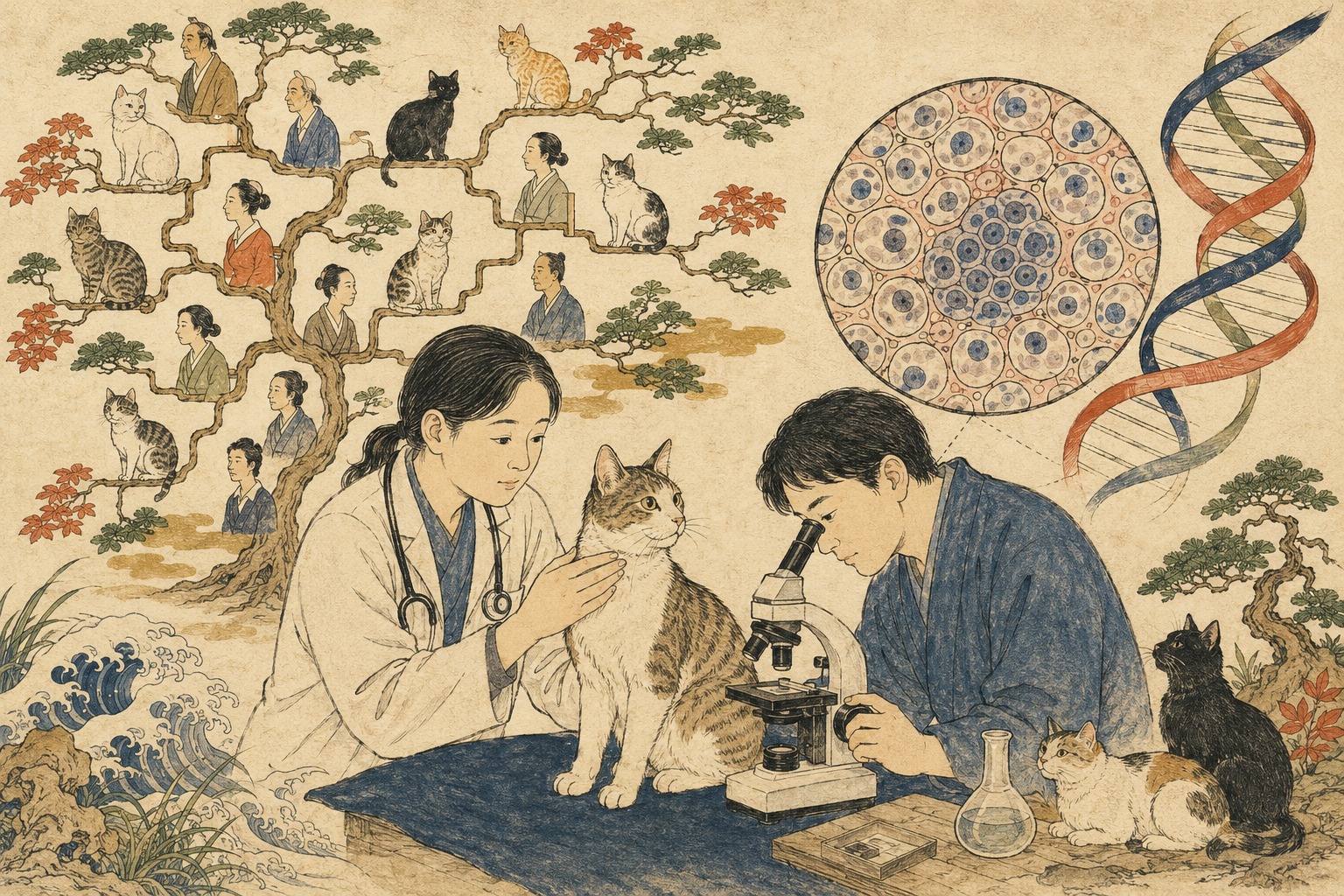
A tube of blood collected in a veterinary hospital can contain two kinds of time. One is the present—the illness that brought a cat into the room. The other reaches back to the embryo: DNA copied into almost every cell and potentially passed from parent to offspring. Sequence a tumor and one often sees changes acquired during the animal’s life. Sequence blood or another normal tissue and one can search for germline differences that existed before the cancer.
A study published August 8 in Scientific Reports by researchers at the RIKEN Center for Integrative Medical Sciences and the University of Tokyo systematically searched that older layer. From 2022 through 2024, the team used surplus blood from 813 cats treated for many different conditions at the University of Tokyo Veterinary Medical Center. Owners had provided written consent for secondary research use. The project caused no experimental infection, anesthesia or euthanasia.
The object was not to declare that cats get the same cancers as people. It was more careful and more foundational: read feline counterparts of genes used in human hereditary-cancer testing, identify sequence changes likely to damage them, and compare those candidates with each cat’s clinical record. The work places testable markers beside a question that has scarcely had a molecular outline: can a cat be born with a clinically important predisposition to cancer?
From 813 to 792, and From 784 Variants to 13
The team adapted a multiplex PCR targeted-sequencing method developed for human genetics to the cat genome. It covered the coding regions and adjacent splice boundaries of 27 genes—including APC, ATM, BRCA1, BRCA2, CHEK2, MSH2, MSH6 and TP53. A design of 1,036 short amplicons spanned 85,629 bases.
All 813 blood samples entered the process, but 21 failed the prespecified coverage threshold. The denominator for the principal frequency is therefore 792. Across the target, 99.6% of bases had at least 20 reads; investigators detected 784 germline variants in the quality-controlled cats. DNA variation is normal. The harder task is deciding which difference is harmless and which may disrupt a protein.
Cats have neither a species-specific equivalent of the standardized human ACMG/AMP interpretation framework nor a ClinVar-scale database connecting variants with disease. The researchers therefore used three filters. First came likely loss-of-function changes: premature stops, reading-frame shifts and disruption of canonical splice sites. Second were feline changes corresponding to human variants labeled pathogenic or likely pathogenic in ClinVar. Third were amino-acid substitutions predicted harmful by at least two of AlphaMissense, CADD and ESM1b.
Thirteen variants survived as “putative pathogenic variants”: eight under the loss-of-function criterion, two by correspondence to ClinVar, and three additional computational predictions. Every carrier was heterozygous. TP53 and CHEK2 variants in blood can sometimes arise from clonal hematopoiesis—an expanding population of altered blood cells rather than the inherited genome. Allele fractions near 50% supported the team’s germline interpretation, but confirmation in another normal tissue or a parent and offspring would strengthen it.
| Evidence level | What this study supplied | What is still needed |
|---|---|---|
| Sequence | High-coverage 27-gene feline panel and 13 candidates | Independent replication plus whole-genome, structural and noncoding searches |
| Pathogenicity | Predicted loss of function, human ClinVar and three in-silico tools | Function in feline cells, cat population frequencies and interpretation standards |
| Inheritance | Heterozygous candidates in blood-derived DNA | Other normal tissues, parents, littermates, offspring and co-segregation |
| Causation | Confirmed or suspected tumors in 7 of 18 carriers | Age-matched controls, longitudinal cohorts and a tumor’s “second hit” |
| Clinical utility | Treatment hypotheses based on DNA-repair pathways | Validated surveillance, doses, safety, controlled trials and treatment responses |
Human Medicine Started With Families
The idea of inherited cancer is older than DNA. In the nineteenth century, the French surgeon Paul Broca documented breast and other cancers recurring across generations of his wife’s family. In 1913, the American pathologist Aldred Warthin described “Family G,” in which early colorectal and uterine cancers appeared repeatedly. It would later be understood as a Lynch syndrome kindred. Doctors could see dark marks accumulating on pedigrees long before they could identify the molecule beneath them.
A conceptual break came in 1971. Geneticist Alfred Knudson studied the ages and one-eye or two-eye patterns of children with retinoblastoma and inferred that a tumor-suppressing system required two “hits.” A child born with one damaged copy needed only to lose the remaining working copy in a retinal cell. The inherited variant was not a tumor. It reduced by one the number of accidents required to approach one.
Molecular biology then named the families’ patterns. Li–Fraumeni syndrome, clinically described in 1969, was linked to germline TP53 variants in 1990. BRCA1 was cloned in 1994 and BRCA2 in 1995. Family history became a test that could inform surveillance, prevention and, later, therapy. Today, roughly 5% to 10% of human cancers are considered hereditary.
1860s Broca and others record cancer clustering across generations
1913 Warthin reports “Family G”
1971 Knudson proposes the two-hit model from retinoblastoma
1990 Germline TP53 variants are linked to Li–Fraumeni syndrome
1994–95 BRCA1 and BRCA2 are cloned
2007–20 The cat reference advances from an initial draft to a long-read assembly
2026 Twenty-seven candidate predisposition genes are surveyed in 813 cats
Cats cannot easily follow that route. Breeding records and medical records live in different places; a change of owner can erase kinship; cancers often arrive late in life; and no nationwide feline cancer registry connects the generations. Namiko Ikeda, Yukihide Momozawa and colleagues therefore chose reverse genetics: begin with genotype and work toward phenotype. It is a bold shortcut across a century and a half of human history. It also imports assumptions from the human gene list into the feline question.
DNA Repair Is the Cell’s Night Shift
Many of the 13 candidates make sense through DNA repair. Each time a cell divides it copies a genome and repairs routine damage. BRCA2 and RAD51C participate in homologous recombination, rebuilding a double-strand break from an intact matching template. ATM and CHEK2 detect damage and signal the cell cycle to stop. TP53 coordinates arrest, repair and cell death. MSH2 and MSH6 correct mispaired letters and small replication slippages.
These genes resemble a maintenance department more than an accelerator. If one inherited copy is weak, the other may still support ordinary life. If a cell later loses the remaining good copy—or disables the same pathway another way—errors can accumulate. Knudson’s two hits remain the essential sketch.
The same gene name does not guarantee the same disease across species. Protein partners, lifespan, hormones, reproductive status, infections, environment and organ biology differ. Human BRCA2 predisposition includes breast, ovarian, prostate and pancreatic cancers; that does not predict the same organs in a cat. The BRCA2 carrier in this study had multicentric lymphoma. A shared gene creates an experiment, not a shared destiny.
The Agreements—and Mismatches—Among 18 Cats
Twelve carriers were mixed-breed cats. Bengal, Ragdoll and Scottish Fold cats accounted for two each. There were eight castrated males, nine spayed females and one intact female. Investigators saw no evident breed, sex or neuter pattern, although 18 animals cannot establish the absence of one with much statistical power.
The case most evocative of a human syndrome was a mixed-breed cat carrying a TP53 stop variant and suspected of having osteosarcoma. Osteosarcoma is one of the sentinel cancers of human Li–Fraumeni syndrome. A different TP53 frameshift carrier, a Bengal, had a confirmed cutaneous mast-cell tumor. Such tumors are relatively familiar in cats and exceptionally rare in humans; their relationship to inherited TP53 disruption is unknown. One gene thus presents both resemblance and species difference.
A mixed-breed cat with a BRCA2 frameshift had multicentric lymphoma. A RAD51C carrier had a giant-cell tumor; a CDKN2A carrier, mammary carcinoma; and an ATM carrier, suspected renal-cell carcinoma. The same CHEK2 frameshift appeared in five mixed-breed cats, one with renal-cell carcinoma and four presenting with other conditions. The same NBN splice candidate occurred in two Ragdolls that did not share a tumor phenotype.
| Candidate gene | Observed example in this study | What can responsibly be said |
|---|---|---|
| TP53 | Suspected osteosarcoma; cutaneous mast-cell tumor | The former invites testing of Li–Fraumeni-like biology; causation is not established |
| BRCA2 | Multicentric lymphoma | A case in which tumor tissue could test homologous-recombination deficiency and PARP sensitivity |
| RAD51C | Giant-cell tumor | A candidate connection between loss of DNA repair and the tumor |
| CDKN2A | Mammary carcinoma | A single observation suggesting a cell-cycle question, not an association |
| CHEK2 | Same candidate in five cats; one renal-cell carcinoma | Low penetrance, a founder effect or a benign feline variant must be distinguished |
| MSH2 / MSH6 | Carriers had no tumor at sampling | Long follow-up could test cancer risk, mismatch-repair loss and immunotherapy hypotheses |
Putting a tumor beside a variant does not prove that one caused the other. Of the seven tumor-bearing carriers, five were confirmed by histopathology or cytology. The suspected osteosarcoma and suspected renal-cell carcinoma were distinct masses on examination or imaging but lacked tissue confirmation. Most candidates appeared in only one cat, preventing a robust gene–tumor association test. The study also did not show loss of the remaining normal allele or functional collapse of the pathway inside a tumor.
Why Did 11 Carriers Have No Tumor?
Eleven of the 18 carriers had no tumor when their blood was collected. That neither immediately falsifies a candidate nor means the cat will eventually develop cancer. Human carriers of pathogenic variants do not all become ill. This incomplete penetrance reflects age, sex, hormones, other genes, environment and chance.
Carriers with tumors were 9.00 to 14.41 years old, with a median of 11.83. Tumor-free carriers were 1.83 to 16.58, with a median of 9.16. The difference did not meet conventional statistical significance (P=0.082). More importantly, noncarriers also showed a large age divide: median 12.75 years for cats with tumors and 6.58 for cats without. The authors acknowledge that the apparent carrier difference could reflect the cohort’s age structure rather than a variant-specific effect.
This is why “7 of 18, or 38.9%” must not be quoted to an owner as an individual risk. The denominator was not a random community sample but patients with assorted diseases referred to a single advanced-care hospital. There was no age-adjusted risk comparison with noncarriers, and the number is not a prospective lifetime incidence. Nor does 2.3% mean that 2.3% of all cats have hereditary cancer. These are measurements for designing the next cohort, not completed risk estimates.
The Ninth Life of the Cat Genome
The search rests on two decades of improving feline references. An initial domestic-cat genome centered on Cinnamon, an Abyssinian, was published in 2007. A stronger comparative assembly followed in 2014. In 2020, long-read sequencing produced the far more continuous Felis_catus_9.0 assembly, improving researchers’ ability to locate genes and disease-causing structural changes. The 2026 team designed its primers against that felCat9 reference.
A separate landmark arrived in February 2026. A Science study compared 493 paired tumor and normal samples across 13 feline cancer types, targeting cat counterparts of about 1,000 human cancer genes. It identified 31 driver genes. TP53 was mutated inside 33% of feline tumors, close to 34% in human pan-cancer data. That oncogenome asked broadly what breaks inside a tumor after cancer arises. The RIKEN–Tokyo study asked narrowly what an animal may have carried before cancer. Somatic and germline projects fill opposite sides of the same map.
Cats have long been understudied beside dogs in comparative oncology. Case networks, funding, reagents and annotation are thinner, while cats’ tendency to hide illness can delay diagnosis. Yet naturally occurring feline mammary carcinoma, oral squamous-cell carcinoma and lymphoma develop in immunocompetent bodies exposed to part of the human household environment. They preserve complexity absent from a mouse engineered with one initiating mutation, and their shorter lives make disease and response observable on a different time scale.
A Cat Is Not a Small Human
Comparative oncology derives value from differences as well as similarities. Feline mammary tumors share some molecular and aggressive features with human breast cancer. Feline oral squamous-cell carcinoma is studied beside human head-and-neck disease. But metabolism, lifespan, drug handling, tumor incidence, infections, neutering and breed structure differ. A drug effective in cats need not work in people; a human-classified variant need not be pathogenic in cats.
The 27 genes were not discovered in an unbiased scan of feline disease. They were selected largely from a human hereditary-cancer panel. Some of the reported human–cat agreement is therefore built into the experiment. Cat-specific predisposition genes outside the panel, regulatory regions and large deletions or duplications could be missed. Variants that do not map neatly to a human coordinate are also harder to judge with human resources.
Even so, a shared vulnerability in an evolutionarily conserved DNA-repair circuit is valuable. Similarities can prioritize therapeutic targets. Differences can reveal why the same starting defect leads to different organs or outcomes in another species. A useful comparative model is not a miniature person. It is another body answering the same biological question.
PARP Inhibitors and Immunotherapy: Hypotheses, Not Prescriptions
The paper’s most concrete clinical idea is to exploit DNA-repair weakness. Tumors deficient in BRCA2, RAD51C or other homologous-recombination components may become unusually dependent on PARP-mediated repair. Blocking PARP can then produce “synthetic lethality,” a strategy used against selected human ovarian, breast, prostate and pancreatic cancers.
But a candidate in blood is not proof that a tumor is homologous-recombination deficient. Investigators would need to show that the remaining normal copy was lost in the cancer, detect genomic scars of HR deficiency, and establish safe feline exposure. The BRCA2 carrier with multicentric lymphoma is an informative research case, but PARP inhibitors are not approved for cats in Japan, and this study neither administered one nor measured a response.
MSH2 and MSH6 candidates suggest a different path. In human tumors, mismatch-repair failure can create many mutations and predict benefit from immune-checkpoint blockade. Both feline carriers were tumor-free at sampling. No one yet knows whether they will develop cancer, what type it might be, or whether it would lack mismatch repair. The development of feline anti-PD-1/PD-L1 antibodies in Japan does not permit a leap from a gene name to treatment.
- Confirm each candidate by another method and normal tissue; measure function in feline cells.
- Sequence matched tumor and normal tissue for loss of the normal allele, HRD or MSI.
- Establish feline pharmacokinetics, toxicity and appropriate dose.
- Measure efficacy in ethical trials against natural history or standard care.
- Explain uncertainty, cost and alternatives to owners while putting each cat’s welfare first.
The Risk of a Test Reaching the Market Before the Evidence
Genetic results provoke action. An owner hearing “high risk” may seek frequent imaging, exclude an animal from breeding or consider preventive intervention. Feline medicine does not yet know which test at which interval improves survival or quality of life for a carrier of any gene in this study. False positives can bring expense, anesthesia, invasive procedures and anxiety; false negatives can create reassurance that distracts from a new lump, weight loss or other symptom.
Breeding demands even more care. Removing every candidate carrier could rapidly shrink diversity in a small breed and expose other recessive diseases. The recurrent CHEK2 candidate in five mixed-breed cats and NBN candidate in two Ragdolls remain uncertain in both pathogenicity and penetrance. Before a company sells the single word “pathogenic,” independent replication, population frequency, family co-segregation, function and clinical utility should be established.
The first benefit must also return to cats. If cats are viewed only as natural experiments for human drugs, research can rationalize burdens they cannot choose and from which they may gain little. Comparative oncology with companion animals should be reciprocal: treat naturally ill patients under ordinary veterinary care, obtain informed owner consent, and share knowledge between species. This study’s use of surplus samples and existing records, without research-only procedures, fits that principle.
What It Would Take to Name a Syndrome
The decisive next step is not simply to find more carriers but to close a chain of evidence. Multicenter cohorts must include general-practice animals and match cats by age, breed and sex. Carriers and noncarriers must be followed over years with consistent diagnostic standards. DNA and medical histories from parents, littermates and offspring could show whether a variant and cancer travel together through a family.
When a carrier develops cancer, blood and tumor should be sequenced as a pair. Did the tumor lose the normal allele—the second hit? Does a BRCA-pathway tumor show homologous-recombination deficiency? Does an MSH-pathway tumor show microsatellite instability and high mutation burden? Feline cells or organoids can test repair and ask whether correcting a variant restores it. Such evidence turns a sequence that happens to coexist with a tumor into a mechanistic cause.
Clinical success should not be counted in tests sold. It should be measured by whether surveillance finds a treatable cancer, extends survival and good-quality time, and outweighs the burden of visits and procedures. Feline genetic counseling, data protection, an owner’s option not to know, and evidence-based breeding guidance would have to grow alongside the assay.
From One Cat Toward Two Medicines
Human hereditary-cancer genetics began in the sorrowful repetition recorded by generations of families. Cats rarely leave that record. Researchers therefore looked backward from blood stored after a hospital visit: from 813 enrolled cats to 792 analyzable ones, from 784 variants to 13 candidates, and then into the medical lives of 18 carriers. Each narrowing produced more questions than answers.
That is not failure. Finding a variant and knowing its meaning are different sciences. This project produced a method and a set of cases with which feline hereditary cancer can now be tested. It did not produce a finished diagnostic. Family, time, tumor, function and treatment must still be joined one link at a time.
If the chain closes, the benefit can run both ways. Cats move toward care based not only on the tumor’s name but on why it arose in that animal. Human researchers gain another mammal that shares homes with people, has an intact immune system and develops cancer naturally—revealing what evolution conserved and where species diverged. Comparative oncology’s promise is not that a cat will replace a person. It is that treating both patient populations seriously will reveal a cancer neither species could show alone.
- This study alone is not a reason to rush a healthy cat into a commercial hereditary-cancer test.
- A lump, appetite or weight loss, bleeding, a wound that will not heal, or changes in breathing or elimination call for veterinary examination before genetic testing.
- Before joining a study or ordering a test, ask what the result changes, whether it is validated in cats, and what evidence-based surveillance follows a positive result.
- Testing and treatment depend on the individual cat. This report is not a veterinary diagnosis or prescription.
- RIKEN and the University of Tokyo: “Possibility of hereditary tumors shared by cats and humans” (August 8, 2026; Japanese)
- Ikeda et al., Scientific Reports: Characterization of putative germline pathogenic variants… (2026; peer-reviewed, open access)
- Francis et al., Science: The oncogenome of the domestic cat (2026)
- Buckley et al., PLOS Genetics: A new domestic cat genome assembly… (2020)
- Cannon, Veterinary Sciences: Cats, Cancer and Comparative Oncology (2015 review)
- U.S. National Cancer Institute: Milestones in Cancer Research and Discovery
- Chernoff, Cancer Research: The two-hit theory hits 50 (2021)
Editor’s note: This account triangulates the primary paper, institutional release, public records and peer-reviewed background literature. Japan.co.jp did not independently interview the researchers. We follow the paper in using “putative pathogenic,” and distinguish confirmed from suspected tumors, germline from tumor-somatic change, and research hypotheses from approved treatment.