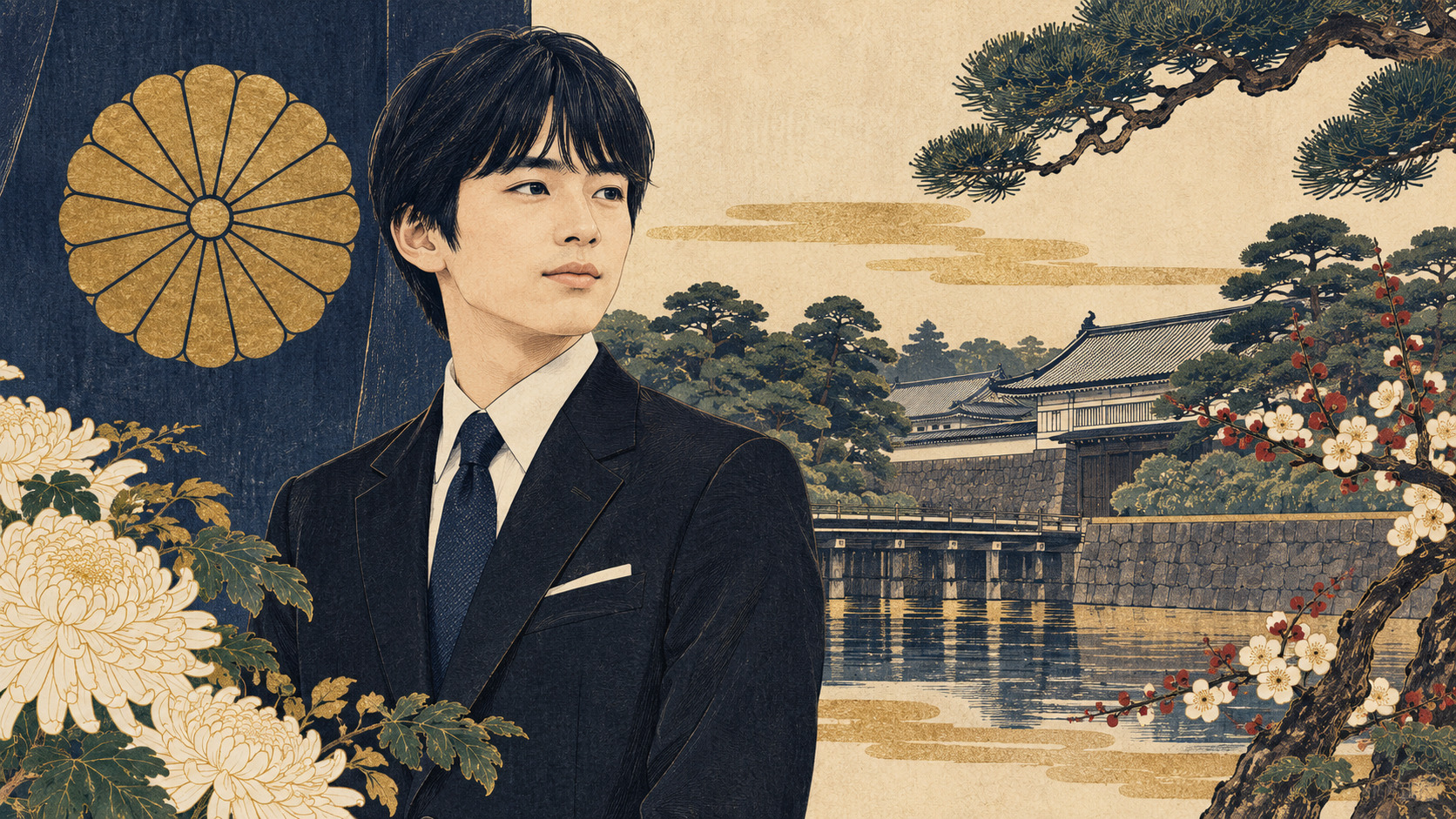
In the images selected by the Imperial Household Agency for Prince Hisahito’s twentieth birthday, Japan’s young prince is not standing beneath a palace chandelier. He is peering through a quadrant telescope at the Science Museum of Map and Survey in Tsukuba, studying how Polaris relates to latitude and examining maps of Tokyo before and after the Meiji era. The setting is unusually apt. His public life is often discussed as destiny; the photographs show him measuring, observing and learning.
Hisahito, the son of Crown Prince and Crown Princess Akishino, turned 20 on September 6. He is a second-year student in the College of Biological Sciences in the University of Tsukuba’s School of Life and Environmental Sciences. According to the Imperial Household Agency’s official birthday account, his work now includes English required for reading biology papers, laboratory courses, increasingly specialized lectures and summer field training. The same account describes a growing calendar of Imperial events, but attaches an important qualifier: he attends to them insofar as they do not interfere with his studies.
The first ordinary year after an extraordinary rite
The most consequential change of the past year is not a title. It is accumulation: rooms entered for the first time, communities encountered, gestures practiced until they became legible. Hisahito began attending central court events as an adult member of the Imperial Family, including the New Year’s Reception, the public New Year greeting, the Imperial lectures and poetry-reading ceremonies, and the Emperor’s Birthday celebrations. In May 2026, he attended his first state banquet, held for Philippine President Ferdinand Marcos Jr. and First Lady Louise Araneta-Marcos.
Away from the palace, the range widened. He toured part of Expo 2025 Osaka, Kansai on his own before joining his father; watched the Tokyo world athletics championships and the Deaflympics; travelled to Hokkaido for the 2026 World Ski Orienteering Championships; and visited Hiroshima. There he laid flowers at the cenotaph in Peace Memorial Park, toured the Honkawa Elementary School Peace Museum and later addressed the 19th Nippon Scout Jamboree—the first formal remarks he had delivered at a public event.
Those appearances suggest recurring concerns—young people, the natural world, disaster memory, peace and international exchange. They do not yet amount to an officially assigned portfolio. No permanent presidency or settled field of public work has been announced for him. The evidence supports a story of formation, not completion.
Why adulthood came in three stages
For much of modern Japanese history, the twentieth birthday could serve as both legal threshold and ceremonial landmark. That alignment disappeared when Japan lowered the general age of adulthood from 20 to 18 in April 2022. Hisahito became the first Imperial Family member to reach adulthood under the revised rule when he turned 18 on September 6, 2024.
The ceremony did not follow immediately. He was then in his final year of high school, preparing for university entrance. The Imperial Household Agency decided that rehearsals and the many related rites should not disrupt his education. The postponement was more than a scheduling convenience: it showed an old institution adjusting its ritual calendar to a student’s contemporary life.
On his nineteenth birthday in 2025, an Imperial envoy first delivered the adult cap to the Akishino residence. At the palace’s Hall of Spring and Autumn, before the Emperor and Empress and his parents, Hisahito wore a ketteki-no-ho court robe and received the cap during the Kakan-no-Gi. He then changed into a hoeki-no-ho robe to worship at the Three Palace Sanctuaries and, in white tie, appeared before the Emperor and Empress in the Matsu-no-Ma state room. The Emperor conferred on him the Grand Cordon of the Supreme Order of the Chrysanthemum.
Visits to Ise Jingu and the mausoleums of successive emperors and empresses followed. Related observances continued into February 2026, ending with a tea gathering on February 28. His twentieth birthday therefore arrived only after the exceptional machinery of coming of age had stopped turning. It marks the beginning not of adulthood, but of life after its ceremonial declaration.
September 6, 2006 — Born in Tokyo, the only son of Crown Prince and Crown Princess Akishino.
April 2022 — Japan’s general age of adulthood falls from 20 to 18.
September 6, 2024 — Becomes an adult member of the Imperial Family at 18.
April 2025 — Enters the University of Tsukuba.
September 6, 2025 — Completes the principal coming-of-age rites at 19.
February 28, 2026 — The final related observance concludes.
September 6, 2026 — Turns 20 while continuing university study and selective public duties.
An ancient cap in a postwar constitutional order
The cap ceremony reaches back through the premodern genpuku tradition, in which a young man’s clothing, hairstyle or name signified entry into adult status. Yet the institution that performs it today is defined by the postwar Constitution. Article 1 makes the Emperor the symbol of the state and the unity of the people, deriving that position from the will of the sovereign people. Article 2 makes the throne dynastic and leaves the rules of succession to the Imperial House Law.
Under that law, Crown Prince Akishino—Hisahito’s father and the Emperor’s younger brother—is first in line. Hisahito is second. The prince’s birthday does not alter that sequence, and the constitutional role awaiting any future emperor is not one of government. The sovereign performs acts of state specified by the Constitution and has no powers related to government.
The succession question nevertheless presses heavily on public discussion because the eligible line is narrow. Parliament passed and promulgated an amendment to the Imperial House Law in July 2026 that will allow princesses to retain Imperial status after marrying a commoner and permit certain male-line descendants of former branches of the Imperial Family to enter the family through adoption. Most provisions take effect three months after promulgation. The adopted man himself is not given succession rights, and the legislation does not make women eligible to inherit the throne. It addresses the number of working Imperial Family members while leaving the basic succession rule intact.
That distinction matters. Hisahito is a person, an adult Imperial and a potential future sovereign; he is not a policy answer. Decisions about the law belong to elected lawmakers, not to the 20-year-old whose life those rules so visibly shape.
A naturalist’s way of looking
Hisahito’s interest in insects has long been treated as a charming biographical detail. It is more substantial than that. In 2023, a paper co-authored by “Hisahito Akishinonomiya,” Imperial Household Agency staff member Ken Iijima and National Museum of Nature and Science zoologist Takuya Kiyoshi appeared in the museum’s peer-reviewed bulletin. Their survey recorded 38 species of dragonflies and damselflies in the Akasaka Imperial Gardens between 2012 and 2022, including 12 species on Tokyo’s threatened-species list. The paper argued that continued stewardship had helped sustain a rare pocket of urban biodiversity.
At his March 2025 news conference, Hisahito described the capacity to pursue an interest deeply as both a strength and, when it hardens into excessive fixation, a weakness. He recalled losing track of time while watching dragonflies around woods and ponds. That degree of concentration may explain the biological sciences. It should not be converted too quickly into a predetermined “environmental” Imperial brand.
Still, scientific observation offers a useful counterpoint to inherited expectation. Field biology asks what is actually present, how it changes and what the evidence permits one to say. Responsible coverage of Hisahito should do the same. The agency confirms continued biological study, fieldwork and observation at the Akasaka grounds. It does not confirm a future specialty, overseas study plan, permanent patronage or eventual timetable of full-time duties.
The value of leaving a life unfinished
Second in line to a throne is an unusually heavy caption to place under a university student. It encourages every appearance to be read as rehearsal and every interest as preparation. But the Japanese monarchy’s postwar legitimacy rests less on spectacle than on accumulated relationships—with disaster survivors, local communities, scholars, athletes and visitors from abroad. Those relationships cannot be learned only inside the palace.
Hisahito’s own formulation has been modest: put study first, receive advice, and address each task with care. His father made the same point in 2025, saying that public appearances would remain limited while his son was a student and that each one should be valued.
Twenty, then, is a new stage in a restrained sense. No statute changes and no crown draws nearer overnight. What begins is the first full year after the cap, when ritual gives way to habit. The test is whether Japan can allow a young adult enough ordinary time to become learned and attentive, even as an extraordinary institution waits around him.
- Prince Hisahito: 悠仁親王, read Hisahito Shinnō. The Imperial Household Agency’s English pages use “Prince Hisahito.”
- Crown Prince Akishino: 秋篠宮皇嗣文仁親王. “Crown Prince” is the agency’s official English rendering for the kōshi, or first person in the line of succession.
- Coming-of-age ceremony: 成年式, seinen-shiki. Its central cap rite is 加冠の儀, Kakan-no-Gi.
- Imperial Household Agency: Prince Hisahito’s twentieth birthday (Japanese, September 6, 2026) — studies, rites, court events and public activities.
- Imperial Household Agency: Prince Hisahito’s first adult news conference (Japanese, March 3, 2025) — his statements on duty, study and natural history.
- Imperial Household Agency: schedule and descriptions of the coming-of-age ceremonies — official names, clothing, places and sequence.
- Imperial Household Agency: eighteenth-birthday account — legal adulthood and the reason for postponing the ceremony.
- J-STAGE: “Odonata fauna of Akasaka Imperial Gardens, Tokyo” — authorship, methods, species count and publication data.
- University of Tsukuba president’s 2025 statement (Japanese) — enrollment in the College of Biological Sciences.
- House of Councillors bill record (Japanese) — passage, promulgation and official summary of the 2026 Imperial House Law amendments.
Editorial note: The Japanese and English reports were written separately. Official Japanese names and readings were checked against Japanese primary sources. Claims about private views, a future portfolio, overseas study or the timing of future duties have not been inferred.