Pochacco is black and white, and somehow perfect for summer
Sanrio is built from color memory. Hello Kitty’s red bow. My Melody’s pink hood. Cinnamoroll’s pale sky blue. Kuromi’s black and purple. Characters do not only live in shape. They live in color. That is why Pochacco’s white body and black floppy ears are quietly powerful. Simple. Cool. Not too sweet. Easy for children, but also surprisingly easy for adults.
POCHACCO CAFE for summer 2026 understands that strength. The concept is monochrome, with blue and green accents. Pochacco appears as a waiter. The P-chans join him. The menu includes black mushroom cream pasta, a frame-inspired egg sandwich plate, chocolate mint, and lemon squash floats. It is cute, but not sugary. Sanrio, but a little grown-up.
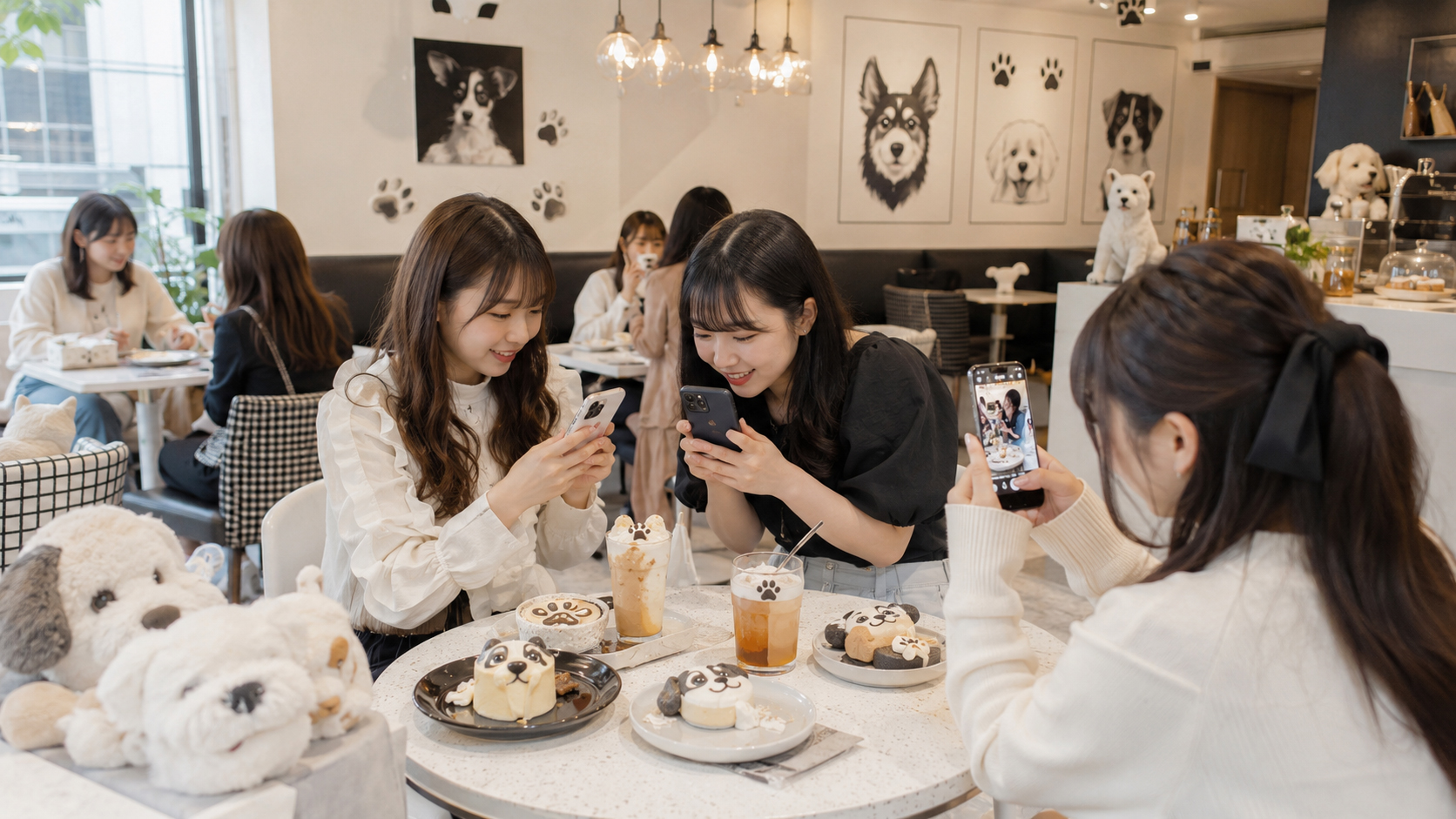
That balance matters now. “Cute” alone can disappear quickly in the social-media feed. A character cafe needs a color system, photogenic dishes, limited goods, a reason to reserve, a reason to post, and a reason to bring a friend. A character cafe is not simply a meal. It is a short exhibition, a shopping moment, a photo shoot, and a fan ritual.
Why a dog born in 1989 still works in 2026
Pochacco debuted in 1989, the year the Heisei era began. Japan still carried the heat of the bubble economy, and character goods, stationery, fancy shops, notebooks, stickers, pencil cases, and small bags were part of daily childhood. Sanrio already had Hello Kitty, but the late 1980s and early 1990s brought a broader cast of characters into schools, bedrooms, bags, and desks.
Pochacco fit that moment. He was sporty, bright, slightly scatterbrained, and easy for both boys and girls to like. Sanrio cuteness was never only pink. Pochacco offered a lighter kind of kawaii: white and black, dog, walking, curiosity, banana ice cream.
From 1991 to 1995, Pochacco won the Sanrio Character Ranking five years in a row. That was not an accident. In early 1990s Japan, he felt current. What is remarkable is that he did not disappear afterward. In 2025 he placed third, and in the 2026 interim ranking he was again third. New characters, social media stars, and changing tastes keep arriving. Pochacco keeps coming back.
The kawaii economy runs on memory
Character popularity is not only a children’s trend. Much of today’s Sanrio strength runs on adult memory. Pencil boards, pen cases, handkerchiefs, sticker books, school bags, little pouches, keychains bought by parents, memo pads traded with friends — these small objects return later as emotional triggers.
Pochacco is especially strong in that memory economy. He feels nostalgic without looking stale. His design is round and simple. His expression is not too loud. He can sit on an adult desk or bag without feeling overly childish. The new monochrome cafe concept seems designed for precisely those grown-up fans.
Sanrio rarely traps its characters inside a single age group. It moves them through cosmetics, apparel, cafes, hotels, exhibitions, anime, corporate collaborations, and oshi goods. POCHACCO CAFE is part of that machine. A character you loved as a child can now be met again over a themed plate and a limited acrylic keychain. That is a strong consumer experience because it feels like reunion.
Tokyo Solamachi and Tennoji MIO are very smart locations
The cafe opens at BOX cafe&space Tokyo Solamachi and BOX cafe&space Tennoji MIO in Osaka. Both locations make sense.
Tokyo Solamachi sits inside Tokyo Skytree Town. It mixes tourists, families, young fans, couples, domestic travelers, and international visitors. Oshiage also connects naturally with Asakusa, Ueno, Kinshicho, and the eastern side of Tokyo tourism. A character cafe needs devoted fans, but it also benefits from people who discover it while already moving through a shopping and sightseeing route. Solamachi has that traffic.
Tennoji MIO has similar strength in Osaka. Tennoji is a major southern Osaka transit and shopping hub, close to Abeno, Shinsekai, Dobutsuen-mae, and Namba routes. Students, shoppers, commuters, families, and tourists overlap there. A limited Sanrio cafe inside a station-connected commercial facility can serve both reserved fans and accidental curiosity.
| Location | Event information |
|---|---|
| Tokyo / Oshiage | BOX cafe&space Tokyo Solamachi. July 2 to August 16, 2026. Hours: 10:00–21:45, 75-minute rotation system. |
| Osaka / Tennoji | BOX cafe&space Tennoji MIO. July 2 to August 9, 2026. Hours: 11:15–21:30, 75-minute rotation system. |
| Reservations | Advance reservations are first-come, first-served. Reservation fee is ¥660 including tax per person, with a reservation benefit. Up to four seats per booking. |
| Design world | Monochrome setting with blue and green accents, waiter Pochacco, and the P-chans. |
| Purpose | A cool summer character cafe designed for photos, goods, and oshi activity. |
The menu is less “food” than a tiny stage for photography
Food in a character cafe has a different job from food in a normal restaurant. Taste matters, but first the dish must make the guest want to take a picture. POCHACCO CAFE understands that.
Pochacco’s frame-style egg sandwich. Pochacco’s croque monsieur. Pochacco’s mushroom cream pasta. Black desserts. Chocolate mint. Lemon squash floats. The menu turns the monochrome concept into something edible, then adds blue and green summer coolness. The table becomes a small studio.
The black mushroom cream pasta is especially smart. Many cute character cafes rely on pastel pink, white, strawberry, cream, and soft sweetness. Black gives the photo weight. It makes Pochacco’s white face stand out. It feels cute, but slightly fashion. That may be the cafe’s clickability in one plate.
Monochrome makes kawaii grow up
Monochrome is strange because it is not really a color. It is the absence of color, and that absence can feel adult. It reduces sweetness, sharpens shape, and creates space. When a character becomes monochrome, childlike cuteness moves a little closer to fashion.
Sanrio is good at this kind of transformation. It can change the mood without damaging the character. Hello Kitty can keep her red bow and still enter luxury branding. Cinnamoroll can float through cafe sweets and soft blue desserts. Kuromi can connect with rebellious youth style. Pochacco can enter monochrome naturally because black and white are already part of his design language.
The blue and green accents are also clever. Pure black and white might feel too heavy for summer. Cool accent colors connect to chocolate mint, lemon squash, and the season. The color system is not decoration. It is product strategy.
The goods are not a side dish. They are the point
Character cafes are built around what guests take home. This cafe offers die-cut stickers, magnets, acrylic keychains, teaspoons, mini acrylic dioramas, flat pouches, glasses, sacoches, reservation-ticket cases, and clear-card menu benefits. That is not just merchandise. It is evidence of the experience.
The cafe lasts 75 minutes. The food disappears. The photos remain on the phone. Goods remain in bags, on desks, and on shelves. Fans carry the character home.
Random goods also connect to modern oshi culture. You want your favorite design. You trade with friends. You buy again. You display. This is a contemporary version of the old sticker and stationery exchange culture. Sanrio has translated Showa and Heisei fancy-shop habits into Reiwa acrylic goods and social posting.
Why character cafes are so strong in Japan
Japanese character cafes can surprise visitors from abroad. Anime, manga, games, Sanrio, idols, films, stage shows — limited-time cafes appear constantly, combining menus, reservation systems, benefits, merchandise, and themed interiors. Fans are not simply eating. They are entering a character’s world briefly.
Part of the reason is that Japan has long known how to eat stories. Ekiben, seasonal sweets, regional limited goods, department store food events, character bento, festival snacks — food often carries place, season, memory, and narrative. Character cafes move that habit into pop culture.
Japan’s cities also support limited-time experiences well. Station-adjacent commercial spaces rotate quickly. Reservation systems are normalized. Small goods production is sophisticated. Social media spreads event information fast. Fans respond to scarcity. If the cafe is only open for a short time, going becomes urgent.
Pochacco survives in the Hapidanbui era
Recent Pochacco popularity also connects to Hapidanbui, the Sanrio unit that brings together Pochacco, Tuxedosam, Keroppi, Bad Badtz-Maru, Hangyodon, and Ahiru no Pekkle. The unit has helped bring nostalgic male Sanrio characters back into current fan life.
This is Sanrio archive strategy. The company does not only create new characters. It re-edits older characters for new eras. Characters that once lived on Heisei school desks now return to Reiwa oshi shelves. Pochacco is especially effective because he is sincere, simple, black-and-white, bright, and easy to reinterpret.
The 2024 anniversary cafe leaned into banana ice cream and celebration. The 2026 cafe shifts toward monochrome coolness. That matters. It shows Pochacco can be interpreted again. He is not only the dog fans used to love. He is a dog who still belongs in a modern cafe.
Kawaii is not childish
Japanese kawaii is often underestimated. Sanrio proves that cuteness can be a serious design and business system. Eye position, absence of mouth, color palette, silhouette, name, birthday, favorite food, friends, goods strategy, seasonal campaigns, and collaborations all matter.
Pochacco has no visible mouth. That allows viewers to project emotion onto him. He can look happy, absentminded, gentle, or slightly confused. His black ears make his silhouette instantly memorable. His white face works on food and goods. His love of banana ice cream becomes menu strategy. Small details like these are why a character can still power a cafe decades after debut.
Kawaii is not childish. Kawaii is a technology for linking memory, emotion, commerce, and identity. POCHACCO CAFE is a place where that technology becomes easy to see.
Tokyo and Osaka will give the same cafe different rhythms
The Tokyo Solamachi cafe will likely flow with Skytree tourism: families, friends, visitors, and fans combining the cafe with shopping and sightseeing. For international travelers, it is a convenient way to add Sanrio to a Tokyo itinerary.
The Osaka Tennoji MIO cafe may feel closer to everyday shopping life: after school, after work, before or after Abeno or Shinsekai, with friends who might add a little joke to every photo. Osaka fans may give the same cafe a different tempo.
That is the pleasure of two-city character cafes. The character is the same. The food is the same. The goods are the same. But the city changes the experience: the surrounding streets, the visitors, the photos, the conversation afterward.
Summer Sanrio is selling coolness
Tokyo and Osaka summers are hot. People want to step indoors. They want cold drinks. They want mint, lemon, blue, green, and air-conditioning. POCHACCO CAFE is not only selling a character. It is selling a small summer refuge.
That is smart event design. In an era of hotter summers, indoor seasonal experiences become stronger: aquariums, hotel events, character cafes, department store pop-ups, observation decks, indoor gardens. The city still wants summer feeling, but it wants it with air-conditioning and a short walk from the station.
A cool cafe, a cute plate, a photo, a limited good. This is not a giant life event. But summer days often get better through small rewards.
Pochacco is a genius of detours
Pochacco’s profile says he loves taking detours on walks. That makes him perfect for a cafe. Cafes are detour spaces: the time between destinations, the pause between plans, the table where friends talk, the place to rest feet, look at photos, and examine what you bought.
At Tokyo Solamachi or Tennoji MIO, POCHACCO CAFE can be a destination for reserved fans or a detour for someone who discovers it while shopping. Both work. Pochacco’s softness can hold both kinds of visit.
Character cafes are short. The seating time is limited. You eat, photograph, buy, talk, and leave. The beginning and end are clear, like a tiny stage play.
In summer 2026, Pochacco becomes a waiter in Tokyo and Osaka. He stands inside a monochrome cafe, cooled by blue and green, and hands fans a short, photogenic break from the heat.
It is more than cute. It is proof that cuteness can grow up and still be worth visiting.
- POCHACCO CAFE opens July 2, 2026 at Tokyo Solamachi and Tennoji MIO in Osaka.
- The Tokyo cafe runs through August 16; the Osaka cafe runs through August 9. Both use a 75-minute rotation system.
- The concept is monochrome with blue and green accents, waiter Pochacco, and P-chans.
- The menu includes black mushroom cream pasta, frame-style plates, chocolate mint, lemon squash floats, and photogenic desserts.
- Pochacco debuted in 1989, won the Sanrio Character Ranking five years in a row from 1991 to 1995, and remains a top-ranked character in the 2020s.
Sources and references
This article was based on public information from Sanrio, the POCHACCO CAFE official site, PR TIMES / LTR Inc., FUN! JAPAN, Sanrio character materials, and character-cafe related information.