Fireworks no longer belong only to the sky
Japanese summer has fireworks. Yukata, food stalls, riversides, beaches, night air, distant cheers — fireworks make summer pause for a few seconds. They rise, open, fade, and disappear. That vanishing is part of the beauty. But seeing fireworks in Tokyo can be hard work: heat, crowds, crowded stations, tired children, sudden rain, and the long way home.
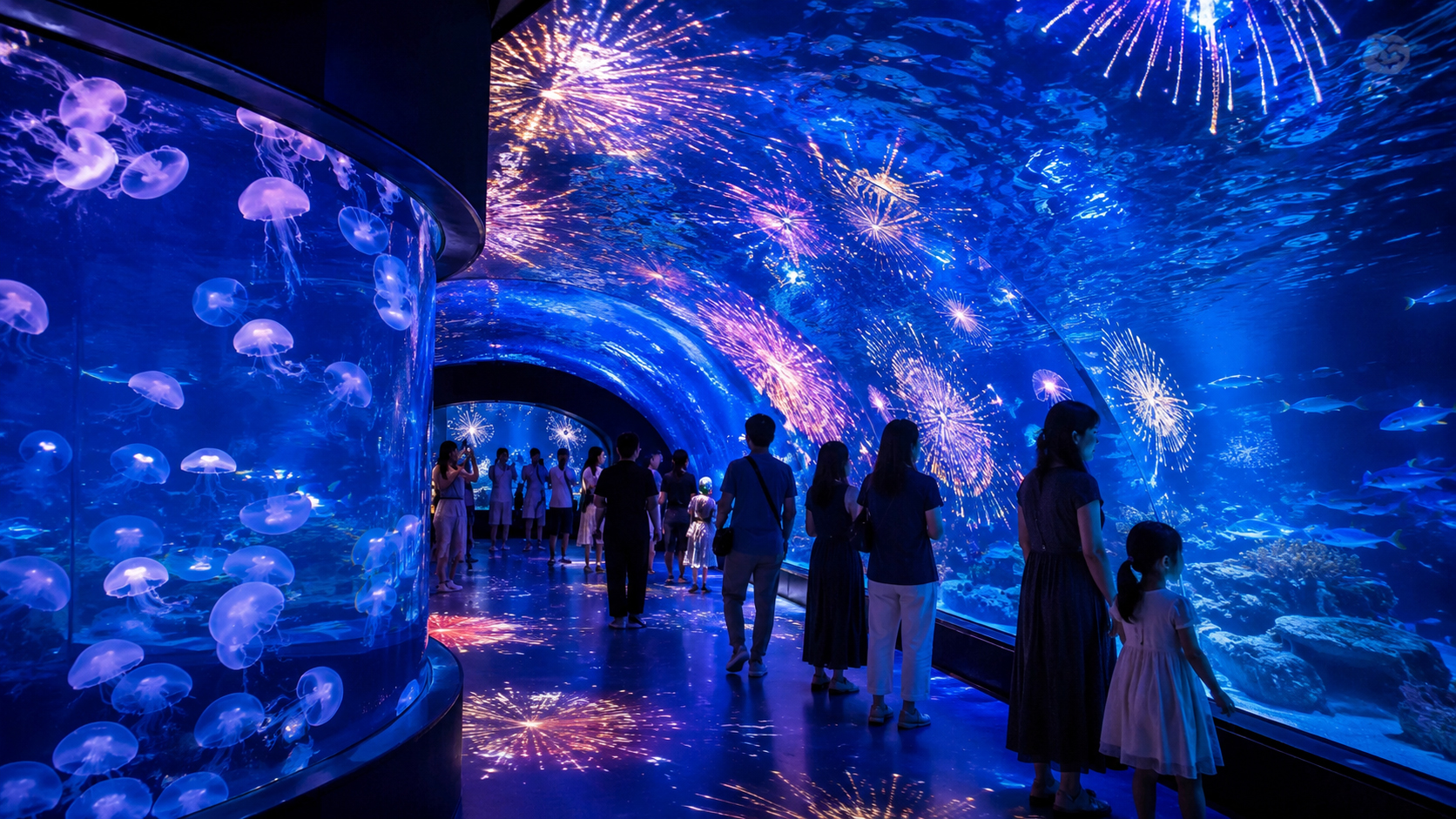
Maxell Aqua Park Shinagawa’s Fireworks Aquarium by NAKED offers a very Tokyo solution: move the fireworks from the sky into the aquarium. Replace the riverbank with indoor coolness. Replace gunpowder with light. Replace the open night with tanks, reflections, music, and water. Make summer visual, but also manageable.
Of course, it is not the same as real fireworks. There is no smoke, no explosive echo in the chest, no vast dark sky. But difference is the point. Digital fireworks are not only a substitute. They are a new kind of summer staging designed for city life.
Shinagawa makes the family trip easier
Aqua Park Shinagawa’s first advantage is location. It is about two minutes from Shinagawa Station’s Takanawa Exit. For families, that matters enormously. Tokyo events are not judged only by content. They are judged by how hard they are to reach, and how tired everyone is by the time the fun begins.
Shinagawa is one of Tokyo’s great movement points: Shinkansen, JR lines, Keikyu, Haneda Airport access, hotels, offices, restaurants, and tourist routes all overlap. It works for Tokyo residents, domestic travelers, and international visitors. A family arriving by bullet train, a visitor coming from Haneda, a parent finishing work, a hotel guest looking for a short evening plan — Shinagawa makes the event easier to say yes to.
The aquarium is indoors, which in Tokyo summer is almost a moral virtue. It works on hot days, rainy days, and days when the forecast makes parents nervous. Children can rest. Food, hotels, trains, and taxis are nearby. A family-friendly event is not only one that children enjoy. It is one that adults can survive.
NAKED turns the aquarium from a viewing place into an immersive place
The event title includes “by NAKED,” and that matters. NAKED is known for using light, projection, sound, and spatial design to expand cultural and tourist spaces. Temples, castles, gardens, flowers, cherry blossoms, autumn leaves, observation decks, and stations have all become digital stages in the company’s hands.
An aquarium is a natural partner. Aquariums are already light-based spaces: dark rooms, illuminated tanks, silver fish, bubbles, water movement, glass, reflection, blue depth. Add digital staging and the tank stops being only an exhibit. The whole room becomes part of the experience.
Fireworks Aquarium is described as a sea-world fireworks festival woven from sound, light, and sparkling water. That does not mean firework shells inside a fish tank. It means the memory of fireworks, the feeling of summer festivals, the shimmer of water, the motion of marine animals, music, and lighting layered together. Visitors are not only looking at fish. They are stepping into a version of summer.
Japanese fireworks carry both mourning and joy
Fireworks in Japan should not be understood only as entertainment. In the Edo period, fireworks became part of urban summer culture. The Sumida River fireworks tradition is often associated with both public enjoyment and remembrance after suffering from famine and disease. Fireworks in Japan hold brightness and mourning together.
That may be why the moment after a firework fades matters so much. The explosion is exciting, but the silence afterward lingers. The sky opens, then empties. What remains is memory: childhood, family, yukata, rivers, night wind, festival food, and the feeling that summer will not last forever.
Aqua Park Shinagawa’s digital fireworks do not reproduce that tradition exactly. They translate its emotion into a form that fits contemporary Tokyo. Not sky height, but water depth. Not smoke, but light. Not a riverbank, but an aquarium. Tradition survives not only by staying unchanged, but by finding new rooms to live in.
The urban aquarium is a very Japanese invention
Japan has a remarkable number of urban aquariums. They are not always by the sea. They appear near stations, inside commercial complexes, beside hotels, on top of buildings, and in dense city districts. That may seem strange, but it fits Japanese urban life perfectly: compress wonder into a convenient, weather-protected, family-friendly space.
Aqua Park Shinagawa is a clear example. It sits near one of Tokyo’s most useful stations, surrounded by hotels, business traffic, restaurants, and entertainment. It is not trying to reproduce wild nature. It is an artificial sea built for city people. That artificiality can be beautiful because it meets urban reality honestly.
An aquarium is education, date spot, family refuge, travel filler, and rainy-day plan all at once. It is strong when the weather is bad. Strong when it is hot. Strong when children need visual stimulation and adults need something simple to manage. Aqua Park Shinagawa packages the feeling of the sea into a form Tokyo can actually use.
The dolphin performance becomes an indoor summer festival stage
Aqua Park Shinagawa is closely associated with dolphin performances: circular arena, music, lighting, water spray, audience response. Add fireworks staging, and the show becomes less like a standard aquarium performance and more like an indoor summer festival.
Dolphin performances also come with modern questions. Animal welfare, education, entertainment, conservation, and the purpose of aquariums are all part of the conversation. The more spectacular an aquarium becomes, the more important it is that spectacle does not replace responsibility.
That is why Fireworks Aquarium should be more than “pretty.” If visitors cheer for dolphins, look into the tanks, and leave with even a small added curiosity about marine life, the event has done something useful. A summer memory can also be a doorway into caring about the ocean.
| What to see | Why families will like it |
|---|---|
| Digital fireworks | Summer festival feeling without heat, rain, or outdoor crowd pressure. |
| Dolphin performance | Music, light, water spray, and motion make it easy for children to understand and enjoy. |
| Near Shinagawa Station | Easy to combine with Shinkansen, Haneda Airport access, hotels, and Tokyo sightseeing. |
| Evening-friendly plan | Works after daytime sightseeing, when families want something cooler and less exhausting. |
| Urban aquarium format | Short, visual, weather-protected, and easier to manage than a large outdoor event. |
Tokyo summer needs indoor events
Recent Japanese summers have changed. The season is no longer simply “hot but fun.” It often requires planning: extreme heat, heatstroke risk, sudden rain, strong sun, and tired bodies. For families with children or older relatives, long outdoor events can be difficult.
That is why indoor seasonal events are becoming more valuable. They are cooler. More predictable. Closer to stations. Easier to combine with food, hotels, and transport. Aqua Park Shinagawa’s Fireworks Aquarium has many of those advantages.
Real Tokyo fireworks still have unmatched force. The open sky, the shared crowd, the dark river, the sound spreading across the city — digital staging cannot fully replace that. But not every family can handle the full outdoor fireworks experience. Fireworks Aquarium matters because it is not a replacement. It is another summer option.
The real family advantage may be the short trip home
Family event stories often ignore one crucial thing: the trip home. After children have had fun, they get sleepy. They get hungry. They get heavy. Bags multiply. Parents are already tired. At that point, the distance to the station can decide whether the event feels like a success.
Aqua Park Shinagawa’s location is powerful for exactly this reason. It is easy for Shinkansen travelers, hotel guests, Haneda users, and Tokyo families. Evening plans become less scary when the exit route is short.
Tourism cannot be built only from dreams. It must account for strollers, bathrooms, snacks, naps, rain, heat, crowds, budgets, and the final train ride. Good family events are kind to all of those details. Fireworks Aquarium has strong visuals, but it also has practical intelligence.
Why water and light photograph so well
Aquarium events are strong on social media for reasons deeper than trendiness. Dark backgrounds, illuminated tanks, moving fish, reflections, blue and purple light, glass depth, bubbles, and water motion erase ordinary surroundings. Add digital fireworks, and the image becomes even stronger.
Photography matters in Tokyo tourism. Families send photos to relatives. Visitors save memories. Children looking up at fish, dolphins jumping through water, light blooming across glass — all of this creates proof of experience. Even a short station-area event can feel substantial if the images are powerful.
But good events cannot survive on photos alone. After the picture, something has to remain: the sound of water, the child’s voice, the coolness of the room, the moment the light fades. Fireworks Aquarium will succeed if it creates not only images, but afterglow.
From Edo riversides to Reiwa Shinagawa
Tokyo summer has always had a relationship with water. Edo rivers, bridges, boats, evening coolness, riverside fireworks. People went toward water to soften the heat of the city. Fireworks rose above that water.
In Reiwa Tokyo, the city can create its own water space. An aquarium is an artificial waterside. Near Shinagawa Station, between hotels, trains, offices, and restaurants, there is a cool, dark sea-world room. Digital fireworks bloom there. It is completely different from Edo riverside fireworks, and yet the instinct is related: gather around water and light to make summer bearable and memorable.
Tradition is not beautiful only when it stays exactly the same. It can also be beautiful when it adapts to urban life. A summer festival enters an aquarium. Fireworks become digital. A child cheers indoors near a major station. That, too, is Tokyo summer.
An event with room for children, parents, and tired people
The best family travel plans understand that not everyone has the same energy at the same time. Children want fish. Parents want cool air. Grandparents may want somewhere to sit. Teenagers want photos. Toddlers get tired suddenly. A strong event must give people more than one way to enjoy it.
Aquariums are good at that. You can move slowly. Stop often. Watch a show or avoid it. Look at tanks quietly. Take photos. Rest between sections. Fireworks Aquarium adds spectacle while keeping the aquarium’s basic softness.
For a Tokyo itinerary, the smartest plan may be outdoor sightseeing earlier, then Shinagawa in the evening. Avoid the worst heat, shorten travel, and end with a cooler memory. Not every day of family travel needs to be heroic. Some days should simply not exhaust everyone.
Another kind of fireworks for Tokyo summer
Fireworks Aquarium does not erase traditional fireworks. It expands the menu. If you want the great river fireworks, go to the sky. If you dislike crowds, have children, worry about rain, or need a shorter plan, go to the aquarium.
This is a sign of mature urban tourism. One tradition does not have to remain locked in one form. Fireworks can bloom in the sky. They can bloom on glass. They can bloom across water. They can bloom in memory.
At Aqua Park Shinagawa, fish move, lights run, water glitters, dolphins jump, and children look up. Outside, Tokyo summer is heavy and hot. Inside, cool fireworks spread through a sea-world room.
Tokyo does this sometimes. It takes tradition seriously enough to move it slightly into the future. And when it works, the result is surprisingly kind.
In summer 2026, fireworks will not only bloom above Tokyo. They will bloom inside Shinagawa’s water, too.
- Maxell Aqua Park Shinagawa’s Fireworks Aquarium by NAKED runs from July 4 to September 6, 2026.
- The event combines digital fireworks, sound, light, sparkling water, and dolphin performances in an indoor summer setting.
- The aquarium is about two minutes from Shinagawa Station’s Takanawa Exit, making it easy for families and travelers.
- Official admission is ¥2,800 for adults, ¥1,300 for elementary and junior-high students, and ¥800 for children ages 4 and up.
- It offers a heat- and rain-friendly alternative to traditional outdoor fireworks and summer festivals.
Sources and references
This article was based on public information from Maxell Aqua Park Shinagawa, the official Fireworks Aquarium by NAKED page, event listings, admission information, and Tokyo tourism references.
- Maxell Aqua Park Shinagawa: Fireworks Aquarium by NAKED
- Maxell Aqua Park Shinagawa: Opening hours and fees
- IWAFU: Maxell Aqua Park Shinagawa Fireworks Aquarium by NAKED
- Maxell Aqua Park Shinagawa: Event schedule
- Maxell Aqua Park Shinagawa: FLOWER AQUARIUM by NAKED
- GO TOKYO: Shinagawa area guide
- Japan National Tourism Organization: Shinagawa