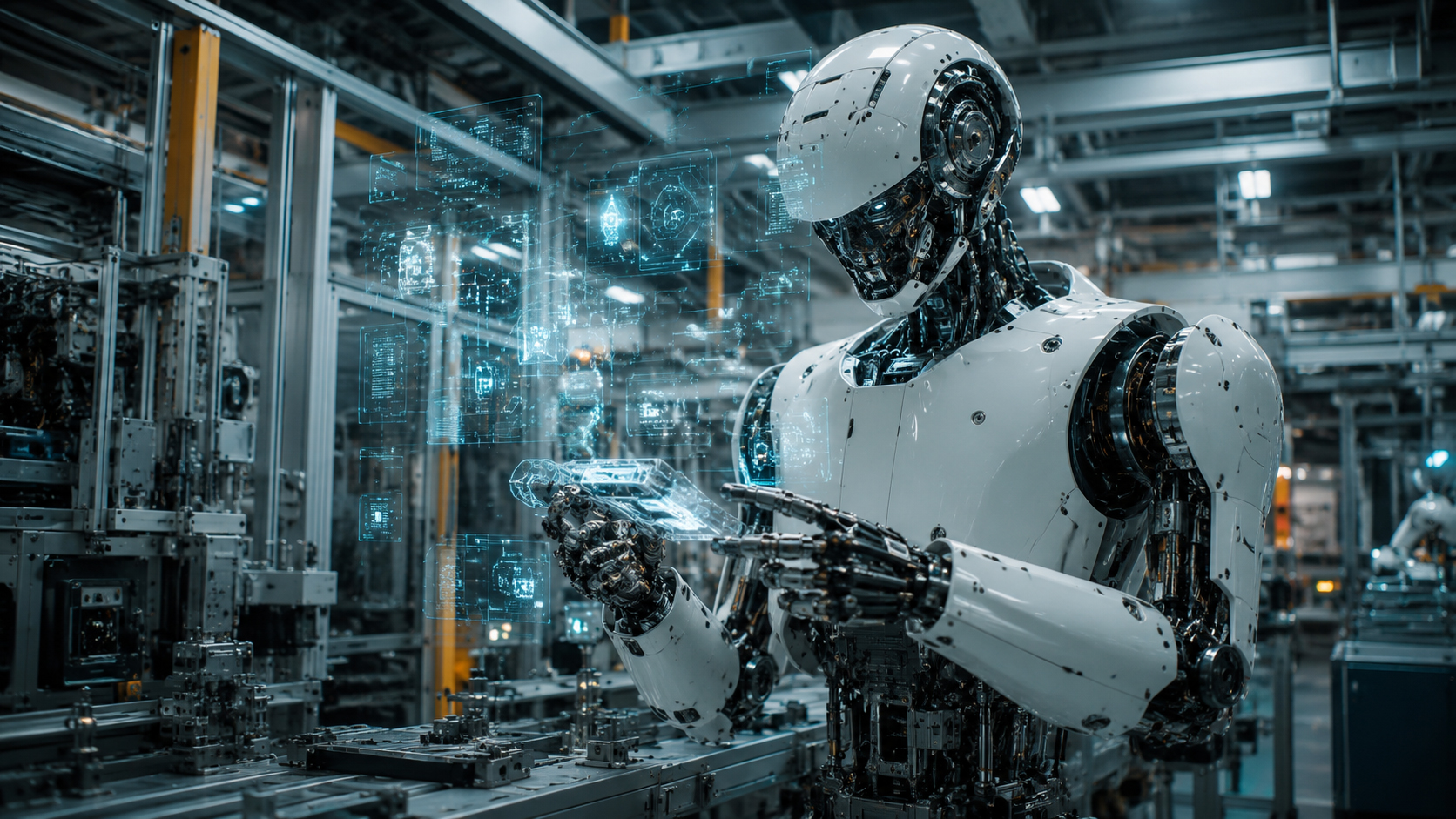
A new phrase has moved into Japan’s technology conversation: physical AI. It does not mean the AI that writes emails, drafts slides or produces images on a screen. It means AI with a body. It means robots that see, move, carry, grip, inspect, avoid people, learn from mistakes and do useful work in factories, warehouses, hospitals, farms, roads, ports and homes. In the first half of 2026, the term began to show up rapidly in Japanese corporate messaging. Robot Start, citing a PR TIMES analysis of 199,535 press releases from January through May, reported that “physical AI” rose 46.38 times year over year to 371 mentions. That may sound like keyword trivia. It is not. It is a signal that Japan’s old robotics identity is being pulled into the new age of foundation models, labor shortages, manufacturing data and national growth policy.
From AI you use to AI you assign
The first public wave of generative AI taught people to think of AI as a tool on the desk. It writes. It summarizes. It searches. It makes images. It edits documents. Physical AI is the next, harder step: AI leaves the desk and enters the workplace. It moves through warehouses, factory floors, farms, construction sites, elder-care facilities and infrastructure corridors. The physical world is far less forgiving than text. Boxes sag. Cables bend. Floors get wet. People move unpredictably. Parts arrive in slightly different orientations. Old machines do not speak modern software languages. This is why traditional robots have been powerful but limited. They are excellent at repeating defined motions in controlled settings. They are much weaker when the world changes.
Physical AI is exciting because it promises to give robots more of what humans bring to messy environments: perception, judgment and adaptation. The robot does not simply repeat a motion. It sees what is in front of it, connects that scene to a goal, chooses an action and adjusts when reality does not match the plan. Picking goods from a mixed shelf, handling flexible material, sorting unpredictable packages, avoiding people in a corridor, cleaning a public space or inspecting a dangerous facility all require more than repetition. They require a kind of embodied intelligence. That is the heart of the phrase.
Why the phrase lands differently in Japan
Few countries have put as much emotion into robots as Japan. Astro Boy, Doraemon, Gundam, factory arms, care robots, aibo and Pepper all belong to the national imagination. Robots in Japan have often been imagined not only as machines, but as companions, workers, guardians and dreams. At the same time, the industrial reality has been just as important. Japan has long been a global powerhouse in conventional industrial robotics, with companies such as Fanuc, Yaskawa Electric and Kawasaki Heavy Industries helping automate factories around the world. Welding, assembly, painting, materials handling and precision movement became part of Japan’s manufacturing signature.
But the 2020s are not the old robot race. Reuters reported in May that one-third of Japanese companies are already using, planning to deploy or considering AI-powered robots. Transportation-equipment makers were the most aggressive, with 80% using or exploring them. Among firms already using, planning or considering AI robots, 71% named manufacturing as a use case. That is not a small cultural curiosity. It is corporate Japan testing whether its industrial robot strength can carry over into autonomous, AI-enabled machines. The pressure is real: China and the United States are moving quickly in AI robotics. Japan’s question is whether it can remain a robot leader when the robot’s brain becomes as important as its motor.
Labor shortage is the strongest market signal
The most powerful reason physical AI matters in Japan is labor shortage. That phrase can become abstract, but on the floor it is painfully concrete. Manufacturers are losing skilled workers to retirement. Logistics companies struggle to staff warehouses and night shifts. Construction, agriculture, cleaning, security, inspection, infrastructure maintenance and elder care all face the same problem. The jobs that are hardest to fill are often the jobs that keep society functioning.
Traditional automation worked best in large, controlled, high-volume factories. Japan, however, is full of small and medium-sized manufacturers, aging equipment, handwritten workarounds, mixed production runs and tacit knowledge. A robot that can repeat the same motion one million times is useful, but not enough. Many Japanese sites need machines that can respond to today’s slightly different part, tomorrow’s packaging change or an urgent short-run order. The true market for physical AI is not only the gleaming factory of the future. It is the ordinary workplace where humans have been “making it work” through experience, improvisation and patience.
METI sees the data wall
Japan’s government is also treating the issue as more than a robot-sales story. In May 2026, METI and NEDO announced selections under the GENIAC project for nine research and development themes related to making manufacturing and other data AI-ready, plus two themes related to robotics foundation models. That wording matters. Japan is not only asking who can build the robot. It is asking who can turn factory and field data into something AI can actually learn from.
Robots do not become intelligent through hardware alone. They need data: motion data, failure data, sensor data, process data, video, task instructions, quality checks, machine status and human corrections. Japan’s manufacturing sites hold enormous tacit knowledge, but much of it is trapped in people’s hands, ears and routines. A veteran worker hears a machine’s abnormal sound. A line leader notices that a tiny delay will cause a larger bottleneck. A technician adjusts pressure or angle by feel. To train useful physical AI, that knowledge has to be captured, organized and protected. The competition is therefore not only a hardware race. It is a race to convert real-world know-how into safe, usable data.
Foundation models are coming to robotics
Foundation models have already reshaped text, images, audio and code. The same idea is now moving into robotics: train large models that can support multiple tasks, multiple environments and even multiple robot bodies. Instead of programming one robot for one rigid task, researchers want systems that connect vision, language, motion and control. A robot might understand an instruction, perceive a scene, plan a sequence and execute it through a body.
But robotics foundation models are harder than chatbots. A language model can produce a bad paragraph and be corrected. A robot can drop a part, injure someone, break equipment or stop a production line. Research surveys on robotics foundation models point to major challenges: lack of robot-relevant training data, safety guarantees, uncertainty management and real-time execution. The promise is large, but the factory floor is not as forgiving as a demo video.
SoftBank’s “robots making robots” signal
SoftBank founder Masayoshi Son has also put the phrase into the business spotlight. Reuters reported on June 24 that Son told shareholders AI is still in its early stages, rejected bubble talk and said SoftBank has started manufacturing robots at what he called a “physical AI plant.” He also said he believed the company was the first in the world to have robots manufacturing robots at scale, while offering few details. Whether the claim proves technically narrow or broadly transformative, the signal is clear: Japan’s AI story is moving beyond models and data centers into machines that act in the world.
SoftBank has been here before. Pepper made social robotics feel close and then also showed the limits of charm, conversation and novelty. The physical AI moment is different. The supporting stack has changed: cloud platforms, edge AI, sensors, chips, foundation models, industrial software, data centers and robotics hardware are beginning to connect into one economic chain. The old robot dream is becoming an infrastructure argument.
Manufacturing strength makes the next problem visible
Japan’s factories are not merely waiting for rescue. Reuters reported that Japan’s manufacturing activity expanded in June, with new orders rising at their fastest pace in more than four years, even as cost pressures remained elevated. When demand is present, labor and equipment constraints become more painful. Firms look for ways to increase capacity, stabilize quality and reduce dependence on scarce skills. That is where physical AI enters the conversation.
The difficulty is that adoption will not be automatic. Robots are expensive. Safety systems, integration, software, maintenance, training and workflow redesign all add cost. A small factory may ask the right question: who will set this up, fix it and adapt it to our work after the sales team leaves? Physical AI will need more than spectacular hardware. It will need system integrators, local support, financing, training, insurance, standards and a business case that works outside flagship factories.
Humanoids or specialized machines?
When people hear physical AI, they often picture humanoid robots. The image is powerful: a machine shaped like a person walking through a workplace designed for human bodies. Doors, stairs, handles, shelves, carts and tools are human-centered, so a human-shaped robot seems logical. Humanoids also tell a good story, and story matters when investors, engineers and policymakers are choosing where to place attention.
Yet the first wave of adoption may not be humanoid. Warehouses, factories, security posts, cleaning routes and inspection sites may be better served by specialized machines: mobile robots, picking arms, drones, inspection rovers, autonomous forklifts, collaborative robots and purpose-built manipulators. The point of physical AI is not the shape. The point is whether the machine can perceive, adapt and complete work safely. Japan’s strongest path may be practical rather than theatrical: robots designed around specific work, upgraded with AI that makes them more flexible.
Japan’s possible advantage
Japan’s winning path may not be to out-hype Silicon Valley or out-scale China overnight. It may be to build the most reliable bridge between AI and the real workplace. Japan has deep strengths in safety, quality, components, sensors, motors, reducers, maintenance discipline and production engineering. If physical AI becomes infrastructure, reliability matters. A robot that works beautifully on stage but fails in a dusty factory is not a product. A less glamorous machine that runs for years, learns safely and fits into existing operations is far more valuable.
Japan also has a cultural opening. It is too simple to say Japan loves robots, but the country does have a long tradition of imagining robots as partners rather than only threats. In a shrinking society, the robot is not always framed as the machine coming for someone’s job. Often it is the machine filling the job nobody can staff. That distinction may matter. Adoption depends not only on technology but on trust.
This is also a regional story
Physical AI is not only a Tokyo exhibition-hall story. Its deepest impact may come in regional factories, farms, logistics centers, ports, care facilities and infrastructure sites. Population decline hits regional Japan first. Many small manufacturers are outside the biggest cities. Roads, bridges, water systems and power networks still need inspection even when the local workforce shrinks. Robots that can extend human capacity may help keep these places functioning.
METI’s 2025 RING Project, created to accelerate robot adoption projects to address regional labor shortages, fits this broader pattern. If physical AI changes Japan, it may do so quietly: not first through a humanoid in every home, but through a machine in a small factory, a warehouse in a regional city, a road-inspection robot in the mountains or a care-support device in a town where the young have moved away.
From robot nation to embodied-AI nation
Japan has long been a robot nation. The next challenge is to become an embodied-AI nation: a country that can teach AI the real world, give machines safe bodies, convert manufacturing knowledge into usable data and deploy robots where people actually need help. The keyword surge around physical AI does not prove that Japan has already won. It proves that companies, policymakers and investors are starting to speak the same language.
New industries often begin as language. First comes the phrase. Then comes the budget. Then the exhibition booth, the engineer, the pilot project, the failed demo, the second attempt, the standard, the supplier network and finally the boring but valuable machine that works every day. Physical AI may now be entering that path in Japan.
AI on the screen has already changed work. The next AI will move across the floor. In Japan’s factories, warehouses, farms, stations and care facilities, the question will not be whether robots are charming. It will be whether they can help keep society running.
The answer will not come from a slogan. It will come from the shop floor.
Sources and references
This article draws on public reporting and releases from Reuters, METI/NEDO, Robot Start, PR TIMES-related trend analysis, Japan Times, BCG and robotics foundation-model research reviews. Technology claims, deployment levels and policy plans may change as companies and government agencies update their programs.
- Robot Start: “Physical AI” rose 46.38x in PR TIMES-linked 2026 first-half trend-word analysis.
- Reuters: One in three Japan firms using or considering AI robots.
- METI/NEDO: GENIAC project selections for AI-ready manufacturing data and robotics foundation models.
- Reuters: SoftBank’s Son says AI is just beginning and refers to a physical AI plant.
- Reuters: Japan’s planned ¥370 trillion public-private investment strategy.
- Reuters: Japan manufacturing PMI and June factory activity.
- Foundation Models in Robotics: research survey on applications, challenges and future directions.