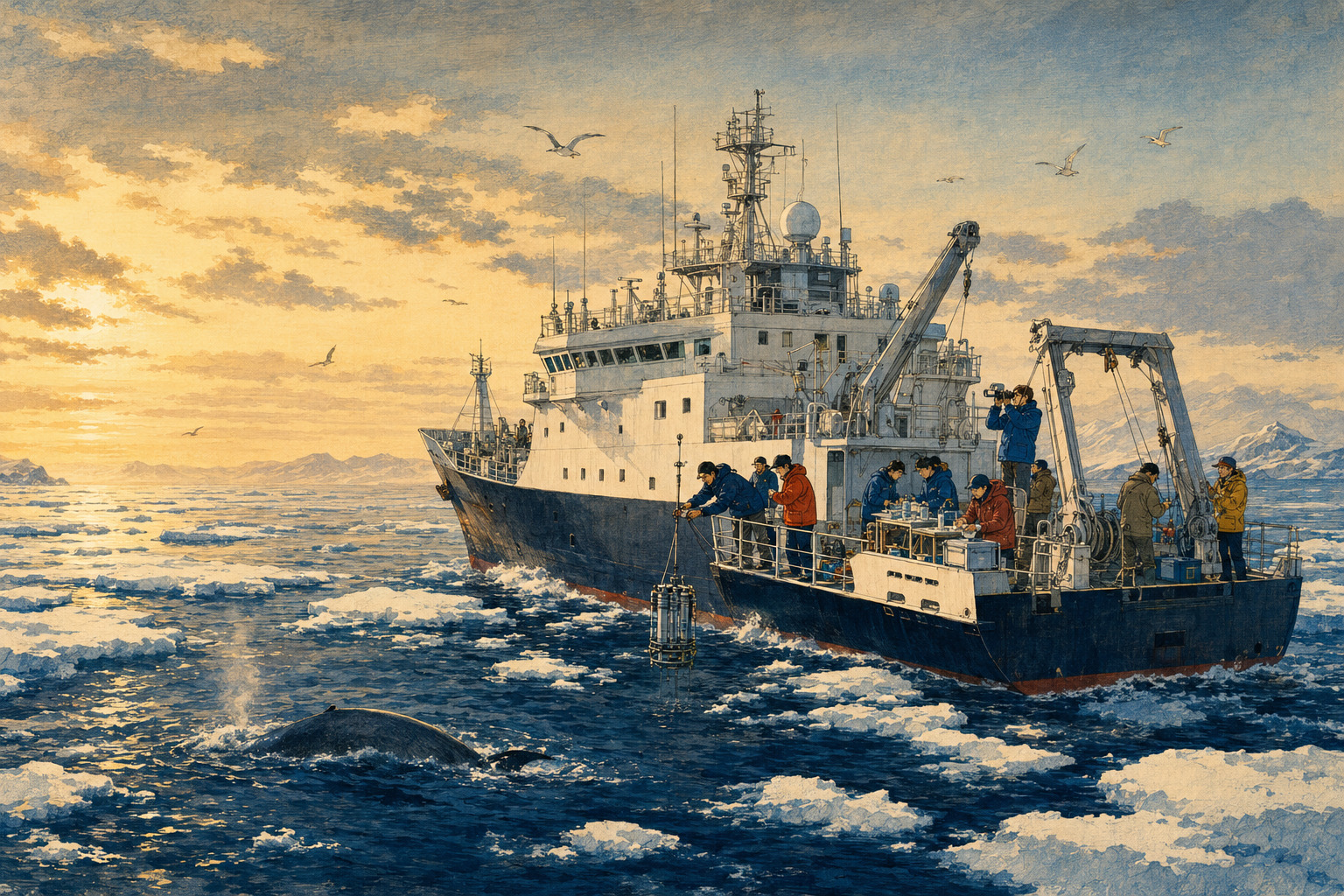
As of July 15, the classroom was back at sea
The plan announced by Hokkaido University, the Japan Agency for Marine-Earth Science and Technology and the National Institute of Polar Research on June 3 was a two-leg passage: Hakodate to the North Pacific, northern Bering Sea and eastern Chukchi Sea; a personnel exchange at Nome; then observations on the return to Hakodate. The actual track published with support from the Arctic Data archive System records departure on June 19, entry into the Bering Sea on June 27, arrival at the Arctic Circle on July 4, entry into Nome on July 8 and departure on July 11.
The latest track image this article could verify runs through July 15. The vessel was conducting its second leg, with return scheduled for July 31. The joint release calls the cruise “43 days,” while the ArCS III voyage page calls it 42. Both can be understood: June 19 to July 31 spans 42 elapsed 24-hour periods but touches 43 calendar dates when both endpoints are counted.
“Underway” is the critical word. Lowering a CTD, imaging plankton and filtering seawater do not prove an ecological change in real time. Samples must be analyzed; instruments calibrated; data quality-controlled, compared and statistically tested; and claims reviewed. Today’s result is an active observing and training system—not a finished scientific conclusion.
A log that separates plans from verified progress
| Date | Status confirmed in public material | Reading it correctly |
|---|---|---|
| June 19 | Departure from Hakodate’s Benten district | The release scheduled a 3 p.m. sailing |
| June 27 | The ADS route page records entry into the Bering Sea | A navigation milestone, not a research finding |
| July 4 | Arrival at the Arctic Circle | The geographic line near 66°33′N, not the same boundary as the Arctic Ocean |
| July 8 | Arrival at Nome | Personnel exchange and land-based learning |
| July 11 | Departure from Nome | Beginning of the second leg |
| July 15 | Latest actual-track image in this article’s evidence window | The present-status cutoff |
| July 31 | Scheduled return to Hakodate | Weather and operations can still change it |
A 2025 student recruitment notice carried a preliminary plan to leave Nome on July 13 and return on August 3. The final June 3 announcement and actual track instead show a July 11 departure and July 31 return. A recruitment timetable written months earlier should not be presented as the final operating record.
This is not an icebreaker
The fifth Oshoro Maru has an ice-strengthened structure designed with voyages from Hokkaido waters toward polar regions in mind. Hokkaido University does not call it an icebreaker and publishes no capability to continuously break thick sea ice. The 2026 operating area is the summer North Pacific, northern Bering Sea and eastern Chukchi Sea.
The distinction matters because Japan’s first dedicated Arctic research vessel, Mirai II, is due in the same year. JAMSTEC’s separate ship is 128 meters long, 13,000 international gross tons and Polar Class 4, designed to break 1.2 meters of level first-year ice continuously at three knots. Delivery is planned for November 2026. Its owner, mission and capability differ from the university’s 78.27-meter, 1,598-gross-ton training ship.
Who sails, and who teaches?
The first leg included students from Hokkaido University’s School and Graduate School of Fisheries Sciences and graduate students from Kyoto and Kanazawa universities who joined observations and data collection. In the second leg, eight undergraduates selected from national, public and private universities from Hokkaido to Okinawa joined an open practicum. The call was not restricted to fisheries or natural science: humanities students and applicants who hope to address Arctic issues through government, business, education or nonprofit work were welcome.
The teaching group includes Hokkaido University associate professor Kohei Matsuno and professor Hiromichi Ueno, NIPR project assistant professor Akiko Mori and JAMSTEC senior researcher Amane Fujiwara. An undergraduate from the University of Hawaiʻi participates through the Uehiro oceanography exchange. An aquarist from Osaka Aquarium Kaiyukan, which has an academic exchange agreement with the School of Fisheries Sciences, supports collection and teaching.
The releases do not give the actual total complement for each leg, a complete demographic breakdown or the application-to-selection ratio. The vessel’s maximum capacity of 99 is not the number confirmed aboard in 2026.
The Arctic course began in winter off Japan
The nationally selected students did not first step aboard at Nome. A required preliminary voyage from February 25 to March 4 off Hokkaido and Tohoku was designed to teach shipboard life, basic ocean observation and safety. The selection notice explicitly said diversity would be considered.
The two-stage design is practical education. Seasickness, compact shared rooms, watchkeeping, cold deck work, heavy instruments and survival equipment should not all be first encountered at a remote Arctic station. A nearby cruise creates a place to make and correct mistakes before the northern work.
In 2026, this is the second Arctic open practicum for undergraduates nationwide. The first was held in 2023. Graduate-focused training during ArCS and ArCS II is being widened by level and discipline into something closer to a national Arctic classroom.
Why the Bering and Chukchi seas?
Bering Strait is the narrow Pacific gateway to the Arctic Ocean. Relatively warm, nutrient-rich Pacific-origin water flows north across the shallow Chukchi shelf, carrying heat, salt, nutrients, plankton and organisms. A change at the gateway can propagate into sea ice, primary production, carbon delivery to the seabed, fish, birds, marine mammals and coastal food systems.
One number cannot describe that chain. A warmer surface does not determine a food web if salinity stratification, nutrients, light and the timing of ice retreat also differ. A phytoplankton bloom may be abundant yet poorly timed for zooplankton or fish larvae. Energy can be present and still fail to reach the consumer that needs it.
The scientific value is repetition across years with comparable stations and methods. The 2026 snapshot cannot diagnose climate change alone. It must be joined to earlier cruises, moorings, satellites and observations from other vessels.
Eight research lines in one ocean
| Theme | Published 2026 plan | Connection under study |
|---|---|---|
| Heat and material transport | Observe marine conditions from the Bering Sea into the Arctic | Pacific-origin heat, salt, nutrients and carbon |
| Greenhouse gases and chemicals | Measure ocean behavior and air–sea exchange | Whether the sea acts as source or sink |
| Plankton | Study phytoplankton and zooplankton at the surface, in the water column and near the bottom | Production, prey, sinking and ice timing |
| Fish | Collect adults, larvae and juveniles to monitor community structure | Northward range shifts and replacement |
| Seabirds | Observe changing distributions visually | Responses to prey and ocean conditions |
| Marine mammals | Relate distributions to environmental factors | Ice, prey and habitat |
| Microplastics | Quantify persistent organic pollutants and attached microbial communities | Particles as chemical and biological carriers |
| Environmental DNA | Detect changes in Arctic fish distribution and diversity | Biological traces that supplement capture records |
The advantage is that physics, chemistry and biology can describe the same water and place. The burden is metadata. The more studies share a cast, the more precisely position, time, depth, filtration volume, preservation and calibration must be recorded. Integrated analysis after the cruise will be only as strong as those shipboard records.
A CTD turns the ocean into a vertical lesson
A student report describes round-the-clock CTD sampling by the chemistry group. A CTD records conductivity—used to derive salinity—temperature and depth. Coupled to water bottles that close at selected levels, it provides seawater for analysis of nutrients, gases, carbon and other chemical constituents.
A surface satellite image cannot show the cold bottom layer, halocline or a water mass flowing beneath another. On the Bering–Chukchi shelf, ice formation and melt, river input, Pacific water and wind mixing create the vertical structure. Each CTD cast makes depth into a page of the ocean textbook.
The vessel’s equipment inventory includes CTD and rosette, expendable XCTD, acoustic current profilers, corers, fisheries echosounders, seabed mapping, nets and observation platforms. That list describes available capability; it does not prove that every instrument was deployed on this cruise.
Plankton enters the classroom as an image
A June 30 shipboard post says surface water taken from the vessel’s seawater intake was passed through a PlanktoScope, producing images and size measurements of phytoplankton. The system was used mainly for particles from about 20 to 200 micrometers, up to roughly 300 micrometers, and occasionally imaged small zooplankton.
Imaging is fast and preserves shape and size. Nets collect larger organisms; microscopy, pigments and genetics refine identity and function. Each method favors some sizes and damages or misses others. No single stream should be presented as “all plankton.”
For a student, collection, instrument settings, image quality, classification and statistics become one chain. Seeing cells on a screen is the beginning of evidence, not the point at which species and ecosystem function have been established.
Environmental DNA collects the trace of presence
Fish and other organisms release DNA in mucus, scales, waste and cells. Filtering seawater, amplifying short sequences and matching them to reference libraries can reveal candidate species that are hard to catch or see. The 2026 plan uses environmental DNA to investigate warming-related shifts in Arctic fish distribution and diversity.
Its power has limits. DNA moves with currents and decays at rates affected by temperature and light. A species absent from the reference database may remain unidentified. Sequence concentration is not automatically population abundance. Field blanks, decontamination, replicate stations and depths, and comparison with nets and acoustics support credible interpretation.
Applied consistently over years, eDNA may sensitively detect northward movement of boreal fish or retreat of Arctic species. It is not a technology for abolishing nets; it is a second window that can reduce blind spots.
People still count birds and whales from deck
Even with acoustics and genetics, visual observation remains essential for relating seabird and marine-mammal distribution, behavior, group size and travel direction to the environment. Oshoro Maru has a visual-observation platform, and the 2026 program includes shifting seabird ranges and environmental controls on Arctic marine mammals.
Observers must log visibility, wave height, fog, sun angle, vessel speed and effort. “Not seen” is not identical to “absent.” Training, photographs and paired observers can address differences between beginners and experts. Learning to quantify the limits of eyesight is part of the course.
Measuring fish, plankton, birds and mammals on one route can link levels of a food web. Co-location alone does not prove causation, however. Prey, breeding, migration, ice, fishing and sound require comparisons over seasons and years.
Microplastics are more than a particle count
The program looks beyond the number of microplastic pieces to persistent organic pollutants adsorbed on their surfaces and the microbial communities attached to them. A small particle can be a substrate for chemicals and biofilms, so material, size, weathering and collection position all matter.
Shipboard work is highly contamination-sensitive. Fibers from clothes, paint, ropes, sampling gear and airborne dust can enter a sample. Blanks, non-plastic tools, covered handling and chemical identification are needed to distinguish the Arctic signal from the vessel itself.
The cruise also consumes fuel and produces emissions. Its social value should ultimately be considered alongside distance, fuel, scientific output and educational benefit. Observation is not environmentally weightless simply because its subject is environmental change.
The work runs around the clock under a midnight sun
Summer north of the Arctic Circle stays bright through local night. A July 1 report describes a student working a 1 a.m. CTD watch in cold air. Sailing east toward Alaska and crossing the International Date Line, the ship gradually advanced its clocks and adjusted the calendar to approach local time.
The vessel is laboratory, dormitory and workplace. Students take turns serving meals and cleaning living areas, then study papers, employment materials or graduate entrance exams between watches. Seasickness, sleep, noise, tight rooms and human relationships are conditions of learning.
The fifth-generation ship uses acoustic and vibration insulation, a floating floor above the engine room, an anti-rolling tank and fin stabilizers. The design ideal of a “quiet, stable floating campus” does not abolish motion at sea.
Nome is a home, not merely a logistics stop
A new element in the 2026 practicum was a community meeting and field learning in Nome. The ArCS III voyage page later posted a July 14 item on a visit to the Carrie M. McLain Memorial Museum. The intention is to treat the Arctic not only as a physical and biological object but as a human region with history, culture, livelihoods and governance.
When a science vessel enters a coastal community, knowledge cannot simply be extracted in one direction. Researchers should explain what is measured, who uses the data, what returns to the community and how students cite experience. Sea ice, fish and marine mammals are connected to local food, safety and culture.
The joint release described the community meeting as planned. This article could not verify a public record of its participants, agenda, agreements or outputs. A scheduled encounter should not be inflated into a completed co-production relationship.
Live video and a public track create a classroom ashore
ADS supplies dated route images, while ArCS III publishes first-person posts from students and researchers. Hokkaido University advertised shipboard live streams for July 15 and July 25 and invited questions and messages. The educational reach can therefore exceed the vessel’s 99 berths.
Public tracking must still balance safety, privacy, limited bandwidth and protection of observations. A dated route image is a record through its update, not necessarily a precise live position. Research communication also needs labels separating a field post, a quality-controlled data set and a peer-reviewed result.
The most instructive outreach would include imperfect days: why a station was canceled, an instrument failed, weather moved a plan or contamination threatened a sample. Science is the work of managing uncertainty, not a stream of beautiful images.
The design of the “quiet, stable” fifth ship
The current vessel was completed at Mitsui Engineering & Shipbuilding’s Tamano works on July 28, 2014. It is 78.27 meters overall and 13 meters wide, with 1,598 domestic gross tons and 1,998 international gross tons. Service speed is 12.5 knots, range 10,000 nautical miles and maximum complement 99.
Three main generator engines provide power to diesel-electric propulsion. Two-speed 1,000/300-kilowatt motors drive one controllable-pitch, highly skewed propeller, serving both transit and slower observation while reducing underwater and onboard noise. A bow thruster and rudder aid maneuvering during stations and fishing operations.
Seven types of research and experimental space across 11 compartments, a container laboratory, onboard network and real-time data display make the ship an adaptable platform rather than a fixed universal laboratory. Instruments can be replaced with the mission. In a training ship, whether students can see and join the work is itself part of performance.
In 1909, the classroom was a wooden schooner
The ship lineage began two years after fisheries education was established at Sapporo Agricultural College in 1907. The first Oshoro Maru was a 31-meter wooden topsail schooner modeled on vessels of the Gloucester cod fishery. Its name came from Oshoro Bay, about 10 kilometers west of Otaru.
By 1926, the first ship had completed 26 voyages and about 50,000 nautical miles as an ocean fisheries training vessel. Sail and auxiliary engine, celestial navigation, nets, specimens and collective life shared one deck. The campus was already mobile a century before the phrase “floating classroom.”
The original name was written with the kanji characters 忍路丸; the present ship uses the phonetic form おしょろ丸. The bay and educational lineage remain the same.
The second ship survived war and returned to the North Pacific
The 1927 replacement was a 42-meter steel barkentine with a 500-horsepower diesel. It trained in the Sea of Okhotsk and expanded to East China Sea trawl surveys in 1931. Its rig and fishing gear were removed during the war; the vessel transported cargo between Hokkaido and Honshu and was strafed during the July 1945 air raids on Hakodate.
Fishing gear was restored in 1949. In 1953 it began summer North Pacific sampling as one of Japan’s vessels for the International North Pacific Fisheries Commission, collecting salmon, plankton and hydrographic data in the northwestern Pacific and southern Bering Sea. It also participated in International Geophysical Year work in 1957–58.
Over 35 years, it traveled about 303,000 miles and trained 1,648 students. Limited freshwater and long cruises without ports contrast with today’s water makers, satellite links and digital sensors, yet the allocation problem remains: how should finite space, power, time and water serve both research and education?
The third ship reached 72°N in 1972
The third Oshoro Maru, completed in 1962, was a 67-meter, 1,180-ton stern trawler with a 2,000-horsepower engine. Its first voyage joined the International Indian Ocean Expedition; North Pacific cruises began in 1963. Foreign scientists joined from 1968, making the ship an international classroom.
During the 1972 northern cruise it reached 72°N in the Chukchi Sea, which Hokkaido University’s history identifies as the northernmost voyage by a Japanese ship at the time. From 1953 through 1977, core work included hydrography, plankton, fish larvae and salmon drift-net sampling. Annual records of oceanographic observation and exploratory fishing began in 1957.
Before its final cruise in 1983, the third ship sailed nearly 530,000 nautical miles and carried 3,263 students and 850 scientists, 144 of them foreign. The internationalization of Arctic training in 2026 therefore has more than half a century of history.
From the fourth to the fifth: a fisheries ship becomes an ecosystem ship
The fourth ship, completed in 1983, supported seamanship and fisheries science for about 31 years. It carried stern-trawl gear, quantitative echosounders, longline and drift-net systems and observation equipment. It received a North Pacific Marine Science Organization ocean-monitoring service award in 2008, supported voyages to ancestral graves in the Northern Territories and trained students from Miyako Fisheries High School after the 2011 earthquake. It made an Arctic voyage in 2013 before retirement.
The fifth ship’s purpose reached beyond fishing technology: globally active people, ecosystem conservation, secure food resources, sustainable management, international joint research and fisheries recovery in disaster areas. The title remained “training ship,” while its intellectual range expanded from fishing to physical, chemical, ecological, information and social questions.
The present ship’s first foreign voyage was a 58-day Arctic-region expedition in 2017. It returned in 2018, 2023 and 2026, layering comparable observations and new student generations over the same broad region.
2017 and 2018 showed that earlier melt does not simply mean more food
In 2018, northern Bering Sea ice retreated roughly a month earlier than normal. Studies comparing Oshoro Maru observations from the summers of 2017 and 2018 found a delayed phytoplankton bloom in the early-retreat year and an increase in small zooplankton and younger stages of large copepods.
It might seem that earlier open water means more light and a longer productive season. But if ice disappears while sunlight is still weak, wind mixes the water and the timing of nutrients and stratification changes, the bloom can be delayed. If large, lipid-rich prey decline, energy transfer to fish, birds and seals can become less efficient.
A 2022 paper and a 2024 size-structure analysis reported that the 2018 community shift likely reduced productivity or transfer efficiency to higher consumers. The result complicates the slogan that Arctic warming uniformly increases production. Amount, species, body size and timing all shape the food web.
In 2023, the Arctic classroom opened to undergraduates nationwide
The 2023 cruise held the first open Arctic practicum for undergraduate students from across Japan. Participants experienced natural-science observations from the physical environment through ecosystems and also studied Arctic politics and culture through lectures and group work with humanities and social-science specialists.
The second edition in 2026 adds a preliminary voyage, community learning in Nome, joint instruction by Hokkaido University, NIPR and JAMSTEC, the University of Hawaiʻi and Kaiyukan. What expanded is not only attendance but the range of disciplines and professions allowed to define an Arctic problem.
Evaluation should continue beyond a memorable voyage. Course credit, skill assessment, continued research, graduate study and employment, cross-disciplinary work and return of knowledge to communities can show whether a once-in-a-lifetime experience became lasting capacity.
ArCS III is the third chapter of a 15-year national program
Japan’s large coordinated Arctic research sequence began with the GRENE Arctic Climate Change Research Project in fiscal 2011, followed by ArCS in 2015–19 and ArCS II in 2020–24. ArCS III began in April 2025 and runs through fiscal 2029, led by NIPR with JAMSTEC and Hokkaido University as deputy institutions.
Its goal is integrated knowledge to help solve social problems arising from environmental and societal change in the Arctic. Ten research themes cover natural science, coastal communities, Indigenous culture, history and governance; seven supporting infrastructures include vessels, ADS, satellites, simulation and human-resource development.
The Oshoro Maru cruise crosses biodiversity, greenhouse-gas and coastal-community work on one deck. Students are not merely users of infrastructure. They are potential future operators, question-setters and negotiators with the people whose region they study.
The 2026 melt season began after a record-low-class winter
The U.S. National Snow and Ice Data Center estimated the 2026 Arctic winter maximum at 14.29 million square kilometers on March 15. That edged below 2025’s 14.31 million, but NSIDC treats values within 40,000 square kilometers as statistically tied. The two years share the lowest maximum in the 48-year satellite record.
An Arctic-wide winter metric cannot be substituted for the ice actually encountered along a July Bering–Chukchi route. Regional melt varies with wind, current, air temperature and snow. NOAA’s 2025 Arctic Report Card also shows long-term ice loss alongside substantial regional differences in Pacific-sector sea-surface temperatures.
That is why field observations remain necessary. Satellites see the whole region frequently but do not directly measure subsurface salinity, nutrients, DNA or plankton size. A ship sees a narrow line in depth. ADS joins the two, placing a cruise inside a longer observing network.
Between the retirement of Mirai and the arrival of Mirai II
JAMSTEC’s oceanographic vessel Mirai conducted 22 Arctic research voyages after entering service in 1997; 2025 was its last. Mirai II, due for delivery in November 2026, will bring ice-zone access, helicopter operations, a large science complement and extended research capacity.
Oshoro Maru is not its replacement. It is Hokkaido University’s training ship, integrating berths for as many as 60 students with fishing, ocean observation and communal life. If a large icebreaker reaches observational gaps while the training vessel repeats gateway sections and educates new cohorts, their roles are complementary.
The important continuity is not the count of ship names but station lines, instruments, calibration, data formats, samples and training. A platform change can create an apparent environmental change. Overlapping observations and intercalibration are essential to any comparison with the past.
Questions that can be answered only after return
| Public now | Not yet known |
|---|---|
| Period, region, two legs, Nome call, major track milestones, eight research themes, participating institutions and eight open-practicum students | Actual total complement and demographics, completed station list, sample counts, missing data, equipment failures, ice encountered and reasons for any schedule changes |
| Some CTD sampling, PlanktoScope work, student life and ADS route communication | Analyzed temperature, salinity, gases, plankton, fish, DNA and pollutant results; statistical significance; comparison with past years |
| Planned community meeting and field course; a public museum-visit item | Local participants, agenda, consent, community outputs and durable collaboration |
| Vessel particulars and maximum complement | 2026 voyage cost, fuel and emissions, communications volume, educational outcomes, data-release date and publication plan |
Unpublished does not imply failed. Some analysis cannot be reported during a cruise, and personal, community or conservation considerations may restrict locations. But “conducted Arctic research” and “explained Arctic change” are different stages. Return, sample processing, quality control, open data, papers and community reporting remain to be followed.
A report card for the floating classroom
For operations, measure completed stations, weather cancellations, injury, instrument uptime, calibration and sample temperature and custody. For science, watch for FAIR data release, comparability to historical sections, reproducible methods and documentation of missing or negative results—not papers alone.
For education, assess the diversity of the eight selected students, before-and-after skills, watches, safety behavior, interdisciplinary group work, credit, continued research and career paths. Enduring seasickness is not the goal; explaining evidence limits, working across disciplines and stopping unsafe work are.
For society, include participation and evaluation in Nome, return of results, data sovereignty, public engagement, fuel and emissions. Student inspiration should not be the only item in the publicity column while community benefit and environmental cost sit outside the table.
The northbound ship carries time in both directions
Oshoro Maru carries future Arctic researchers north from Hakodate. It also carries the past onto its deck: the wooden schooner of 1909, North Pacific sampling in 1953, 72°N in 1972, the ice-and-plankton comparison of 2017–18 and the first national open practicum in 2023. The value of 117 years is not age; it is a chain of records and people that can be compared.
The 2026 voyage is not yet a conclusion. On the latest track the ship was at sea, before return and before sample analysis. Yet a milestone is visible: Arctic research has widened from an expedition for a few specialists into educational infrastructure connecting undergraduates nationwide, graduate researchers, an overseas university, an aquarium, coastal residents and an audience ashore.
Arctic change is too fast to understand from one summer. The answer is to return to the same water, lower an instrument to the same depth, add a new method and hand both procedure and unanswered question to the next student. Japan’s floating Arctic classroom sails north not merely to reach a station, but to build a society capable of continuing the observation.
Sources and further reading
- Hokkaido University, JAMSTEC and NIPR, Oshoro Maru Arctic voyage release (Japanese, June 3, 2026): schedule, participants, research and teaching plan, vessel context.
- JAMSTEC joint-release page (Japanese, June 3, 2026): 43-day wording, Nome and ArCS III support.
- ArCS III, 2026 Oshoro Maru Arctic voyage (Japanese): eight research lines, participants, dispatches and practicum.
- ArCS III, 2026 voyage route (Japanese): actual track and milestones through July 15.
- ArCS III open-practicum call (Japanese, August 20, 2025): preparatory voyage, purpose, applicants, capacity and provisional schedule.
- Hokkaido University, live broadcasts from the Arctic voyage (July 2, 2026): July 15 and 25 events.
- ArCS III, “Night observations” (Japanese, July 6, 2026): CTD sampling, night shift and midnight sun.
- ArCS III, “Plankton research” (Japanese, July 3, 2026): PlanktoScope, intake water and particle sizes.
- ArCS III, “What surprised me about life aboard” (Japanese, July 6, 2026): seasickness and student life.
- Hokkaido University, Oshoro Maru: construction purpose, fields, specifications, propulsion and capacity.
- Hokkaido University, history of Oshoro Maru: first through fourth ships, northern cruises, students and scientists.
- Hokkaido University, observation and research equipment (Japanese): CTD, nets, acoustics, corers and observation platform.
- Hokkaido University, machinery (Japanese): electric propulsion, generators, controllable-pitch propeller and water makers.
- Hokkaido University, living facilities (Japanese): acoustic insulation, floating floor, anti-rolling tank and fin stabilizers.
- Hokkaido University, “Training Ship Oshoro-Maru embarked towards the Arctic” (June 12, 2023): fifth ship, 2014 completion and 2023 voyage.
- Hokkaido University, 2017 return from the Arctic region: present vessel’s first overseas cruise.
- Hokkaido University, early ice retreat reduces large zooplankton (Japanese, February 2022): explanation of the 2017–18 observations.
- Kimura et al., “Effects of Early Sea-Ice Reduction on Zooplankton…” (2022): northern Bering community and production comparison.
- Hokkaido University, productivity decline following earlier sea-ice melt (Japanese, January 2024): size structure and transfer to higher consumers.
- ArCS III project overview (Japanese): lineage from GRENE, fiscal 2025–29, ten research themes and seven infrastructures.
- NSIDC, “Arctic sea ice record low maximum strikes again” (March 26, 2026): 14.29 million km² and statistical tie for the 48-year low.
- NOAA Arctic Report Card 2025: long-term sea ice, warming and Bering–Chukchi ecosystem context.
- ArCS III, Mirai 2025 Arctic voyage (Japanese): 22 Arctic cruises and final northern mission.
- JAMSTEC, naming and launch of Mirai II (Japanese): 128 meters, 13,000 tons, PC4, icebreaking capability and November 2026 target.
Editor’s note: This article relies principally on primary sources and peer-reviewed research available through July 17, 2026; route status is cut off at July 15. Plans, confirmed movement, shipboard activity and analyzed findings are separately labeled. The 2026 voyage is still underway: return, station completion, sample analysis and educational assessment are not complete. The maximum complement of 99 is not presented as the actual number aboard. Oshoro Maru is an ice-strengthened training ship, separate from the icebreaking Mirai II. June 19 through July 31 is 42 elapsed days and 43 inclusive calendar dates. The hero is an editorial illustration. The exchange-rate display uses this issue’s specified value: 1 US Dollar = 162.39 Japanese Yen.