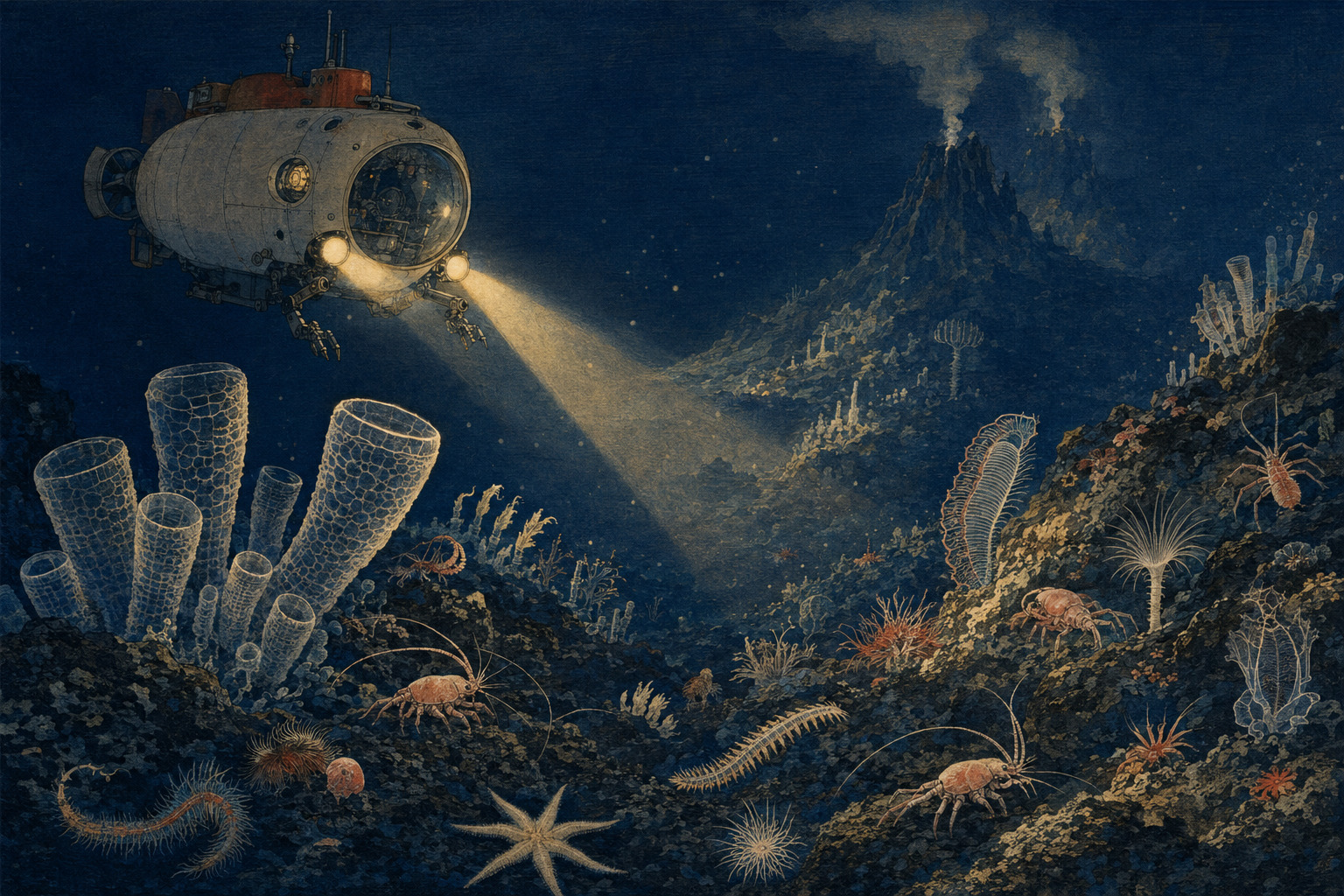
Thirty-eight is a beginning, not the end of the work
On March 9, 2026, the Japan Agency for Marine-Earth Science and Technology—JAMSTEC—and the Nippon Foundation–Nekton Ocean Census announced that specialists had confirmed 38 species new to science from two Japanese deep-sea regions. Another 28 were judged highly likely to be new. The seafloor had been illuminated the previous June. The public number came only after specimens, microscope images, published descriptions and DNA evidence had been compared on shore.
The first distinction is essential. JAMSTEC defines the 38 as specimens that expert taxonomists concluded belong to undescribed species with no scientific names. That does not mean all 38 have already received valid names in peer-reviewed descriptions. In March, papers for many were still being prepared. The line between the two reported categories is whether the specialists considered the undescribed status established or still needed more comparison.
“More than 528” also requires care. JAMSTEC’s precise term is specimen lots, not 528 individual animals. A lot may contain several individuals collected together, while tissue, tiny organisms or material preserved by different methods may be managed separately. Nor were all 80 animals recorded at Nankai Trough seeps new species. That inventory includes known species, Japanese first records, range extensions and undescribed forms across five sites.
Twenty days, ten dives and a short window on the bottom
The expedition ran for 20 days, from June 4 to 23, 2025. JAMSTEC’s support ship Yokosuka deployed the human-occupied Shinkai 6500 for ten dives, according to the mission record. The international team included researchers from JAMSTEC, Ocean Census, Nagoya University, Hokkaido University and the Australian National University.
A 6,500-meter dive is not eight hours on the seabed. The vehicle descends at about 45 meters a minute, so reaching maximum depth takes roughly two and a half hours; the ascent takes about the same. Its normal dive duration, including both journeys, is eight hours. Although seven searchlights pierce the water, JAMSTEC says their effective visual range is only about ten meters in favorable, particle-free conditions.
That makes selection as important as volume. Is an animal living inside a sponge or merely caught against it? Does a crustacean consistently sit on one coral? Where is a clam bed in relation to carbonate crust and active fluid flow? A biologist looking through the viewport can connect a specimen with behavior, substrate and neighboring species, then use the manipulators to preserve that context. JAMSTEC credits direct observation and the presence of specialists from different branches of zoology with recovering an unusually broad slice of each community.
One expedition entered two different worlds
The cruise joined two ecologically distinct landscapes. The Nankai Trough is a plate boundary running from Suruga Bay toward waters off Hyuga-nada, famous for earthquake and crustal research. Methane-rich fluids escape through parts of its seabed at cold seeps. The Shichiyo Seamount Chain lies roughly 500 to 700 kilometers southeast of Tokyo along the Izu–Ogasawara volcanic arc. Hard rock, steep flanks, summit plateaus and altered currents form a mosaic of habitats.
At Nankai, the aim was a coordinated comparison of known seep locations whose biology had never been surveyed consistently. At Shichiyo, Shinkai 6500 entered Nichiyo, Getsuyo, Kayo and Kinyo seamounts—Sunday, Monday, Tuesday and Friday—whose deeper biological communities had been essentially unvisited. One region was a famous geologic zone with a biological blank. The other consisted of named mountains on a chart whose ecosystems had not been seen in place.
| Region | Setting | 2025 approach | Principal result |
|---|---|---|---|
| Nankai Trough | Plate boundary, methane seeps, mud and carbonate substrate | Five seeps from 600 to 4,600 m surveyed consistently | Recorded fauna rose from 14 species to 80, with range and national records |
| Shichiyo Seamounts | Volcanic peaks, hard rock, slopes and localized currents | First biological dives at four little-explored seamounts | Sponge grounds, coral gardens, five new squat lobsters and sponge-dwelling worms |
Nankai Trough: from 14 recorded animals to 80
A peer-reviewed study led by JAMSTEC’s Chong Chen and published in Ecosphere in November 2025 compared five methane seeps: Daini Tenryu Knoll at about 600 meters, Ryuyo Canyon at 1,000 meters, Oomine Ridge at 2,000 meters, Yukie Ridge at 2,500 meters and a site off Cape Muroto at 4,600 meters.
Earlier literature contained only 14 seep-associated animal species across those locations, or one to six at any individual site. The new survey documented 80 in total and 15 to 30 per site. They comprised 33 molluscs, 23 annelids, 11 arthropods, five nemertean ribbon worms, four echinoderms, three cnidarians and one bryozoan. Eighty is about 5.7 times fourteen, so the cautious formulation is that recorded diversity increased more than fivefold.
This does not mean life multiplied fivefold in a few years. Much of it had been there but had not been found by earlier, uneven sampling. A “sampling effect”—more effort produces more species—is built into the comparison. Yet that effect is itself the point: it measures how thin the region’s biological ledger had been. Eighty is not a final ceiling. It is closer to the first reliable baseline produced with a coordinated design.
A food web without sunlight
Most surface food webs begin when phytoplankton use sunlight to make organic matter, some of which eventually sinks. At cold seeps, microbes use energy released by oxidizing reduced chemicals such as methane and hydrogen sulfide to fix carbon. Some animals graze on those microbes. Others, including certain clams and tubeworms, house bacterial partners that provide nutrition. That chemosynthetic production allows dense pockets of life in permanent darkness.
“Cold” distinguishes these seeps from hot hydrothermal discharge; it does not imply biological inactivity. The volume and chemistry of fluid, the sediment or rock, depth and current determine which microbes and animals can persist. By spanning 600 to 4,600 meters, the 2025 survey was designed to compare turnover along the same margin, not merely assemble a gallery of strange creatures.
Decades of geophysical observation have made Nankai one of the most closely watched subduction zones on Earth, while biological coverage remained sparse. Earthquake science asks how the seabed deforms and releases stress. Ecology asks what lives on that seafloor and how it responds to fluid flow and disturbance. The two questions reinforce each other when geology, chemistry and species are placed on the same map.
Shichiyo: sponge grounds and coral gardens
At Shichiyo, the submersible’s lights revealed dense sponge grounds and cold-water coral gardens. Seamounts behave like islands rising above the abyssal plain. They redirect currents, deliver suspended food and provide hard attachment surfaces that are scarce in surrounding sediment. Isolation between peaks may also give animals with limited dispersal their own evolutionary histories.
The cruise found five new squat-lobster species, including members of Munidopsis, along with new observations or collections of octocorals, ribbon worms, amphipods, gastropods and kinorhynchs. Some records were new for Japanese waters; others involved organisms previously considered rare. The effort also included the inconspicuous majority—protists, nematodes, copepods and tardigrades living between sediment grains—not just large animals that photograph well.
The public announcement has not yet provided a complete, formally named catalogue of all 38 species. That restraint matters. A new-species tally depends partly on which specialists joined, what mesh sizes and preservation methods were used, and whether DNA-quality tissue survived. The mission did not finish counting Shichiyo. It opened four windows and began measuring how much remained outside them.
Two worms sharing a glass castle
A hexactinellid, or glass sponge, collected on Getsuyo Seamount builds an intricate silica skeleton. Inside it were two hesionid polychaete worms using the same sponge as habitat. An integrative study combining morphology and molecular phylogenetics formally described them as Dalhousiella yabukii and Leocratides watanabeae on March 9, 2026.
The evolutionary result is more interesting than the count of two. Phylogenetic analysis suggests that sponge symbiosis arose once in the common ancestor of the two genera. Yet the new worms are not each other’s closest relatives; they sit in separate sister lineages. Each appears to have specialized independently on the same scarce glass-sponge niche, an example of convergent host use among related symbionts.
Without a submersible view and careful sampling, a preserved worm in a jar could lose the evidence that it lived inside the same sponge as another species. Video alone, however, cannot establish a new species. Researchers compared microscopic structures such as chaetae, jaws and body segments, tested evolutionary placement with DNA, and preserved specimens. When field context meets collection-based taxonomy, a curious animal becomes evidence capable of testing an evolutionary hypothesis.
From “confirmed” to a valid scientific name
A taxonomist’s conclusion that a specimen matches no known species is different from establishing a new zoological name under the International Code of Zoological Nomenclature. Researchers first make a detailed morphological description and compare the candidate with literature, close relatives and, where possible, type material. DNA is powerful evidence, but a barcode difference does not mechanically declare a species.
A formal description then provides diagnostic characters, a name and its derivation, locality and habitat information. It explicitly fixes a holotype or type series—the physical reference that carries the name—and deposits material where future researchers can examine it. Electronic works have additional conditions, including registration in ZooBank in applicable cases. Peer reviewers test whether comparison is adequate and whether the name duplicates something already established.
| Stage | What is known | Number in this story |
|---|---|---|
| Collection | Organism linked to place, imagery and environmental context | More than 528 specimen lots |
| Provisional identification | Sorted toward family, genus or a possible known species | The workshop’s starting point |
| Potential new species | Probably undescribed, but more comparison is required | 28 |
| Confirmed undescribed species | Specialists judge that it is not a known named species | 38 |
| Formal description | Diagnosis, name, type and publication satisfy the Code | Proceeding paper by paper; the two glass-sponge worms are complete |
“Thirty-eight confirmed new species” is therefore not hype, but it must not be rewritten as “all 38 formally named.” Discovery occurs at sea, confirmation develops in laboratories and expert meetings, and a name becomes available through durable evidence and publication. All three stages are real; their clocks run at different speeds.
Bring the specimens to the specialists
Only two pilots and one researcher fit inside Shinkai 6500. Even an entire cruise cannot carry every specialist in molluscs, annelids, crustaceans, ribbon worms, corals, sponges and microscopic fauna. From September 29 to October 10, 2025, taxonomists from Japan and abroad therefore assembled at JAMSTEC headquarters in Yokosuka to examine the collection together.
The workshop model does more than save time. A specimen one scientist regards as a juvenile may be recognized by another as a different genus. When morphology and a genetic result disagree, specialists can discuss preservation, contamination, cryptic species or flaws in the existing classification. They can distribute subsamples while keeping specimen identifiers, images and possible type material traceable.
Ocean Census links expeditions, Species Discovery Workshops, high-resolution imaging, genetics and a public data platform in an attempt to prevent collected animals from waiting years on a shelf for the right expert. Acceleration is not a shortcut around taxonomic standards. It is an effort to shorten the delay before evidence and expertise meet.
Why put a scientist in the vehicle?
Deep-sea research also uses remotely operated vehicles, autonomous vehicles, corers, trawls and environmental DNA. A human-occupied submersible is not always superior. Robots can survey wider areas, remain down longer and enter higher-risk settings; quantitative corers can sample small sediment animals more consistently.
What Shinkai 6500 provides is a scientist’s depth perception, peripheral view and ability to revise a decision when an unexpected relationship appears. Instead of cutting a sponge blindly, the team can orient it to retain internal fauna and record the surrounding community. It can collect repeat samples from the same substrate when an unusual animal appears. In 2025, that selectivity helped preserve evidence of symbiosis and community structure.
The viewport is also narrow, and observer interest introduces bias. Animals buried in featureless mud are easy to miss. The strongest system is not “human versus robot.” It combines a human’s judgment with an ROV’s endurance, an AUV’s map, quantitative sediment sampling, DNA and long-term observatories.
One hundred and fifty years after the “lifeless abyss”
In the early nineteenth century, European naturalists seriously debated whether pressure and darkness made life impossible in the deep ocean. The 1872–76 voyage of HMS Challenger lowered more than seven kilometers of sounding and dredging line and recovered animals from great depths. More than 4,700 new species were described from its material, helping end the idea of an azoic abyss. The ship called in Japan in 1875 before continuing across the Pacific.
The next conceptual shock came in 1977, when the crewed submersible Alvin encountered luxuriant animal communities at hydrothermal vents on the Galápagos Rift. A major ecosystem could be supported not only by photosynthetic production falling from above but also by chemical energy from within Earth. Nankai cold-seep research belongs to the scientific lineage opened by that discovery.
Exploration history should not be reduced to an uncomplicated heroic march. The nineteenth-century collecting network was entangled with empire, and surviving accounts contain racial assumptions rejected today. Modern species discovery must ask who holds specimens and data, who has the authority to name life, and how coastal nations and communities share in the result. A plan to publish records from Japan’s exclusive economic zone through an open platform carries that modern responsibility.
Japan’s path from Shinkai 2000 to 6500
JAMSTEC’s predecessor, the Japan Marine Science and Technology Center, was established in October 1971. Japan’s first full-fledged crewed deep-sea research submersible, Shinkai 2000, was completed in 1981 and began research dives in 1983. In 1984 it found a dense Calyptogena clam community at about 1,100 meters off Hatsushima in Sagami Bay—an emblematic beginning for Japanese cold-seep and chemosynthetic-ecosystem research.
In 1989 the vehicle found Japan’s first black-smoker vent in the Okinawa Trough. The support ship Yokosuka and the Shinkai 6500 system were completed in April 1990, and the deeper vehicle began research missions in 1991. Shinkai 2000 made its 1,411th and last dive in November 2002 and retired in 2004, its operational experience feeding the next generation of vehicles.
Shinkai 6500 encloses its three occupants in a titanium-alloy sphere only two meters in internal diameter. At 6,500 meters, its hull must withstand roughly 681 atmospheres. By 2025 it had completed more than 1,800 dives in the Pacific, Atlantic and Indian oceans. The ten dives in this story were not a sudden technological miracle. They rested on half a century of ships, maintenance, collections, data systems and trained people.
| Year | Milestone | Why it leads to 2025 |
|---|---|---|
| 1872–76 | HMS Challenger global voyage | Specimens demonstrate diverse life at depth |
| 1977 | Alvin observes a hydrothermal-vent ecosystem | Reveals a food web independent of sunlight |
| 1971 | Japan Marine Science and Technology Center founded | Creates institutional continuity for deep-sea engineering |
| 1981–84 | Shinkai 2000 completed; Hatsushima clam community found | Advances Japanese chemosynthetic-ecosystem research |
| 1990–91 | Yokosuka and Shinkai 6500 completed; research starts | Direct observation and selective sampling to 6,500 m |
| 2023 | Ocean Census launched | Connects cruises, taxonomy and open data internationally |
| 2025 | Twenty-day cruise, ten dives and autumn workshop | Turns 528+ lots into 38 confirmed species and 28 candidates |
| 2026 | Peer-reviewed papers and the March announcement | Baseline and formal descriptions enter the public record |
A baseline makes change visible
A biodiversity baseline does not automatically decide whether development should proceed. It is a ruler: which species lived where, at what abundance and in what relationships at a defined time. Without it, later changes cannot be separated reliably into natural variability, earthquakes or changes in seep flow, and effects of human activity.
JAMSTEC notes that seabed-resource development, including methane hydrate, and infrastructure such as offshore wind may affect marine environments that include the deep sea. That is not a claim that a specific project has been approved at these nine survey locations. It is a warning about beginning impact assessment with an empty biological ledger. Slow-growing coral and sponge communities, and symbionts confined to rare hosts, are especially difficult to manage when recovery times and alternative habitats are unknown.
Open data are part of conservation. Searchable locations, depths, images, specimen identifiers, sequences and identification histories allow errors to be corrected and future surveys to be compared. Precise localities for vulnerable species can sometimes create collecting pressure, however. Open science is not indiscriminate release; it is a design for reuse, specimen traceability and appropriate protection.
What the expedition shows—and what it does not
| The evidence supports | The evidence does not yet support |
|---|---|
| Taxonomists recognized 38 undescribed species and 28 strong candidates from two regions | All 38 have completed formal publication and a public scientific-name list |
| Five Nankai seeps yielded a combined inventory of 80 animal species | All 80 are new, or 80 is the final richness of the whole trough |
| Four Shichiyo seamounts held rich sponge and coral communities | The biomass, endemism and conservation status of the entire chain are settled |
| Direct human observation helped preserve ecological context | Human submersibles outperform robots for every deep-sea task |
| The data form a valuable pre-impact baseline | One expedition can determine the effects of a specific project or an MPA boundary |
About 240,000 marine species have been formally documented, while some estimates suggest millions remain. The undiscovered share varies sharply by group, depth and method. A slogan such as “90 percent of the ocean is unknown” can muddle maps, physical observations, ecology and named species. The strongest evidence here is local and concrete: a systematic look at only a handful of Japanese deep-sea sites revealed this many undescribed animals.
A name is a system for not forgetting
New-species stories often turn animals into momentary spectacles of shape and color. Taxonomy does something quieter and more durable: it turns surprise into standardized knowledge. A name allows a later cruise, a fisheries record, an environmental-DNA sample, a conservation assessment and an evolutionary study to refer to the same organism. A type specimen lets scientists return to what that name originally meant even when classification changes.
The number 38 does not mean Japan’s deep ocean has been “discovered.” Ten dives exposing so much novelty demonstrate the size of the unsurveyed world. The 28 candidates await better comparisons or more material. The 38 confirmed undescribed species await papers and type designations one by one. The Nankai list of 80 awaits seasonal work, larvae, microscopic fauna and time-series observation.
From Challenger’s rope to Shinkai 6500’s titanium sphere, deep-sea technology has enlarged the field of view. But discovery persists through more than a vehicle: it needs collections, taxonomists, mariners, engineers, open data and a next generation of specialists. To name a worm living in a glass castle is to place that small life in the world’s shared memory. The 528 specimen lots completed their ascent from the seabed. Their longer scientific voyage has only begun.
Sources and further reading
- JAMSTEC: “Japan’s rich deep-sea biodiversity revealed” (March 9, 2026): 38 species, 28 candidates, 528 lots, Nankai inventory and outlook.
- Ocean Census results announcement (March 10, 2026): international project, specimen workflow, papers and open data.
- Ocean Census: JAMSTEC–Shinkai expedition: 20 days, ten dives, participating institutions and collection range.
- JAMSTEC expedition launch (June 3, 2025): objectives, international team and open-science plan.
- Chen et al., “Biological surveys reveal unexpectedly high faunal diversity at Nankai Trough methane seeps,” Ecosphere (2025): peer-reviewed five-seep and 80-species study.
- Jimi et al., “Single origin and convergent host use of hexactinellid sponge symbiosis…” (2026): formal description of two worms and phylogeny of sponge symbiosis.
- JAMSTEC: Shinkai 6500: pressure hull, dive schedule, lighting, occupants and equipment.
- JAMSTEC: Shinkai 2000: Hatsushima community, Okinawa Trough and 1,411-dive record.
- JAMSTEC history: 1971 establishment and 1990 completion of Yokosuka and the Shinkai 6500 system.
- Ocean Census: Nankai Trough dive site: geology, cold seeps and survey history.
- Ocean Census: Shichiyo Seamounts dive site: volcanic arc, topography and biological knowledge gap.
- Ocean Census Biodiversity Data Platform: planned public home for expedition records.
- Natural History Museum: HMS Challenger: the 1872–76 voyage, more than 4,700 new species and collection legacy.
- NOAA: the 1977 hydrothermal-vent ecosystem discovery: Alvin observations and the history of chemosynthetic ecology.
- ICZN Code, Article 16: post-1999 names and explicit fixation of name-bearing types.
- ICZN Code, Article 72: general provisions for type series and name-bearing types.
Editor’s note: “Confirmed new species” follows JAMSTEC’s definition—taxonomic specialists judged the material to represent unnamed, undescribed species. It does not mean formal descriptions for all 38 are complete. The 528 figure counts specimen lots, while 80 is the full animal inventory from five Nankai seep sites. The discussion of development concerns the general value of a baseline and does not assert that a particular project has been approved at a survey site. The hero image is an editorial illustration, not a field photograph.