- A Yokozuna Reclaims Momentum, but Not Control of the Race
- Why the Opening-Day Defeat Mattered
- Five Wins, Five Different Tactical Problems
- The Geometry of the Sixth-Day Win
- Nine Leaders and an Open Title Race
- From Ishikawa to the Seventy-Fifth Yokozuna
- What the Yokozuna Rank Demands
- Kyushu Is the Final Stop in Sumo’s Annual Circuit
- What Comes Next, and What Remains Unverified
- A Comeback Is a Process, Not a Verdict
A Yokozuna Reclaims Momentum, but Not Control of the Race
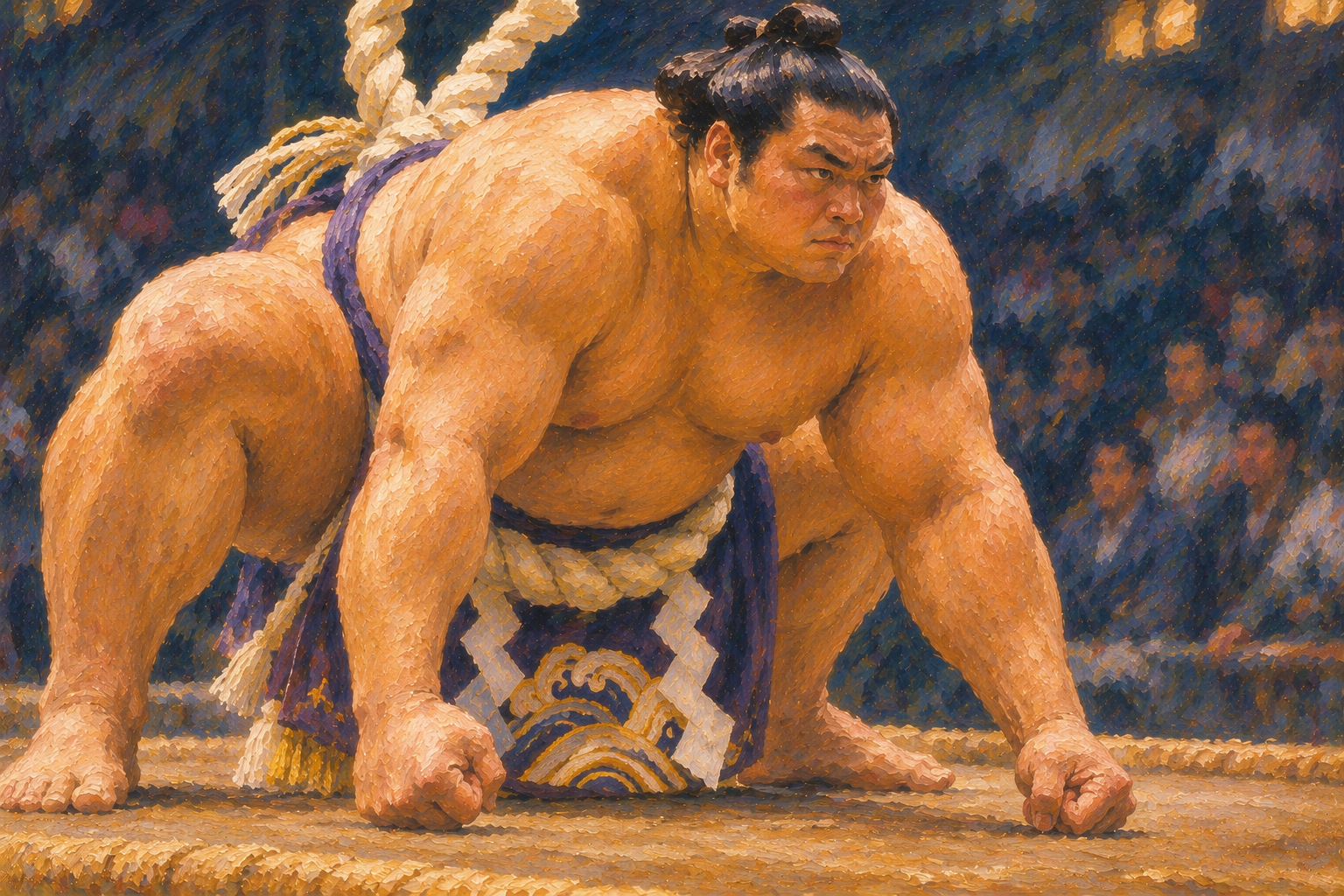
At Fukuoka Kokusai Center on November 13, Ōnosato drove Hakunofuji toward the edge of the ring and finished with oshitaoshi, a forceful push-down. The win was his fifth in succession since an opening-day defeat. At 5–1 after six days of the Kyushu Grand Sumo Tournament, the 26-year-old grand champion had found a way back into a championship contest that initially looked capable of escaping him.
The day also eliminated the division’s final unbeaten record: sekiwake Atamifuji lost to former ōzeki Asanoyama. Nine wrestlers were consequently tied at 5–1. That is a very different condition from a yokozuna running away with a tournament. This is a report of verified action through November 13; the scheduled bouts on November 14 and 15 are not represented as completed results.
Why the Opening-Day Defeat Mattered
Ōnosato arrived in Fukuoka hoping to follow his September 2026 championship, won with a 12–3 record, with a second consecutive title. Instead, he lost on November 8 to komusubi Yoshinofuji by tsukiotoshi, a thrust-down. The bout required the judges to review a close finish, but the initial ruling stood. A wrestler whose most effective matches often end with the opponent moving backward had been derailed at the very beginning.
Yoshinofuji had already become a difficult opponent for the yokozuna. Previous encounters included victories in November 2025 and January and July 2026, alongside a March default when Ōnosato withdrew. Counting a default as though it were a competed bout would obscure the technical story: when Yoshinofuji attacks low and keeps moving, he can expose moments when Ōnosato pulls backward or lets his upper body rise.
Five Wins, Five Different Tactical Problems
The comeback was not a series of interchangeable power performances. On November 9, Ōnosato defeated Fujiryōga by yorikiri, forcing him out with a secured hold. On November 10, he beat Asanoyama by yoritaoshi, a force-out that ended with the opponent falling. November 11 brought a sukuinage, or beltless scoop throw, against Fujiseiun. He then beat Ura by hatakikomi, a slap-down, on November 12.
Those results reveal adaptability. They also invite scrutiny. Against Fujiryōga, Ōnosato was forced back toward the tawara, the straw-bale boundary, before escaping and reversing the bout. A pulling technique can save an encounter but may be less reliable than sustained forward pressure when opponents know to pursue aggressively. The record of five straight wins deserves praise without erasing the moments of vulnerability within it.
The Geometry of the Sixth-Day Win
Against Hakunofuji, the yokozuna’s defining action was not simply the final shove. Hakunofuji sought to insert his left arm inside and establish a preferred grip. Ōnosato used his right arm from outside—an ottsuke, or pressing block—to limit that opening, maintaining forward movement and pushing his opponent off balance before the final oshitaoshi.
The Japan Sumo Association officially lists thrusting, pushing, right-handed four-point grips and force-outs among Ōnosato’s preferred techniques. His height and weight provide leverage, but technical terms explain more than size does. Sashi refers to gaining an inside arm position; ottsuke is a means of neutralizing that attempt from the outside. When the timing is right, a wrestler can make the opponent lose his posture before the decisive move.
Nine Leaders and an Open Title Race
The standings after day six offered a rare degree of congestion. Alongside Ōnosato, ōzeki Kirishima moved to 5–1 by beating Fujiryōga. Atamifuji slipped to the same mark when Asanoyama beat him by yorikiri. Other challengers, including Wakamotoharu and Kinbōzan, also remained in the one-loss group.
Elsewhere among the upper ranks, yokozuna Hōshōryū halted a three-bout losing streak by defeating Takayasu and returned to 3–3. Ōzeki Aonishiki defeated Churanoumi by uwatenage to improve to 4–2, while Kotozakura lost to Yoshinofuji and likewise stood at 4–2. These diverging trajectories show why the expression “the leader” needs qualification when nine wrestlers share the best record.
From Ishikawa to the Seventy-Fifth Yokozuna
Born on June 7, 2000, in Tsubata, Ishikawa Prefecture, Ōnosato Taiki entered professional sumo in May 2023 after a strong amateur career. His real name is Nakamura Taiki. According to the Japan Sumo Association, he reached the top division in January 2024 and the rank of ōzeki in November of that year. The association approved his promotion on May 28, 2025, making him the sport’s 75th yokozuna; he appeared on the July 2025 rankings at that rank.
His stable, Nishonoseki-beya, is headed by the former yokozuna Kisenosato. The speed of his ascent invites comparison with earlier generations, yet rapid promotion has a cost: experienced opponents obtain video, refine their approaches to the opening charge and search for recurring weaknesses. Maintaining an advantage is often harder than first demonstrating it.
What the Yokozuna Rank Demands
Sumo’s hierarchy is not merely a league table. A yokozuna occupies the highest rank and, unlike an ōzeki, does not ordinarily face demotion after an unsuccessful tournament. Tradition therefore places special weight on sustained competitive standards. Commentary about a yokozuna’s dignity can sometimes be subjective; the more useful journalistic inquiry concerns identifiable choices in the ring.
For Ōnosato, those choices include whether he moves forward immediately, protects the inside lane, maintains balance when an opponent shifts direction and resists the temptation to pull. A decisive push-down in one bout cannot prove that every problem has been fixed. It can, however, demonstrate one successful technical answer to a specific challenge.
Kyushu Is the Final Stop in Sumo’s Annual Circuit
Grand sumo holds six honbasho, or official tournaments, each year. The November meeting in Fukuoka is the final event on that calendar. The 2026 Kyushu tournament runs from November 8 to 22 at Fukuoka Kokusai Center, with 15 days of competition. The schedule creates a powerful annual rhythm: wrestlers close one season while simultaneously preparing for the next.
The event also has a local dimension. Wrestlers train and engage with regional supporters during their stay in Kyushu; fans rally around competitors with ties to nearby prefectures. Yoshinofuji, from Kumamoto, brought precisely that regional interest into the opening-day upset of the sport’s leading figure. For a local audience, this is more than a televised ranking contest.
What Comes Next, and What Remains Unverified
The association’s published day-seven schedule paired Ōnosato with komusubi Churanoumi on November 14. Churanoumi stood at 1–5 through the first six days, but a large difference in records does not settle a match before the opening charge. The result is not known within this report’s November 13 evidence cutoff.
Nine more days still remained in the event after day six. Later high-rank pairings, injury management and adjustments by opponents can change the standings quickly. A complete November 16 retrospective must incorporate the November 14–15 results from the Japan Sumo Association before publication. It would be inaccurate to predict the title, claim a seventh victory or identify a champion from the evidence available here.
A Comeback Is a Process, Not a Verdict
What makes Ōnosato’s sequence compelling is the movement from a damaging defeat toward progressively stronger forward sumo. He survived a difficult second day, won with different techniques, and on the sixth day shut down Hakunofuji’s preferred inside attack. These are concrete signs of resilience and tactical responsiveness.
Yet a yokozuna’s tournament is measured across fifteen days, not six. The nine-way tie makes that especially clear. The question for Fukuoka is not whether Ōnosato can produce a single commanding bout—he already has—but whether he can reproduce the balance, positioning and urgency required when every rival has now studied the opening week.
Sources and methodology
Reporting cutoff: after day six, November 13, 2026 (Japan Standard Time). Later tournament results are not available to this report. Rankings, names and records are checked against the Japan Sumo Association; bout details are compared with dated Japanese sports coverage. No independent ringside reporting or interviews were conducted.
- 日本相撲協会:大の里泰輝公式力士プロフィール / JSA rikishi profile
- 日本相撲協会:第75代横綱 大の里 / Official yokozuna promotion
- 日本相撲協会:二所ノ関部屋 / Nishonoseki stable
- 日本相撲協会:歴代横綱 第75代大の里 / Historical yokozuna profile
- スポーツナビ:2026年11月場所 大の里星取表 / Day-by-day results
- スポーツナビ:11月場所取組結果 / Daily tournament result
- 日刊スポーツ:11月13日 伯乃富士戦 / Bout analysis
- 共同通信:11月13日の優勝争い / Day-six contenders
- 日刊スポーツ:11月14日の取組予定 / Scheduled next bout