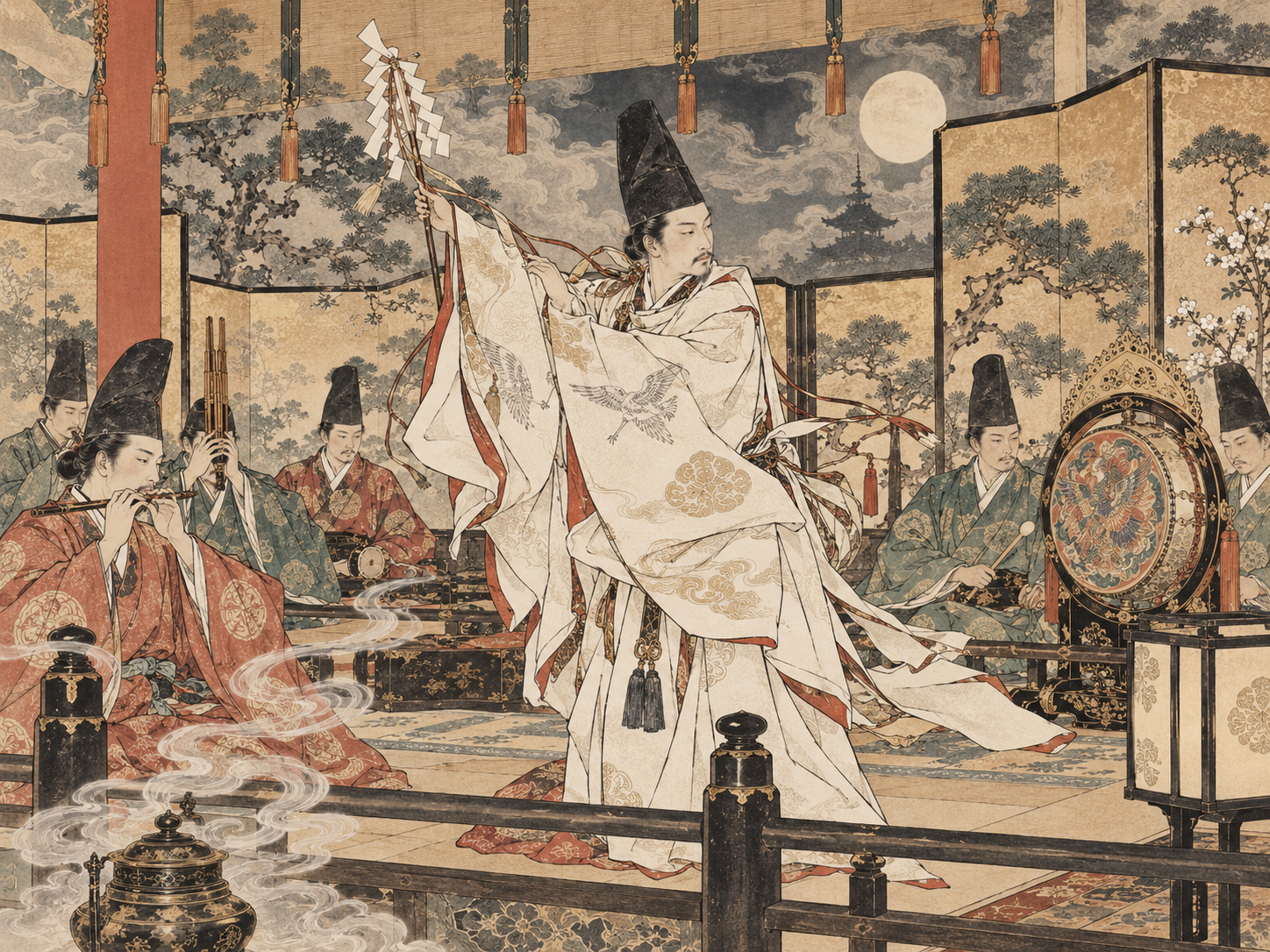
A modern theater can easily show us a visual fantasy of Abe no Seimei’s world. The harder question is what that world should sound like.
On Nov. 27 and 28, Tokyo’s MoN Takanawa: The Museum of Narratives will present Listen to the Manga Onmyoji — The Gagaku Cosmos Connecting Heaven and Earth in its Box1000 theater. The performance rebuilds Reiko Okano’s manga through gagaku, electronic music, manga imagery and spatial sound. Okano supervises and appears onstage; the gagaku ensemble Reigakusha and musician Ichiko Hashimoto perform; Bruce Ikeda directs; Yamaha Sound System provides immersive-audio technology support.
Okano’s Onmyoji began with Baku Yumemakura’s fiction
Reiko Okano’s Onmyoji is based on Baku Yumemakura’s novel series. First published as manga in 1993 and collected by Hakusensha in 13 volumes, it centers on Abe no Seimei and Minamoto no Hiromasa in a Heian capital where visible and invisible worlds continually overlap. The manga won the fifth Osamu Tezuka Cultural Prize Manga Grand Prize in 2001 and the 37th Seiun Award’s comic category in 2006.
The production’s own framing matters. It is not presenting Onmyoji primarily as monster-fighting fantasy. The organizers emphasize the aesthetic sense and cosmology surrounding Seimei and Hiromasa. Okano describes her manga as a story in which two extraordinary figures versed in onmyōdō and gagaku use music, dance and ritual blessing to connect emotional worlds and calm troubled spirits.
Abe no Seimei was real. The legendary Seimei was accumulated later.
Abe no Seimei was a historical onmyōji active in the Heian period. Japan’s National Museum of Japanese History explains that onmyōdō developed in antiquity and expanded over the medieval and early-modern periods. Onmyōji served within the state’s Onmyōryō while also participating in private rites for aristocrats and warriors, working with calendars, divination and ritual knowledge.
The same museum stresses that Seimei’s later supernatural image accumulated through storytelling. Traditions that his mother was a fox, or that he could understand the meaning of crow calls, belong to the legend that developed around the historical figure.
Okano’s manga lives deliberately between those layers. It is not a documentary reconstruction of the historical Seimei, but it uses Heian institutions, concepts of time and direction, ritual, music and bodily perception to imagine how a different worldview might have felt.
Minamoto no Hiromasa makes sound a second protagonist
Opposite Seimei in the manga is Minamoto no Hiromasa, represented as an extraordinary flute player and a figure later praised as a master—almost a patron saint—of gagaku. The production uses that musical identity as a bridge from manga narrative into live sound.
Historical Hiromasa and literary Hiromasa should not be collapsed into one person. Traditions surrounding famous musicians grow over time, just as Seimei’s magical reputation did. The concert is not claiming to reconstruct a set list that the historical Hiromasa actually heard in the tenth century. It is using surviving repertory, reconstructed works and new music to create a modern acoustic reading of Okano’s Heian world.
Gagaku is not simply “ancient Japanese music”
Japan’s Imperial Household Agency explains that gagaku grew from the fusion of indigenous Japanese song and dance with music and dance transmitted from continental Asia and the Korean Peninsula from around the fifth century onward. The form was largely established by around the tenth century and preserved under imperial patronage.
Its repertory includes indigenous kuniburi no utamai; tōgaku associated with continental Chinese traditions; komagaku associated with the Korean Peninsula; and vocal forms including saibara and rōei that developed under continental musical influence. Performance forms include instrumental kangen, dance-centered bugaku and vocal music.
Gagaku performed by the Imperial Household Agency’s Music Department was designated an Important Intangible Cultural Property in 1955 and was inscribed on UNESCO’s Representative List of the Intangible Cultural Heritage of Humanity in 2009. The “ancient sound” used by Onmyoji is therefore a living performance tradition, not merely an archaeological reconstruction.
Reigakusha has never treated preservation and creation as opposites
Reigakusha was founded in 1985 by Sukeyasu Shiba, a former musician of the Imperial Household Agency’s Music Department. Its mission has included classical gagaku, reconstruction of lost repertory, performance on reconstructed Shōsōin instruments and commissions from contemporary composers. Mayumi Miyata is the ensemble’s current music director.
One of the impulses behind its founding was Shiba’s desire to perform Toru Takemitsu’s gagaku work In an Autumn Garden at the highest level. Reigakusha has spent four decades moving between historical repertory and contemporary composition.
That history makes a performance mixing manga, ambient electronics, reconstructed gagaku and immersive sound less anomalous than it might appear. Reigakusha itself was built on the premise that ancient instruments can remain alive by being used in both inherited and new music.
The 2000 album is the missing link
This is not Okano’s first attempt to give Onmyoji an acoustic world. The 2000 album music for Onmyoji was produced by Okano, who also performed on wagon. Reigakusha, then led by Shiba, supplied gagaku performances, while Brian Eno contributed ambient music.
The 2026 production expands that earlier relationship into physical theater. Reigakusha returns; Ichiko Hashimoto adds keyboard-based ambient music and her composition Uzu; manga imagery and Heian-inspired visuals are placed inside the spatial audio environment of Box1000.
The set list is real gagaku, not atmospheric shorthand
The published program is unusually specific: Sōjō no Chōshi, Shunteika, Ōshikichō no Chōshi, Jussuiraku, the biwa secret piece Yōshin-sō, bugaku Ryōō Ichigu, Hyōjō no Chōshi, the solo wagon piece Sugagaki, the saibara song Asukai, Banshikichō no Chōshi, Sokō (first prelude), bugaku Seigaiha, Taishikichō no Chōshi, Chōgeishi, the rōei Jisei, and Hashimoto’s Uzu.
Some material, including parts associated with Ryōō and the saibara Asukai, reflects reconstruction work by Sukeyasu Shiba. The program therefore openly layers living classical repertory, historically reconstructed music and contemporary composition rather than pretending to offer an untouched soundtrack from the tenth century.
| Element | Detail |
|---|---|
| Performance | Listen to the Manga Onmyoji — The Gagaku Cosmos Connecting Heaven and Earth |
| Dates | Nov. 27, 2026 at 18:30; Nov. 28 at 14:00 |
| Venue | MoN Takanawa Box1000, 3-16-1 Mita, Minato-ku, Tokyo |
| Supervision / appearance | Reiko Okano |
| Direction | Bruce Ikeda |
| Performers | Reigakusha, Ichiko Hashimoto, Reiko Okano |
| Audio support | Yamaha Sound System |
| Planned duration | Approx. 140 minutes |
Shō, hichiriki and ryūteki: understanding the physical sound
In gagaku kangen, three wind instruments are central: the shō, hichiriki and ryūteki. The shō creates sustained clustered sonorities, the hichiriki carries an intense melodic line, and the ryūteki moves across a broader range. Biwa and gakusō strings join percussion including kakko, taiko and shōko.
The production offers a roughly 40-minute pre-show instrument experience for the first 50 ticket holders in the special category, including shō, hichiriki, ryūteki, kakko, gakudaiko and shōko. That small workshop changes the cultural proposition: the instruments are not simply “ancient atmosphere” but physical systems of breath, fingers, skin, metal and timing.
Seigaiha carries its own literary memory
One listed dance, Seigaiha, has a famous literary afterlife. In The Tale of Genji, Genji and Tō no Chūjō perform the dance during the “Momiji no Ga” chapter, their beauty and movement becoming part of the social drama of the court.
Its presence in an Onmyoji concert helps keep the Heian world from collapsing into “magic.” Music, costume, poetry, season, ceremony and bodily performance all belonged to the cultural environment from which later stories of Seimei emerged.
Onmyōdō was more than magic
Modern fantasy often turns the onmyōji into a sorcerer. Historical research offers a broader picture. The National Museum of Japanese History emphasizes calendar-making, astronomy, divination, ritual and the interpretation of auspicious and inauspicious time and direction.
For Heian aristocrats, directional prohibitions and calendrical judgments were not simply private superstition; they shaped travel, ritual and social behavior. Reading Okano’s cosmology therefore requires understanding onmyōdō as a system for assigning meaning to time and space, not only as supernatural combat.
Immersive audio is interpretation, not archaeological reconstruction
Yamaha Sound System is providing immersive-audio technology for Box1000. Spatial sound can locate and move sound around an audience, creating an acoustic environment rather than a conventional front-facing concert image.
But the production is not a scientific reconstruction of tenth-century Heian acoustics. We do not possess complete records of room acoustics, audience arrangements, environmental sound or every performance practice surrounding Seimei and Hiromasa. The organizers themselves describe the work as a reconstruction through music, imagery and spatial direction.
The fair critical question is therefore not whether the audience will hear “exactly what Seimei heard.” It is whether classical gagaku, reconstructed repertory, manga imagery, electronics and modern spatial audio can create a convincing new way to perceive the historical imagination behind the story.
- Which manga scenes are paired with which pieces of gagaku repertory
- Where Reigakusha’s acoustic instruments end and Hashimoto’s electronic sound begins
- How Sukeyasu Shiba’s reconstructed material functions within the narrative
- How central Okano’s own spoken commentary and wagon performance become
- Whether immersive audio deepens the spatial quality of live gagaku or overwhelms it
- How clearly the production distinguishes historical Heian practice from the manga’s imaginative cosmology
A rare loop from manga back into classical culture
Modern adaptations usually move in the other direction: classical literature or performance is translated into manga, animation or film. This Onmyoji project reverses the flow. A modern manga is returning to the historical sound culture embedded inside its fictional world.
Yumemakura’s novels became Okano’s manga. The manga produced the 2000 album. Twenty-six years later, that acoustic relationship expands into a live work combining gagaku, wagon, electronics, images and immersive sound.
The concert cannot prove what the historical Abe no Seimei heard. Its more interesting task is to reveal what contemporary Japan chooses to make audible when it imagines a world a thousand years away. Pulling sound out of manga panels and sending it back toward classical performance may be the most modern thing about the project.
Sources & Reference Material
- MoN Takanawa, official page for Listen to the Manga Onmyoji — The Gagaku Cosmos Connecting Heaven and Earth.
- JR East Culture Foundation, Onmyoji concert announcement, Oct. 2, 2026 (Japanese).
- Reigakusha, concert program, performers and instrument workshop.
- Reiko Okano official site, detailed concert program.
- Hakusensha, Onmyoji manga publication information.
- Reiko Okano official site, Onmyoji and Onmyoji Tamatebako bibliography.
- Imperial Household Agency, history and structure of gagaku.
- National Museum of Japanese History, historical onmyoji and the later legend of Abe no Seimei.
- Reigakusha, ensemble history and work with classical, reconstructed and contemporary gagaku.
- Reiko Okano official management news, 2026 Onmyoji concert information.
Reporting cutoff: Oct. 6, 2026, 1:21 PM JST. Because the performances are in November, the exact manga imagery, final sequencing and instrumentation, immersive-speaker layout and any late production changes are not yet verifiable. No historical source establishes that Abe no Seimei or Minamoto no Hiromasa heard this repertory in anything resembling the modern concert sequence; the production is treated here as a contemporary reconstruction, not an acoustic reenactment.