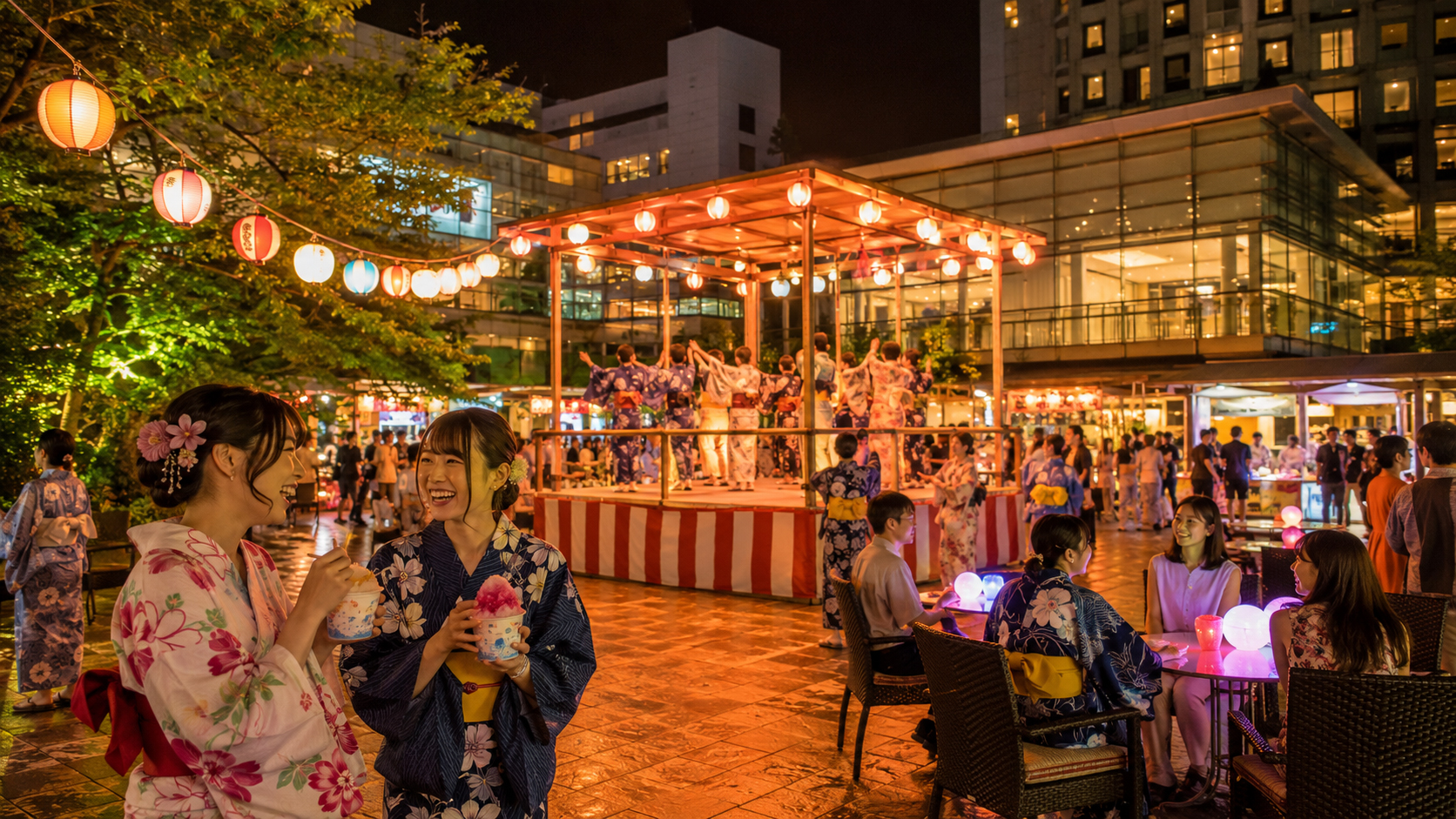
You come back to the hotel, and the festival starts
There is a small sadness in many travel nights. You eat, walk, photograph, wander, take the train, and return to the hotel. The lobby is clean. The room is comfortable. The shower works. But the city ends at the elevator. In Osaka, that feels like a waste. Osaka is best when it is still a little loud, a little friendly, a little pushy, and very ready to make a joke after sunset.
OMO7 Osaka by Hoshino Resorts has a very Osaka answer to the problem of the night ending too early: turn the hotel garden into a festival. Not just lanterns and a snack stand. Add comedy. Add exaggerated poses. Add takoyaki gestures. Add “nande yanen” motions. Add Yoshimoto comedians. Turn the hotel night into one more piece of Osaka before bed.
From June 15 to August 31, 2026, OSAKA PIKAPIKA NIGHT Summer Festival transforms the hotel’s regular evening event into a seasonal celebration. The setting is the hotel’s spacious garden. When night falls, light, food, games, dance, and Osaka humor appear, allowing guests to feel that the city has followed them home.
The city hotel becomes a neighborhood theater
OMO is Hoshino Resorts’ urban tourism brand, and its best idea is simple: a city hotel should not trap the traveler inside the hotel. It should push the traveler into the city, explain the city, translate the city, and then keep the city’s rhythm alive after the guest returns.
OMO7 Osaka is especially well placed for that mission. Shin-Imamiya is not a neutral location. It sits near Shinsekai, Tsutenkaku, Janjan Yokocho, Tennoji, Abeno, and Namba. It is close to tourist Osaka, working Osaka, nostalgic Osaka, and slightly chaotic Osaka. It is not the kind of district where a hotel can succeed by pretending the city outside is generic.
That is why the hotel’s “Naniwa luxury” idea works. This is not silent Tokyo elegance. It is brighter, looser, more talkative, more theatrical, and not afraid of being a little ridiculous. But it still has to be designed well. OSAKA PIKAPIKA NIGHT Summer Festival shows that philosophy clearly: make the garden a stage, make the wall a screen, bend bon odori toward comedy, put jokes into food, enlarge the games, and connect the stay to the local personality.
Kotekote Bon Odori SHOW TIME: the courage to put “nande yanen” into a dance
The main event is the Kotekote Bon Odori SHOW TIME. According to official event information, a giant yagura image is projected onto roughly 100 meters of hotel wall, creating a festival stage for an Osaka-style original bon odori. The choreography includes takoyaki poses and “nande yanen” poses.
This is extremely correct Osaka. Bon odori is traditionally a community body language. People form a circle, repeat simple movements, and enter the same rhythm. You do not have to be perfect. You only have to join. When Osaka humor is added, the embarrassment softens. A tourist may hesitate if asked to dance a traditional local dance correctly. But if the movement is “nande yanen,” everyone gets permission to be silly.
The involvement of Yoshimoto comedians matters. Osaka comedy is not only about funny lines. It is timing, reaction, interruption, distance, and a relationship with the audience. Visitors often sense this in Osaka without knowing how to name it: shopkeepers speak more directly, servers add a line, strangers may talk a little closer than expected. Comedy is part of the social lubricant of the city.
Bringing comedians into a hotel event is not just entertainment. It brings Osaka’s conversational style into the guest experience.
Billiken Kinkin shaved ice: Osaka cools down its lucky god
The food is not merely summery. At OMO Café & Bar, the festival features Billiken Kinkin shaved ice, inspired by Billiken, the lucky god strongly associated with Shinsekai. As guests eat, colorful jelly appears inside, turning the dessert into a small fortune-telling game.
Billiken was originally an American-born good-luck figure from the early twentieth century, but Osaka adopted him with particular affection. In Shinsekai, and especially around Tsutenkaku, Billiken became a strange, charming guardian of local luck. Rub the feet, people say, and good fortune may follow.
Turning Billiken into shaved ice is very Osaka. Making the shaved ice “kinkin” cold is even more Osaka. Hiding a fortune inside is the final move. Osaka food is often not only about taste. It creates conversation. Takoyaki is hot, so people react. Kushikatsu has the no-double-dipping rule, so people talk. Mixed juice triggers nostalgia. Shaved ice with a hidden fortune makes people ask, “What color did you get?” Food becomes a social switch.
Kushi churros and sho-ga-nade: Osaka makes the name funny first
The festival also includes “No Double-Dipping! Kushi Churros” and “Sho-ga-nade,” a refreshing drink that blends Osaka’s nostalgic hiyashi-ame ginger sweetness with lemon. Again, the naming matters.
Kushi churros are a parody of kushikatsu culture. In Osaka’s kushikatsu shops, the no-double-dipping sauce rule became both a hygiene rule and a tourist joke. Move that phrase onto a sweet churro, and the food is already smiling before anyone takes a bite.
Sho-ga-nade works the same way. Hiyashi-ame is an old Kansai drink with malt syrup and ginger. Add lemon and the sound of lemonade, and the name becomes a tiny cultural bridge: old Osaka refreshment, new hotel playfulness, and summer heat in one cup.
The giant takoyaki smart ball is exactly the right kind of ridiculous
The festival also introduces a “Dodeka Takoyaki Smart Ball,” reportedly over two meters long. Smart ball has an old-fashioned ring to it: a Showa-era amusement, simpler than pachinko, a little nostalgic, connected to old entertainment districts, hot springs, and festival spaces.
Then OMO7 Osaka turns it into a giant takoyaki. The more you explain it, the more ridiculous it becomes. That is a virtue. Travelers do not live on history museums alone. They also want a moment where they laugh and ask, “Why is this so big?” Osaka is good at that kind of hospitality.
The hotel setting makes it even better. Old amusement culture, festival games, takoyaki iconography, Hoshino Resorts staging, and a modern hotel garden all collide. Too elegant a hotel would never do it. Too careless a hotel would make it cheap. OMO7 Osaka is trying to live in the sweet spot between designed and foolish.
| Festival feature | Why it feels Osaka |
|---|---|
| Kotekote Bon Odori SHOW TIME | Traditional bon odori becomes participatory comedy with takoyaki and “nande yanen” gestures. |
| Yoshimoto comedians | The city’s timing, tsukkomi, and audience relationship enter the hotel night. |
| Billiken Kinkin shaved ice | Shinsekai’s lucky god becomes cold, sweet, and fortune-telling. |
| No Double-Dipping! Kushi Churros | Kushikatsu etiquette becomes a dessert joke. |
| Dodeka Takoyaki Smart Ball | Showa amusement, festival play, takoyaki, and Osaka exaggeration in one oversized game. |
Why Osaka can turn laughter into tourism
When people say Osaka is funny, they do not only mean that it produces comedians. Osaka conversation often feels a little closer to performance. Shopping street calls, restaurant banter, taxi chatter, casual tsukkomi, and a willingness to talk to strangers all create a city that feels socially warmer and sometimes more direct than expected.
This does not mean every Osakan is funny. That would be a lazy myth, and probably annoying to many Osakans. But there is a real culture of not fearing conversation. Part of that comes from Osaka’s history as a merchant city. During the Edo period, Osaka was called the nation’s kitchen, a center of rice, goods, finance, merchants, theater, food, and distribution. Commerce requires talk. Talk creates timing. Timing invites humor.
Later, kamigata rakugo, manzai, Shochiku, Yoshimoto, theater culture, and television comedy strengthened that identity. For tourism, laughter is powerful because it turns the visitor from observer into participant. A temple can be admired from outside. A joke pulls you in. OMO7 Osaka’s summer festival is smart because it does not let guests remain only spectators. It makes them dance a little, laugh a little, and perhaps feel slightly embarrassed. Those are the moments that stick.
The strength of Shin-Imamiya
OMO7 Osaka’s Shin-Imamiya location is not simple, and that is part of its strength. The area is near Shinsekai and Tsutenkaku, with strong access to Tennoji, Namba, and Kansai International Airport. It also carries a long history of labor, budget lodging, entertainment, working-class life, and social complexity. In recent years, redevelopment and hotel investment have changed the area’s image.
Building a hotel here is not just a real estate move. It changes how the district is narrated. For travelers, Shin-Imamiya can shift from “a cheap place to sleep” to “an entrance into thick Osaka.” OMO7 Osaka is part of that shift, and PIKAPIKA NIGHT is a translation device.
A guest laughs and dances in the hotel garden at night, then walks to Tsutenkaku or Janjan Yokocho the next morning. The hotel has not cut itself off from the neighborhood. It has softened the entrance into it. That is a new role for city hotels: not replacing the city, not sanitizing it into nothing, but giving travelers a safer, more legible first doorway into local intensity.
Bon odori was always a technology for bringing people into the circle
Bon odori is one of Japan’s gentlest public spaces. You do not need to be skilled. You can watch from outside. You can join late. Children, adults, locals, visitors, yukata, T-shirts, tourists, and elders can share the same circle. It is a festival, but not a competition.
That makes it perfect for a hotel event. The challenge in hotel programming is lowering the threshold for participation. A stage show can leave guests passive. A club event can feel intimidating. Bon odori says: come in if you want, make mistakes, follow the person in front of you.
Adding takoyaki and “nande yanen” gestures may look like a joke, but it is also faithful to the spirit of bon odori. Regional dances have always changed by place and time. New movements enter. Local identity enters. If a bon odori happens at an Osaka hotel, of course Osaka comedy belongs inside it.
The hotel night becomes the destination
For a long time, Japanese city hotels were transportation and sleep machines: near the station, clean, safe, convenient, breakfast included. That was enough. But as inbound tourism grows and domestic travelers seek more memorable experiences, the hotel itself must often become part of the destination.
OMO7 Osaka’s summer festival fits that shift. Guests explore Osaka by day. At night, the hotel continues Osaka rather than ending it. Before going upstairs, they eat shaved ice, play a game, dance badly, watch someone make a “nande yanen” motion, and laugh. The next day, they do not feel they merely saw Osaka. They feel they joined it for a moment.
This is good for the city, too. Safe evening programming can extend stays and help families or first-time international visitors participate without feeling lost. It can introduce local culture without flattening it. In a city as intense as Osaka, the design of that doorway matters.
Osaka is joking, but it is serious about the joke
It would be easy to dismiss this festival as light: takoyaki poses, “nande yanen” poses, Billiken shaved ice, kushi churros, giant takoyaki smart ball. On paper, it sounds like a tourist joke.
But Osaka’s strength is that it jokes seriously. Making people laugh requires preparation. Making something feel casual requires design. Creating a space where strangers feel safe enough to participate requires staff movement, lighting, timing, sound, food, signage, and a very careful distance between host and guest. Done badly, it becomes awkward. Done well, it lowers the traveler’s defenses.
Osaka gives travelers permission not to be too proper. In Kyoto, visitors straighten their posture. In Tokyo, they match the speed. In Nara, they walk quietly. In Osaka, they are allowed to laugh a little. OMO7 Osaka’s summer festival works because it feels like that permission slip.
One more bite of shaved ice before bed
Osaka summers are hot and humid. After walking all day, the body gets heavy by evening. That is why a night festival needs something cold. Eat the Billiken Kinkin shaved ice, discover the jelly color, ask someone else what fortune they got. That small conversation may last longer in memory than a perfect hotel corridor.
A hotel night does not always need to be quiet. Sometimes it should glow, move, joke, and end with cold sweetness. OSAKA PIKAPIKA NIGHT Summer Festival brings Osaka into the hotel without forcing it.
The value of a hotel event is not only luxury. It is whether it creates a memory. The night you made a takoyaki pose. The night you waved your arm in a “nande yanen” motion. The night your shaved ice told your fortune. The night you played a giant takoyaki game in a hotel garden.
It is a little ridiculous. That is why it might be a very good trip.
- OMO7 Osaka’s OSAKA PIKAPIKA NIGHT Summer Festival runs from June 15 to August 31, 2026.
- The Kotekote Bon Odori SHOW TIME uses a giant yagura image projected across about 100 meters of hotel wall.
- Takoyaki poses, “nande yanen” poses, and Yoshimoto comedians bring Osaka comedy into the guest experience.
- Billiken Kinkin shaved ice, No Double-Dipping! Kushi Churros, and Sho-ga-nade turn food into conversation.
- The event shows how a city hotel can become a continuation of the city, not merely a place to sleep.
Sources and references
This article was based on public information from OMO7 Osaka by Hoshino Resorts, Hoshino Resorts event materials, PR TIMES, OSAKA PIKAPIKA NIGHT information, OMO7 Osaka official pages, and Osaka tourism references.
- OMO7 Osaka by Hoshino Resorts: OSAKA PIKAPIKA NIGHT Summer Festival
- PR TIMES: OMO7 Osaka launches OSAKA PIKAPIKA NIGHT Summer Festival
- OMO7 Osaka: OSAKA PIKAPIKA NIGHT
- OMO7 Osaka Hotel by Hoshino Resorts Official Site
- OMO7 Osaka Activities
- Rakuten Travel: Summer Festivals in Osaka 2026
- MATCHA: OMO7 Osaka by Hoshino Resorts and city tourism