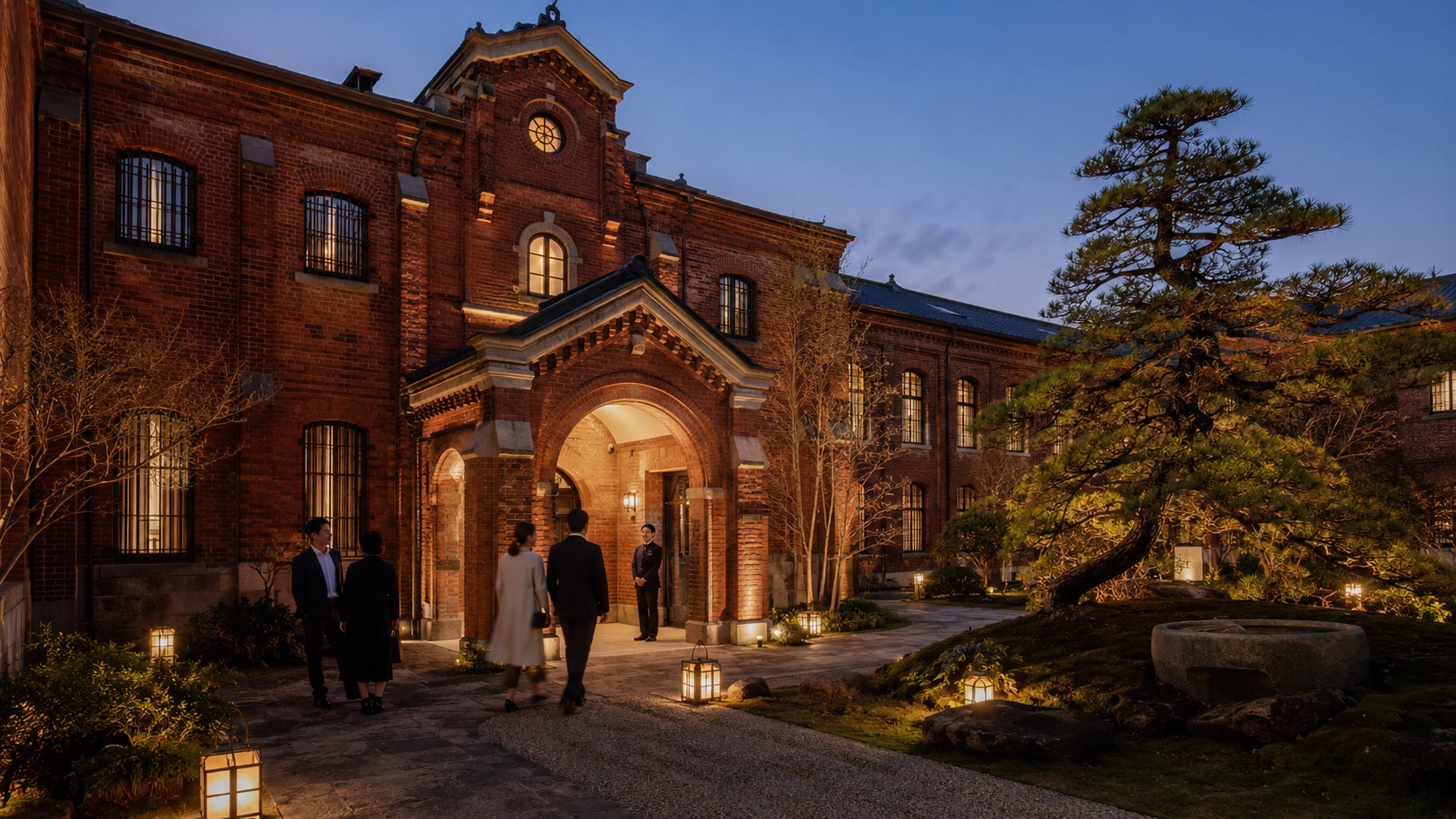
You do not simply check in. You enter a building with a memory
Before the front desk, before the room key, before the tea and the carefully staged calm, there is a wall. It is red brick, but not the cute red brick of a nostalgic café or a fashionable warehouse. This wall once separated people from the world. The gate was not designed merely to welcome. It was designed to decide who could pass and who could not.
That is what makes HOSHINOYA Nara Prison so arresting. It opens on June 25, 2026 as Japan’s first luxury hotel adapted from a former prison. Written as a headline, the idea sounds almost too clickable: stay overnight in a prison, but make it elegant. Yet standing before the former Nara Prison, the story becomes deeper and less gimmicky. This is not a novelty hotel. It is a question built in brick.
Nara is usually sold through an older dream of Japan: Todai-ji, Kasuga Taisha, Kofuku-ji, deer, lanterns, moss, school trips, and the soft authority of the ancient capital. But on the northern side of the city sits another Nara, a Meiji Nara, a modernizing Nara, a Japan that wanted to prove to the world it could build courts, prisons, schools, ministries, and systems worthy of a modern state. The former Nara Prison is that Japan, still standing.
Meiji Japan used red brick to announce that it had become modern
To understand the former Nara Prison, you have to return to the Meiji period. After the collapse of the Tokugawa shogunate, Japan was under pressure to modernize quickly. Railways, schools, banks, courts, ministries, factories, a parliament, a modern military, and a modern legal system were not only domestic reforms. They were messages to the outside world.
Prisons were part of that message. A modern nation needed modern correctional institutions. Not merely rough holding cells, but organized facilities with rules, hygiene, surveillance, classification, discipline, and architectural order. The Meiji government’s “Five Great Prisons” — in Chiba, Kanazawa, Nagasaki, Kagoshima, and Nara — were built as symbols of that ambition. Nara is the survivor that still lets the public read the original idea most clearly.
Completed in 1908, the former Nara Prison belongs to a moment when Japan had recently defeated Russia and was testing its new identity as a rising power. The red-brick Romanesque style was not accidental. The arches, long walls, and formal symmetry spoke a language the Meiji state wanted the world to understand: Japan was not merely old, refined, and exotic. It was modern, legal, disciplined, and sovereign.
The unsettling contradiction of a beautiful prison
Many people who see the former Nara Prison for the first time say the same thing: it is beautiful. That is true, and also uncomfortable. A prison is a place where freedom is removed. It contains stories of crime, punishment, isolation, regret, social failure, broken families, and attempts at rehabilitation. To describe it only as photogenic would be too light.
And yet the beauty is real. The red brick has depth. The arches are dignified. The radial cell blocks create a geometry of order. The building was designed for control, but time has given it a strange gravity. It is not the beauty of a shrine or a garden. It is the beauty of a system made visible, softened by age but not erased by it.
This is the challenge for HOSHINOYA. A hotel must comfort. A heritage site must remember. A luxury brand must create ease, but this building should not become easy. If the renovation becomes too theatrical, the site risks becoming a theme park. If it becomes too polished, the history disappears. If it becomes too severe, it stops being travel. The narrow path is the interesting path: preserve the memory, create rest, and never let the guest forget where they are.
Nara gains another timeline
Nara tourism usually points backward to ancient Japan: the eighth-century capital, Buddhist statecraft, aristocratic power, sacred deer, and the architecture of temples. The former Nara Prison adds a different timeline. It is not the Nara of the Nara period. It is the Nara of Meiji modernity.
That matters because Nara has often been treated as a day-trip city. Visitors come from Kyoto or Osaka, see Todai-ji, feed or photograph the deer, wander through Naramachi, and leave before dinner. That is a pleasant trip, but it undersells the city. Nara is not merely old Japan in a convenient afternoon package. It is a layered city, and layers require time.
HOSHINOYA Nara Prison gives travelers a reason to stay. It gives them night Nara, morning Nara, quiet Nara. It allows a guest to spend one day with ancient religious authority and another with the architecture of a modern legal state. Few cities can offer that contrast in such a compact emotional geography.
| How to read the trip | What HOSHINOYA Nara Prison adds |
|---|---|
| Ancient Nara | The hotel adds a Meiji timeline to a city usually understood through temples, deer, and the ancient capital. |
| Architecture Nara | Wooden temple architecture is joined by red brick, arches, radial planning, and correctional design. |
| Overnight Nara | The opening gives travelers a serious reason to stay past the day-trip rhythm. |
| Heritage Japan | The project becomes a case study in preserving a difficult building by giving it a new use. |
Preservation and use are always arguing. That is why this works
Japan has countless heritage buildings: castles, temples, shrines, machiya, schools, factories, warehouses, stations, government offices, hospitals, and prisons. The problem is not simply whether to save them. The problem is how. Preservation costs money. Empty buildings decay. Used buildings change. Change too much and the heritage is damaged. Change too little and the building becomes impossible to maintain.
The former Nara Prison project is one answer to that impossible argument. It does not merely freeze the building. It gives it economic life. The museum gives it educational life. The hotel gives it emotional and experiential life. Of course, this is difficult. Seismic reinforcement, fire safety, accessibility, climate control, room comfort, circulation, and cultural property restrictions all collide inside a building never designed for hospitality.
But the difficulty is exactly why the project matters. Heritage cannot survive forever as scenery. It must be cared for, funded, entered, questioned, and sometimes reimagined. HOSHINOYA Nara Prison tries to walk the narrow line between conservation and commerce. Done well, that line can be elegant. Done poorly, it can be vulgar. This opening will be watched because the stakes are higher than a hotel review.
The museum keeps the hotel from becoming too light
The Nara Prison Museum, opened on April 27, 2026, is not a decorative add-on. It is the moral ballast of the whole project. Without the museum, the hotel might risk becoming simply “that cool prison hotel.” With the museum, the site asks visitors to engage with the history of corrections, confinement, rehabilitation, and the social structures around incarceration.
That matters. A prison converted into a luxury hotel can easily become a design stunt. Guests take photos, make jokes about sleeping in a cell, and move on. The museum complicates that impulse. It reminds visitors that the site was not built as atmosphere. It was built for people, rules, punishment, order, and reform. The building’s beauty does not cancel its purpose.
The best travel does not always make the world simpler. Sometimes it makes the world more precise. A guest may visit the museum by day, walk through the red-brick architecture, think about freedom, then return to a quiet lounge and realize that comfort feels different when the building has once meant its opposite.
The HOSHINOYA question: can luxury carry weight?
HOSHINOYA’s best properties do not merely offer expensive sleep. They turn place into experience. In Karuizawa, Kyoto, Taketomi Island, and elsewhere, the brand has built its reputation around a sense of location — landscape, climate, craft, season, ritual, and quiet theatricality. Nara Prison may be its most delicate stage.
Here, luxury cannot be only softness. It must include restraint. It cannot drown the building in decoration. It cannot turn the prison into a costume. The power of the site is in the spaces themselves: red brick, long corridors, repeated windows, controlled sightlines, the memory of gates and cells, the gradual transformation of closure into hospitality.
A good hotel takes you somewhere else. A great hotel takes you deeper into where you already are. HOSHINOYA Nara Prison will succeed if guests leave not merely saying, “I stayed in a former prison,” but, “I understood Nara differently.”
Japan’s prison hotel is not just a prison hotel
Other countries have converted former prisons into hotels. Boston’s Liberty Hotel is one famous example. Europe has several. The appeal is clear: heavy architecture, strong story, adaptive reuse, memorable rooms. But Nara’s version has a distinctly Japanese layering.
This is not just adaptive reuse. It is Meiji modernization inside an ancient capital, redesigned by one of Japan’s most sophisticated hospitality brands, connected to a museum, and framed as a cultural property rather than a novelty attraction. Ancient Japan, modern Japan, and luxury Japan meet in one red-brick complex.
That is why the hotel feels surprisingly right for Nara. Nara is already a city of layered time. The eighth century is visible. Sacred landscapes remain. Edo and Meiji traces exist in the streets. The former prison adds a sharper, less romantic layer. It reminds visitors that Japan’s history is not only temples, poems, gardens, and deer. It is also institutions, law, discipline, punishment, and reform.
Do not turn this into a cute travel gimmick
HOSHINOYA Nara Prison will be easy to market. The name is strong. The image is strong. The phrase “luxury prison hotel” travels fast. Social media will love it. International travel media will love it. The red brick will photograph beautifully.
But the site deserves better than novelty. This is not a cute travel gimmick. It can be beautiful, luxurious, and memorable, but it should also be serious. That does not mean grim. It means honest. The building should be allowed to remain complicated.
The ideal guest is not only someone looking for an unusual hotel. It is someone who likes architecture, history, heritage, difficult beauty, and travel that changes the way a city feels. For that traveler, this may become one of Japan’s most memorable stays of 2026.
Nara becomes deeper
Nara does not need a new hotel to be important. Todai-ji will still be Todai-ji. Kasuga Taisha will still be Kasuga Taisha. The deer will still cross the road as if they own the map. The ancient capital remains the ancient capital.
But HOSHINOYA Nara Prison changes the reading of the city. It adds a Meiji chapter to a tourist imagination dominated by the Nara period. It gives the city another reason for travelers to stay overnight. It shows that Japanese heritage is not only about preserving beautiful temples, but also about confronting difficult institutions.
A prison becomes a hotel. Said quickly, it sounds strange. Said more carefully, a closed building becomes a place of reflection. A wall that once separated people from freedom becomes a wall that asks visitors what freedom means. A corridor once designed for surveillance becomes a corridor for slow walking. A building made for confinement becomes a place where travelers can think about release.
It is a little unsettling, very beautiful, and deeply Japanese.
On June 25, 2026, Nara gets a new landmark. But it is not new. It has been there all along, waiting for Japan to find another way to let it speak.
- HOSHINOYA Nara Prison opens on June 25, 2026 as Japan’s first luxury hotel adapted from a former prison.
- The former Nara Prison is a National Important Cultural Property and the best-preserved survivor of the Meiji government’s Five Great Prisons.
- The hotel has 48 rooms, giving the large historic complex a small-scale, high-end hospitality model.
- The Nara Prison Museum opened on April 27, 2026 and gives the hotel project historical and ethical weight.
- The opening adds a Meiji modernization layer to Nara tourism, which is usually framed around ancient temples, deer, and the old capital.
Sources and references
This article was based on public information from Hoshino Resorts, the official HOSHINOYA Nara Prison site, Nara Prison Museum by Hoshino Resorts, Japan Guide, designboom, and Reuters Connect.
- HOSHINOYA Nara Prison Official Site
- Hoshino Resorts: HOSHINOYA Nara Prison set to open on June 25, 2026
- Nara Prison Museum by Hoshino Resorts
- Hoshino Resorts: Nara Prison Museum Opening on April 27, 2026
- Japan Guide: New Opening — Nara Prison Museum
- designboom: Japan's oldest prison set to be regenerated as luxury hotel
- Reuters Connect: Former Japanese prison to re-open as luxury hotel