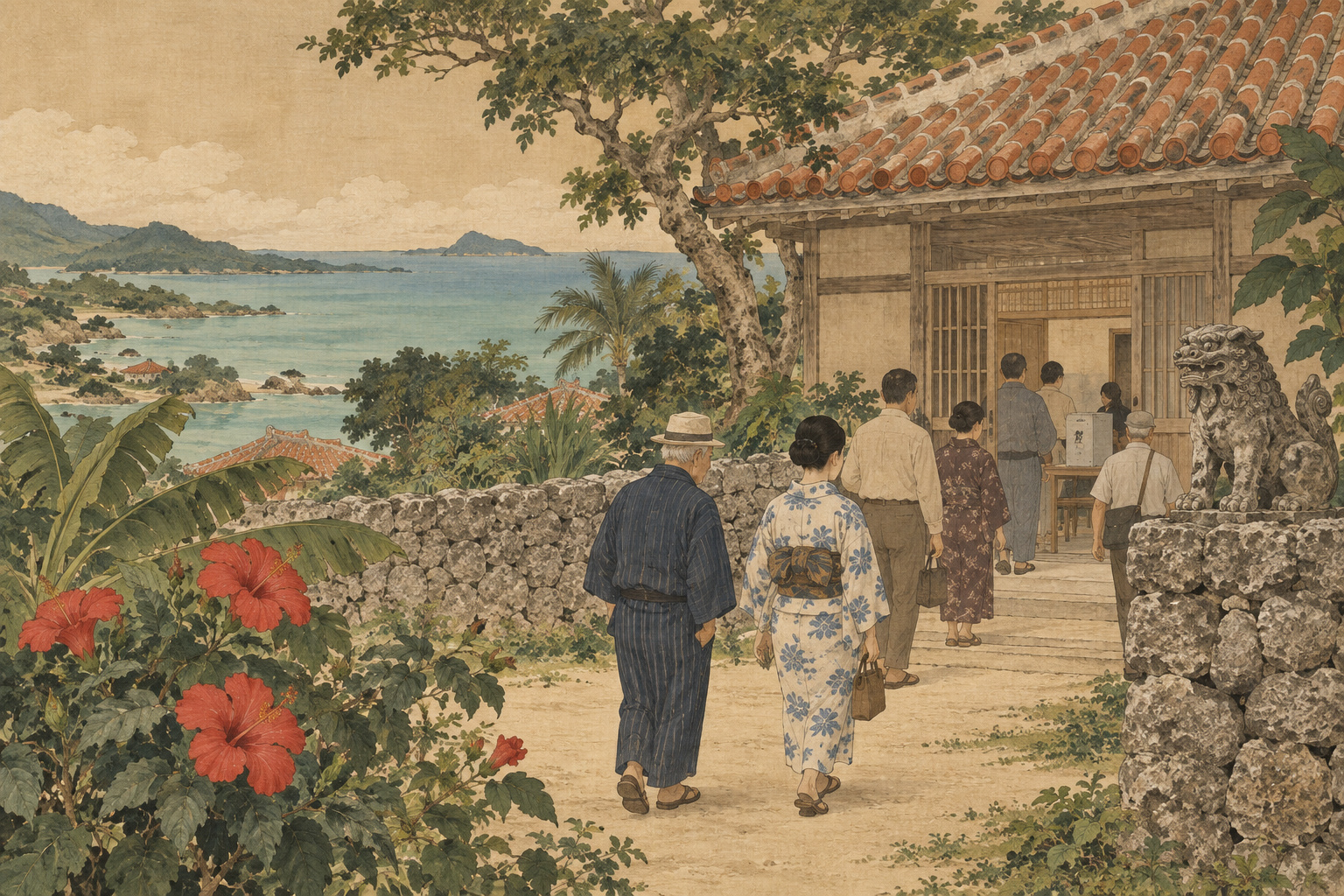
Genta Koja won Okinawa’s September 13 gubernatorial election, defeating incumbent Denny Tamaki and opening the way to a prefectural administration more receptive to the relocation of the U.S. military’s Futenma air station to Henoko. TV Asahi reported the first-time victory for the former Naha deputy mayor that evening. The election commission’s final turnout figure was 61.57%, up from 57.92% in 2022.[1][3]
The result changes the political relationship between Okinawa and Tokyo. It also transfers responsibility for an ambitious economic promise to the incoming leadership. Koja must now show how cooperation with the national government can improve household finances, while answering residents whose objections to Henoko extend beyond the identity of the governor.
| Candidate | Votes counted |
|---|---|
| Genta Koja | 377,201 |
| Denny Tamaki | 252,425 |
| カネシマシュン | 3,406 |
| ヒガタカシ | 2,527 |
| すえよしまさひろ | 1,642 |
| 屋良朝助 | 1,610 |
These are interim figures, not final vote totals. Minor candidates retain their registered Japanese ballot names.[2]
A promise that will need a precise definition
Koja, 42, lists experience at the Ministry of Internal Affairs and Communications, in Nagasaki prefecture’s finance administration and as Naha’s deputy mayor. His campaign presented connections across national and local government as resources for delivering change. His name is written 古謝玄太; the election commission gives the reading Koja Genta for his registered name, 古謝げんた.[4][5]
His platform sets a target of ¥5 million in per-capita prefectural income and proposes support for business digitization, artificial intelligence and higher-value industries. It also sets expansion targets for child-rearing spending and tourism revenue. These are campaign objectives, not enacted appropriations or demonstrated outcomes.[6]
The choice of income measure matters. Okinawa’s statistics office explicitly explains that per-capita prefectural income includes employee compensation, property income and corporate income, divided by population. It is not an estimate of each resident’s salary or actual personal receipts. Stronger corporate earnings can improve the aggregate without giving every worker a corresponding pay rise.[8]
A credible assessment of the pledge therefore needs more than a rising average. It needs wages, household resources after taxes and social contributions, and purchasing power after inflation. It also needs distribution: whether gains reach people on low earnings, parents unable to work longer hours and residents outside the most prosperous districts. That is an analytical test of the promise, rather than a prediction that it will succeed or fail.
What prices reveal—and what they cannot
Okinawa’s July consumer-price report, released August 28, recorded a 2.9% annual rise in the prefecture-wide headline index. Food rose 4.3% and transport and communications 3.2%; food contributed 1.35 percentage points to overall inflation. Naha’s headline increase was a different figure, 2.1%. The city and prefectural series should not be used interchangeably.[9]
For a household with little room to cut essential spending, more expensive food can reduce the money left for almost everything else. Yet price statistics cannot establish why individuals voted as they did. They describe a material pressure facing the next administration; they do not substitute for an exit poll or evidence about voter motivation.
There are also two different clocks in any response. Temporary assistance can help a family meet an immediate bill. Training, investment and more productive businesses may support earnings over a longer period. Neither makes the other unnecessary. The practical question is how the administration will bridge the interval between announcing an economic strategy and delivering an improvement that residents can feel.
The losing campaign also had an economic programme
Tamaki’s candidate-submitted platform sought expanded free medical care at the point of use through age 18, broader school-meal support, more childcare workers and help with travel and accommodation for medical treatment away from an island. It also proposed financing support for smaller businesses. Alongside those measures, it demanded an early end to operations at Futenma and a halt to construction at Henoko.[7]
Describing the contest simply as an economic candidate defeating a bases candidate would therefore omit substantial parts of the campaign. Both offered measures affecting everyday life. Their competing accounts of how to deliver them—and how to exercise Okinawa’s voice in relations with Tokyo—were central to the choice. Victory gives Koja authority to pursue his programme, but does not tell us that every supporter endorsed every element of it.
Why a relocation became a test of self-government
The Okinawa Reversion Agreement took effect on May 15, 1972. The change in administration did not remove the military-base issue from local politics. In its explanation of opposition to Henoko, the prefectural government traces the burden to wartime and postwar land acquisition and points to Okinawa’s concentration of roughly seven-tenths of Japan’s land area used exclusively by U.S. military facilities. The denominator is military-facility area, not all U.S. personnel or every type of shared installation.[10][18]
The December 1996 final report of the Special Action Committee on Okinawa, or SACO, linked Futenma’s return to the provision of replacement facilities and other conditions. The enduring difficulty lies in that connection: returning land and removing the risks associated with an existing airfield have been tied to providing military functions elsewhere.[11]
Japan’s Defense Ministry argues that Henoko relocation is the solution for avoiding the permanent retention of Futenma. It records the prefectural reclamation approval in 2013. The prefectural government’s opposing explanation emphasizes the continuing base burden, public opposition, damage to the Henoko–Oura Bay environment and doubts about achieving early relief for communities around Futenma. These are competing official positions, not interchangeable descriptions of an agreed outcome.[12][13]
For the incoming governor, accepting relocation will not by itself settle the questions residents can reasonably ask about it. Construction progress, environmental monitoring and an actual reduction in the burden around Futenma are different results. A government that presents one as proof of all three would be asking the public to accept more than the evidence establishes.
A referendum and an election answer different questions
In the 2019 prefectural referendum, 434,273 votes opposed reclamation at Henoko: 71.7% of ballots cast, on turnout of 52.48%. That was not 71.7% of all residents. Nor was the referendum the same exercise as choosing a governor responsible for the whole range of prefectural policy.[14]
The 2026 result cannot simply be read backward as an erasure of that earlier vote. Equally, the earlier referendum cannot be used to disregard the new choice of governor. Both belong in the record. The responsible political task is to explain decisions to people on different sides of the dispute, including those who support economic cooperation with Tokyo but remain uneasy about the relocation.
There is also a distinction between political opposition and the administrative machinery of construction. RBC’s campaign-opening analysis described work proceeding through the national government’s substitute execution of approval powers. The Defense Ministry says the reclamation change associated with ground improvement was approved in December 2023, with work subsequently proceeding on the Oura Bay side. Koja inherits an ongoing project, rather than a proposal that first becomes actionable because he won.[12][15]
Cooperation with Tokyo already has institutions
Okinawa development funding did not begin with this election. The Cabinet Office describes the block-grant system as allowing locally selected projects responding to Okinawa’s circumstances. Its June 26 announcement put the fiscal 2026 budget for the Okinawa special promotion “soft” grant at ¥34.66 billion. That is one funding programme, not the total Okinawa development budget.[16][17]
Closer political relations may ease coordination, but that proposition should be tested through delivery. Did a project proceed? Who used it? Did it improve access to childcare, transport or work? An announcement of funding is not yet a service received, and a longstanding grant cannot fairly be counted as a newly invented achievement.
Tourism presents a similar accounting challenge. Higher visitor spending is valuable to residents to the extent that it supports local suppliers, durable employment and better compensation. A hotel investment and household disposable income measure different things. Evaluating an expansion strategy means following the money beyond the initial investment or sales figure, to the businesses and workers who retain it.
The same discipline should apply to public services. More childcare spending may relieve a family’s costs, but staffing and available places determine whether the family can use the service. A programme can be fully budgeted yet inaccessible to the people it was intended to help. The administration needs to report expenditure and access separately.
The next test is delivery
Three sets of evidence will matter after the celebrations. The first is a costed timetable for economic and family policies, separating actions within prefectural control from those requiring national legislation or private investment. The second is transparent reporting on Henoko and on the burden around Futenma. The third is a distributional account of who benefits across islands, age groups and household circumstances.
These tests do not require assuming that cooperation with Tokyo is either a cure for Okinawa’s problems or a surrender of its interests. They require the new administration to explain what it secures, what it concedes and what changes for residents. Koja has won the opportunity to govern. Turning that opportunity into better living standards, while maintaining a credible voice on the base dispute, is the work the election has left him.
Sources and references
- TV Asahi: Genta Koja wins first election as governor, September 13
- Okinawa election commission: count at 23:30 JST, September 13
- Okinawa election commission: final turnout
- Okinawa election commission: candidate names and readings
- Genta Koja: official campaign profile
- Genta Koja: campaign policy platform
- Denny Tamaki: candidate-submitted election platform
- Okinawa prefectural accounts and definition of per-capita income
- Okinawa: July 2026 consumer prices, released August 28
- Ministry of Foreign Affairs: original Okinawa Reversion Agreement
- Ministry of Foreign Affairs: SACO final report, December 2, 1996
- Ministry of Defense: Futenma replacement facility
- Okinawa prefecture: reasons for opposing relocation to Henoko
- Okinawa prefecture: 2019 referendum results
- RBC: campaign alignment and issues, August 27
- Cabinet Office: Okinawa development block grants
- Cabinet Office: second FY2026 soft-grant allocation
- Okinawa prefecture: Henoko and the history of the base burden
Evidence reviewed September 14, 2026, Japan time. Vote figures are the official September 13, 23:30 JST snapshot. Policy targets are campaign pledges; interpretations are Japan.co.jp analysis unless otherwise attributed.