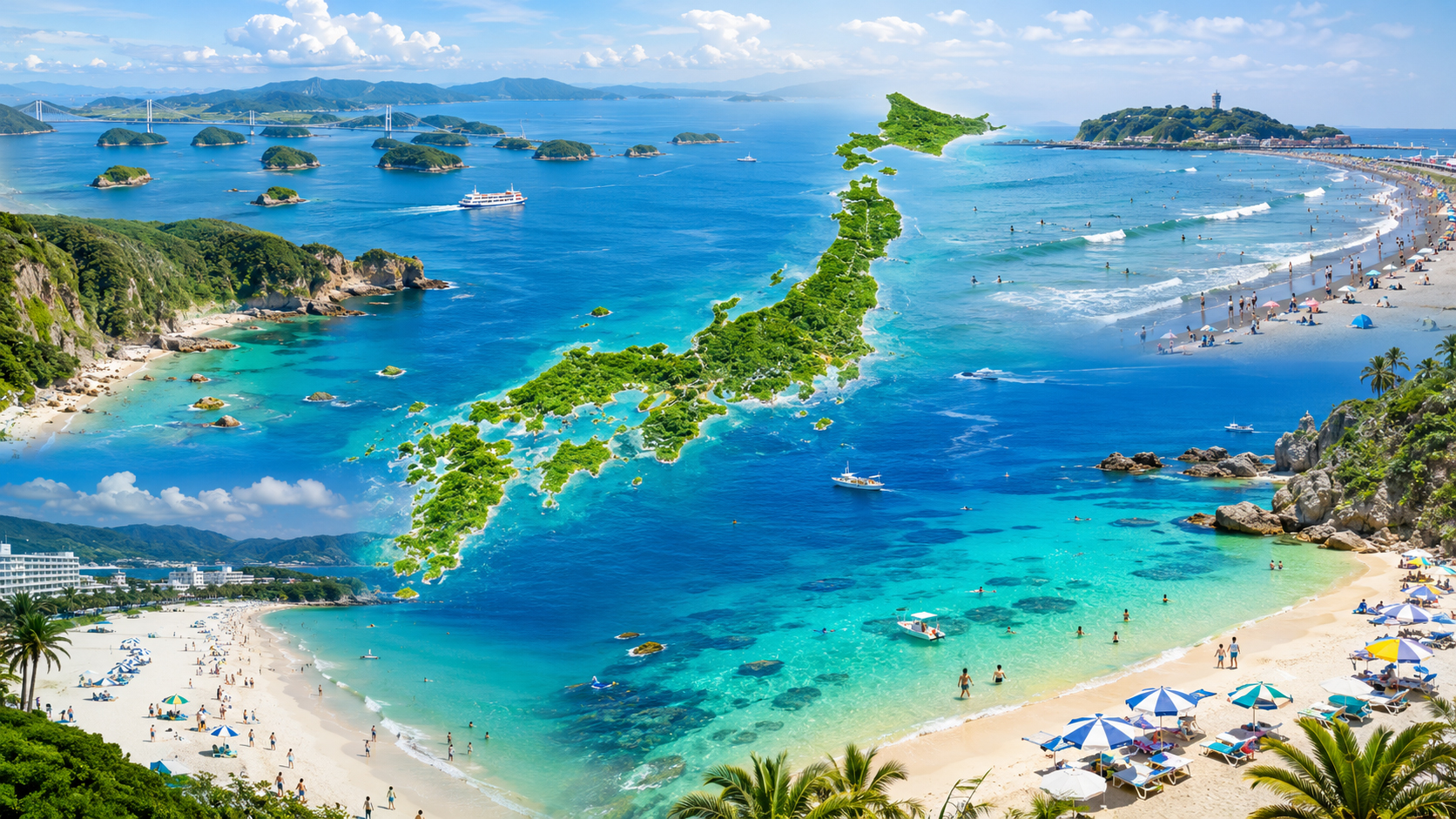
Okinawa’s water is blue enough to cancel your personality
Okinawa has a dangerous talent. It can turn a responsible adult into a person who says, “Maybe I do need a straw hat.” The sea appears outside the taxi window, the phone goes quiet, and the traveler who was answering work emails five minutes ago begins discussing snorkeling masks with the seriousness of a cabinet minister.
That is the cheerful problem with Okinawa. It is Japan’s tropical beach capital, but it is not merely a pretty postcard with better humidity. Okinawa is a chain of islands with coral reefs, former Ryukyu Kingdom trading routes, deep wartime memory, American influence, resort development, island tourism, marine conservation, and a growing question: how do you welcome millions of people to paradise without making paradise sigh loudly into a beach towel?
This story is a beach guide, yes. It is also a reminder that Okinawa’s sea is alive. It is not wallpaper. It is not a free filter. It is habitat, history, livelihood, playground, laboratory, memory, and occasionally the place where a tourist discovers that applying sunscreen after snorkeling is not a strategy.
The Ryukyu sea came before the resort brochure
Long before resort pools, beach umbrellas, and hotel breakfast buffets with heroic omelet stations, the waters around Okinawa connected the Ryukyu Kingdom to China, Japan, Southeast Asia, and beyond. The sea was not a wall. It was a road. Ships carried goods, diplomacy, language, music, ceramics, textiles, foodways, and ideas.
That history still matters. Okinawa’s food is not quite mainland Japanese food. Its music has a different lilt. Its markets smell of seaweed, pork, tropical fruit, bitter melon, and frying oil doing important national service. Its islands have their own rhythms. Visitors arrive for the blue water, but the blue water is only the front door.
The 1975 Okinawa International Ocean Expo also helped shape modern Okinawa as a marine destination. The Ocean Expo Park area, Okinawa Churaumi Aquarium, and Emerald Beach carry forward that mix of research, spectacle, tourism, and ocean education. Okinawa learned to present the sea to the world. The world, naturally, responded by packing swimsuits incorrectly and arriving in large numbers.
Where to go: Okinawa is not one beach
For first-time visitors, the west coast of Okinawa Island is the easiest introduction. Onna, Nago, Motobu, and the surrounding resort belt offer hotels, beaches, marine activities, snorkeling tours, restaurants, and the deeply civilized possibility of returning to your room before your shoulders become tempura.
Onna is the classic resort zone. Cape Maeda and the Blue Cave area are popular for snorkeling and diving. Manza and Seragaki put you near dramatic coastal scenery and resort beaches. Nago and Busena feel a little farther north and calmer. Motobu puts you near Okinawa Churaumi Aquarium, Emerald Beach, Sesoko Island, and the road toward Kouri Island. Cross the bridge to Kouri and someone in the car will make a noise that is not technically a word but means, “This is why we came.”
Southern Okinawa, including Itoman and Toyosaki, is useful for shorter trips or arrival/departure days because it keeps you closer to Naha Airport. If your schedule is tight, this matters. A perfect beach that requires three hours of logistics is not always better than a very good beach that allows lunch, a shower, and a dignified return to the hotel.
Then there are the outer islands: Kerama, Miyako, Ishigaki, Taketomi, Iriomote, and more. Kerama is famous for clear water. Miyako is beloved for white sand, bridges, and cinematic shallows. Ishigaki opens the door to Yaeyama island-hopping. But do not turn an Okinawa trip into a military campaign. Beach joy depends on unused time. Put “do nothing” on the itinerary. It may be the most expensive activity you never paid for.
Coral reefs are underwater cities
One reason Okinawa feels so different from much of mainland Japan is its coral. Official tourism information describes Okinawa as one of the world’s coral-rich regions, with more than 200 of the world’s 800 coral species found in the reefs around the islands. Coral is not rock. It is living animal architecture. Fish, crustaceans, algae, mollusks, and countless small creatures use reefs as shelter, dining room, nursery, and neighborhood.
Snorkeling makes this obvious in the most undignified possible way. You put your face in the water and instantly become a floating tourist pancake hovering above a busy marine city. The fish seem calm. You are not calm. You try to say “wow” underwater and your mask fills with seawater. The reef remains unimpressed.
That wonder needs manners. Do not stand on coral. Do not kick coral. Do not feed fish. Use reef-conscious behavior. Stay inside permitted areas. Wear a life jacket if you are not a confident swimmer, and honestly even if you are. A reef is not a theme park floor. It breaks.
The pressure of popularity
Okinawa’s popularity brings money, jobs, restaurants, hotels, flights, and opportunity. It also brings traffic, crowded beaches, pressure on quiet communities, marine litter, reef damage, and a feeling among some locals that the island is being loved a bit too enthusiastically. Love can be heavy. Ask any beach parking lot in August.
Marine conservation groups in Okinawa have warned that growing marine leisure activity can lead to coral damage from careless use of popular snorkeling and diving sites, as well as litter that harms reefs and marine life. This does not mean visitors should stay away. It means visitors should behave like guests, not conquerors with matching rash guards.
The easiest rules are also the best. Arrive early. Use designated parking. Swim where swimming is allowed. Respect private land and village roads. Take trash away. Buy locally. Book responsible operators. Do not chase turtles. Do not touch coral. Do not assume that because something is beautiful, it exists for your selfie.
Where to stay and eat
The following are real, practical options for a beach-focused Okinawa trip. Details can change, so confirm rates, hours, closures, and reservations directly before you go. The ocean may be flexible. Hotel inventory is not.
StayHalekulani Okinawa
Address: 1967-1 Nakama, Onna-son, Kunigami-gun, Okinawa 904-0401
Phone: +81-98-953-8600 / Website: okinawa.halekulani.com
A polished luxury resort in Onna. Your wallet may whisper, but the sunset will speak louder.
StayANA InterContinental Manza Beach Resort
Address: 2260 Seragaki, Onna-son, Kunigami-gun, Okinawa 904-0493
Phone: 098-966-1211 / Website: anaintercontinental-manza.jp
A classic resort near Cape Manza with beach access, marine activities, and the comforting feeling that someone else has thought about towels.
StayHyatt Regency Seragaki Island Okinawa
Address: 1108 Seragaki, Onna-son, Kunigami-gun, Okinawa 904-0404
Phone: +81-98-960-4321 / Website: hyatt.com
A resort on a small island connected to the main island. It gives you the island feeling without asking you to negotiate a ferry schedule.
StayThe Busena Terrace
Address: 1808 Kise, Nago, Okinawa 905-0026
Phone: +81-(0)980-51-1333 / Website: terrace.co.jp/en/busena
A landmark Nago resort opened in 1997. Elegant, calm, and very good at making “one more night” sound reasonable.
StaySouthern Beach Hotel & Resort Okinawa
Address: 1-6-1 Nishizaki-cho, Itoman City, Okinawa 901-0306
Phone: +81-98-992-7500 / Website: southernbeach-okinawa.com
A useful southern base near Naha Airport for travelers who refuse to waste arrival day indoors.
EatKaisen Ryori Hama no Ie
Address: 2097 Nakadomari, Onna-son, Kunigami-gun, Okinawa 904-0415
Phone: 098-965-0870 / Website: kaisen-hamanoya.jp
A seafood restaurant in Onna. After swimming, humans become very honest about grilled fish.
EatPizza Cafe Kajinhou
Address: 1153-2 Yamazato, Motobu-cho, Kunigami-gun, Okinawa
Phone: 0980-47-5537 / Website: kajinhou.com
Famous hilltop pizza with a view. Not traditional Okinawan cuisine, but neither is your vacation hat, and here we are.
EatKafuu Resort Fuchaku CONDO・HOTEL Restaurants
Address: 246-1 Aza Fuchaku Shirifukuchihara, Onna-son, Kunigami-gun, Okinawa 904-0413
Phone: +81-(0)98-964-7000 / Website: kafuu-okinawa.jp
Convenient Onna resort dining with multiple restaurant options. Confirm access and reservations before wandering in with beach hair and confidence.
EatNaha First Makishi Public Market
Address: 2-10-1 Matsuo, Naha, Okinawa 900-0014
Phone: 098-867-6560 / Website: kosetsu-ichiba.com
The stomach of Naha: seafood, pork, tropical produce, and the kind of market energy that makes a normal lunch feel like field research.
StopKouri Ocean Tower
Address: 538 Kouri, Nakijin-son, Kunigami-gun, Okinawa Prefecture
Phone: 0980-56-1616 / Website: kouri-oceantower.com
A viewpoint and island stop on Kouri Island. The bridge view does a lot of emotional heavy lifting.


Safety, without removing the fun
Okinawa is beautiful, but it is still nature. Venomous marine life, strong sun, changing weather, tides, typhoon swell, and currents deserve attention. Official safety guidance advises swimming in designated areas, wearing marine shoes and protective swimwear, and knowing what to do in an emergency.
Do not underestimate the sun. A sunburn is not a souvenir; it is a small medical event with vacation branding. Bring water, shade, a hat, and patience. Reapply sunscreen. Rest. If traveling with children, make the adults drink water first. Children are surprisingly resilient; dehydrated adults become furniture.
For snorkeling, use a life jacket, avoid going alone, check sea conditions, and cancel if the weather is wrong. The sea will still be there tomorrow. Pride is lighter than foam and far less useful.
The best way to enjoy Okinawa
The secret to Okinawa is not doing everything. Do not stack three beaches, two cafés, a cave tour, an aquarium, a sunset viewpoint, and a market dinner into one day unless your real goal is to become a damp logistics manager.
Pick fewer places. Watch the same water change from morning silver to noon turquoise to evening blue. Eat fish. Buy sanpin tea. Wander a market. Take a nap without apologizing to productivity. Okinawa rewards the traveler who stops performing travel.
On the final day, you will probably buy too many sata andagi doughnuts at the airport. This is normal. Okinawa leaves people with small regrets and large smiles. The sea does that. It makes humans ridiculous, hungry, sun-aware, and briefly wise.
- Okinawa is Japan’s tropical beach capital, but its beaches sit inside a deeper story of Ryukyu history, resort development, and marine ecology.
- Coral reefs are living ecosystems, not props. Do not touch, stand on, or damage them.
- Popularity brings both economic benefit and environmental pressure.
- Good beach travel combines hotel choice, food, transportation, safety, and manners.
- The most luxurious Okinawa itinerary includes time to do absolutely nothing.
Sources and references
This feature is based on official Okinawa tourism information, MATCHA, hotel and restaurant official pages, and published coral conservation resources.
- MATCHA: Okinawa's Best Beaches: 13 Beautiful Spots and How to Get There, updated June 8, 2026
- Visit Okinawa Japan: Okinawa Snorkeling Guide
- Visit Okinawa Japan: Enjoying Okinawa Safely
- Marine Biodiversity Fund Okinawa: Sustainable Marine Leisure
- Halekulani Okinawa
- ANA InterContinental Manza Beach Resort
- Hyatt Regency Seragaki Island Okinawa
- The Busena Terrace
- Southern Beach Hotel & Resort Okinawa
- 海鮮料理 浜の家
- Pizza Cafe Kajinhou
- Kafuu Resort Fuchaku Condo・Hotel restaurants
- Kouri Ocean Tower