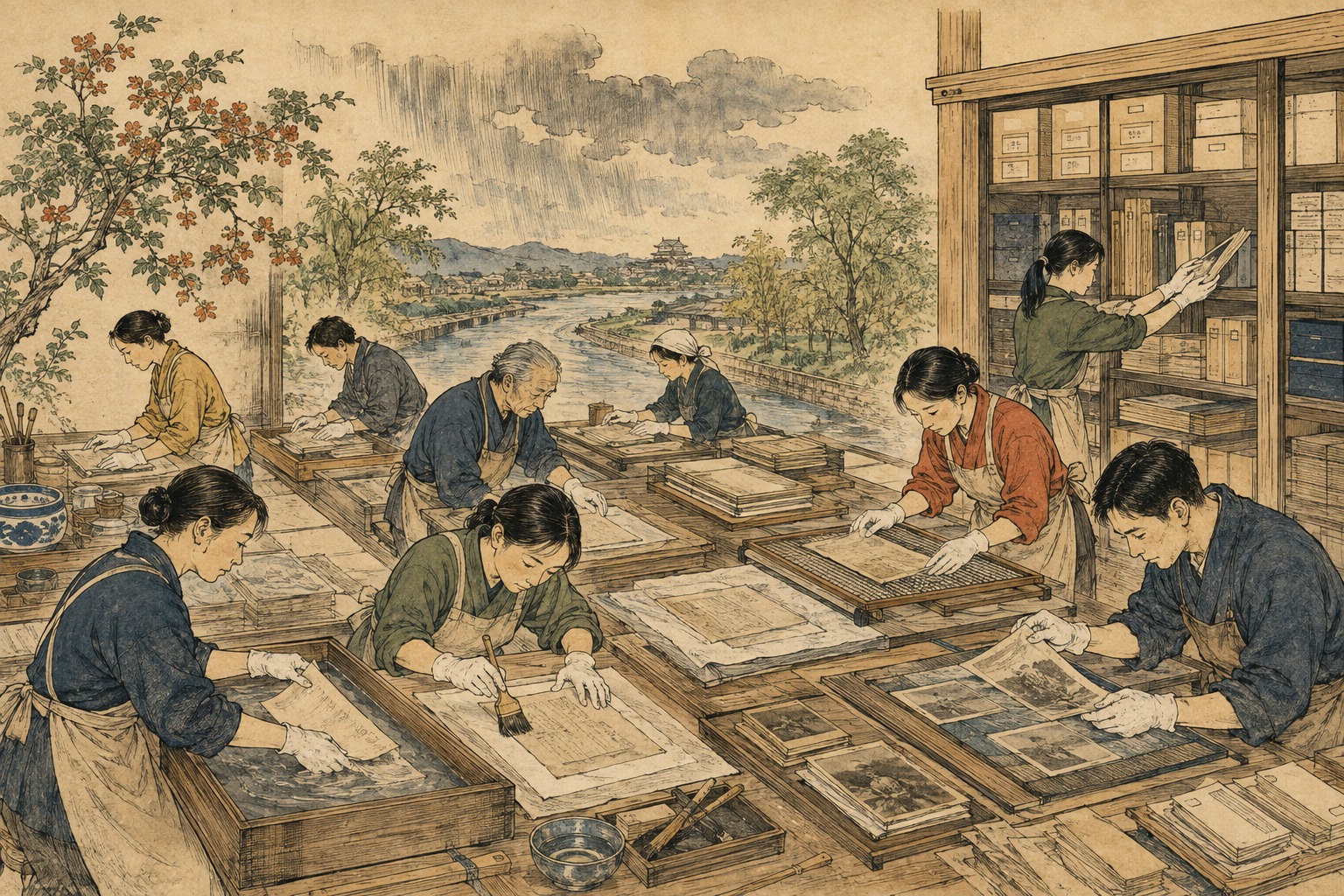
After a flood, the contents of a house are forced into two categories: what can be kept and what must go. Mud-filled tatami, broken furniture and dead appliances have to move outside before a family can recover a place to sleep. In that necessary speed, a stained account book or a bundle of handwriting no one can immediately read can look like refuse.
In July 2018, a volunteer shoveling sediment from a damaged house in Kita Ward, Okayama City, interrupted that sorting. The volunteer noticed the old documents and alerted Okayama Historical Materials Network—Okayama Shiryo Net. Katsunori Imazu, director of Okayama University’s Research Institute for the Dynamics of Civilizations and head of the network, later stressed that the alert came from a mud-removal volunteer. The university release does not name that person. Yet the future of 278 documents changed at that moment.
The papers belonged to the Muto family, soy-sauce brewers in Kanagawa Village, Mitsu District. They include military mail, production and business books from the brewery, and education records. Their dates extend from the Meiji era into the postwar period. They were not a designated national treasure or the state papers of a famous politician. That is precisely their importance: they preserve the outlines of people who worked, extended credit, studied and waited for mail from a war.
July 2018: When paper becomes disaster waste
The Japan Meteorological Agency’s “Heavy Rain Event of July 2018” lasted from June 28 through July 8, bringing record rain across a wide area, principally in western Japan. An extraordinary supply of moisture fed a stationary seasonal front. The agency’s national toll, drawn from the fire service white paper, lists 224 dead, eight missing and 6,758 homes destroyed. Okayama Prefecture’s review recorded 71 dead or missing in the prefecture, 9,300 homes destroyed or damaged, and 7,008 flooded above or below floor level.
The deep inundation of Mabi in Kurashiki became the disaster’s defining image, but damage did not stop at one district. Okayama City’s resilience plan says more than 6,000 buildings in the city were damaged by flooding and landslides. The Muto archive was found in Kita Ward. The university has not disclosed which watercourse flooded the property or the exact depth and duration of inundation. Mabi’s familiar images should not be used to fill an unknown geography.
In the first hours and days, the priorities are life, medicine, food, shelter, roads, power and water. Privately held documents are often absent from the registers that tell officials where designated cultural properties are kept. Owners may not know what is in an inherited stack. Unless someone at the clearing site can think, “This might be a community record,” its disappearance will never enter the disaster statistics.
The 48-hour clock: Clean, dry—and do not scramble
Wet paper runs on another clock. The National Diet Library warns that the risk of mold rises after roughly 48 hours and recommends rapid drying. For a small incident, surface water may be blotted, absorbent sheets inserted and changed, and air circulated. If a large quantity cannot be dried in time, temporary freezing can arrest mold growth until treatment becomes possible. Flood mud may contain microorganisms, oils, sand and other contaminants, making personal protection and isolation part of the response.
Those are general emergency principles, not a treatment report for the Muto papers. Okayama University confirms that volunteers worked with the network to clean and dry them. It has not published which items were washed, the water quality used, the drying technique, or how adhered leaves were opened. This article does not retrofit a generic manual onto an undocumented item-by-item process.
Keeping records together can matter as much as getting them dry. Their shelf, box and bundle; the order of pages; the bond between an envelope and its contents—each carries information. A number on one sheet may say little. Manufacturing books, credit ledgers, receipts and family letters preserved as one group can connect production, sales, household finance and personal relationships. If cleaning destroys those associations, the words survive but part of the evidence does not.
Conservation does not mean making an old record look new. It means stopping active damage, restoring safe access where possible, documenting intervention and preventing the next handling from causing another loss. Missing words are not cosmetically invented. A tide line or distortion can itself become evidence of what the archive experienced in 2018.
| Stage | Confirmed for the Muto papers | Information generally at risk |
|---|---|---|
| Discovery | A general mud-removal volunteer noticed the papers and contacted the network | Original room, shelf, box and bundle |
| First aid | The network and volunteers cleaned and dried the documents | Wetness, contamination, mold, before-and-after condition |
| Arrangement | Kazufumi Uemura and Masanobu Higashino published a catalogue and introduction in 2020 | Title, date, creator, recipient, physical form and original grouping |
| Imaging and study | Photography and the research phase concluded at the end of 2025 | Correct link between item number, image file and transcription |
| Donation and access | The owner donated the group to the Central Library in June 2026 | Provenance, access terms, storage and continued cataloguing |
From 281 to 278: A catalogue does more than count
In March 2020, Uemura and Higashino published “The List and Introduction of Mutou Family Documents from Kanagawa Village, Mitsu District, Okayama Province” in volume 49 of Okayama University’s Journal of Humanities and Social Sciences. The network’s April announcement described “all 281 items.” The university’s 2026 release and the final donation, however, count 278.
A difference of three does not necessarily mean three losses. Archival counts can change when an envelope and several enclosed sheets are treated as one unit rather than several; when inserts receive subordinate numbers; or when further arrangement changes the attribution of an item. But the official record reviewed here does not explain this particular difference. It would be equally unwarranted to claim that three items were consolidated or that three disappeared.
Cataloguing is not simply transcription. Who created the record, for whom, when and why? Which book precedes it? Was it enclosed with another paper? Which family activity generated it? Archivists assign working titles, estimate dates, record form and dimensions, and make relationships searchable. A catalogue changes records from things that merely exist into evidence that can be found, compared and challenged.
Inside the brewery books: Reading an economy, not a flavor
The Muto family brewed soy sauce in Kanagawa. The records include manufacturing books that describe ingredients and batches, and accounts receivable ledgers that document sales. In conventional honjozo brewing today, steamed soybeans and roasted wheat are inoculated with koji mold, combined with brine to form moromi, and fermented and matured over many months. In a business where inputs are purchased long before finished sauce is sold, books connect biological time to cash flow.
A manufacturing ledger can be more than a recipe. If it records raw materials and quantities, season, brewing vessel or batch and output, it can support questions about the scale of the brewery, its technology and response to price changes. A sales-on-credit ledger records goods supplied before payment. Customer, place, quantity and settlement dates can reveal a trading radius and a web of local trust.
The summaries released so far do not publish individual figures, customer names, brands or a precise operating chronology. Those are research possibilities, not completed findings about the Muto business. Good local economic history does not decorate gaps with plausible claims. It compares one surviving entry with another, and then with prices, maps, tax records and other businesses of the same period.
Japan’s industrialization looks incomplete when told only through large corporate histories. Food on ordinary tables came from breweries and shops distributed across towns and villages. Soybeans, wheat, salt, fuel, vats, transport and credit all converged behind one bottle. The Muto accounts may allow that chain to be drawn from Kanagawa outward.
From a war zone to Kanagawa: The two distances in military mail
A second core group is military mail sent by a soldier serving in the 1904–05 Russo-Japanese War. The university says the letters describe the battlefield and military service. The public summary does not establish the writer’s unit, recipient or participation in a particular battle.
State papers record declaration, mobilization, operations and diplomacy from above. A household letter changes the scale. Military security restricted what a soldier could write, and a writer may have tried to reassure people at home. Even so, handwriting, address, date, postmark, gaps on the page and recurring subjects measure the distance between front and family. They return a mobilized soldier to his place as someone’s son, husband or brother.
Military letters and brewery accounts matter more because they survived together. Rather than sealing war into diplomatic history and credit sales into business history, researchers can ask how an absence affected work and household decisions, or how a village understood an overseas war. Close reading may or may not answer those questions. Preserving the group keeps them askable.
Education records—and the recovery after an earlier age of flood
The 2020 introduction divides the collection into military mail, soy-sauce business records and education records. Education receives less attention in the 2026 donation announcement, but remains part of the collection. School and learning records can illuminate how literacy and numeracy entered a family business and how a rural community encountered the institutions of the modern state.
The catalogue announcement identifies another remarkable feature: documents from the Meiji 30s and 40s, the period of recovery after devastating floods struck Okayama in the Meiji 20s. Major floods came in 1892 and 1893. Okayama City’s disaster history records 423 deaths across the prefecture in the October 1893 storm and flood, 12,920 homes swept away, destroyed or partly destroyed, and 50,209 flooded.
The times overlap. Papers nearly erased by water in 2018 preserve the era in which people rebuilt production, trade and education after the floods of the 1890s. That does not establish that the Muto papers describe the earlier disaster itself in detail. It does mean they preserve the everyday life of recovery—evidence for treating reconstruction not only as levees and budgets, but as the restoration of work, credit and learning.
1995 and the invention of the shiryo net
The institutional story begins with the Great Hanshin-Awaji Earthquake of January 1995. As homes collapsed and reconstruction advanced, historians, heritage workers and citizens saw privately held records at risk. They organized the Historical Materials Network in Kobe. Its evolving model went beyond waiting for formal requests: patrol affected areas, learn where collections are, speak with owners, and mobilize emergency care.
Other regional shiryo nets followed earthquakes and floods across Japan. By the mid-2010s, Kobe University researchers counted more than 20. These networks do not replace national or municipal cultural-property rescue. They extend attention to material that designation systems often miss: family documents, shop accounts, neighborhood-association records, photographs and ordinary objects.
Okayama Historical Materials Network was established in 2005. It emphasized preparedness—locating materials and building relationships before a disaster—and the 2018 floods became its first full-scale response. The group rescued about 1,700 items from seven locations, then continued cleaning, drying, study and return. After the Muto donation, the university said only one group of roughly 350 items remained to complete.
Those numbers explain why eight years cannot be judged simply as delay. Stabilizing a mass of wet paper is only the opening stage. Ownership and wishes must be confirmed; documents numbered, read, imaged and catalogued; and a sustainable destination found. Much of the labor is performed by volunteers with regular jobs. A flood happens overnight. The recovery of memory works on a scale of years.
1892–93 Catastrophic floods strike Okayama; the collection includes records from the subsequent Meiji recovery era
1904–05 Russo-Japanese War military mail reaches the Muto household
1995 The Kobe Historical Materials Network emerges after the Great Hanshin-Awaji Earthquake
2005 Okayama Historical Materials Network is established
July 2018 A mud-removal volunteer’s alert leads to rescue of the Muto archive
March–April 2020 Catalogue and scholarly introduction appear; the announcement counts 281 items
End of 2025 Photography and research are completed
June 23, 2026 The owner donates 278 items to Okayama City Central Library
August 2, 2026 A public report at the prefectural archives presents the rescue and local history
Why keep an original after it has been photographed?
Completing photography at the end of 2025 was a major step. Images can reduce repeated opening of fragile originals, magnify writing, let distant researchers compare documents and support collaborative transcription. The National Diet Library likewise supplies digital surrogates to expand access while protecting originals from handling.
But an image is a surrogate, not the original. Paper thickness, binding, verso, watermark, raised ink, erasure, fold, the pairing of envelope and enclosure, and page order cannot always be captured in a single frame. Poor resolution or color management can close off future analysis. Digital files also require redundant storage, checksums, migration, metadata and access controls.
Preservation is therefore doubled, not replaced. The original is stored under stable conditions while routine use shifts toward good images. The image remains linked to the physical identifier and its capture history. Digitization is not an exit that permits paper to be discarded; it is an entrance that lets use increase while the paper rests.
When family papers become public memory
On June 23, the owner donated the 278 documents to Okayama City Central Library. Continued private custody was possible, but rebuilding, inheritance, vacant houses and future disasters can destabilize a family archive. Donation transfers ownership and long-term responsibility into a public institution.
The Central Library already collects and interprets local flood history. In 2024, its “Records and Lessons of Floods” exhibition showed maps of breached embankments and inundation, village damage reports, and materials on the 1892 and 1934 disasters. The Muto papers add another provenance: not merely records about a community, but records damaged and rescued by that community.
Donation does not make every item instantly available online. Accession checking, preservation, catalogue integration and access review may come first. Okayama University said the transfer was expected to let many citizens see and use the material, but by this article’s cutoff the library had not announced an opening date or the extent of digital access. Prospective users should contact the library before visiting.
Public custody must also preserve the family context. If every sheet is isolated as “military mail” or “business account,” the relation among work, schooling and war weakens. The family name is not simply an ownership label. Provenance is the key that keeps the documents readable together.
Do not turn “emotional recovery” into a comforting ending
Okayama University says rescued records can support kokoro no fukko—often translated as emotional, psychological or spiritual recovery—by revealing histories that exist only in the affected town. The phrase does not mean a manuscript substitutes for a home or income. It means that after material reconstruction, people still need the ability to know what existed there and how earlier residents lived.
Volunteer generosity alone cannot secure the next archive. Storage, drying space, protective equipment, transport, professional staff and digital preservation cost money. Owners need a known contact before a storm. Municipal disaster-waste planning can provide a temporary route for suspected cultural material. Libraries, museums, archives, universities, fire services and volunteer centers need a relationship before the emergency.
Families can also prepare. Make a simple inventory of old papers and photographs, and tell more than one person where they are. Store them above floor level; do not assume an airtight plastic box solves humidity. Keep a representative image set and inventory elsewhere. After a disaster, do not force adhered sheets apart. Ask a regional materials network, library, archive or museum before discarding. Flood mud and mold can harm health, so long handling without protection is unsafe.
- Put human safety and building stability first; do not re-enter an unsafe site for records.
- Photograph the discovery location and arrangement, and do not mix materials from different owners.
- Do not rub wet paper or force apart pages that have adhered.
- Assume mold and contaminated mud; use gloves, respiratory protection and ventilation.
- For a large quantity, contact a regional historical-materials network, library, archive or museum promptly rather than improvising a wash.
- Freezing can be useful but is not appropriate for every medium; seek advice on selection and packaging.
The discoverer whose name is not in the record
There is no single, tidy hero in the Muto archive. The owner kept the papers. A mud-removal volunteer noticed them. The network responded. Citizens repeated the slow work of cleaning and drying. Researchers read and catalogued. Someone linked every image to a number. The library accepted custody. Remove any one step and 278 records might not survive in their present form.
Age does not automatically make paper useful. A record becomes knowledge when it is kept in context, described, read and tested against other evidence. The ingredients in the manufacturing book became soy sauce long ago; the debts in the sales ledger were settled or abandoned; the soldier and his correspondents are gone. Yet the papers still permit questions about how a community worked, trusted, learned and experienced war.
In July 2018, an unnamed person paused in the mud and thought that these papers might not belong in the waste pile. In June 2026, that judgment arrived at a city library. Protecting history is rarely one heroic recovery. It is the decision of one person handed to the next, carried for eight years, until private memory becomes a public trust.
- Okayama University, “Old documents rescued from the western Japan floods donated to Okayama City” (July 31, 2026; Japanese)
- Okayama University detailed press release (rescue, treatment, research, donation and wider 2018 operation; Japanese PDF)
- Okayama Historical Materials Network, Muto catalogue announcement (April 17, 2020; count, categories and earlier flood-recovery records; Japanese)
- Kazufumi Uemura and Masanobu Higashino, “The List and Introduction of Mutou Family Documents” (2020, vol. 49, pp. 37–55; Japanese)
- Japan Meteorological Agency, Heavy Rain Event of July 2018 (meteorology and national losses; Japanese)
- Okayama Prefecture, review of the July 2018 flood response (prefectural losses; Japanese PDF)
- National Diet Library, disaster response for collections (wet paper, mold risk, drying and freezing; Japanese)
- National Diet Library, “To Save Water-Damaged Materials” (emergency care and follow-up; Japanese)
- Kobe University, regional historical-materials networks (development after the 1995 earthquake; Japanese)
- Okayama City Central Library, “Records and Lessons of Floods” (the library’s interpretation of local flood history; Japanese)
- National Diet Library, digitization of collections (balancing original preservation and access; Japanese)
- Japan Soy Sauce Association, manufacturing process (general context for conventional brewing; Japanese)
Editor’s note: This article cross-checked public materials from the university, volunteer network, government agencies, the National Diet Library and the scholarly catalogue. Japan.co.jp did not independently interview the owner, rescuers, researchers or library. It does not infer unreleased document contents, item-level treatments or access dates. It identifies the 281/278 count difference and leaves its cause unresolved.