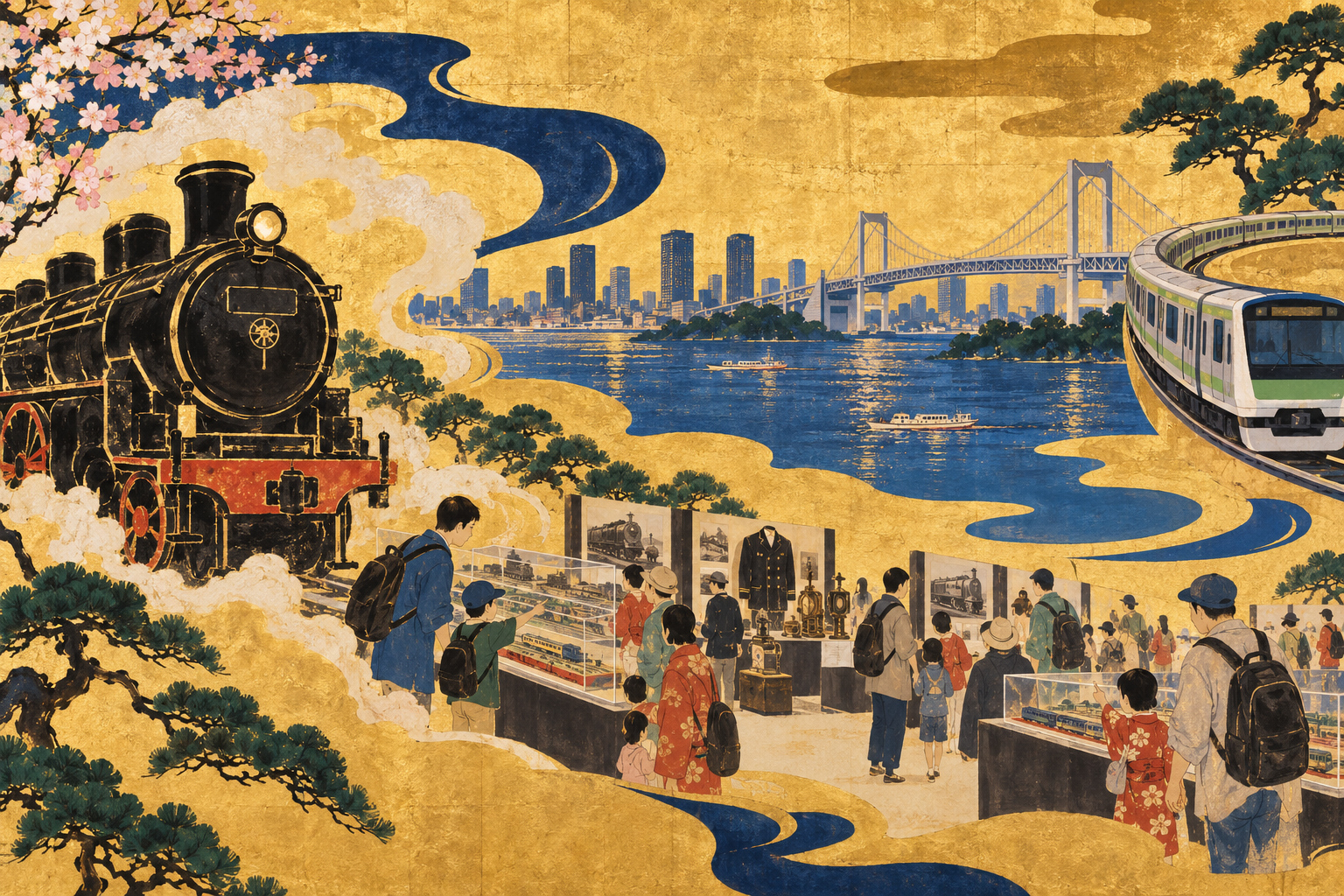
A railway usually enters our lives as a practical question: which platform, what time, where to change? A festival offers time to ask something less hurried. Beyond the train we recognise, what places and people does this network connect?
The 33rd Railway Festival is scheduled for October 10–11 in Tokyo’s waterfront district. The Ministry of Land, Infrastructure, Transport and Tourism names the East Promenade’s Ishi to Hikari and Hana plazas as the venue, with opening hours of 10 a.m.–5 p.m. both days. The Railway Day Executive Committee organises the event. [1]
For families and enthusiasts, the appeal can begin with a familiar train or an unfamiliar company name. Its wider interest lies in the opportunity to connect railway enthusiasm with the communities on the other end of the line.
A network with many different identities
The ministry’s current event page lists JR companies alongside municipal transport, private operators and regional railways. It says exhibitors and the layout may change. [1]
That variety offers a useful starting point. A commuter route and a regional line belong to the same broad world of rail travel, but questions about their passengers and purposes can lead in different directions. Looking beyond a company emblem means asking where its services go and what journeys they make possible.
Institutional history matters alongside engineering. The division and privatisation of Japanese National Railways took place in April 1987. Understanding the railways today therefore involves changes in responsibility and organisation, as well as changes in trains. [5]
That reform is not an explanation of every railway’s origins. For a visitor, the useful lesson is to resist treating the entire system as one organisation. A name encountered at the festival can become the starting point for learning how a particular route fits into a particular place.
Why Japan marks October 14
Railway Day, established in 1994, commemorates the October 14, 1872 opening of Japan’s first railway between Shimbashi and Yokohama. The ministry describes its purpose as deepening public understanding and interest through events involving operators, related organisations and government. [1]
The historical starting point is still interpretable in Shiodome. Old Shimbashi Station’s railway history exhibition occupies a building recreating the exterior of the station at the time of the railway’s opening. It is a reconstruction, rather than a surviving original station building. [4]
That distinction suggests a rewarding way to approach railway history. There is the history of what was built, and there is the subsequent work of preserving, reconstructing and explaining it. Both influence what a visitor can see today.
A chronology of machines tells one part of the story. A history of stations asks other questions: who gathered there, why they travelled, and how the place fitted into a town. The October celebration can accommodate both kinds of curiosity.
The station as a record of everyday life
A separate exhibition at Old Shimbashi Station provides a contemporary example. Running July 28–November 23, “昭和100年記念 昭和の駅風景” looks back at station scenes from the Shōwa period. It draws on prize-winning photographs from public competitions held by the former Transportation Museum between 1951 and 1972, presenting selected station images with testimony from the period. This is a separate cultural programme, not a festival activity. [4]
Such photographs invite viewers to look beyond identifying a locomotive. The positions of people, their belongings and their use of station space can prompt different readings of the same image. Enthusiasm for railways can also leave material through which later generations examine a community’s past.
Families need not begin with technical vocabulary. Asking about a first independent train journey or a station used for school can open a conversation across generations. Memory provides another route into the subject.
The waterfront has its own transport history
Symbol Promenade Park, which contains the festival venue, links the Aomi, Ariake and Daiba areas with pedestrian routes. It opened on April 1, 1996. The public space is part of the story: a place designed to connect different parts of the waterfront now provides a setting for a railway gathering. [2]
Yurikamome’s official chronology dates its opening to November 1995 and the extension between Ariake and Toyosu to March 2006. Travelling to the area can therefore become a way of thinking about a more recent phase of Tokyo’s transport development. [6]
For navigation, the specific plazas matter more than the broad label “Odaiba.” The park operator identifies Kokusai-tenjijo on the Rinkai Line as close to both plazas, with access also available from Ariake on Yurikamome. Its guide puts Ishi to Hikari plaza about five minutes on foot from Tokyo Big Sight station. These are ordinary park-access estimates, not forecasts of festival-day pedestrian conditions. [3]
Looking beyond the visitor’s railway
The community dimension becomes clearer when tourism and everyday transport are considered together. MLIT describes regional railways as infrastructure for commuting, education and local economic activity. Its published figures for fiscal 2023 show 80 of 96 operators in the stated group recording ordinary losses in their railway or tramway businesses. Those are dated sector figures, not a financial assessment of the festival’s exhibitors. [7]
The figures give context without deciding the future of any individual route. A visitor’s pleasure in a journey and a resident’s need to reach school or work are different questions, both worth asking. The attractive train is one element in a larger transport relationship.
Japan.co.jp suggests following up an encounter with a regional railway by opening a map. What lies beyond its stations? Which journeys might local people need to make? This turns a company name into a geographical question and a possible future visit.
It also keeps the scale of the festival in perspective. A weekend of public interest cannot settle questions about long-term services. It can give someone a reason to learn more about a place previously outside their attention.
Planning a visit
| Dates and hours | October 10–11, 2026; 10 a.m.–5 p.m. each day. |
|---|---|
| Venue | Odaiba East Promenade: Ishi to Hikari plaza and Hana plaza. |
| Organiser | Railway Day Executive Committee. |
| Updates | Official MLIT festival page. |
The park website provides a barrier-free map. Visitors who need particular access arrangements should distinguish the park’s facilities from the temporary event layout, and check the latest organiser and railway information before travelling. Allowing time to reach the correct plaza is more useful than simply choosing a station with “Odaiba” in its name. [2][3]
Japan.co.jp analysis: a reason to look further down the line
The most lasting result of a railway festival may be modest: remembering a new operator, finding its route on a map, or deciding to visit a town. These are small changes in attention, but they connect an enjoyable day out with places beyond the venue.
Specialist knowledge can enrich that experience without being a condition of entry into the subject. Someone interested in engineering, someone remembering a childhood station and someone planning a family trip can arrive at different questions about the same railway.
The opportunity this October is to let a familiar fascination lead somewhere unfamiliar. A train worth knowing about can also be a reason to discover the community it serves.
- MLIT, Railway Day and the 33rd Railway Festival
- Tokyo Port Terminal Corporation, Symbol Promenade Park
- Tokyo Port Terminal Corporation, access to the park’s individual plazas
- East Japan Railway Culture Foundation, Old Shimbashi Station and its 2026 station-photography exhibition
- MLIT, Japanese National Railways reform
- Yurikamome, official company chronology
- MLIT, regional railway policy; statistics refer to the years specified