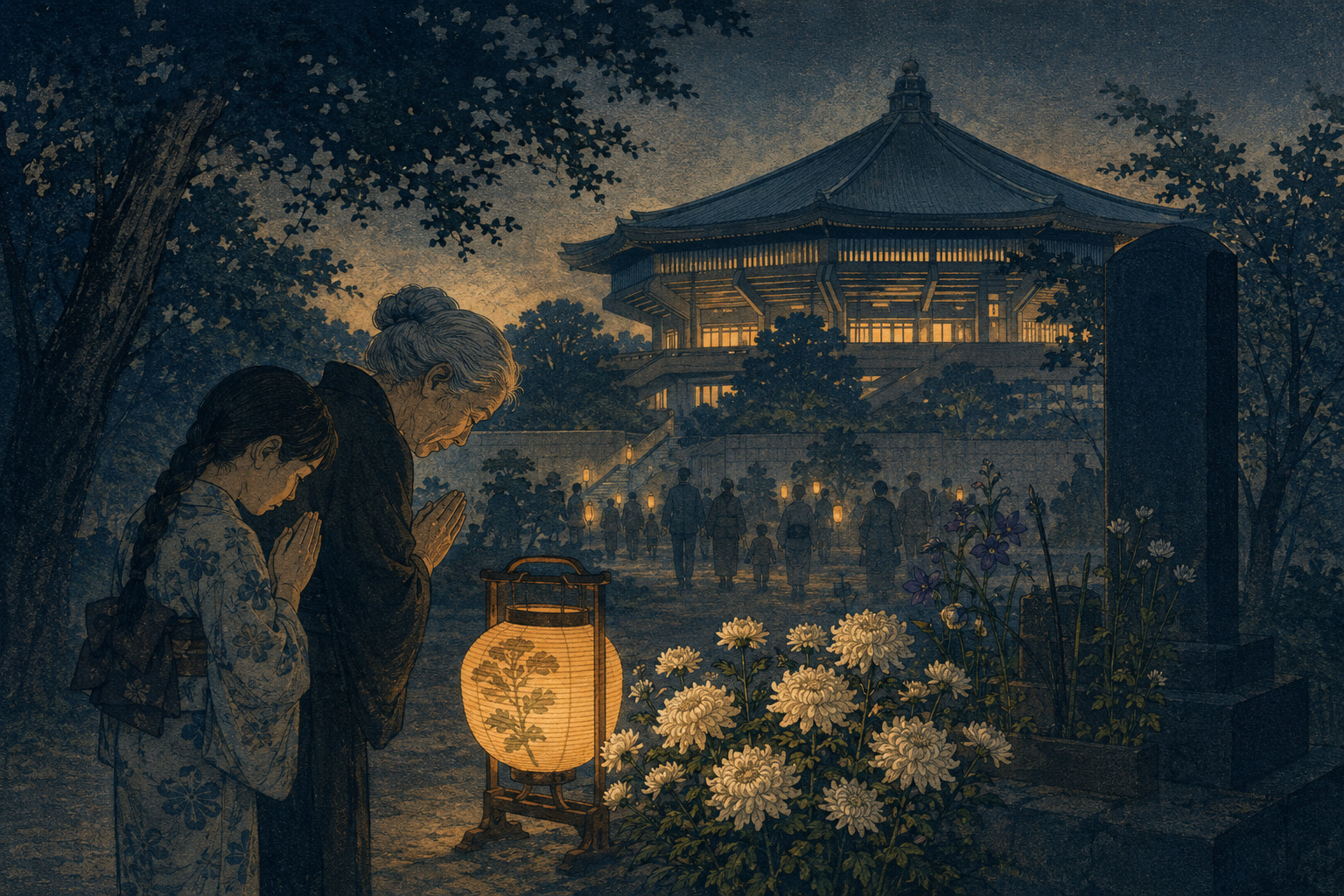
A few minutes before noon, one household may be quieting itself in front of a Buddhist altar. Incense drifts past a photograph. Fruit, rice or a favorite sweet has been set down for someone who is absent and, during Obon, imagined to be near. In another room, a television shows the white-draped memorial altar inside the Nippon Budokan. Then the clock reaches twelve. For one minute, a country is asked to stop.
The silence belongs to two different kinds of return. August 15 falls in the middle of the month-late Obon observed across much of Japan, when families welcome ancestors, tend graves and go home. It is also the state-designated Day for Mourning the War Dead and Praying for Peace, marking 81 years since the emperor’s recorded voice told the Japanese public that the war was ending.
The overlap can feel inevitable, as if the national ceremony were an extension of Obon. Historically, it was not designed that way. Obon’s midsummer place is ancient. August 15, 1945, was determined by the last, chaotic decisions of a collapsing war. Yet the coincidence has acquired enormous emotional force. The old family season gave the postwar date a language of homecoming, while war had left an unbearable number of people who could never come home.
One Date, Three Historical Moments
Calling August 15 simply “the anniversary of Japan’s surrender” is understandable, but it compresses three separate moments. The distinction is more than pedantry. It shows how public memory chooses a date.
On August 14, 1945, after an Imperial Conference, Japan decided to accept the Potsdam Declaration. An Imperial Rescript on the Termination of the War was completed and promulgated. That night, Emperor Hirohito recorded its text. At noon on August 15, the recording was broadcast by radio. Many listeners could barely understand its formal language or the poor sound, but the meaning became clear: the state was ordering the war to stop.
The legal and military process was not finished. The formal Instrument of Surrender was signed on September 2 aboard the USS Missouri in Tokyo Bay. Foreign Minister Mamoru Shigemitsu signed on behalf of the emperor and government; General Yoshijiro Umezu signed for Imperial General Headquarters. Allied representatives then added their signatures.
Japan remembers August 15 because it was the day the war’s ending entered ordinary life through the radio. The country’s official name for the date is not “Surrender Day.” Since a 1982 Cabinet decision, it has been the Day for Mourning the War Dead and Praying for Peace. The phrase directs attention away from a diplomatic instrument and toward the dead, the bereaved and a future without another war.
August 14, 1945 Japan decides to accept the Potsdam Declaration; the rescript is completed and recorded that night.
Noon, August 15 The imperial broadcast tells the Japanese public that the war is ending.
September 2 Japan signs the Instrument of Surrender aboard the USS Missouri.
August 15, 1963 The first National Memorial Ceremony for the War Dead is held at Hibiya Public Hall.
April 13, 1982 A Cabinet decision formally designates August 15 as the day of mourning and prayer for peace.
August 15, 2026 Japan marks 81 years since the broadcast, in the middle of August Obon.
A Document Made Under Impossible Pressure
The original war-termination rescript survives in the National Archives of Japan. It does not look like an abstract endpoint. The paper bears the physical evidence of haste: words scraped away, text inserted with brackets, ministers’ signatures crowded beneath a decision made as the state ran out of time.
The archive explains that drafting began around August 10 and continued through a long Cabinet meeting on the 14th. A clean copy was being prepared before the language was final. There was no time to start again, so corrections were made directly to the formal document. The emperor recorded it late that night. The recording itself survived an attempted coup by officers who sought to prevent the broadcast.
For August 2026, that same original is on special display at the National Archives’ Tokyo building in Kitanomaru Park, only a short walk from the Budokan. From August 12 through 16, the displayed portion shows the imperial signature and seal. A visitor can therefore move between the arena where the state performs its annual remembrance and the fragile object that explains why the ceremony falls on this day.
The document also reveals the limits of national memory. The broadcast spoke to Japanese subjects through the voice of the emperor and described the decision in the state’s own terms. It did not provide a full account of the invasion of China, colonial rule in Korea and elsewhere, the treatment of prisoners and forced laborers, or the vast suffering Japan’s war created across Asia and the Pacific. The end of fighting was shared; the experience of August 15 was not.
Obon Was Already Waiting
Long before 1945, the fifteenth day of the seventh lunar month was associated with the Buddhist Ullambana observance and with rites for the dead. In Japan, temple practice, ancestral belief and local custom developed over centuries into Obon: welcoming fires, lanterns, graveside visits, offerings, Bon dances and sending rites.
After Japan adopted the solar calendar in 1873, many communities moved the observance one month later to preserve its late-summer season. The result was month-late Bon, generally August 13 through 16. The 15th became a central day when ancestors were understood to be present and family obligations were active.
Nothing in the historical record suggests that the final wartime decisions were scheduled to exploit this ritual calendar. The coincidence was contingent. But in the decades after 1945, it joined two emotional geographies: the household, where particular relatives are remembered by name, and the nation, which mourns millions in a collective category.
That joining is especially powerful because Japanese war deaths were so often deaths far from the family grave. Soldiers, civilian employees and others died across islands, jungles, seas and detention sites. Civilians died in air raids at home and in the collapse of the empire abroad. Some families received ashes; some received a box containing a fragment, a notice or nothing identifiable at all. Obon promised return in ritual at the exact historical moment when war had made physical return impossible.
How a National Ritual Was Built
The present ceremony was not simply inherited from wartime Japan. It was created in the postwar constitutional order. On May 14, 1963, the Cabinet approved a National Memorial Ceremony for all the war dead, to be held that August 15 at Hibiya Public Hall in the presence of the Emperor and Empress.
The decision defined the scope broadly within Japan’s official category. It included military personnel, civilian employees and quasi-members of the military, civilians who died violently in former overseas territories, and victims of war damage within Japan. It also made a fundamental institutional choice: the ceremony would include no religious rite.
That sentence creates a bright line between Budokan and Obon. A family may chant a sutra, burn incense or speak of ancestral spirits according to Buddhist, Shinto, Christian, local or personal practice. The state ceremony is intentionally nonreligious. It uses civic forms—anthem, addresses, silence and flowers—to make national mourning possible without prescribing a faith.
The annual ceremony continued, and the 1982 Cabinet decision gave August 15 its present official designation. Today, the familiar order begins shortly before noon. Their Majesties attend; the prime minister delivers an address; the time signal marks a minute of silence; the emperor speaks; representatives offer memorial words and flowers. The Ministry of Health, Labour and Welfare asks people across Japan to observe the silence wherever they are.
| Household Obon | National ceremony |
|---|---|
| Family and community practice, with dates and customs that vary | Government-sponsored ceremony held annually on August 15 |
| May include Buddhist and other religious or spiritual rites | Explicitly nonreligious under the 1963 Cabinet decision |
| Remembers named relatives and ancestors through intimate objects and places | Commemorates Japan’s approximately 3.1 million war dead as a national category |
| Welcomes the ancestors and then sends them away | Uses silence, public words and flowers to renew a pledge for peace |
The Number 3.1 Million—and What It Contains
The government describes the ceremony as mourning approximately 3.1 million Japanese war dead. The 1963 definition shows that this is not simply a roll of soldiers killed in combat. It gathers military and civilian deaths, deaths overseas and deaths from air raids and other war damage at home.
A number that large can create scale while erasing texture. Inside it were children killed under burning cities, sailors whose ships disappeared, nurses and civilian employees, settlers caught in the collapse of Japanese rule, conscripts, and people whose last known location was only a place name on a military notice. The public ceremony cannot tell all those lives. Families, local archives, museums, testimony and graves carry the detail that the state’s number cannot.
But the national category has another boundary: it counts Japan’s dead. A truthful prayer for peace must also face the deaths and suffering caused by Japan’s colonial rule and aggression. For Koreans, August 15 is Liberation Day, celebrating release from Japanese colonial rule. Across China, Southeast Asia and the Pacific, the date sits within memories of occupation, mass violence, forced labor, hunger and resistance.
Japan’s own postwar government has formally acknowledged that history. In his August 15, 1995 statement, Prime Minister Tomiichi Murayama referred to colonial rule and aggression, “tremendous damage and suffering,” deep remorse and a heartfelt apology. That record makes an ethical point: honoring Japanese bereavement and acknowledging victims beyond Japan are not rival acts. A national memorial that speaks of peace becomes credible only when grief does not stop at the national border.
- August 14 was the decision to accept the Potsdam Declaration; August 15 was the broadcast; September 2 was the formal signing.
- The national ceremony coincides with Obon, but it is a secular state observance, not a government Obon rite.
- The official 3.1 million figure covers Japan’s war dead, including civilians; it is not a count of all victims of the Asia-Pacific War.
- The 2026 ceremony had not taken place when this edition was prepared; attendance and remarks must not be reported as completed events.
The Dead Who Have Not Returned
The language of homecoming becomes painfully literal in the government’s remains-recovery program. The Ministry of Health, Labour and Welfare estimates that about 2.4 million Japanese died overseas. As of March 31, 2026, about 1.28 million sets of remains had been recovered. Approximately 1.12 million remained unrecovered.
The ministry estimates that about 300,000 of those unrecovered dead were lost at sea. Another 230,000 are in places where collection is difficult because of the circumstances of foreign governments. That leaves as many as 590,000 whose recovery remains the continuing focus of fieldwork, identification and diplomacy.
These are not only statistics left by a distant war. On July 9, 2026, ten sets of remains recovered from Iwo Jima were returned to the Japanese mainland. In May, 193 sets collected from Iwo Jima, Palau, the Mariana, Chuuk and Marshall islands, the Philippines, former Soviet regions and Kazakhstan were placed in the Chidorigafuchi National Cemetery after they could not be returned to families. By March 2026, the cemetery held the remains of approximately 371,000 unidentified war dead.
Chidorigafuchi stands in the same Kitanomaru landscape as the Budokan and the National Archives. Within a short walk are three forms of evidence: a ceremony for millions, a paper recording the state’s decision, and remains without confirmed family graves. Together they make August 15 less a symbolic anniversary than an unfinished material history.
When the Bereaved Are Born After the War
For decades, many who traveled to the national ceremony carried direct memories: a father who left, a brother whose letter stopped, a child killed in an air raid. Time has changed the meaning of “bereaved family.” In 2025, the ministry said that, for the first time, more than half of the planned bereaved-family participants had been born after the war.
That threshold does not mean grief has become artificial. It means memory has become inherited. Grandchildren and great-grandchildren may know a dead relative through a photograph, military papers, a name on a monument, a story repeated by an aging parent or a silence no one could explain. Their task is not to pretend they possess the experience of 1945. It is to preserve the evidence, listen carefully and refuse the comfort of a simplified past.
The annual ceremony has adapted by including younger bereaved representatives in flower offerings. The change is visible in family journeys too. A descendant may attend because an elderly parent cannot travel, or because no one else is left to carry the name. This is how a rite changes from testimony into transmission.
The transition also raises a hard question. When no participant personally remembers the person mourned, what prevents ritual from becoming empty? The answer cannot be more solemn language alone. It lies in records, names, contested history, recovered remains, international perspectives and the willingness to ask what the dead were doing, where they died and whose lives the war destroyed around them.
The Emperor’s Words and the Weight of Repetition
The imperial words at the ceremony are brief and closely watched. In 2025, at the 80-year mark, Emperor Naruhito expressed deep sorrow, referred to “deep reflection” on the past and spoke of passing the hardships of the war and postwar years to future generations. He wished that people would continue to seek peace and human happiness together.
No 2026 words had been delivered when this article was completed, and none should be anticipated. The importance of the annual formula lies precisely in repetition under changing conditions. Each year fewer witnesses remain. Each year the geopolitical present supplies new reasons not to treat “never again” as automatic.
A minute of silence can be dismissed as too small for the scale of the history. It is small. It cannot recover a body, resolve a textbook dispute, comfort every family or repair colonial violence. But silence can create a common threshold. What matters is what people permit into it—and what they do when it ends.
At Noon, Two Rooms Become One
Imagine the household again. The ancestral tablet stands in the half-light. Perhaps the family grave was cleaned in the morning before the heat intensified. Perhaps no one follows formal rites, but a photograph has been set out because August makes absence visible. On the screen, the vast Budokan is arranged around a single white center.
The two rooms are not the same. One belongs to kinship, affection and particular memory. The other belongs to government, public language and the contested scale of the nation. One can remember a voice but overlook history. The other can acknowledge history but flatten a life into a number. Their coincidence on August 15 is valuable because each can expose the other’s limits.
Obon says: make a place for the dead at home. The national ceremony says: make a place for the consequences of war in public life. Historical responsibility adds a third instruction: remember those outside the family and outside the nation whose suffering made Japan’s war not only a tragedy endured, but also a tragedy inflicted.
At noon, the silence will last one minute. The work of remembrance begins when the clock moves again—in the decision to keep a name, examine a document, visit a grave, recover remains, hear a neighbor’s history and refuse to turn mourning into innocence. Eighty-one years after the broadcast, peace is not the absence of sound. It is the discipline of remembering fully.
Reporting Notes and Principal Sources
This article uses public information checked through August 14, 2026 at 7:04 AM JST. Because publication precedes the ceremony, 2026 attendance figures and arrangements are described as planned. The illustration is interpretive, not documentary. English translations of Japanese institutional terms are descriptive.
- Ministry of Health, Labour and Welfare: Planned 2026 National Memorial Ceremony for the War Dead
- Ministry of Health, Labour and Welfare: National ceremony and overseas remains-recovery program
- Ministry of Health, Labour and Welfare: August 15 day of mourning and prayer for peace
- National Diet Library: May 14, 1963 Cabinet decision creating the national ceremony
- National Archives of Japan: Imperial Rescript on the Termination of the War
- National Archives of Japan: 2026 special display of the original rescript
- Ministry of Foreign Affairs: Signing of the Instrument of Surrender on September 2, 1945
- Ministry of Foreign Affairs: Murayama statement of August 15, 1995
- Ministry of Health, Labour and Welfare: 2025 generational change among bereaved attendees
- Ministry of Health, Labour and Welfare: July 2026 return of remains from Iwo Jima
- Ministry of Health, Labour and Welfare: May 2026 Chidorigafuchi interment ceremony
- Ministry of Health, Labour and Welfare: Chidorigafuchi cemetery and the March 2026 remains total
- Imperial Household Agency: The Emperor’s words at the 2025 ceremony
- Republic of Korea Ministry of the Interior and Safety: 2025 Liberation Day commemoration
- Government of Japan: Obon customs and the August observance