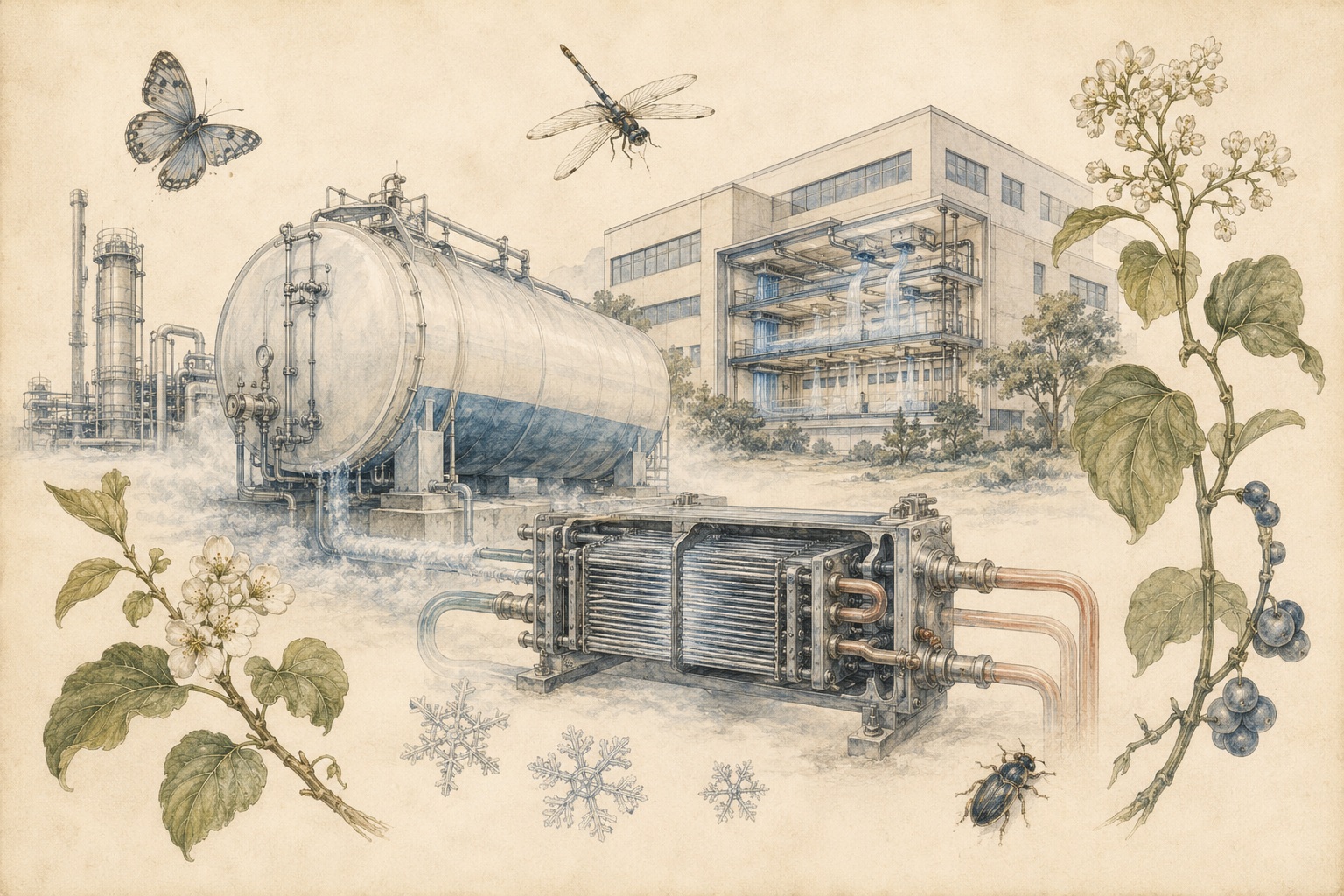
Hydrogen carries energy before anyone burns it. More precisely, when hydrogen has been liquefied, some of the enormous work used to remove heat from the gas remains embodied in its physical state as cold. Hydrogen becomes liquid at roughly minus 253°C. That makes it denser and far easier to store and transport in bulk. But before most fuel cells or industrial users can consume it, the liquid is normally warmed and returned to gas. The extraordinary cold is allowed to disappear into the surroundings.
For decades that loss was treated as an unavoidable detail. Liquid hydrogen was a way to move hydrogen molecules; the cold was a side effect. Obayashi and Iwatani are turning the premise around. If the liquid has to be warmed anyway, can a building be cooled in the process? Can a freezer operate? Can laboratory cooling water be produced? In other words, after energy has already been spent to reach minus 253°C, can one more useful service be extracted before the hydrogen becomes ordinary gas?
On June 18, 2026, the companies announced a heat exchanger that can stably recover that cold and said they had begun demonstration use for building air conditioning and refrigeration at Iwatani’s research facilities. The important engineering result is not merely that “cold hydrogen can cool something.” The team addressed one of the problems that makes direct cryogenic cold recovery surprisingly difficult: the secondary coolant itself can freeze against the heat-transfer surface and begin to block the exchanger.
Where did hydrogen’s cold used to go?
Liquid hydrogen behaves very differently from room-temperature hydrogen gas. Cooling hydrogen to a cryogenic liquid increases its density and makes large-scale storage and transport more practical. Iwatani has supplied liquid hydrogen to industrial users and hydrogen stations for decades.
Most end users, however, do not want the fuel in that physical state. A fuel cell generally receives hydrogen as a gas. Many industrial processes do the same. Liquid hydrogen therefore leaves a tank, enters a vaporizer and absorbs heat from air or another heat source until it returns to gaseous form.
From an energy-flow perspective, something odd happens. At the liquefaction plant, electricity was used to remove heat from the hydrogen. At the user site, heat is simply put back into it. Unless the cold state is used for another purpose, part of the value created by liquefaction is discarded.
When liquid hydrogen was a specialized, relatively small-volume product, the lost cold could remain a secondary issue. If Japan eventually operates 40,000 m³ hydrogen carriers, 50,000 m³ receiving tanks and large industrial hydrogen clusters, the amount of cold released during vaporization grows with the hydrogen flow. Cold then becomes infrastructure-scale energy.
Why such an obvious idea proved technically awkward
At first glance the solution seems trivial: run water past the liquid hydrogen and make cold water. Minus 253°C is too extreme for that simplicity.
In an indirect system, a secondary coolant such as chilled water or brine flows on one side of a heat exchanger while liquid hydrogen flows on the other. Heat moves from the coolant toward the hydrogen, helping the hydrogen boil. But the wall next to the hydrogen is so cold that part of the secondary fluid can freeze at the heat-transfer surface.
As the frozen layer develops, heat-transfer performance changes. If freezing progresses far enough, the flow passage can narrow or even block. The fluid meant to carry useful cold can effectively clog its own heat exchanger.
Traditional solutions can involve careful coolant selection, multi-stage heat exchange or control schemes designed to avoid freezing. Each extra layer adds equipment, maintenance and cost. If the hardware required to recover cold becomes more expensive than the electricity saved by the building chiller, the thermodynamic opportunity never becomes a business.
Instead of preventing freezing, learn to work through it
The unusual part of the Obayashi-Iwatani approach is that the researchers did not simply try to eliminate solidification. Beginning in October 2022, with research cooperation from Kansai University, the team studied a heat-transfer problem in which two phase changes occur at the same surface: hydrogen boils on one side while the secondary coolant solidifies on the other.
On the hydrogen side, the wall supplies heat and the cryogenic liquid boils. On the secondary side, the wall removes heat and a liquid freezes. These processes interact, changing thermal resistance and flow conditions over time.
After clarifying the heat-transfer characteristics through the university-supported research, the companies used actual liquid hydrogen at Iwatani’s facility to investigate real exchanger behavior. They then developed a system that can continue recovering cold stably even when secondary-coolant solidification occurs.
The heat-exchange section is based on a relatively simple double-pipe structure. Rather than adding a collection of elaborate moving machines, the concept focuses on making the heat-transfer process itself robust.
That simplicity matters in building services. Cooling equipment has to run for thousands of hours. If a system needs constant specialist supervision, has many failure points or is difficult to maintain, it will struggle to move beyond a demonstration plant. A technology that looks less futuristic can be more commercially important precisely because facilities engineers can understand and service it.
About 90%: what the headline number means—and what it does not
In the current demonstration, liquid hydrogen already being supplied to fuel cells at Iwatani’s research site serves as the cold source. The new system intercepts the cold during the normal vaporization process and sends useful cooling toward building air-conditioning and refrigeration loads.
Obayashi says the demonstration has recovered approximately 90% of the cold available from the liquid-hydrogen vaporization process and confirmed a contribution to reducing electricity used for building cooling.
The number needs careful interpretation. It does not mean that 90% of the electricity originally consumed to liquefy the hydrogen is recovered. Nor is it the efficiency of the entire liquid-hydrogen supply chain. It refers to roughly 90% of the cold energy available at the point where the liquid hydrogen is being vaporized.
It also does not mean that a building’s air-conditioning electricity necessarily falls by 90%. Actual electricity reduction depends on hydrogen flow, cooling load, temperature level, pumping energy, storage strategy and how the cold-recovery system interacts with conventional chillers. Those are exactly the operating questions the continued demonstration is meant to answer.
| What “90%” means | What it does not mean |
|---|---|
| Roughly 90% of the cold available during liquid-hydrogen vaporization is recovered | It is not recovery of 90% of the electricity used for hydrogen liquefaction |
| Recovered cold can contribute to building cooling and refrigeration | It does not mean every building will cut cooling electricity by 90% |
| A demonstrated technical result at the Iwatani site | It is not a guaranteed performance figure for every future commercial installation |
Freezing first, air conditioning later: cascade the temperature
The companies are also testing a cascade approach in which the cold is not consumed in a single application. Refrigeration and ordinary building air conditioning require different temperature levels. Very cold energy can be allocated first to the applications that need the lowest temperatures, then the remaining cooling potential can serve warmer loads.
From a thermodynamic perspective, extremely low temperature has a higher quality than ordinary chilled water. Using all of that temperature difference just to make moderately cool air can destroy part of its useful potential. Arranging customers by temperature allows the same cryogenic stream to produce several services as it warms.
When Obayashi and Iwatani first announced the building-cold demonstration concept in 2022, they also described producing chilled water for air conditioning and laboratory equipment and storing cold in ice. Ice storage matters because liquid-hydrogen use and building cooling demand do not necessarily occur at the same moment.
Hydrogen can vaporize at night while a building’s largest cooling load arrives the following afternoon. Freeze water when hydrogen is available, then melt the ice during the peak. In effect, an ice-storage tank becomes a simple time-shifting device for hydrogen cold.
The 2026 exchanger supports that earlier vision from a more fundamental direction: it makes the cold source itself more stable and predictable.
Iwatani’s liquid-hydrogen story began in 1978
Iwatani’s presence in the project is not accidental. The company says it began handling hydrogen in 1941 and started hydrogen-business operations at Japan’s first large-scale commercial liquid-hydrogen production plant in 1978. It later supplied liquid hydrogen for space applications and in 2006 began operations at Hydro Edge in Sakai, one of Japan’s major liquid-hydrogen production bases.
For Iwatani, the extreme cold of liquid hydrogen is therefore not a newly discovered physical property. It is something the company has handled operationally for decades.
What has changed is the accounting of value. Historically, the product was the hydrogen molecule. It was delivered to industry, rockets or filling stations. The cold released at use was a condition to manage.
As hydrogen volumes rise, that assumption becomes harder to defend. More liquid hydrogen consumed means more cold released. If a cold warehouse, data center, laboratory or office complex is nearby, ignoring that resource becomes an opportunity cost.
The research building became part of the experiment
The demonstration site itself is part of the story. Iwatani’s Central Research Institute and Advanced Hydrogen Technology Center were completed in April 2013, with Obayashi responsible for design and construction. A hydrogen station is integrated with the research complex.
When the companies launched the cold-utilization work in 2022, Obayashi described the facility as a visible R&D base for a carbon-neutral society and outlined possible uses including air-conditioning chilled water, laboratory cooling water and ice thermal storage.
The contractor that designed and built the facility is now, more than a decade later, using the building’s own energy system as a research platform. That shows how the role of a construction company is changing.
If future factories, logistics parks or data centers use large volumes of liquid hydrogen, designers can treat the hydrogen plant as a fenced-off utility at the edge of the site—or they can integrate cold, waste heat, electricity and building HVAC from the first sketch. The latter approach can change the efficiency of the entire campus.
Why would a construction company design a liquid-hydrogen heat exchanger?
Obayashi is known primarily as a general contractor, so hydrogen heat-transfer research can look outside its traditional business. Yet air conditioning, hot water, lighting and mechanical systems are major parts of building energy consumption. In refrigerated facilities, cooling can be one of the defining loads.
If hydrogen enters a site, its state changes can become part of the building-services design. Fuel-cell waste heat can support hot-water loads. Liquid-hydrogen cold can support chilled-water loads. Onsite generation, heat, cold and storage can be controlled as one energy system.
Obayashi has been involved in hydrogen power and local-energy projects in Kobe, hydrogen-energy management work at Toyota’s headquarters plant, hydrogen-supply optimization in Namie, and—in 2026 with Iwatani and Komatsu—the first Japanese construction-site proof of concept of a hydrogen fuel-cell hydraulic excavator.
Hydrogen is therefore becoming a construction-sector question as much as an energy-company question: how construction equipment is powered, how a campus gets energy and how a finished building uses every useful temperature stream available to it.
Cold cannot travel like electricity
The biggest limitation of cryogenic cold recovery is geography. Electricity can move tens or hundreds of kilometers through wires. Hydrogen can move through pipes or trucks. Cold is much harder to transport over distance.
Chilled water or brine gains heat from the surroundings as it travels. Pumps consume energy. Insulated distribution lines cost money. The farther the cooling customer is from the hydrogen vaporizer, the faster the business case deteriorates.
That limitation can become a planning principle. Put cold-storage logistics beside a hydrogen station. Place data centers near a large liquid-hydrogen terminal. Cluster food processing, freezer warehouses, laboratories and district cooling around locations where liquid hydrogen is routinely vaporized.
Hydrogen infrastructure may someday be sited not only according to “Can a ship dock here?” or “Is industrial land available?” but also “Who can buy the cold?”
- Building air conditioning: chilled-water supply for offices, laboratories and commercial facilities.
- Cold storage and freezing: logistics warehouses, food processing and low-temperature storage.
- Data centers: relatively stable, year-round cooling demand.
- Laboratory processes: equipment and process cooling.
- Ice thermal storage: decoupling the time hydrogen is vaporized from the time cooling is needed.
- Cascade use: allocating the cold sequentially from lower-temperature to higher-temperature applications.
LNG taught Japan that a fuel’s temperature can have value
Using the cold of a liquefied fuel is not an entirely new idea. Japan has imported LNG at roughly minus 162°C for decades. LNG receiving terminals vaporize the fuel before it enters city-gas networks or power plants, and cold-energy utilization has long been part of the engineering conversation around those terminals.
LNG cold has been used in applications such as air separation, refrigeration and power-recovery concepts. Liquid hydrogen arrives roughly 90 degrees Celsius colder. That increases the quality of the cold resource but also makes freezing, material behavior, insulation and safety more difficult.
Hydrogen cannot simply copy the LNG industry. But LNG established an important industrial principle: when a cryogenic fuel is imported and vaporized, the temperature difference can be a co-product rather than a waste stream.
Japanese industrial history is full of this logic. Refineries turned by-products into petrochemical feedstocks. Steelworks burned by-product gases for power. Waste heat became steam. Competitive industrial systems often emerge by monetizing what an earlier generation discarded.
Cold recovery does not undo the energy cost of liquefaction
The environmental case needs restraint. Cooling hydrogen gas all the way to minus 253°C requires substantial energy. Recovering cold at the destination cannot reverse every inefficiency in the liquefaction process.
Real liquefiers contain compressors, expanders, heat exchangers and unavoidable thermodynamic losses. Cold recovery should not be described as a way to make liquid hydrogen lossless.
But once a supply chain has already chosen liquid hydrogen for bulk storage or transportation, the decision changes. The liquid must eventually be vaporized. If useful cold is available during a process that will happen anyway, capturing it is generally preferable to rejecting it unused.
A useful analogy is regenerative braking. Regeneration does not return all the energy used to accelerate an electric vehicle. It still makes more sense than converting all braking energy into waste heat. Liquid-hydrogen cold recovery belongs to the same family of engineering ideas: collect value from an energy flow that already exists.
If hydrogen is expensive, sell more than the molecule
Hydrogen economics remain difficult because cost accumulates across production, liquefaction, transportation, storage, vaporization, delivery and equipment investment.
One strategy is to make each component cheaper. Another is to create several products from the same infrastructure.
Sell hydrogen as fuel. Sell the cold released during vaporization as cooling. If a fuel cell is used, recover the heat for hot water or space heating. If the hydrogen originated in electrolysis, find a customer for oxygen as well. A hydrogen hub becomes more viable when the same energy chain produces several revenue or avoided-cost streams.
This resembles the Maibara regional hydrogen concept being studied in Shiga, where hydrogen may be used first in CNT manufacturing, then recovered for a filling station, while electrolyzer oxygen and waste heat are assigned potential local users. The broader lesson is the same: one way to make hydrogen cheaper is to count values beyond hydrogen itself.
The hardest scheduling problem: hydrogen use and cooling demand may not occur together
Office cooling peaks on hot summer afternoons. Freezer warehouses run more continuously. Hydrogen-station demand follows vehicle arrivals. Fuel-cell research equipment follows experiment schedules.
The cold appears when hydrogen vaporizes, not automatically when the building needs cooling. A system can recover 90% of available cold and still waste much of the economic value if nobody needs it at that hour.
This is why the ice-storage idea raised in 2022 is important. Make ice when liquid hydrogen is being used, then melt that ice hours later during the building’s air-conditioning peak. The storage tank acts like a low-tech battery for temperature.
Cascade use across refrigeration and air conditioning provides another form of demand aggregation. Different customers and temperature levels make it easier to use more of the available cold over more hours.
The eventual economics may depend less on the exchanger’s laboratory efficiency than on the portfolio of nearby cooling customers.
What is a unit of hydrogen cold worth?
The June 2026 release does not disclose the capital cost of the system, commercial system price, payback period or a cost per unit of recovered cooling.
Those are important unanswered questions. Conventional high-efficiency chillers are mature equipment. A hydrogen cold-recovery system requires heat exchangers, pumps, piping, controls, safety equipment, possible thermal storage and installation work.
The strongest business cases are likely to be sites with large and steady liquid-hydrogen throughput, large nearby cooling demand and enough avoided chiller operation to justify the additional equipment. A small hydrogen station connected through a long chilled-water network to a distant office building could look very different.
When Obayashi and Iwatani say they will accumulate design and operating knowledge, part of that task is learning where this technology is economically appropriate—and where it is not.
Safety: use the cold without sending hydrogen through the building
Liquid hydrogen is both a cryogenic material and a flammable fuel. Recovering its cold for air conditioning does not mean routing hydrogen itself through office floors. The indirect heat-exchange approach separates the hydrogen system from the building cooling loop.
Hydrogen stays inside dedicated hydrogen equipment. Chilled water, brine or another secondary medium carries only the thermal effect toward air-conditioning or refrigeration systems.
That separation is an important safety principle. The hydrogen side still requires cryogenic-compatible materials, leak detection, ventilation, isolation and careful management of thermal contraction. The secondary side has to manage freezing and flow behavior without creating pressure or blockage problems.
As Japan’s hydrogen terminals grow, this small exchanger becomes more valuable
Japan’s liquid-hydrogen scale is beginning to change. In Kawasaki, Japan Suiso Energy is developing a terminal with a 50,000 m³ storage tank while Kawasaki Heavy Industries is building a 40,000 m³ carrier. The objective is a commercial-scale international supply chain in the 2030s.
If those systems materialize, liquid-hydrogen vaporization rates will be orders of magnitude larger than today’s filling-station demand. Power plants, steelworks and chemical users may require continuous send-out from terminals.
At that point, cold recovery stops being a small research-building efficiency measure. It can become a design question for an entire port-industrial district.
Cold warehouses and data centers are natural neighbors for ports and logistics areas. Food distribution requires refrigeration. District cooling can aggregate building demand. A hydrogen terminal could become both a fuel terminal and a cold-energy hub.
At scale, a figure even more important than 90% recovery may be the number of hours per year someone is willing to buy the cold.
A hydrogen city will be judged by pipes, not blue flames
Popular images of a hydrogen society feature fuel-cell cars, aircraft, giant ships and gas turbines. The equipment that makes an energy transition work is more often a heat exchanger, pump, valve, insulation layer, chilled-water pipe or control algorithm.
The Obayashi-Iwatani result belongs to that quieter category. A double-pipe exchanger. A secondary coolant that freezes. Hydrogen that boils. Recovered cold. A building chiller that does not have to work as hard.
The more expensive hydrogen remains, the more important it becomes to use every energy stream more than once. Use the molecule as fuel. Use the cold for cooling. Recover fuel-cell heat for hot water. Design the site so that by-products find customers instead of exhaust vents.
If liquid hydrogen becomes a major energy carrier for Japan, the best future terminals may not be the ones that simply store the most hydrogen.
They may be the ones that use its pressure, its temperature, its heat flows and finally the molecule itself.
Minus 253°C is not merely a temperature. It is evidence that someone, somewhere, already spent energy to create that physical state. Obayashi and Iwatani are trying to make sure Japan does not pay for that cold and then throw it away.
1941 Iwatani begins handling hydrogen.
1978 Iwatani begins hydrogen operations at Japan’s first large-scale commercial liquid-hydrogen production plant.
1980s Japan expands liquid-hydrogen use in its space program, adding to domestic cryogenic-handling experience.
2006 Large-scale liquid-hydrogen production begins at Hydro Edge in Sakai.
April 2013 Iwatani’s Central Research Institute and Advanced Hydrogen Technology Center are completed, designed and constructed by Obayashi.
August 31, 2022 Obayashi and Iwatani announce Japan’s first demonstration aimed at using liquid-hydrogen cold in buildings.
October 2022 Research begins with Kansai University cooperation into simultaneous hydrogen boiling and secondary-coolant solidification.
2022–2025 The companies investigate heat-transfer characteristics using actual liquid hydrogen at Iwatani’s site.
June 18, 2026 The companies announce a simple double-pipe technology that remains stable despite freezing, report about 90% cold recovery and begin building/refrigeration demonstrations.
Next Cascade use across refrigeration and air conditioning, design practices, operating methods and commercial applicability will be evaluated.
2030s If large-scale liquid-hydrogen supply chains develop, cold recovery could become part of the design of ports, logistics districts, data centers and building-energy systems.
Reporting notes and principal sources
This article uses public information checked through August 9, 2026, 12:50 a.m. JST. The “about 90%” figure is the share of cold available during liquid-hydrogen vaporization that Obayashi and Iwatani say the demonstration recovers. It is not recovery of 90% of liquefaction electricity, a 90% reduction in building air-conditioning electricity or a 90% efficiency figure for the full hydrogen supply chain. Commercial equipment price, payback period, exchanger capacity, hydrogen throughput and a market price for recovered cold have not been disclosed and are not inferred.
- Obayashi / Iwatani: development of stable liquid-hydrogen cold-recovery heat exchanger, June 18, 2026
- Iwatani: demonstration toward building air-conditioning and refrigeration use of liquid-hydrogen cold, June 18, 2026
- Obayashi: Japan’s first demonstration project to use liquid-hydrogen cold in buildings, August 31, 2022
- Iwatani: Our History — hydrogen handling from 1941 and commercial liquid-hydrogen operations from 1978
- Iwatani: Financial Information 2024 — domestic liquid-hydrogen business information
- Obayashi / Iwatani / Komatsu: hydrogen fuel-cell excavator construction-site PoC, 2026
- Obayashi: Japan-New Zealand Hydrogen Corridor, 2026