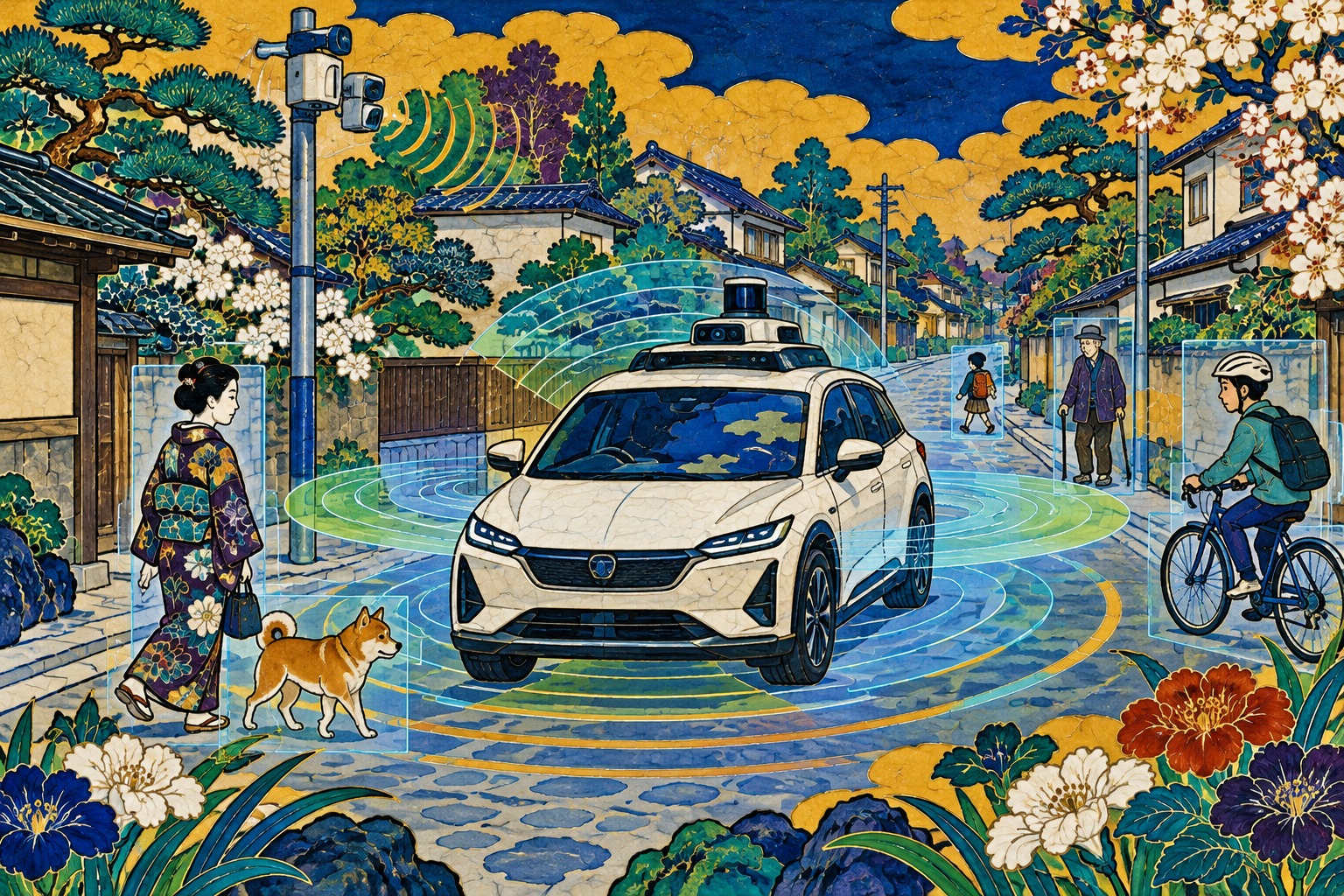
How many uneventful kilometers prove that an automated vehicle is safe—ten, ten thousand, ten million? Counting crashes alone misses the moments that nearly became one: a cyclist appearing from behind a parked van, a pedestrian edging toward a crossing, an abrupt path change, or a safety driver taking control before the system’s choice is tested.
A public-road demonstration announced September 4 by NTT Mobility Co., Ltd. and MS&AD Insurance Group’s Aioi Nissay Dowa Insurance Co., Ltd. tries to make those precursors visible. Instead of reading the test vehicle’s telemetry in isolation, the companies will compare it with knowledge accumulated through the insurer’s telematics auto policies—including driver behavior, near-miss locations and traffic volume.
What the Two Data Sets Can Reveal
NTT Mobility will plan and oversee the demonstration, provide the vehicle, and handle its operation and management. The vehicle is a modified version of Toyota Motor Corp.’s e-Palette. Aioi Nissay Dowa will install a telematics device, collect driving data, compare the new observations with its existing telematics data, identify improvements and analyze measures that may prevent risk from becoming an incident.
The conceptual advance is to overlay a vehicle-centered view with a road-centered one. An automated-driving system can record what its sensors perceived, the motion it selected and when a human intervened. Insurance telematics can show how a much larger population of human-driven vehicles has behaved at the same locations. Places where both data sets show stress may be structurally difficult. Behavior distinctive to the automated vehicle may expose a system-specific weakness.
| Participant | Published responsibility | Core analytical question |
|---|---|---|
| NTT Mobility | Planning, oversight, vehicle supply, operations, and system/operations improvement based on findings | Can each finding be converted into a repeatable corrective change? |
| Aioi Nissay Dowa | Telematics installation and collection, comparison, safety verification, risk analysis and prevention measures | Can human-driving data form a fair and useful benchmark? |
The disclosure does not identify the measurement fields. It does not say which combination of speed, harsh acceleration or braking, lateral motion, disengagements, human interventions or proximity events will be captured, or at what frequency. Nor does it publish a safety-score formula, pass threshold, control population or matched road conditions. Until those details exist, it is too early to claim that safety has been “quantified.”
Level 2 Is Not a Shortcut to Level 4
At Level 2, the system may support both longitudinal and lateral control, but the driver continuously monitors the road and responds. At Level 4, the system performs the complete dynamic driving task and achieves a safe state within a defined operational domain; no driver is required inside that domain. The gap encompasses far more than sensor accuracy: remote supervision, cabin safety, fleet operations, maintenance, fallback behavior, incident response and government authorization all matter.
Japan made Level 3 legally possible in 2020. Amendments effective in April 2023 created the permit system for tokutei jido unko—specified automated operation corresponding to Level 4 without a driver. The following May, Eiheiji in Fukui Prefecture launched Japan’s first Level 4 mobility service without an onboard or remote driver. The government is aiming for automated-driving services in more than 100 locations in fiscal 2027 and 10,000 automated vehicles in fiscal 2030.
The Musashino work matters not because Level 2 can be relabeled Level 4, but because supervised operation can expose immaturity at lower consequence. A safety driver’s intervention is not an embarrassment to hide. Properly categorized, it is a leading indicator that tells engineers and operators what must change before the human fallback can be removed.
Musashino Offers the Difficulty of Everyday Life
The published area runs from Musashino City Hall toward Kichijoji Station. The city describes dense residential districts with narrow local streets and mixed flows of pedestrians, bicycles, motorcycles and cars. Near Kichijoji, route buses, deliveries, shoppers, parked vehicles and intersections produce a high density of low-speed decisions. A calm maximum speed does not imply a simple environment.
In June, Musashino signed a cooperation agreement with NTT East and NTT Mobility. One workstream tests multiple vehicle types between City Hall and Kichijoji. Another, around Musashisakai Station, tests infrastructure-coordinated driving using smart poles in a complicated traffic environment. Future use in the city’s Mu-Bus community service and existing bus routes is explicitly under consideration.
Those projects should not be collapsed into one. The Aioi collaboration concerns the comparison of vehicle and insurance telematics in the City Hall–Kichijoji area. The smart-pole work around Musashisakai is a separate part of the municipal agreement and is not listed in the September 4 insurer announcement.
A City Looking Beyond 30 Years of Mu-Bus
Musashino has a history of treating mobility as civic design. On November 26, 1995, after a resident’s letter drew attention to transport gaps, the city launched Mu-Bus on the Kichijoji East Loop as Japan’s first community bus. It grew to seven lines and nine routes. Cumulative ridership passed 60 million in August 2024.
That success has not insulated the network from labor constraints. In April 2026, the city reduced frequencies on several routes, citing the driver shortage, traffic congestion and slow operation on streets crowded with people and bicycles. Weekday service on the Kichijoji Northwest Loop fell from five buses an hour to four; the Sakai Southwest Loop fell from four to two.
Automation cannot immediately reverse those cuts. A Level 2 vehicle with a responsible driver offers little direct labor saving. Yet a city deciding which functions might eventually move from human operators to machines has to test safety where service is actually difficult—not only on a quiet private course.
Insurance Moves Upstream of the Crash
Insurance traditionally pools the probability of loss and pays after harm occurs. Telematics moved insurers upstream by adding individual driving behavior and location to the risk model. In 2015, Aioi Nissay Dowa announced its T-Connect-linked “Tsunagaru” auto policy. By the end of July 2026, the company said it had about 2.22 million telematics auto-insurance contracts.
Its services score safe driving, provide advice and offer premium discounts. The company also uses driving data with municipalities, police and businesses through its SAFE TOWN DRIVE program. The Musashino test shifts that expertise again—from rating human policyholders to assessing the behavior of an automated-driving system and its operating environment.
A human insurance score cannot simply be pasted onto a machine. A deceleration that feels normal when a person drives may feel abrupt and unsettling in a shuttle. A machine’s scrupulous stop may be technically lawful yet surprising to following drivers or passing bicycles. Collision avoidance, ride quality and legibility to other road users are related but distinct dimensions that require separate measures.
A Young Company With a Year-Round Field
NTT Mobility itself is new. Established December 15, 2025 and wholly owned by NTT Corp., it combines automated-vehicle supply and management, deployment and operational support, and remote-monitoring services. The group says it has participated in more than 60 automated-driving demonstrations nationwide. The new company is an attempt to turn that distributed experience into repeatable deployment capacity.
In June 2026 it opened the Co-Creation Hub at the NTT Musashino Research and Development Center for year-round testing across seasons and traffic conditions. On September 3, NTT Mobility said it would begin public-road testing of a modified e-Palette carrying an automated-driving system supplied by U.S.-based May Mobility. The insurer announcement the following day also specifies a modified e-Palette, but the two releases do not establish that they refer to the same individual vehicle. What is clear is that vehicle testing and insurer-led risk analysis now sit within the year-round program.
Toyota’s e-Palette, launched in 2025, can accept a Level 2-equivalent automated-driving system. Toyota designed a vehicle-control interface for third-party automated-driving kits and built in redundant systems. The automaker aims to introduce a version equipped with a Level 4-compliant system in fiscal 2027. The precise specification of the modified Musashino vehicle—and how it differs from the production model—has not been disclosed.
The Traps in Safety Comparison
- Exposure: Not just distance, but intersections, bicycles, pedestrians, night, rain and other risk-bearing encounters.
- Interventions: Why a safety driver took over, and how that differs from a successful automated avoidance.
- Comparability: Route, speed, time, vehicle size, weather and passenger load across human and automated samples.
- Rare crashes: Leading indicators such as harsh control, minimum separation and rule deviations.
- Privacy: Purpose, retention, anonymization and access controls for location, time, images and behavior.
The statistical problem is severe. The rarer a serious crash is, the more driving is needed to compare crash rates with confidence. Seven months in one city may not establish a general superiority over human drivers. Scenario-level exposure and defensible surrogate safety measures therefore become essential.
Insurance data is not a perfect “human baseline,” either. Policyholders may differ in age, vehicle, geography and driving time. A harsh-braking cluster can mark a dangerous junction—or the successful evasive behavior of careful people. Without disclosure of the comparison population and adjustments, outsiders cannot tell what a resulting score means.
Success Means More Than “No Crashes”
1995 · Musashino launches Mu-Bus, Japan’s first community bus.
2015 · Aioi announces its connected-car telematics policy.
2020 · Level 3 becomes legally possible in Japan.
2023 · The Level 4 permit framework takes effect; Eiheiji opens Japan’s first service without a driver.
2024 · Mu-Bus passes 60 million cumulative riders.
June 2026 · Musashino, NTT East and NTT Mobility sign their cooperation agreement.
Sep. 2026–Mar. 2027 · The vehicle-versus-telematics safety demonstration runs.
A useful final report would disclose more than a zero in the crash column. It would say how far and how long the vehicle ran, across what weather and traffic; how risk scenarios were classified; how often humans intervened or the machine used harsh control; what changed afterward; and whether the same indicators improved. It would explain the human-driver comparison set and report how passengers, pedestrians and cyclists perceived the service.
Responsibility for each remedy matters too. Should software change, should operations lower speed or move a stop, or should the city address parking and infrastructure? The demonstration’s most valuable outcome would be a method that treats safety as an interaction among person, vehicle, road and operations—not as a defect assigned to one box.
Public acceptance will not emerge from showing residents a futuristic shuttle. Trust requires measuring warning signs on streets people use every day, explaining what was changed, and showing that the process can be repeated elsewhere. Musashino’s seven-month test is not a declaration that driverless transport has arrived. It is a test of whether safety itself can become a disciplined cycle of evidence and correction.
- NTT Mobility and Aioi Nissay Dowa, Sept. 4, 2026 — purpose, period, area, vehicle, roles and telematics contract count.
- NTT Mobility and May Mobility, Sept. 3, 2026 — public-road e-Palette test, ADS and Co-Creation Hub.
- Musashino City, June 17, 2026 — cooperation agreement, street conditions, separate test programs and possible future bus use.
- Musashino City, 2026 — Mu-Bus timetable reductions and operating constraints.
- Musashino City, Dec. 16, 2024 — Mu-Bus launch, routes and 60-million-rider milestone.
- Ministry of Land, Infrastructure, Transport and Tourism, automated-vehicle terminology — distinction between Level 2 driver assistance and Levels 3–5.
- MLIT, May 12, 2023 — launch of Japan’s first Level 4 mobility service without a driver in Eiheiji.
- Ministry of Economy, Trade and Industry, Mobility DX Strategy 2025 — deployment targets.
- Toyota Motor Corp., Sept. 15, 2025 — e-Palette’s Level 2 compatibility, vehicle-control interface and redundancy.
- Aioi Nissay Dowa, Feb. 5, 2015 — connected-car policy and telematics history.
Editor’s note: This report is based on information published through September 5, 2026. It does not infer demonstration results, measurement fields, scoring formulas, pass thresholds, distance, human interventions, incidents, near misses or passenger operations.