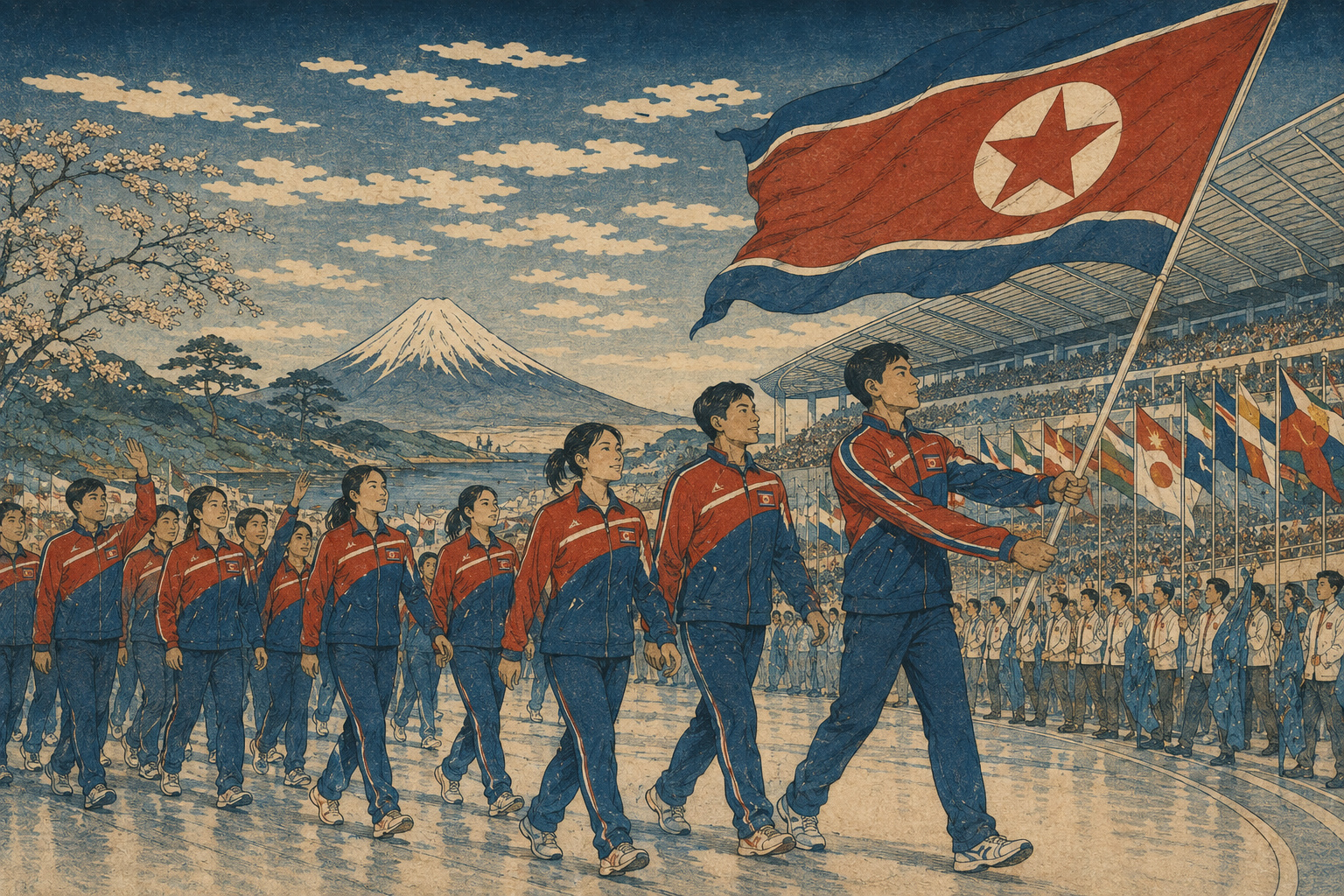
North Korea’s athletes must pass through two gates before they can compete in Japan. The first belongs to sport: entries, eligibility, accreditation and event rules administered through the Olympic Council of Asia, the organising committee and the relevant federations. The second belongs to the Japanese state: visas, landing permission and the exceptions—if granted—to a policy that in principle bars North Korean nationals from entering the country.
Those gates are related, but they are not interchangeable. An athlete can be entered in an Asian Games event without that entry itself constituting Japanese immigration clearance. A government can preserve a sanctions policy while still making a narrowly defined sporting exception. Much of the significance of North Korea’s expected presence at Aichi-Nagoya 2026 lies in whether Japan can keep that distinction visible, lawful and fair.
One delegation, three different counts
The headline number came from an interview with Ko Chol-ho, secretary general of the Olympic Committee of the Democratic People’s Republic of Korea. Follow-up coverage by the Choson Sinbo said more than 100 athletes would compete in men’s and women’s football, weightlifting, wrestling, boxing, table tennis, gymnastics, shooting and other events. Reuters reported the plan as approximately 100 athletes in 14 sports.
A later Choson Sinbo article described a delegation of about 180. The two figures are not inherently contradictory. “Athletes” counts competitors. “Delegation” ordinarily extends beyond competitors to some combination of coaches, team officials, medical and technical personnel and National Olympic Committee staff. The published source did not disclose the actual breakdown, however, so subtracting 100 from 180 and labeling the remainder “officials” would create precision that the evidence does not provide.
The same discipline is needed when reading the sport count. One Choson Sinbo article used the figure 15, while Reuters and the publication’s own event guide used 14. The guide lists 15 competition categories because men’s football and women’s football appear separately. Count football once, and the list contains 14 distinct sports.
| Figure | What it describes | What it does not establish |
|---|---|---|
| More than 100 | Expected athletes who would compete | The total size of the delegation or the number already cleared to enter Japan |
| About 180 | The wider delegation reported on September 2 | A final role-by-role roster of athletes, coaches, officials and support staff |
| 14 sports | Distinct sports when football is counted once | The number of separate men’s and women’s competition categories |
| 15 categories | The published list with women’s and men’s football separated | Evidence that an additional, unidentified sport has been added |
The listed programme covers football, karate, table tennis, soft tennis, boxing, gymnastics, shooting, canoe sprint, weightlifting, athletics, badminton, diving, wrestling and judo. Until the final individual entries are public, the list remains a plan rather than a complete attendance record.
The North Korean Games begin before the Games
The official Asian Games run from September 19 through October 4. North Korea’s competition is scheduled to begin five days before the opening ceremony. The women’s football team is due to play Bangladesh at Osaka’s Nagai Stadium on September 14, then Myanmar at the same venue on September 17 and South Korea at Shizuoka’s Ecopa Stadium on September 21.
The men open against China at Wave Stadium Kariya in Aichi on September 16, followed by the United Arab Emirates on September 20 and Iran on September 23. The delegation’s public presence will therefore unfold across Osaka, Aichi and Shizuoka before the ceremonial focus settles on Nagoya.
That timing matters. Ceremonies invite symbolism: flags, uniforms, official greetings and political interpretation. Football begins with more practical obligations. Teams need training access, transport, medical support, interpreters, equipment handling and predictable rules. A credible host must deliver those functions without turning ordinary competition logistics into either a diplomatic favour or a form of collective punishment.
A smaller team with substantial competitive weight
North Korea sent 185 athletes in 18 sports to the Hangzhou Asian Games held in 2023. They won 39 medals—11 gold, 18 silver and 10 bronze. Reuters, citing Korean media, reported that Ko hoped the smaller Aichi-Nagoya team would surpass that medal performance. The aspiration is attributable to the interview coverage; it is not a formal forecast endorsed by the organising committee.
Women’s football supplies the clearest historical claim. North Korea won the Asian Games title in Busan in 2002, Doha in 2006 and Incheon in 2014, then took silver in Hangzhou. Its planned roster also reaches into sports in which North Korean athletes have produced world-level results, including weightlifting, wrestling, table tennis and diving.
A reduced delegation may represent concentration on stronger events, but that remains an inference until the full entry list is available. Weight categories, draws, injuries, qualification status and last-minute substitutions can reshape medal prospects. It is more defensible to say that the team is smaller than in Hangzhou—not that it is less competitive.
Japan’s second gate: the “in principle” entry ban
In February 2016, Japan announced unilateral measures against North Korea that included an “in principle” ban on the entry of North Korean nationals. The qualification matters. In a 2019 Diet committee hearing about the Tokyo Olympics, the government explained that when an intention to enter Japan is presented, it considers individually whether exceptional circumstances justify admission.
Japan has used that space before. North Korean athletes were admitted as an exception for the 2017 Sapporo Asian Winter Games. In February 2024, the North Korean women’s football team travelled to Tokyo for an Olympic qualifier at the National Stadium—the first visit by a North Korean football team in seven years, according to Reuters.
Precedent is not blanket approval. Entry in an OCA system, possession of Games accreditation and qualification for an event do not by themselves determine Japanese immigration status. Competitors, coaches, medical staff, NOC officials, media and supporters may present different legal and administrative questions. A Japan-based athlete may not follow the same route as a delegation member travelling from Pyongyang.
The two-gate test
- Sporting gate: Entry, eligibility, competition rules and accreditation are administered by the OCA, organisers and federations.
- State gate: Visas, landing permission and any exception to Japanese measures remain government functions.
- Public-language test: “Entered,” “expected,” “cleared,” “arrived” and “competed” should not be used as synonyms.
Japan has a legitimate interest in applying its law and security policy. The Games have a legitimate interest in non-discriminatory competition among qualified athletes. Transparent separation of the two processes is how those interests can coexist. Opacity would expose athletes to uncertainty and allow every routine administrative step to be recast as a political message.
A sporting corridor older than the current sanctions
Japan and North Korea have no diplomatic relations, but sporting contact is not new. Japan’s 1973 Diplomatic Bluebook described de facto contacts despite the absence of formal ties. It recorded a 15-person North Korean delegation at the 1972 Sapporo Winter Olympics and identified the January 1973 visit of a North Korean high-school football team as the first bilateral sports exchange.
At the 1985 Summer Universiade in Kobe, the Choson Sinbo says North Korea sent a delegation of about 130, entered eight sports and won eight medals, including three gold. The International University Sports Federation independently records the most memorable result: football joined the core Universiade programme in Kobe, and North Korea defeated Uruguay to become its inaugural champion.
In 1991, a unified North–South Korean women’s team won the Corbillon Cup at the World Table Tennis Championships in Chiba. It remains one of sport’s strongest images of Korean cooperation. It did not normalize Japan–North Korea relations, and North Korea did not attend the 1994 Hiroshima Asian Games.
1972: A 15-person North Korean delegation attends the Sapporo Winter Olympics.
1973: A North Korean high-school football team makes what Japan’s Foreign Ministry called the first bilateral sports exchange.
1985: A delegation of about 130 attends the Kobe Universiade; North Korea wins the inaugural Universiade football title.
1991: A unified Korean women’s team wins the world table tennis team title in Chiba.
1994: North Korea does not attend the Hiroshima Asian Games.
2017: Japan admits a North Korean team under a sporting exception for the Sapporo Asian Winter Games.
2021: North Korea misses the Tokyo 2020 Olympics, held in 2021; the IOC suspends its NOC through the end of 2022.
2023: North Korea returns to a major multi-sport event in Hangzhou and wins 39 medals.
2024: Its women’s football team plays Japan in Tokyo.
2026: More than 100 athletes and a wider delegation of about 180 are expected for Aichi-Nagoya.
The pattern is not a steady march toward reconciliation. It is a narrow corridor that opens for defined events, closes again and depends on political conditions, host-country decisions and sporting eligibility. That is precisely why the 2026 visit should not be sold as a diplomatic breakthrough. Its significance is more modest and more concrete: contact remains administratively possible even when normalization remains distant.
The athletes whose lives already cross the divide
At least two expected competitors complicate the image of a delegation arriving as a single bloc from North Korea. Forward Ri Song-a was born in Osaka and plays for Sanfrecce Hiroshima Regina in Japan’s WE League. Her club profile records her as a member of the Democratic People’s Republic of Korea women’s national team in 2026. The club had announced her selection for the AFC Women’s Asian Cup earlier in the year.
The Choson Sinbo also identifies karate competitor Jong Seri, a Korea University graduate affiliated with the Korean Residents’ Karate Association in Japan, as scheduled for the women’s under-61-kilogram kumite event. Public sources reviewed for this article do not establish either athlete’s passport, legal nationality, residence status or immigration route, and Japan.co.jp does not infer them.
That restraint is not a technical footnote. National-team affiliation, ethnic identity, residence, citizenship and place of training are separate categories. International sport compresses them into a flag for the duration of competition, but reporting should not pretend the compression describes the whole person.
What the Games cannot settle
Japan’s official policy remains anchored in the 2002 Japan–DPRK Pyongyang Declaration: comprehensive resolution of the abduction, nuclear and missile issues, settlement of the past and eventual normalization. Japan’s Foreign Ministry also describes North Korea’s nuclear and missile activity as a grave and imminent security threat. Those are the Japanese government’s stated positions, and none is changed by a team entering a stadium.
Participation is not diplomatic recognition, sanctions relief or progress on the abductee issue. Refusing to treat athletes as extensions of state conduct is not an endorsement of that conduct. The distinction can feel unsatisfying because sport makes the flag highly visible. It is nevertheless essential.
Sport can establish a bounded encounter: common measurements, shared rules, a visible result and moments in which people from politically estranged societies occupy the same physical space. It cannot conduct nuclear inspections, negotiate the return of abductees or sign a normalization agreement. Claims that a match “changes everything” burden athletes with work that diplomats and governments have not completed.
Five tests for Japan as host
Japan.co.jp analysis
- Publish the stages: Distinguish registration, immigration clearance, arrival and actual participation as the roster changes.
- Separate jurisdictions: Do not turn sanctions policy into a competition penalty, or accreditation into automatic border permission.
- Protect people: Prevent intimidation, discriminatory harassment and political exploitation of athletes, spectators and Japan’s Korean communities while preserving legitimate journalism and expression.
- Provide equal conditions: Ensure reasonable parity in training, transport, interpretation, medical care, testing, accommodation and access to event information.
- Control the symbolism: Do not market a handshake as normalization, and do not assign the conduct of a state to every athlete carrying its flag.
Aichi-Nagoya will stage 41 sports, 68 disciplines and 460 events, with all 45 Asian National Olympic Committees expected. Japan is hosting the summer Asian Games for the third time, after Tokyo in 1958 and Hiroshima in 1994. The organisers have already had to secure accommodation for more than 17,000 registered athletes and officials without a conventional athletes’ village. North Korea is therefore both a politically exceptional case and one operational challenge among thousands.
Once the first whistle sounds on September 14, the focus should narrow—briefly and usefully—to movement, tactics, balance and score. The larger test will remain outside the touchline. Can Japan administer an exception as a transparent rule rather than an unexplained favour? Can North Korea send athletes without reducing them entirely to state symbols? Can spectators and media criticize governments without withdrawing dignity from competitors?
The arrival of a North Korean delegation will not melt the political ice between Tokyo and Pyongyang. It may demonstrate something less dramatic but still valuable: that a host can maintain a hard diplomatic disagreement, apply its own law and allow a fair contest at the same time. For a relationship with so few functioning channels, competence itself would be a meaningful result.
Sources and documentation
- Choson Sinbo, interview with DPRK Olympic Committee Secretary General Ko Chol-ho (August 24, 2026; official Japanese institutional title, name and post, post-pandemic return)
- Choson Sinbo, preview of North Korea’s Aichi-Nagoya team (August 31, 2026; more than 100 athletes, sports, football schedule, Ri Song-a and Jong Seri)
- Choson Sinbo, film and history of the Kobe 1985 delegation (September 2, 2026; expected 180-person 2026 delegation and approximately 130 in 1985)
- Choson Sinbo, Aichi-Nagoya 2026 special section (the 15 listed competition categories, 14-sport summary and schedules)
- Reuters, “North Korea to send around 100 athletes to Asian Games in Japan” (August 26, 2026; 14 sports, Hangzhou delegation and medal total, reported medal ambition)
- Japanese Olympic Committee, Aichi-Nagoya Asian Games (official Japanese event title and September 19–October 4 dates)
- ANOC, OCA Executive Board approval of the Aichi-Nagoya sports programme (41 sports, 68 disciplines, 460 events and hosting history)
- Reuters, “Asian Games organisers, OCA say accommodation secured despite entry surge” (August 28, 2026; more than 17,000 registered athletes and officials)
- Ministry of Foreign Affairs of Japan, unilateral measures against North Korea (February 10, 2016; the in-principle entry ban)
- House of Representatives, Committee on Education, Culture, Sports, Science and Technology (March 13, 2019; individual consideration of exceptional circumstances for entry)
- Reuters, “Japan considering North Korea's participation in 2026 Asian Games” (September 18, 2025; lack of diplomatic ties, entry issue and absence from Hiroshima 1994)
- Nikkan Sports, North Korean delegation arrives for the Sapporo Asian Winter Games (February 17, 2017; sporting exception under Japanese measures)
- Reuters, North Korean women’s football team’s 2024 match in Tokyo (February 28, 2024)
- Ministry of Foreign Affairs of Japan, Diplomatic Bluebook 1973 (de facto contacts, Sapporo 1972 and the 1973 high-school football exchange)
- FISU, “Spotlight: Remembering the Kobe 1985 Summer Universiade” (North Korea’s inaugural Universiade football title)
- International Table Tennis Federation, History of Table Tennis (the unified Korean women’s team’s 1991 victory in Chiba)
- International Olympic Committee, suspension of the DPRK NOC (September 8, 2021)
- Ministry of Foreign Affairs of Japan, Diplomatic Bluebook 2025, Korean Peninsula (Japan’s stated policy on abductions, nuclear and missile issues, and normalization)
- Sanfrecce Hiroshima Regina, Ri Song-a player profile (official reading, birthplace, club and 2026 national-team record)
- Sanfrecce Hiroshima Regina, announcement of Ri Song-a’s DPRK selection (February 18, 2026)
This report incorporates material publicly available through 2:00 p.m. JST on September 2, 2026. The English edition was written independently rather than translated from the Japanese article. The athlete and delegation figures originate in the Choson Sinbo’s interview coverage and follow-up reporting; Reuters independently reported approximately 100 athletes in 14 sports. Where the Choson Sinbo event page’s Games-wide sport and event totals differ from the OCA-approved programme, this article uses the OCA figures of 41 sports, 68 disciplines and 460 events. Japan.co.jp did not find a public final Entry by Name roster, the composition of the reported 180-person delegation, confirmation of completed Japanese immigration clearance for every member, or travel arrangements. It does not infer the citizenship, passport or residence status of Japan-based athletes.
Image rights: © 2026 Japan.co.jp. This AI-assisted editorial illustration may not be republished or reused without permission. For licensing, use the contact page.