- The dam that never rose—and the communities that moved anyway
- How a 1968 survey became a half-century commitment
- What the yen figures actually measure
- Relocation before cancellation: the human asymmetry
- The five-party bargain of 2016
- What construction looks like without a dam
- Flood protection after the great-dam model
- Can rural development be measured beyond ribbon cuttings?
- Three painted screens to preserve a vanished way of life
- The questions facing November 13
The dam that never rose—and the communities that moved anyway
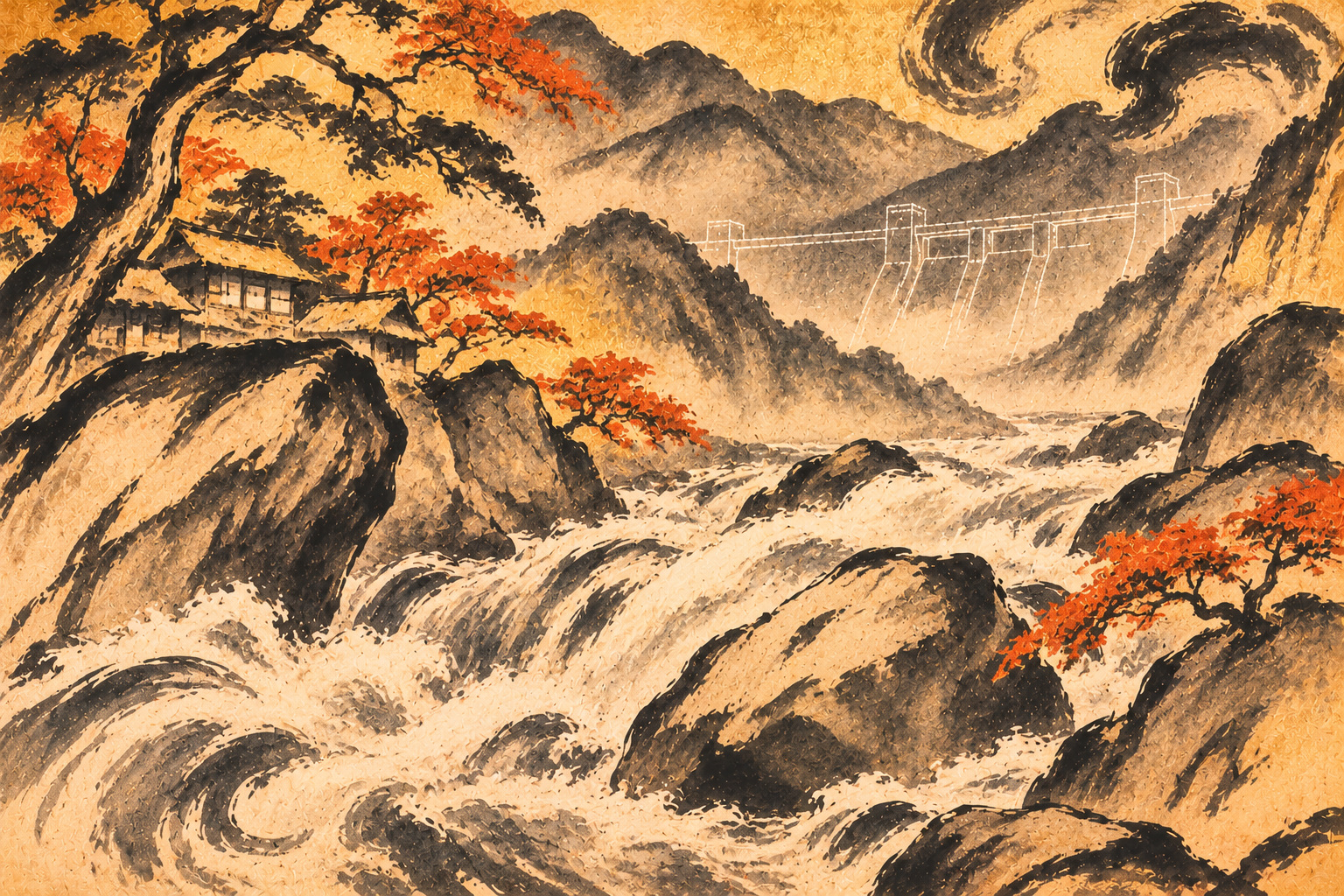
There is no 145-meter dam wall towering over the upper Takatoki River valley in Shiga Prefecture. Yet the abandoned scheme left material traces: relocated village sites, roads built for a project that would not be completed, and a long list of promises about how residents should live afterward. A river project can be canceled with an administrative decision. Rebuilding the trust, access and livelihoods around it takes decades.
On November 13, 2026, five parties are scheduled to convene the 22nd regional-development council at the Yogo Community Development Center in Nagahama. According to the Kinki Regional Development Bureau, participants will inspect local projects and review progress under the 2026 implementation plan. The meeting runs from 2 to 5 p.m. Japan time; substantive proceedings are closed, with a media briefing expected at about 5 p.m. This report is written in advance and claims no knowledge of its conclusions.
How a 1968 survey became a half-century commitment
The central government began preliminary studies of the proposed Niu Dam in 1968. A basic plan was issued in 1992, envisaging a multipurpose structure for flood regulation on the Anegawa–Takatoki River system, maintenance of river flows including emergency drought supplementation, and drinking-water supplies. The Water Resources Development Public Corporation, predecessor to the Japan Water Agency, took over the project, and associated road works proceeded.
Japan's postwar development model often treated large dams as instruments for managing flood hazards and supplying fast-growing urban economies. The economic setting changed. In December 2009, the proposed dam entered a nationwide review process for major river projects. After comparative assessments, the Ministry of Land, Infrastructure, Transport and Tourism determined on July 20, 2016 that the project should be stopped. The formal abolition of its implementation plan was approved on March 31, 2017. The decision came nearly 48 years after the initial studies.
What the yen figures actually measure
The planned rock-fill dam would have stood 145 meters high with gross storage of 150 million cubic meters. A revised project plan in 2002 gave an estimated total construction cost of about ¥110 billion. That was an estimate for a proposed completed project—not proof that ¥110 billion was spent.
A June 2017 presentation by the Japan Water Agency separately estimated the cost through termination at about ¥61.7 billion, including approximately ¥4 billion for additional shutdown-related work. These are historical, provisional figures. They should not be mistaken for a fully audited November 2026 closeout. Neither is the gap between ¥110 billion and ¥61.7 billion a defensible statement of “taxpayer savings”: flood-control substitutes, site management and community reconstruction have their own budgets and timeframes. The key public-accountability question is how the final project accounts relate to the continuing regional obligations.
Relocation before cancellation: the human asymmetry
In an especially telling entry, the Japan Water Agency's project chronology records completion of the relocation of homes subject to submergence by December 1996. Nagahama City, meanwhile, still describes work to maintain and arrange the former sites of settlements moved collectively for the dam. The scheme disappeared; the historic disruption did not.
Those documents do not independently establish how many households moved, what each received in compensation, or how former residents now evaluate the process. Those are questions for historical records and firsthand interviews, not opportunities to invent voices. But the asymmetry is unmistakable: the state can reconsider an engineering solution decades into planning, while families cannot simply reverse a move. Any serious assessment of cancellation must consider whether the affected people obtained the replacement infrastructure and services on which the original bargain depended.
The five-party bargain of 2016
On September 11, 2016, representatives of the local Niu Dam countermeasures committee, the Kinki Regional Development Bureau, Shiga Prefecture, Nagahama City and the Japan Water Agency signed a basic agreement on regional improvements after cancellation. They established a council the following October and adopted an implementation plan in 2017. The 2026 edition is part of that continuing accountability framework, not the unveiling of an entirely new project.
Six local priorities set out in the early agreement were improved road access, management of forests around the watershed, Takatoki River flood and river-flow measures, productive reuse of excavated-soil receiving sites, economic revitalization grounded in nature and culture, and basic conditions for safe daily life. These categories make sense to planners. To residents, what matters is whether roads are open in winter, emergency vehicles can reach homes, and economic opportunities exist after the construction jobs have gone.
What construction looks like without a dam
Nagahama City's September 2026 project inventory provides a more concrete picture. It lists snow-melting equipment in the Kami-Niu district; a roughly 1.8-kilometer bypass connecting the Sugimoto and Kami-Niu areas; improvements and bridge widening on the Nakagōchi–Kinomoto prefectural road; and work on the sites of former relocated villages. The city warns that ordinary vehicles are not yet permitted on a specified section of the latter road. A project being worked on is not the same as an asset ready for public use.
The city reports that work to reconstruct the Harigawa weir has been completed. Separately, 2026 planning for the Takatoki River refers to levee raising, surveying, land acquisition and detailed design for retention areas. These are different projects, carried out by different agencies on different schedules. Evaluating progress requires distinguishing approved plans, construction under way, completed work and measurable public benefits.
Flood protection after the great-dam model
The original Niu Dam was intended to perform several functions simultaneously. Its cancellation did not cancel the need to manage floods, dry-weather flows and water supply. Nor does any single alternative necessarily replicate every function of the proposed reservoir. River-channel work, levee reinforcement, retention areas, management of existing infrastructure and water-demand planning need to be assessed individually against explicit objectives.
An August 2022 period of heavy rain in the Takatoki River area gave renewed urgency to flood recovery, a topic included in the May 2026 council process. It would be irresponsible to conclude that a completed Niu Dam would certainly have prevented particular damage, or that cancellation itself made the watershed safer, without a hydrological analysis of the event and a credible counterfactual. Good policy reporting should ask what level of protection is funded, what has been delivered, and how that standard is tested.
Can rural development be measured beyond ribbon cuttings?
Nagahama lists plans involving Woody Pal Yogo and Myori no Sato, proposals to attract private-sector operation of tourism facilities, renewed uses around Lake Yogo, potential production on excavated-soil sites, and conservation of large trees and remaining forests. Its account also describes preparations for accommodation development on a former site around the lake. None of those descriptions proves visitor growth, durable jobs or a profitable business model.
This is where an investigative test becomes useful. For a road, ask its opening date, travel-time benefit and annual maintenance cost. For a visitor facility, ask annual guests, local employment and public subsidy. For a forest, ask who manages it and for how long. For a new industrial or agricultural use, ask whether local families can participate. A government can count completed projects while the population still declines. Both measurements matter, but they are not interchangeable.
Three painted screens to preserve a vanished way of life
One of the most revealing community projects is not a piece of concrete. Nagahama reports the completion of a three-part series of Yogo hometown painted screens, based on oral accounts of earlier community life and covering Yogo, Kataoka and Niu districts. The municipality hopes the screens can support exchange and educational activities. They provide a reminder that infrastructure planning rearranges a social landscape, not merely a physical one.
A painting can record the route people once walked to school, seasonal work, festivals and relationships across a valley. It cannot restore a demolished village, nor substitute for restitution. There is a worthwhile reporting opportunity in exploring who contributed those memories, whether descendants agree with the representation and whether the work is accessible to younger residents. The story of a canceled dam becomes more intelligible when told through the places it expected to erase.
The questions facing November 13
The 22nd council is scheduled to inspect sites and discuss the 2026 implementation plan. Because its substantive session is closed, the forthcoming media briefing and later published records will be crucial. Useful questions include: Which roads are now accessible to the general public? Which flood-defense projects have budgets and finish dates? What liabilities remain for land management and restored works? How are former residents represented? What evidence shows that development funding has strengthened the local economy?
The Niu Dam case offers a wider lesson for countries facing expensive legacy infrastructure plans. Cancellation may be economically or environmentally justified, yet still leave obligations to people who reorganized their lives around the promise of construction. The most revealing monument to this project may not be the dam that was never built. It may be whether the surrounding communities can remain viable long after the decision to abandon it.
Primary documents and verification
The 2017 cost estimate, 2026 project plan and scheduled November 13 meeting are separate records and timeframes.
- Source: MLIT Kinki: November 6, 2026 meeting notice
- Source: MLIT Kinki: Niu Dam regional development council and project history
- Source: MLIT Kinki: 2026 regional development implementation plan
- Source: Nagahama City: projects following cancellation (September 2026)
- Source: Nagahama City: May 28 council summary
- Source: Water Resources Agency: June 2017 cost and project chronology
- Source: MLIT: initial 2017 regional development plan